What Should I Pack for My First Solo Trip as a Woman?
Quick Answer
For your first solo trip as a woman, pack light enough to manage every bag yourself while prioritizing documents, medication, comfortable clothes, phone power, backup payment, and a few practical safety items. I also recommend reviewing the U.S. State Department’s guidance for women travelers before an international trip.
First Solo Trip Packing Priorities
- Documents: Carry the identification, passport, visas, tickets, and insurance information your trip requires.
- Money backups: Bring your main payment method plus a second option stored separately.
- Phone power: Pack your charger, cable, compatible adapter, and a charged power bank if useful for your itinerary.
- Comfortable clothing: Build a small mix-and-match wardrobe based on your weather and activities.
- Health essentials: Keep medication, basic personal-care items, and anything difficult to replace close to you.
- Safety basics: Save accommodation details, emergency contacts, maps, and transportation information offline.
One Rule I Follow
- Before leaving home, I make sure I can lift, carry, and move every piece of luggage without anyone helping me.
If you’re wondering what should I pack for my first solo trip as a woman, the goal isn’t to prepare for every situation imaginable. Your goal is to carry what helps you stay comfortable, organized, healthy, connected, and independent.
For a first-time solo female travel experience in 2026, I would rather leave one unnecessary outfit at home than drag an overloaded suitcase through a station. This guide walks through exactly what deserves space in your bag and what usually doesn’t.
In This Guide
- What Should Be on a First Solo Trip Packing List?
- How Many Clothes and Shoes Should I Bring?
- What Safety and Security Items Should a Woman Pack?
- What Should Go in My Carry-On or Day Bag?
- What Toiletries and Health Items Do I Need?
- How Can I Pack Light Without Forgetting Essentials?
- First Solo Trip Packing FAQ
What Should Be on a First Solo Trip Packing List?
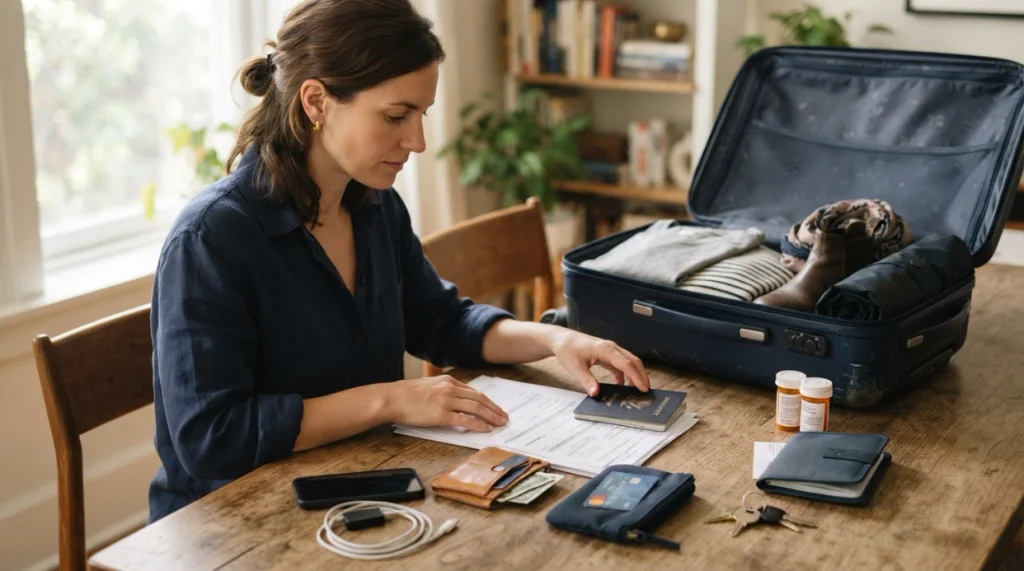
A first solo trip packing list should cover six areas: documents, money, clothing, health, technology, and destination-specific essentials. Start with things that would be difficult to replace, then add comfort items.
Definition: A solo female travel packing list is a personalized checklist for a woman managing her trip independently, including her luggage, documents, health needs, communication, daily clothing, money, and practical safety preparation.
Start with your non-negotiable essentials
I pack the things that could seriously disrupt my trip if forgotten before I think about outfits. A forgotten T-shirt is easy to replace; a passport or essential prescription may not be.
- Passport or required photo identification
- Visa or entry documents when required
- Flight, train, or bus information
- Accommodation address and booking details
- Travel insurance information when applicable
- Prescription medication and necessary medical supplies
- Wallet and primary payment card
- Backup payment method stored separately
- Phone and charging cable
- House keys for your return home
For international travel, check passport validity, visa rules, entry requirements, and destination-specific guidance before departure. The State Department’s International Travel Checklist is a useful starting point for U.S. travelers.
Build the rest around the trip you’re actually taking
Your destination should decide much of your packing list. A three-night city break requires different gear from a week of hiking, beach time, or winter sightseeing.
- Weather: Check daytime temperatures, nighttime temperatures, rain, wind, and seasonal conditions.
- Activities: List anything requiring specific clothing, footwear, or equipment.
- Local customs: Research whether religious sites or cultural settings require more coverage.
- Laundry access: Easy laundry lets you repeat clothes and reduce luggage.
- Transportation: Frequent trains, stairs, cobblestones, and buses favor lighter luggage.
A practical packing breakdown by trip length
I don’t use these numbers as rigid rules. They’re a starting point for a simple wardrobe when laundry is available or repeating clothes doesn’t bother you.
| Trip Length | Tops | Bottoms | Underwear | Shoes | Laundry Plan |
|---|---|---|---|---|---|
| 2–3 days | 2–3 | 1–2 | 3–4 pairs | 1–2 pairs | Usually none |
| 4–5 days | 3–4 | 2–3 | 5–6 pairs | 1–2 pairs | Optional |
| 6–8 days | 4–5 | 2–3 | 5–7 pairs | 2 pairs | One wash |
| 9+ days | 4–6 | 3 | 5–7 pairs | 2 pairs | Plan regular laundry |
The longer my trip becomes, the less I try to pack one fresh outfit per day. Laundry weighs nothing while ten extra outfits definitely do.
Section Takeaway: Build your first solo travel packing list from irreplaceable essentials outward, then adjust clothing and gear to the destination instead of packing for imaginary scenarios.
How Many Clothes and Shoes Should I Bring?
Bring enough clothing to stay comfortable without creating a suitcase you resent carrying. For most trips, interchangeable pieces work better than separate outfits for every day.
Create a small capsule wardrobe
A capsule wardrobe is simply a small group of clothes that work together in several combinations. I choose neutral or coordinating pieces because they reduce decision-making and luggage weight.
- 2–5 tops depending on trip length
- 1–3 comfortable bottoms
- One warmer layer
- Underwear and bras for your laundry schedule
- Sleepwear
- Weather-appropriate outerwear
- Swimwear when needed
- One outfit for a nicer dinner or event if planned
I also avoid taking clothes that require constant adjusting, special undergarments, difficult ironing, or shoes I haven’t tested. Solo travel feels easier when your clothes simply work.
Pack clothing for local customs
Comfort isn’t only about temperature. Clothing expectations can differ around religious sites, conservative communities, upscale venues, and specific activities.
A lightweight scarf or overshirt can be useful where extra coverage is expected. Researching those details before leaving is much easier than discovering them at the entrance to an attraction.
Be strict about shoes
Shoes consume more bag space than almost anything else. I normally begin with the pair I’ll wear during my longest walking day.
- Walking shoe: A broken-in pair for sightseeing and transit.
- Second shoe: Add only when your itinerary creates a clear need.
- Sandals or flip-flops: Useful for beaches, shared showers, or hot destinations.
- Activity footwear: Bring hiking or formal shoes only when the activity is confirmed.
New shoes are a poor experiment for a first solo trip. Blisters feel much more annoying when you’re the person responsible for getting yourself back across the city.
Use layers instead of bulky backups
Weather can shift during long sightseeing days. A base layer, light sweater, and rain shell often give you more flexibility than one bulky item.
I check the forecast again shortly before departure. That final check has saved me from packing coats for warm weekends and forgetting rain protection when conditions changed.
Section Takeaway: Choose clothes that mix, repeat, layer, and feel comfortable for long days. Limit shoes unless your itinerary gives each pair a specific job.
What Safety and Security Items Should a Woman Pack?
The most useful solo travel safety items are often simple backups rather than dramatic gadgets. Good information, battery power, duplicate payment options, and secure storage solve many common travel problems.
Carry backup access to money
I don’t keep every card and all my cash in one wallet. Losing one pouch shouldn’t remove my ability to pay for accommodation or transportation.
- Main bank or credit card in your everyday wallet
- Backup card stored separately
- Small amount of emergency cash when useful locally
- Bank contact information saved securely
- Digital wallet set up before departure, where supported
Create offline copies of essential information
Your phone can lose service exactly when you need directions. Before arrival, I save information that lets me reach my accommodation without opening email or relying on mobile data.
- Accommodation name and address
- Booking confirmation
- Airport or station transfer instructions
- Travel tickets
- Emergency contacts
- Insurance information
- Offline map of the arrival area
Keep sensitive documents protected rather than scattering unencrypted copies across devices. The goal is useful redundancy, not creating unnecessary exposure.
Consider a few legal, low-complexity safety tools
A simple personal alarm or whistle may fit some travelers, but you should check destination and airline rules before packing safety devices. Items that are legal at home may be restricted elsewhere.
I prefer tools that don’t create another legal or security problem at a border. Preparation and transportation planning remain more useful than carrying an object you don’t know how to use.
Share the right information with someone at home
Give a trusted person enough information to help if plans go wrong. You don’t need to send them a minute-by-minute itinerary.
- Your main accommodation details
- Major transportation bookings
- Your general route
- Your travel insurance details when relevant
- A reasonable check-in plan
Keep your accommodation details more private with strangers you meet during the trip. Being friendly doesn’t require explaining exactly where you’re sleeping or when nobody expects you back.
Section Takeaway: Pack safety through redundancy. Separate your money, save essential information offline, keep someone trusted informed, and verify local rules before carrying any personal safety device.
What Should Go in My Carry-On or Day Bag?
Your carry-on or personal bag should contain anything you cannot comfortably lose for a day. That usually means documents, medication, money, technology, and a few basic comfort items.
Keep critical items within reach
- Passport or identification
- Wallet
- Phone
- Essential medication
- Charging cable
- Power bank when appropriate
- Accommodation details
- Transportation tickets
- Headphones or earplugs
- Glasses or contact-lens essentials
- One small snack
- Empty refillable water bottle when airport rules require it
If I’m checking a suitcase, I also place one change of underwear and a basic top in my carry-on. A delayed bag becomes much less stressful when I can manage the first night without shopping immediately.
Organize around your arrival
I pack for the first hour at my destination, not just the flight. Anything needed between landing and reaching my room should be easy to access.
- Local SIM or eSIM information
- Arrival address
- Transit or transfer instructions
- Weather layer
- Small amount of local currency when needed
- Portable charger
Digging through a suitcase on a station platform isn’t how I want to start a solo trip. Easy access lowers stress when I’m tired and still learning the surroundings.
Check airline and security rules before flying
Carry-on restrictions vary by country, airline, airport, and item type. For U.S. departures, the TSA’s travel tips and screening guidance can help you check current requirements before you pack.
Don’t assume something allowed in checked baggage is automatically allowed in the cabin. Check both your security authority and airline when you’re unsure.
Section Takeaway: Your carry-on is your short-term survival bag, not a second suitcase. Keep identification, medicine, money, communication tools, and arrival information where you can reach them quickly.
What Toiletries and Health Items Do I Need?
Bring the personal-care products you use consistently and anything that may be difficult to replace. Skip the oversized beauty routine unless those products genuinely matter to you.
Keep toiletries simple
- Toothbrush and toothpaste
- Deodorant
- Face wash and moisturizer
- Sunscreen appropriate for your destination
- Hairbrush or comb
- Hair ties or clips
- Small shampoo and conditioner if your accommodation doesn’t provide them
- Menstrual products you prefer
- Minimal makeup if you normally wear it
- Contact-lens supplies when needed
Decanting everyday products into smaller containers can save significant space. Label similar-looking liquids before leaving so you aren’t guessing after a long travel day.
Build a travel health kit around your destination
A useful health kit is personal. Your destination, activities, medical needs, climate, and access to pharmacies should determine what comes with you.
- Prescription medication
- Copies of prescriptions when appropriate
- Regular over-the-counter medication you depend on
- Small first-aid basics
- Blister treatment for walking-heavy trips
- Hand sanitizer
- Insect repellent where relevant
- Sun protection
The CDC’s Pack Smart guidance offers a broader travel health checklist that you can adjust to your destination. You don’t need to carry every item listed for every trip.
Give medication special attention
Don’t assume a prescription or over-the-counter medicine that’s common at home is permitted everywhere. Rules differ between destinations and transit countries.
The CDC’s guidance on traveling abroad with medicine recommends checking destination rules and preparing your medication before international travel.
Pro tip: Before an international trip, check official destination health guidance, medication restrictions, and entry requirements rather than relying on an old packing list or social-media post.
Pack menstrual products based on your comfort
You may be able to buy pads, tampons, cups, or other products at your destination, but selection varies. I would pack enough of my preferred product to avoid making that search urgent.
If your cycle might begin during a long transit day, keep supplies in your personal bag. Don’t bury all of them inside checked luggage.
Section Takeaway: Bring the health and personal-care items that would be inconvenient to replace, and verify medication rules before crossing borders. Your travel health kit should match your real destination, not every possible emergency.
How Can I Pack Light Without Forgetting Essentials?
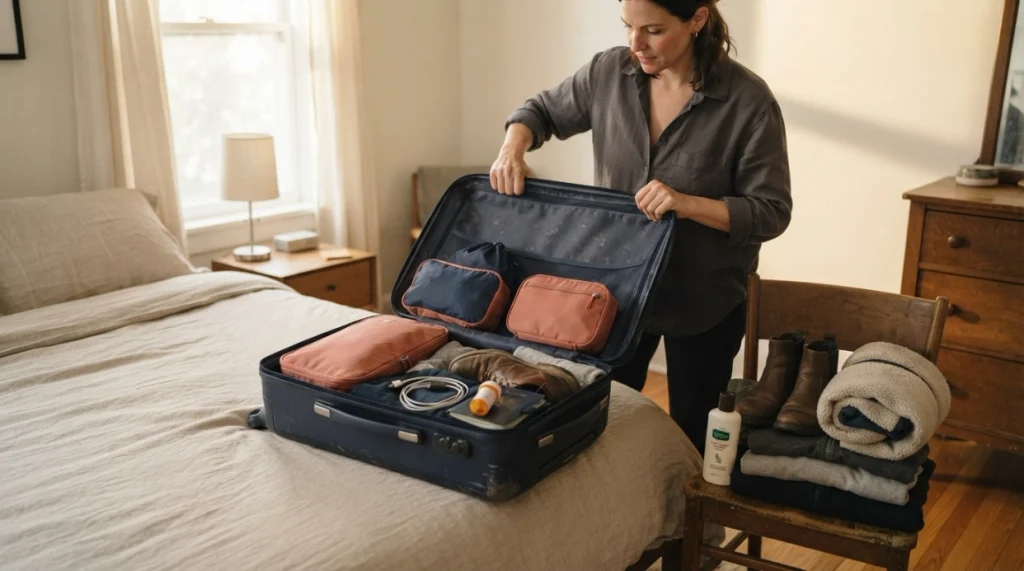
The easiest way to pack light is to separate needs from options before anything enters your suitcase. I make the first packing pile small, then add extras only when space remains.
Use a three-stage packing method
- Pack essentials first: Documents, medication, phone gear, underwear, comfortable clothing, and required activity items.
- Add useful comforts: A book, small beauty kit, second pair of shoes, or other items you’ll genuinely use.
- Remove insurance packing: Take out things included only because you can imagine one unlikely situation where they might help.
This method catches a common first-solo-trip problem: anxiety turning into luggage. More belongings don’t automatically make you more prepared.
Lay everything out before closing the bag
I like to see the entire packing list at once. Duplicate items become obvious when they’re spread across a bed instead of hidden in separate compartments.
- Remove duplicate toiletries.
- Choose one charging setup where possible.
- Reduce clothes that don’t combine with other pieces.
- Question every third pair of shoes.
- Leave bulky “maybe” items behind.
- Plan laundry rather than carrying a fresh outfit for every day.
Use packing cubes for organization, not permission to overpack
Packing cubes help separate categories and make hostel, hotel, and suitcase organization easier. They don’t reduce the physical weight of what you’re carrying.
I use one cube for everyday clothes and a smaller one for underwear and sleepwear. A lightweight laundry bag then keeps worn clothing separate.
Do the carry-it-yourself test
Once everything is packed, lift the bag onto a chair or bed. Carry it around your home and walk up a flight of stairs if that’s safe for you.
If that short test feels miserable, imagine managing the same bag through a station after a delayed train. Remove weight before the trip does it for you.
Leave room for the unexpected
A completely stuffed suitcase is harder to repack. It also leaves no space for a snack, small souvenir, extra layer, or item purchased during the trip.
I prefer leaving a little breathing room. Packing becomes easier on checkout morning when every item doesn’t need perfect compression.
Use this final ten-minute check
- Do I have the correct identification?
- Do I have required medication?
- Can I access money in two ways?
- Can I charge my phone?
- Do I know my first accommodation address?
- Do my clothes match the weather?
- Can I comfortably walk in my shoes?
- Can I carry all my luggage alone?
- Have I downloaded important information?
- Have I removed things I’m packing only from anxiety?
That final question is one of my favorites. Nervous first-time travelers often need a clearer plan, not another five pounds of belongings.
Section Takeaway: Pack in layers of importance, remove duplicates, test the weight, and leave spare room. A manageable bag gives you more independence every time you change accommodation or transportation.
First Solo Trip Packing FAQ
Should I bring a suitcase or backpack for my first solo trip?
Choose whichever you can manage comfortably without help. A wheeled suitcase works well on smooth streets and airports, while a backpack can be easier with stairs, uneven streets, and frequent public-transport changes.
How much luggage should I take on my first solo trip?
Take the smallest practical amount for your itinerary. For a short city trip, many travelers can manage with a carry-on-sized bag and personal item, but your climate, activities, medical needs, and airline allowance may change that.
Should I pack pepper spray or another self-defense item?
Don’t pack a self-defense device until you’ve checked airline, security, customs, and local laws at your destination. Some items that are legal where you live may be prohibited during transportation or illegal after arrival.
How much cash should a woman carry when traveling alone?
There isn’t one correct amount because payment habits vary by destination. Carry enough emergency cash to solve a small problem, then keep a backup card or payment method separately instead of relying entirely on one wallet.
Where should I keep my passport while traveling solo?
Keep it in a secure place under your control and follow local identification requirements. During transit, I prefer a zipped compartment that’s accessible to me but difficult for someone else to reach casually.
Should I take expensive jewelry on my first solo trip?
If jewelry isn’t necessary for your itinerary, leaving high-value pieces at home simplifies travel. You have fewer valuable items to track, insure, secure, remove at certain activities, or worry about losing.
What is the one thing first-time solo travelers most often overpack?
Clothing is an easy category to overpack because every imagined situation creates another outfit. Build around repeatable pieces, one reliable walking shoe, layers, and a realistic laundry plan instead.
Your first solo trip doesn’t require the perfect suitcase. It requires a bag you can manage and the essentials that let you solve ordinary travel problems independently.
Start with documents, medication, money, phone power, comfortable clothing, and your arrival plan. Then trim everything else until your luggage feels like a tool rather than another responsibility.
Use this checklist as your base, adjust it for your destination, and do one final weather and document check before leaving. Once your bag is packed, you can put your attention where it belongs: on experiencing your first solo trip.