What Mistakes Should a Woman Avoid on Her First Solo Trip?
Quick Answer
The biggest mistakes a woman should avoid on her first solo trip are overpacking, arriving without a safe transfer plan, sharing too much personal information, ignoring local customs, carrying only one payment method, and building an itinerary with no breathing room. Before leaving, research your destination and check an official travel advisory for current safety information.
Six mistakes to avoid first
- Overplanning: Leave enough flexibility to rest, change plans, or respond to delays.
- Risky arrival: Know how you will get from the airport or station to your accommodation before landing.
- Oversharing: Don’t tell strangers exactly where you’re staying or that nobody expects you back.
- One payment method: Carry cards and emergency money in separate places.
- Ignoring instincts: Leave situations that make you uncomfortable without worrying about appearing rude.
- Doing too much: Your first solo journey does not need to prove anything to anyone.
A simple rule
- Make the first 12 hours of the trip predictable, then give yourself more freedom once you’re settled.
If you’re wondering what mistakes should a woman avoid on her first solo trip, focus less on becoming fearless and more on becoming prepared. Most first-time solo travel mistakes come from poor logistics, rushing decisions, or putting unnecessary pressure on yourself.
My favorite approach is simple: remove avoidable problems before departure, then stay flexible once the trip begins. That makes solo female travel feel much less intimidating.
In This Guide
- What mistakes should you avoid before booking your first solo trip?
- Why is arriving without a safe first-night plan a mistake?
- What safety mistakes should first-time solo female travelers avoid?
- What money, phone, and packing mistakes cause problems?
- What social and mindset mistakes should women avoid?
- Frequently asked questions
- What should you remember before your first solo trip?
Definition: Solo female travel means taking a trip independently as a woman without a companion responsible for sharing your itinerary, transportation, accommodation, or day-to-day decisions. You may still join tours, stay in social accommodations, or meet people along the way.
What Mistakes Should You Avoid Before Booking Your First Solo Trip?
The first major mistake is choosing a trip because it looks impressive instead of because it suits your current confidence level. Your first solo trip should be manageable enough that you can enjoy independence without fighting unnecessary logistical problems.
A complicated three-country itinerary can wait. A well-connected destination with straightforward transportation and accommodation may give you a much stronger introduction to traveling alone.
Don’t book before researching how the destination works
Research should go beyond finding attractions. Learn how you’ll move between the airport, accommodation, neighborhoods, train stations, and places you want to visit.
- Check visa and entry requirements.
- Research local transportation options.
- Learn which neighborhoods suit visitors.
- Check local customs and expected dress.
- Find out whether cash or cards are commonly used.
- Save local emergency and accommodation contact details.
- Review destination-specific health guidance.
For international trips, the CDC’s pre-travel guidance recommends checking destination-specific health information before departure. It also advises travelers who need medical guidance to speak with a healthcare provider several weeks before traveling.
Pro tip: Check official government travel and health sources shortly before departure because entry rules, security conditions, and health guidance can change.
Don’t build an itinerary that has no recovery time
First-time solo travelers sometimes schedule every hour because an empty calendar feels uncomfortable. The result can be a trip that becomes exhausting after two days.
I prefer treating the first day as an arrival day rather than a sightseeing day. That creates room for delayed flights, jet lag, navigation mistakes, groceries, and an early night.
| Common first-trip mistake | Better default | Practical target |
|---|---|---|
| Scheduling sightseeing immediately | Keep arrival day light | One simple activity at most |
| Changing hotels repeatedly | Use fewer bases | Stay several nights when practical |
| Booking tight connections | Add transfer time | Allow a meaningful buffer |
| Carrying one bank card | Separate backups | Two payment methods minimum |
| Keeping plans only on your phone | Store offline copies | Accommodation, tickets, contacts |
| Planning every minute | Leave flexible time | At least one open block most days |
Another mistake is picking the cheapest option automatically. A slightly more expensive hotel beside reliable public transportation may save money, time, and stress compared with a remote bargain.
Section Takeaway: Choose simplicity over ambition for your first solo journey. Research the practical details before paying for a trip that looks good only on paper.
Why Is Arriving Without a Safe First-Night Plan a Mistake?
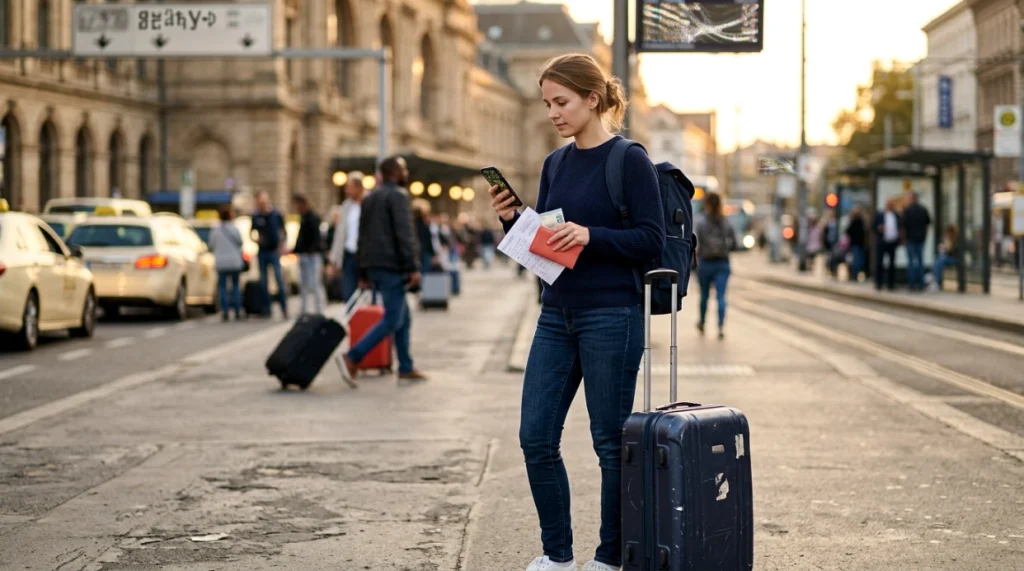
Your arrival is one part of the trip worth planning in detail. Being tired, carrying luggage, and navigating an unfamiliar transport system can make small problems harder to solve.
I treat the first 12 hours as a mini-itinerary. I want to know where I’m sleeping, how I’m getting there, and what I’ll do if the original transport plan fails.
Don’t land without knowing how you’ll reach your accommodation
Before departure, save the accommodation’s full address and phone number offline. Screenshot the booking confirmation too.
- Identify the official airport or station transport options.
- Check the approximate journey time.
- Save your accommodation on an offline map.
- Know whether you need local cash for transport.
- Keep one backup transport option.
- Tell someone when you’ve arrived safely.
Arriving during daylight can make a first solo arrival easier when schedules allow. You can see your surroundings, find food, and understand the neighborhood before evening.
Don’t assume every cheap accommodation is a good solo choice
Price is only one part of accommodation value. Location, reception hours, transport access, recent guest feedback, and room security matter too.
If you’re considering a hostel, remember that a hostel is simply budget accommodation where guests may share rooms and common spaces. Many also offer private rooms or women-only dorms.
- Look for a location near transportation you expect to use.
- Check whether reception operates when you arrive.
- Read recent reviews for recurring security or cleanliness issues.
- Confirm how doors, lockers, or room access work.
- Check the route back after evening activities.
A gorgeous property far outside town can become inconvenient once you’re alone and paying for late-night transport. Convenience has value.
Don’t wander around exhausted just because you feel you should explore
There is no prize for sightseeing immediately after a long flight. Exhaustion can make navigation, communication, and decision-making worse.
Eat, hydrate, shower, charge your phone, and learn the immediate area. Tomorrow will still be there.
Section Takeaway: Make your arrival boring in the best possible way. A predictable transfer, confirmed accommodation, charged phone, and backup plan can remove much of the first-night anxiety.
What Safety Mistakes Should First-Time Solo Female Travelers Avoid?
The biggest safety mistake is expecting either total danger or total safety. Risk changes by destination, neighborhood, time of day, transportation method, and situation.
Good solo female travel safety is mostly about maintaining options. You want enough information, communication, and flexibility to leave a situation when something feels wrong.
Don’t tell new acquaintances more than they need to know
Meeting people is one of the best parts of solo travel. You still don’t need to give a stranger your room number, exact daily schedule, or detailed information about being completely alone.
- Share the neighborhood instead of your exact hotel when appropriate.
- Avoid announcing an empty itinerary to strangers.
- Don’t post your exact live location publicly.
- Meet new people in public places first.
- Arrange your own route home.
You can be friendly without surrendering privacy. Those two things work perfectly well together.
Don’t stay somewhere because leaving might seem rude
If a conversation, vehicle, venue, date, tour, or street makes you uncomfortable, move. You don’t need enough evidence to defend the decision to somebody else.
I’ve found it useful to make leaving mentally easy before I need to do it. I identify exits, keep transport apps ready, and maintain enough money to change plans.
Don’t disappear without anyone knowing your general plan
Give one trusted person a basic itinerary and important accommodation details. Agree on a communication rhythm that works for both of you.
- Share major flight or train details.
- Share accommodation information.
- Agree when you’ll normally check in.
- Explain what someone should do if they cannot reach you.
- Update them after major itinerary changes.
U.S. citizens traveling abroad can also consider the free Smart Traveler Enrollment Program, which provides embassy and consulate updates for registered destinations.
Don’t let alcohol remove your exit plan
You don’t need to avoid nightlife to travel responsibly. You do need to stay capable of recognizing your surroundings and getting yourself back safely.
Keep control of your drink and transportation plan. If you meet people you trust, that can make an evening more social, but it shouldn’t replace your own route home.
Pro tip: Emergency numbers and official assistance procedures differ by country. Save the relevant local numbers from an official source rather than assuming your home country’s number will work.
Section Takeaway: Safety isn’t about being suspicious of everyone. Keep control of your location, transportation, communication, and ability to leave.
What Money, Phone, and Packing Mistakes Cause Problems?
Some of the most stressful solo travel problems aren’t dramatic. A dead phone, blocked card, overloaded suitcase, or missing charger can ruin an otherwise easy day.
Redundancy matters more when you’re alone because there’s no travel partner carrying a backup.
Don’t keep all your money in one place
Separate your main card, backup card, and emergency cash. Losing one wallet shouldn’t remove every way you have to pay.
- Carry at least two usable payment methods when possible.
- Store the backup separately from your primary wallet.
- Keep a small emergency cash reserve.
- Know how to contact your bank if a card stops working.
- Check foreign transaction and ATM fees before departure.
A backup card isn’t useful if it sits beside the first card in a stolen wallet. Separation is the important part.
Don’t depend completely on live internet access
Phones are powerful travel tools, but coverage can fail. Batteries also die at inconvenient moments.
- Download offline maps.
- Screenshot accommodation details.
- Save transport tickets offline.
- Store important contacts outside one messaging app.
- Carry a charging cable and suitable adapter.
- Consider a power bank for long travel days.
I also keep enough information offline to reach my accommodation without searching my email. That small habit makes arrival days calmer.
Don’t overpack because you’re traveling alone
Many first-time solo travelers pack for every imaginary emergency. Then they have to drag that emergency kit through airports, staircases, stations, buses, and crowded streets.
Pack for what you’re likely to do. Leave room for laundry and repeated outfits.
- Choose shoes you can comfortably walk in.
- Build outfits around interchangeable pieces.
- Keep medications and essentials in your carry-on.
- Leave valuable jewelry you don’t need at home.
- Test whether you can lift and carry your luggage yourself.
One practical test is walking around your home with your packed bag for several minutes. If that already feels miserable, remove something.
Don’t forget basic health planning
Carry necessary medication in accordance with destination rules and keep important medical information accessible. Consider how you would obtain care if you became ill or injured.
The CDC’s health guidance for travelers during a trip covers issues such as safe transportation, illness, hygiene, and obtaining care while away.
Pro tip: For destination-specific health risks, vaccines, and medication rules, check an official health authority before you travel.
Section Takeaway: Build small backups into your trip. A second payment method, offline information, reasonable luggage, and a charged phone solve more problems than carrying endless “just in case” items.
What Social and Mindset Mistakes Should Women Avoid?

First-time solo travel can become disappointing when you expect every day to feel empowering. Some moments will feel exciting, while others may feel lonely, awkward, tiring, or ordinary.
That’s normal. Traveling alone doesn’t remove normal human emotions.
Don’t think you have to do everything alone
Solo travel describes who controls the trip. It doesn’t require isolation.
- Join a walking tour.
- Book a cooking class.
- Take a small-group day trip.
- Attend a hostel social event.
- Join an organized activity.
- Talk with other travelers in shared spaces.
Lonely Planet’s solo travel tips for women also emphasize easing into independent travel instead of forcing yourself outside every comfort zone at once.
Don’t trust someone simply because you’re lonely
Loneliness can make instant friendships feel deeper than they are. Enjoy spontaneous connections, but let trust develop at a sensible pace.
For first meetings, public places keep things simple. Maintain your own transport, phone, money, and accommodation access.
Don’t copy another traveler’s comfort level
A traveler who has visited 40 countries may make choices you don’t yet want to make. Their confidence doesn’t create an obligation for you.
You can skip nightlife, take a taxi instead of walking, book a private room, or join a guided tour. None of those choices make the trip less independent.
Don’t confuse discomfort with failure
Your first meal alone may feel strange. Your first navigation mistake may make you wonder why you came.
Give yourself time before making a judgment about the entire trip. Confidence often grows through dozens of small decisions rather than one dramatic breakthrough.
Don’t pressure yourself to maximize every day
Travel can turn into a checklist when you’ve spent money to reach a destination. Rest can start to feel wasteful.
It isn’t. A quiet afternoon, early night, café visit, or slower morning may make the next day much better.
- Choose one main priority for the day.
- Add optional activities around it.
- Keep some unscheduled time.
- Change plans when your energy changes.
As of 2026, my strongest advice for a first solo journey remains surprisingly low-tech: make fewer irreversible decisions. Flexible plans give you room to respond to how the destination actually feels once you’re there.
Section Takeaway: You don’t need to perform independence. Build the trip around your own comfort, stay open to people without rushing trust, and let confidence develop naturally.
Frequently Asked Questions
Is a first solo trip dangerous for a woman?
No destination or travel style is risk-free, and risk varies widely by location and situation. Research current conditions, choose appropriate accommodation and transport, maintain communication with someone you trust, and use official destination guidance when making safety decisions.
How many days should a woman’s first solo trip be?
There is no perfect length. A shorter trip can be easier if you’re testing solo travel for the first time, while a longer trip may suit someone already comfortable navigating unfamiliar places independently.
Should I tell people I’m traveling alone?
You don’t need to hide solo travel from everyone, but avoid unnecessarily sharing detailed information with strangers. You can say you’re meeting friends later or keep your accommodation and daily schedule private when a conversation feels intrusive.
Is staying in a hostel safe for a solo female traveler?
Hostel safety varies by property. Check recent reviews, location, access controls, locker availability, reception hours, and room options. Women-only dorms or private rooms may feel more comfortable for some first-time travelers.
Should I arrive during daylight on my first solo trip?
Daylight arrival can simplify orientation because transportation, signs, shops, and your surroundings may be easier to understand. It isn’t always possible, so the more important step is arranging a clear transfer plan before you arrive.
How much money should I keep for emergencies?
There is no universal amount because costs differ by destination. Keep enough accessible backup money to cover an unexpected meal, local transport, communication, or another small disruption, while storing larger backup funds through a separate payment method.
What if I feel lonely during my first solo trip?
Don’t treat loneliness as proof that solo travel was a mistake. Join a group activity, call someone at home, spend time in a social common area, or simply rest and reassess the next day.
What Should You Remember Before Your First Solo Trip?
The goal of your first solo trip isn’t to prove that you’re fearless. It’s to learn that you can make decisions, solve ordinary problems, and enjoy a destination on your own terms.
The most avoidable mistakes come from rushed planning, weak arrival logistics, oversharing, relying on one payment or communication method, overpacking, and pushing yourself beyond your comfort level.
- Research before booking.
- Make your first-night plan simple.
- Keep important backups separate.
- Protect your personal information.
- Listen when a situation feels wrong.
- Leave room to change your mind.
- Rest when you need it.
Your first solo journey doesn’t need to be perfect to be successful. Prepare the parts that matter, stay flexible with the rest, and let the experience teach you what kind of solo traveler you want to become.