Should My First Solo Trip as a Woman Be Domestic or International?
Quick Answer
For most women, a domestic trip is the easier first solo trip because it removes passports, visas, currency changes, language barriers, and unfamiliar laws from the learning curve. An international first trip can still be a great choice if you pick an easy-to-navigate destination, arrive during daylight, book accommodation ahead, and review reliable safety guidance for women travelers before leaving.
The biggest differences
- Domestic is simpler: You usually deal with fewer documents, fewer cultural adjustments, and easier communication.
- International feels bigger: You may gain more cultural novelty, but you also manage more unfamiliar systems alone.
- Safety is destination-specific: Crossing a border does not automatically make a trip dangerous, and staying domestic does not automatically make it safe.
- Confidence matters: Choose the trip where you can solve small problems without feeling overwhelmed.
- Keep it manageable: A three-to-five-day first trip is often long enough to build confidence without creating too much pressure.
My simple rule
- Start domestic if being alone is the challenge. Consider international if you already travel confidently and unfamiliar logistics excite you more than they worry you.
Choosing between a domestic and international first solo trip can feel like choosing between the “safe” option and the adventurous one. I don’t think that’s the most useful way to look at it.
Your first solo trip should teach you how you travel when nobody else is making decisions for you. The best destination is the one that gives you enough independence to grow without burying you under problems you aren’t ready to manage yet.
In This Guide
- Should your first solo trip be domestic or international?
- What are the biggest differences between domestic and international solo travel?
- When is a domestic solo trip the better choice?
- When does an international first solo trip make sense?
- How do you choose the right first solo destination?
- How should a woman plan her first solo trip safely?
- Frequently asked questions
Should Your First Solo Trip Be Domestic or International?
For many first-time solo women travelers, domestic is the lower-friction starting point. International travel can work just as well when the destination fits your experience and comfort level.
The real question isn’t whether one is universally better. It’s how many unfamiliar things you want to handle at the same time.
Definition: Solo female travel means taking a trip without a personal travel companion and managing your own transport, accommodation, schedule, decisions, and day-to-day safety while away.
On a domestic trip, you may already understand the language, payment system, phone network, social norms, emergency services, and transportation style. That gives you more mental space to practice being alone.
You’ll still learn important solo-travel skills. You have to choose where to stay, eat by yourself, navigate unfamiliar streets, change plans, and decide when a situation doesn’t feel right.
- Choose domestic first if you’ve rarely traveled without family or friends.
- Consider international if you’ve handled airports, hotels, and public transportation independently before.
- Choose either if the destination is well researched and the logistics feel manageable.
One of the biggest mistakes I see is treating an international trip as proof that you’re “brave enough.” There is no prize for making your first solo experience harder than it needs to be.
A successful two-night trip three hours from home can teach you more than an exhausting week overseas. Confidence usually grows from completing manageable challenges.
I also wouldn’t choose domestic solely because relatives are nervous about international travel. Look at the actual destination, your preparation, and the specific risks instead.
Section Takeaway: Your first solo trip should stretch your independence, not test your ability to survive unnecessary complications. Domestic often makes that easier, but the destination matters more than the border.
What Are the Biggest Differences Between Domestic and International Solo Travel?
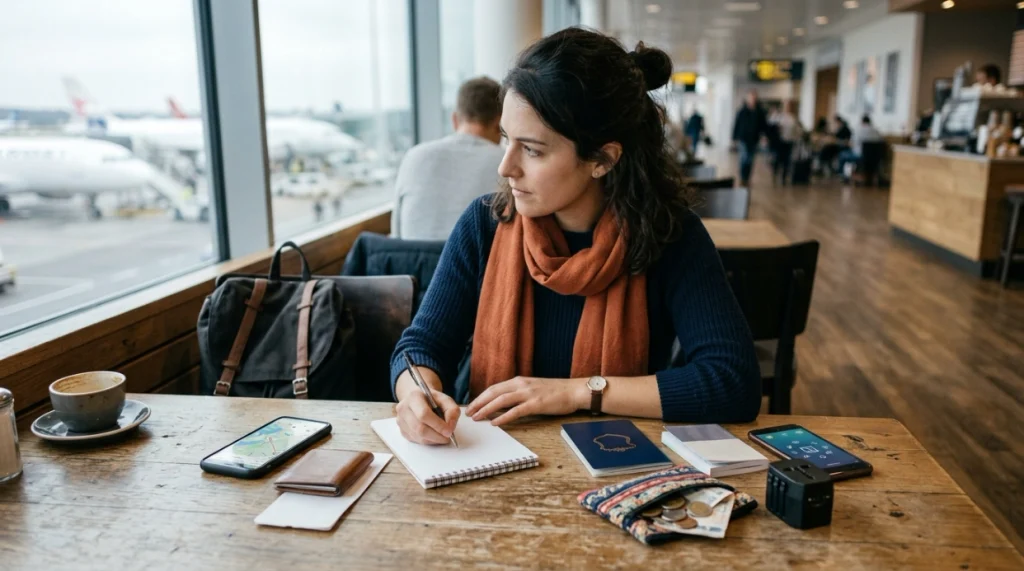
International travel usually adds more planning layers. Domestic travel usually lets you focus more heavily on the experience of being alone.
Neither format is automatically safer. A familiar country can contain neighborhoods or situations you should avoid, while a carefully selected foreign destination can have straightforward transit and excellent tourism infrastructure.
| Factor | Domestic First Trip | International First Trip |
|---|---|---|
| Documents | Usually simpler | Passport and possibly visa or entry requirements |
| Language | Often familiar | May require translation tools or basic phrases |
| Money | Familiar currency and payment habits | Currency conversion, foreign transaction issues, or cash planning |
| Phone access | Existing mobile plan may work normally | May require roaming, an eSIM, or a local SIM |
| Cultural adjustment | Usually lower | Local customs and laws may differ substantially |
| Recommended first-trip pace | I often suggest 2-4 nights | I often suggest 4-7 nights for a single-city trip |
| Backup options | Getting home may be simpler | Flight changes and border requirements can complicate a quick return |
The biggest international difference for me isn’t the flight distance. It’s the number of tiny decisions that suddenly require attention.
How do I get from the airport? Will my phone connect? Can I use my bank card? Is tap water safe? What happens if my flight arrives after public transport closes?
None of those questions should stop you. They simply use mental energy, and that matters when you’re also adjusting to spending several days alone.
Domestic travel removes some of that decision fatigue. It lets you discover whether you enjoy solo dining, independent sightseeing, quiet evenings, and making every choice yourself.
Section Takeaway: International travel isn’t necessarily harder because it is farther away. It’s harder when it stacks unfamiliar transportation, language, money, laws, culture, and communication on top of your first experience traveling alone.
When Is a Domestic Solo Trip the Better Choice?
Start domestically when you want to practice solo travel without changing every part of your normal environment. It’s particularly useful when the idea of simply being alone already feels challenging.
My favorite first-trip formula is uncomplicated: one city, one hotel, one main transportation method, and only a few scheduled activities.
If you’ve never spent much time alone away from home
Solo travel feels different from spending an afternoon alone. There is nobody automatically waiting for dinner, checking directions, or watching your luggage while you use the restroom.
A short domestic trip lets you experience those moments without also worrying about immigration or foreign-language communication.
If travel logistics already make you anxious
Choose a destination you can reach with one simple flight, train journey, or drive. Avoid making your first trip a complicated chain of transfers.
- Book one accommodation for the whole trip.
- Arrive during daylight when possible.
- Plan your airport or station transfer before departure.
- Save your accommodation address offline.
- Choose one or two activities each day instead of scheduling every hour.
If you want an easy exit option
Knowing you could change your plans and return home can reduce first-trip anxiety. You may never use that option, but it can make leaving easier.
I wouldn’t book a nonrefundable seven-night itinerary for a nervous first solo traveler. Two or three nights can be enough to prove that you can handle the basics.
If your family is nervous about your first trip
A domestic trip can also help establish a communication routine. Decide how often you’ll check in before you leave instead of spending the trip constantly reassuring people.
For example, one morning message and one evening message may be enough. Share your lodging details and core itinerary with one trusted person rather than posting your movements publicly.
A short first trip is not a lesser adventure. It’s practice with a boarding pass.
When Does an International First Solo Trip Make Sense?
An international first solo trip can work when you already handle travel logistics comfortably and choose a low-complexity destination. You don’t need years of solo experience before crossing a border alone.
What matters is reducing avoidable uncertainty before departure.
You already travel independently in other situations
Maybe you’ve flown alone for work, moved to a new city, studied away from home, or regularly navigate unfamiliar places yourself. Those skills transfer well.
You may be new to solo vacations without being new to independence.
You can keep the itinerary simple
For a first international solo trip, I prefer one well-connected city over racing through three countries. Changing hotels every night creates more opportunities for missed trains, misplaced belongings, and exhaustion.
- Choose direct transportation when practical.
- Stay centrally rather than saving a small amount far outside the city.
- Book your first nights before departure.
- Know how you’ll reach your accommodation.
- Keep your arrival day light.
Before an international trip, check the destination’s entry rules, official safety information, local laws, and transportation guidance. The U.S. State Department’s international travel planning resources provide one useful starting point for U.S. travelers.
You enjoy research rather than resent it
International travel requires homework. If learning transit routes, cultural etiquette, airport procedures, and local phrases sounds interesting, that preparation can become part of the fun.
If it already feels exhausting, simplify the trip instead.
You have enough time before departure
Don’t force an international first trip because you found a cheap flight leaving next week. Give yourself time to understand the destination.
Health preparation can also require lead time. CDC guidance recommends checking destination-specific health information before travel and notes that some travelers should speak with a healthcare provider weeks before departure.
Pro tip: Before international travel, review destination-specific information through the CDC’s pre-travel guidance and your own government’s official travel advisory service.
How Do You Choose the Right First Solo Destination?
Choose your first destination by its practical difficulty, not its Instagram appeal. A city can look beautiful and still be a frustrating place to learn solo travel.
I use a simple seven-question test when judging whether a destination suits a first solo trip.
- Can I reach my accommodation easily? I want a clear route from the airport, station, or parking area without improvised transport.
- Can I get around without depending on strangers? Reliable public transport, reputable taxis, rideshare services, or walkable central areas reduce friction.
- Can I stay somewhere central? Saving money isn’t useful if every evening ends with an uncomfortable journey through an isolated area.
- Will my phone work? Navigation, translation, transportation apps, and communication become much easier with dependable data.
- Do I understand important local norms? Clothing expectations, alcohol laws, photography rules, religious customs, and social norms may affect your plans.
- Do I have a backup plan? Know what you’ll do if your phone dies, your card fails, transportation stops, or your accommodation disappoints you.
- Does thinking about the trip create more curiosity than dread? Some nerves are normal. Constant panic is a reason to make the itinerary easier.
Think about your personal difficulty level
Two women can visit the same destination and experience completely different levels of difficulty. Language skills, mobility, travel experience, budget, race, nationality, disability, and cultural familiarity can all shape a trip.
That’s why generic “best places for solo women” lists should be inspiration, not instructions. Even established travel publications discussing how to begin solo travel emphasize easing into the experience in ways that match your comfort level.
Build a small first itinerary
I like three-to-five-day trips for beginners. They’re long enough to move past the awkward first evening but short enough that the trip doesn’t feel endless.
A simple schedule might look like this:
- Day 1: Arrive, check in, walk nearby, and eat somewhere easy.
- Day 2: Take a guided tour or visit one major attraction.
- Day 3: Explore independently and practice changing plans spontaneously.
- Day 4: Add a slower activity, café, museum, beach, or neighborhood walk.
- Day 5: Have breakfast, pack calmly, and travel home.
You don’t need to prove independence by refusing tours. A walking tour on day two can help you learn the city while meeting other travelers.
The goal is controlled independence. Give yourself structure without turning the trip into a school timetable.
Section Takeaway: A good first solo destination is easy enough to navigate that you can spend your energy enjoying independence instead of constantly recovering from logistical problems.
How Should a Woman Plan Her First Solo Trip Safely?
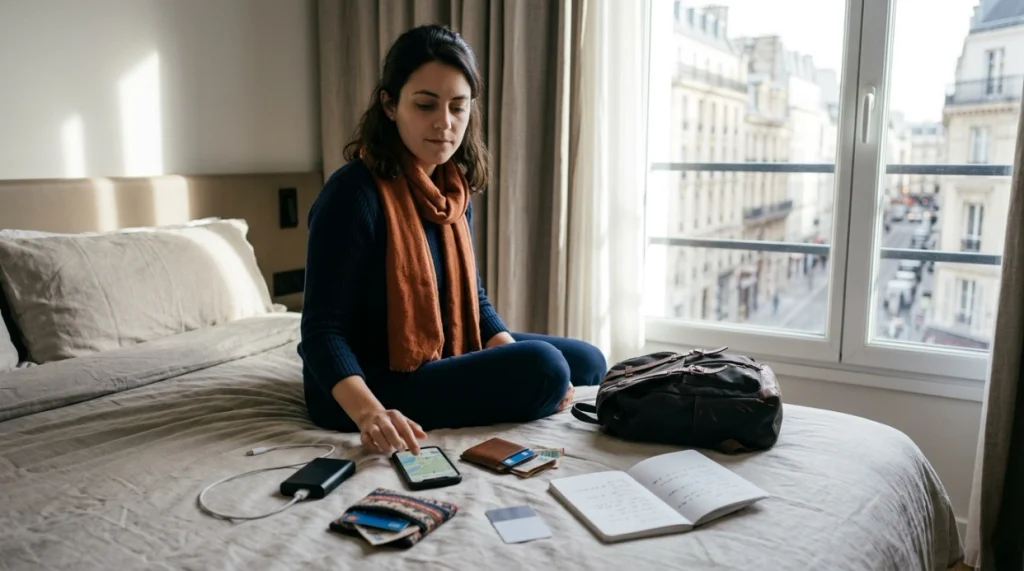
Good solo female travel safety starts before you leave. You want simple systems that still work when you’re tired, distracted, offline, or dealing with an unexpected change.
I divide preparation into transportation, accommodation, money, communication, and emergency planning.
Plan the first hour carefully
The first hour in an unfamiliar place is when I want the fewest decisions. I prefer arriving during daylight and knowing exactly how I’m getting to my accommodation.
- Save the full accommodation address.
- Screenshot the booking confirmation.
- Download an offline map.
- Know the approximate journey time.
- Identify an official taxi, train, bus, shuttle, or reputable app-based option.
Choose accommodation for location, not just price
Read recent reviews and study the surrounding streets on a map. Look at how you’ll get back after dinner, not only how close the property is to daytime attractions.
I also prefer a staffed hotel, established hostel, or highly reviewed accommodation on early solo trips. The cheapest room can become expensive if you need taxis every night.
Separate your money
Never make one wallet your single point of failure. Carry your main payment method separately from a backup card and emergency cash.
- Take at least two usable payment methods when possible.
- Keep one backup somewhere secure.
- Know how to freeze a lost card.
- Avoid displaying large amounts of cash.
Create a communication plan
Give one trusted person your accommodation details and basic itinerary. Agree on when you’ll check in so a missed message has meaning.
Keep a charged phone and a power bank. Save important numbers somewhere besides your contacts list.
Listen to discomfort early
You don’t need courtroom-level evidence before leaving an uncomfortable situation. Change seats, enter a shop, cancel the ride, return to your hotel, or spend extra money on safer transportation.
Being polite matters less than getting somewhere you feel secure.
Research laws and emergency procedures
International travelers should know local emergency numbers, embassy or consular options when applicable, and major local laws affecting visitors. Domestic travelers should still identify nearby medical facilities and understand local transportation risks.
Pro tip: Travel conditions can change quickly. As of 2026, check official government advisories shortly before departure rather than relying solely on old blog posts or social media videos.
Section Takeaway: Solo travel safety is mostly about reducing avoidable uncertainty. Plan your arrival, protect access to money and communication, share your core itinerary, and give yourself permission to change plans when something feels wrong.
Frequently Asked Questions
Is it safer for a woman to travel domestically alone first?
Domestic travel can feel safer because the systems, language, laws, and emergency procedures may be more familiar. However, safety depends on the specific destination and circumstances, so research neighborhoods, transportation, lodging, and current local conditions even when traveling inside your own country.
Can my very first solo trip be international?
Yes. An international destination can work for a first solo trip if you keep the itinerary simple, understand entry requirements, arrange reliable transportation, choose well-located accommodation, maintain phone access, and research local laws and customs before departure.
How long should my first solo trip be?
I usually suggest about three to five days for a first solo leisure trip. That gives you time to settle in and experience independent travel without committing to a long itinerary before you know how you’ll feel traveling alone.
Should I stay in a hotel or hostel on my first solo trip?
Choose based on the experience you want. A hotel usually offers more privacy, while a well-reviewed hostel may make meeting people easier. For either option, prioritize a convenient location, recent reviews, secure access, and straightforward transportation.
What if I feel lonely on my first solo trip?
Loneliness doesn’t mean solo travel was a mistake. Join a walking tour, take a class, eat somewhere with counter seating, call someone at home, or spend an evening resting. Solo travel includes both independence and choosing when you want social contact.
What if I get scared after I’ve already booked the trip?
Reduce the trip’s difficulty instead of immediately canceling it. Prebook your first transfer, shorten the itinerary, choose better-located accommodation, schedule a guided activity for your first full day, and create a clear check-in plan with someone you trust.
Final takeaway: Your first solo trip doesn’t need to be the boldest journey of your life. It needs to leave you thinking, “I can do this again.”
If domestic travel gives you enough challenge to build that confidence, start there. If international travel feels manageable after careful research, you don’t need a practice trip simply to earn permission to go abroad.
Choose the destination where preparation turns your nerves into excitement. Then keep the itinerary simple, trust your judgment, and let your first solo trip be the beginning rather than the ultimate test.