How Can a Woman Feel Comfortable Eating Alone on Her First Solo Trip?
Quick Answer
A woman can feel more comfortable eating alone on her first solo trip by making the first meal easy, choosing a relaxed restaurant, arriving before the busiest period, and bringing one familiar activity such as a book. Solo dining often feels much less unusual once you have completed the first meal, and experienced solo travelers also describe enjoying eating alone.
Make your first solo meal easier
- Start casually: Choose a café, food hall, counter-service restaurant, or relaxed neighborhood spot.
- Check first: Look at the menu, location, opening hours, and journey back before leaving your accommodation.
- Go early: Eating slightly before the busiest dinner period can make the room feel easier to navigate.
- Bring comfort: Carry a book, journal, or downloaded article if having something to do helps you settle.
- Order normally: You do not need to rush, explain yourself, or pretend that someone is joining you.
- Leave freely: If the restaurant or surrounding area makes you uncomfortable, choose somewhere else.
A useful first-night goal
- Your first meal does not need to be memorable. It only needs to help you learn that you can walk in, order, eat, pay, and leave comfortably by yourself.
If you’re wondering how a woman can feel comfortable eating alone on her first solo trip, the hardest part is often the anticipation. Sitting at the table is usually easier than imagining yourself sitting there.
I recommend treating solo dining as a travel skill rather than a confidence test. You can make the first experience deliberately easy, then become more adventurous as the trip continues.
In This Guide
- Why does eating alone feel awkward on a first solo trip?
- Where should you eat your first meal alone?
- How can you prepare before entering the restaurant?
- What should you do once you are sitting alone?
- What if you feel awkward, lonely, or unsafe?
- What is a simple first solo dinner plan?
- Frequently asked questions
Why Does Eating Alone Feel Awkward on a First Solo Trip?
Eating alone can feel uncomfortable because the situation is unfamiliar, not because you are doing anything wrong. Your attention may turn inward when you have nobody across the table to talk with.
You may wonder whether other diners are noticing you. Most people, however, are busy with their own meals, conversations, phones, or plans.
Solo dining is a skill you can practice
Solo dining simply means having a meal at a restaurant, café, market, or similar place without a dining companion. It does not mean you have to avoid conversations or social experiences.
Think about the first time you navigated an unfamiliar train station. It probably demanded more concentration than the tenth time.
- First meal: everything feels noticeable.
- Second meal: you understand the routine.
- Third meal: choosing a table feels more normal.
- Later meals: you may begin enjoying the freedom.
The goal is not to force yourself to love solo dining immediately. Your first goal is simply to discover that you can handle it.
Stop treating the meal like a performance
A common mistake is wondering how you are supposed to look while sitting alone. That thought creates pressure that does not need to exist.
You are a customer having lunch or dinner. You do not need to look busy enough, confident enough, or adventurous enough.
Once I frame the meal as an ordinary part of the day, the decision becomes simpler. I choose food because I am hungry, not because the restaurant experience must prove something.
Section Takeaway: Feeling awkward during your first solo meal is not evidence that solo travel is going badly. Treat the meal as practice, and let familiarity do some of the confidence-building for you.
Where Should You Eat Your First Meal Alone?
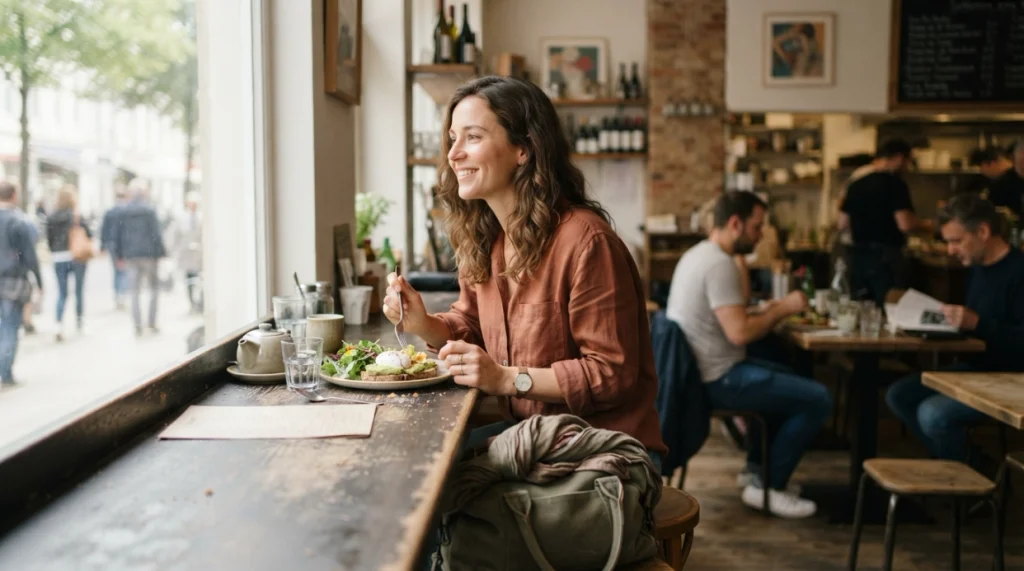
The easiest first restaurant is usually somewhere casual, visible, and simple to enter. Save the formal tasting menu or romantic candlelit restaurant until you know whether that setting appeals to you alone.
I like places where ordering and leaving are straightforward. Fewer unknowns mean less unnecessary nervousness.
| Meal setting | Good for a first meal? | Planning time | Why it can feel easier |
|---|---|---|---|
| Café | Excellent | 30–60 minutes | Casual atmosphere and shorter meal |
| Food hall or market | Excellent | 30–60 minutes | Flexible seating and plenty to observe |
| Counter-service restaurant | Excellent | 30–60 minutes | Simple ordering with little waiting |
| Busy casual restaurant | Good | 45–75 minutes | Lively environment reduces self-consciousness |
| Traditional full-service dinner | Good once comfortable | 60–90 minutes | More time alone between courses |
These meal times are simple planning estimates rather than restaurant rules. Local dining culture and service style can change them considerably.
Counter seating can remove some pressure
A counter or bar seat often feels different from occupying a two-person table. You face the counter, kitchen, or room rather than an empty chair.
Some restaurants also have communal tables. These can work well when you want company nearby without committing to a conversation.
Lunch may be easier than dinner
Try your first proper solo restaurant experience at lunch if dinner feels intimidating. Daytime dining is often mentally easier because it feels like one activity within a busy day.
You can still challenge yourself later. Confidence tends to grow faster through manageable experiences than through one overwhelming test.
How Can You Prepare Before Entering the Restaurant?
Remove as many small decisions as possible before you leave your accommodation. Knowing where you are going makes the experience feel intentional instead of uncertain.
- Save two restaurant choices. A backup prevents one long queue or closure from becoming stressful.
- Look at the menu. Knowing roughly what you might order removes one decision at the table.
- Check the route home. Save it offline if mobile service could become unreliable.
- Choose your timing. An early meal can feel calmer than arriving during the busiest period.
- Carry payment options. Keep a working card or appropriate local payment method available.
- Tell someone your general plans when appropriate. This is especially useful during a first international solo trip.
Practice before the trip if dining alone feels especially difficult
You do not have to make a foreign city the first place you ever eat alone. Try a coffee, breakfast, or lunch by yourself near home before departure.
Then increase the difficulty gradually. A café can become lunch, and lunch can become a full dinner.
Know the local context
Restaurants and social customs differ between destinations. Clothing expectations, transport options, payment systems, alcohol rules, and opening times can all change your evening plans.
For international travel, review official destination information and the U.S. State Department’s guidance for women travelers or the equivalent advice from your own government.
Pro tip: Check current government travel guidance close to departure rather than relying on an old blog post for destination-specific safety information.
What Should You Do Once You Are Sitting Alone?
Give yourself permission to behave exactly as you would during any other meal. Look at the menu, order what you want, and take whatever reasonable amount of time feels comfortable.
You do not need to fill every silent second. Quiet is part of the experience.
Should you use your phone?
Yes, if it helps you relax. There is no rule requiring a solo traveler to stare confidently into the middle distance for an hour.
Just avoid becoming so absorbed that you stop noticing your belongings, surroundings, food, or route home. The phone should be a comfort tool, not your entire environment.
Bring one small activity
A familiar activity can help during the waiting periods between ordering and eating.
- A paperback or e-reader
- A small journal
- A downloaded article
- A few postcards to write
- Notes for tomorrow’s itinerary
People-watching can be enough too. One advantage of solo dining is that you notice details you might miss during a conversation.
Use the staff interaction as an anchor
Restaurant staff deal with solo diners. You can simply ask for a table for one and continue like any other guest.
A useful script is just, “Hi, table for one, please.” Nothing more needs explaining.
Section Takeaway: Once seated, stop looking for the correct way to appear alone. Order normally, use a book or phone if you want one, and give yourself time to settle into the room.
What If You Feel Awkward, Lonely, or Unsafe?
Awkwardness, loneliness, and feeling unsafe are three different problems. Responding to the correct one matters.
If you feel awkward
Stay for a few more minutes before deciding the meal is going badly. The first five minutes can feel much stranger than the next twenty.
- Read the menu slowly.
- Order a drink or starter.
- Put your phone away for two minutes.
- Notice what is happening around you.
- Remind yourself that eating alone is an ordinary activity.
If you feel lonely
A solo trip does not require being alone every hour. Add planned social contact instead of expecting restaurants to satisfy all your social needs.
You can search organized activities and local communities through platforms such as women’s solo travel groups on Meetup.
- Join a walking tour.
- Book a cooking class.
- Stay in a social hostel or guesthouse if that suits you.
- Call someone at home after dinner.
- Attend a group activity earlier in the day.
Then your solo meal becomes quiet time between social activities rather than proof that you are isolated.
If you feel unsafe
Do not remain somewhere solely because you already ordered or worry about appearing rude. Pay, cancel the order if possible, or leave when that is the safer choice.
Keep control of your phone, payment method, accommodation access, and transportation. Avoid sharing your room number or detailed itinerary with strangers you have just met.
For any destination-specific concern, verify current official guidance before your trip.
Section Takeaway: Mild awkwardness may be worth sitting through, but a genuine safety concern deserves action. Solo travel should increase your choices, not trap you in a situation you want to leave.
What Is a Simple First Solo Dinner Plan?

For your first evening, make dinner deliberately uncomplicated. Arrival day already contains enough decisions.
Here is a beginner-friendly routine I recommend.
- 4:30–5:00 p.m.: Check tomorrow’s plans and decide where you want dinner.
- 5:00–5:15 p.m.: Check the menu, route, opening hours, and backup restaurant.
- 5:30–6:00 p.m.: Leave before you become extremely hungry or tired.
- 6:00 p.m.: Ask for a table for one and order something straightforward.
- During the meal: Read, journal, people-watch, or simply enjoy your food.
- After eating: Pay before you feel rushed and follow your planned route back.
The exact times should match local dining culture. In some destinations, 6 p.m. is normal dinner time, while elsewhere restaurants become lively much later.
Give yourself three levels of difficulty
Your confidence can build across the trip rather than appearing on day one.
- Level 1: Coffee, bakery breakfast, food hall, or takeaway eaten somewhere pleasant.
- Level 2: Casual lunch or counter-service dinner.
- Level 3: Full-service restaurant you genuinely want to experience.
By the third level, the mechanics of eating alone may already feel familiar. That lets you focus more on the food and destination.
Do not judge your entire solo trip by one meal
Your first dinner might still feel uncomfortable. Jet lag, hunger, travel fatigue, unfamiliar surroundings, and nervousness can all pile up on arrival day.
Try another meal under different conditions before deciding that you dislike dining alone. Breakfast in sunlight can feel completely different from dinner after a tiring flight.
Section Takeaway: Make your first dinner predictable and your later meals more adventurous. Confidence grows when you repeatedly complete manageable experiences on your own.
Frequently Asked Questions
Is it weird for a woman to eat alone at a restaurant?
No. Solo diners are common in cafés, restaurants, food halls, hotel dining rooms, and business districts. You may notice your own solitude more strongly because it is new to you, but you do not need a companion to justify taking a table.
What should I say when I enter a restaurant alone?
Simply say, “Table for one, please,” or tell the host you are dining alone. You do not need to explain that you are traveling solo, waiting for nobody, or challenging yourself to become more confident.
Should I bring a book when eating alone?
Bring one if reading helps you relax. A book, Kindle, journal, or downloaded article can make waiting comfortable, but you may eventually discover that observing the restaurant and enjoying the food is enough.
Is lunch easier than dinner for a first solo meal?
Lunch can be an easier starting point because it often feels less formal and fits naturally between sightseeing activities. If evening dining makes you nervous, practice with breakfast or lunch before attempting a longer full-service dinner.
What if people stare at me because I am alone?
Someone may occasionally look in your direction, just as people notice other diners around them. You cannot know what a stranger is thinking, so avoid turning a brief glance into evidence that you are being judged.
How can I avoid feeling lonely during solo dinners?
Balance quiet meals with social activities elsewhere in your itinerary. A walking tour, class, hostel event, group excursion, or scheduled call home can give you connection without making every meal depend on meeting someone.
Is it safe to tell restaurant staff that I am traveling alone?
You normally do not need to discuss your wider travel situation. Saying that you need a table for one is enough, while details such as your hotel room, complete itinerary, or how long nobody expects to hear from you can remain private.
Your First Solo Meal Does Not Need to Feel Brave
You do not need to walk into your first restaurant feeling fearless. You only need a manageable plan and enough confidence to try.
Choose somewhere easy, know how you will get back, ask for a table for one, and order the food you want. That small routine can turn one of the most intimidating parts of a first solo trip into one of the most ordinary.
Your second meal will probably feel more familiar. By the end of the trip, you may even find yourself choosing a restaurant because you want to enjoy it alone.