How Can a Woman Keep Her Hotel Location Private While Traveling Alone?
Quick Answer
A woman can keep her hotel location private by avoiding real-time social media posts, protecting her room number, limiting location sharing, and refusing to disclose accommodation details to strangers. She should also ask hotel staff to keep guest information confidential and share her address privately with one trusted emergency contact. These precautions support the Australian government’s solo travel safety recommendations.
Six ways to protect your hotel privacy
- Delay social posts: Share identifiable hotel photos after checkout.
- Protect your room number: Ask reception to write it down rather than announce it.
- Limit location access: Review app permissions and public location sharing.
- Keep conversations vague: Avoid telling new acquaintances exactly where you’re staying.
- Request staff discretion: Ask the hotel not to disclose your presence or room details to callers or visitors.
- Maintain a safety contact: Give one trusted person your actual accommodation address.
One important distinction
- Keep your location private from strangers, not from everyone who could help you during an emergency.
When women ask me how to keep their hotel location private, they’re usually worried about more than social media. They want to explore freely without making themselves easy to find.
My approach to solo female travel privacy is simple: share less publicly, stay reachable privately, and make hotel discretion part of the booking process. Here’s how to put that approach into practice.
In This Guide
- Why Does Hotel Location Privacy Matter?
- How Can You Choose a Hotel That Protects Your Privacy?
- How Can You Hide Your Hotel Location Online?
- How Do You Keep Your Location Private at Check-In?
- How Can You Protect Your Privacy Outside the Hotel?
- What Should You Do If Someone Discovers Your Hotel?
- Frequently Asked Questions
Why Does Hotel Location Privacy Matter for Women Traveling Alone?
Hotel location privacy means controlling who knows your accommodation’s name, address, room number, and the dates you’re staying there. It’s an important part of personal safety during solo travel.
Your hotel is more than somewhere to sleep. It’s also your private base when you need rest, help, or distance from an uncomfortable encounter.
Privacy and secrecy are not the same
You don’t need to hide your whereabouts from everyone. The goal is to avoid giving unnecessary access to people you don’t know well.
I find it useful to divide location information into three categories:
- Public: General destination information, such as visiting Paris or Lisbon.
- Private: Hotel name, street address, floor, and arrival schedule.
- Trusted: Full booking details shared with a reliable emergency contact.
This distinction lets you enjoy conversations and social activities without disclosing your exact sleeping location.
What information can reveal your hotel?
People often think only a hotel name or address counts as identifying information. Smaller details can also reveal your location.
- A distinctive view from your bedroom window.
- Hotel-branded bedding, stationery, or key cards.
- Restaurant menus showing the property name.
- Room numbers visible in photographs.
- Geotagged Instagram stories or public check-ins.
- Repeated posts revealing your daily route.
- A booking confirmation visible on your phone.
One detail alone might reveal little. Several details together can make your accommodation easier to identify.
Why solo travelers benefit from a privacy routine
Traveling alone means you often handle unexpected situations without a companion beside you. That makes advance planning especially useful.
Privacy habits reduce unnecessary exposure, but they cannot guarantee safety. Secure accommodation, reliable transportation, and emergency preparation still matter.
Section Takeaway: Protecting your hotel location means controlling unnecessary disclosures while preserving access to trusted help.
How Can You Choose a Hotel That Protects Your Privacy?

Choose accommodation with reliable reception, controlled guest access, and clear privacy procedures. A good location is helpful, but the hotel’s daily security practices matter just as much.
Look for discreet guest services before booking
I prefer properties where I can contact reception easily and ask questions before paying. A simple conversation can reveal whether staff take privacy requests seriously.
Consider asking these questions:
- Is reception staffed around the clock?
- Do staff verify visitors before directing them to guest rooms?
- Will reception avoid announcing room numbers aloud?
- Can the property avoid confirming a guest’s presence to outside callers?
- Do elevators or accommodation floors require guest access cards?
- Can I request a different room if I feel uncomfortable?
Not every property offers every feature. These questions help you understand its actual procedures rather than assuming a hotel is secure because it’s expensive.
Compare accommodation types for privacy
Different places offer different levels of privacy. I compare the sleeping arrangement, public access, and availability of assistance before choosing.
| Accommodation | Typical Privacy | Main Consideration |
|---|---|---|
| Hotel with staffed reception | High room privacy | Confirm visitor and guest-information procedures. |
| Boutique guesthouse | Varies by property | Check staffing hours and entrance controls. |
| Private hostel room | Moderate to high | Shared corridors and common spaces increase encounters. |
| Shared hostel dorm | Low sleeping-area privacy | Room location is known to fellow occupants. |
| Entire apartment rental | High personal space | Host access and emergency support vary. |
These are practical comparisons, not security ratings. An individual hotel’s management can matter more than its accommodation category.
Check reviews for problems that affect privacy
Look beyond comments about breakfast and comfortable beds. Search recent reviews for problems involving access, locks, reception, and unexpected visitors.
- Guests entering accommodation floors without verification.
- Broken door locks or poorly maintained entrances.
- Unresponsive reception during nighttime incidents.
- Unwanted disturbances or repeated knocks.
- Problems with connecting doors or shared access.
One complaint doesn’t establish a pattern. Repeated, detailed reports deserve closer attention.
The U.S. State Department’s lodging safety guidance also recommends researching properties, checking security features, and planning emergency exits.
Section Takeaway: Book accommodation for practical security and staff support, not simply its price, appearance, or star rating.
How Can a Woman Hide Her Hotel Location on Social Media and Travel Apps?
The simplest digital privacy rule is to avoid posting your exact accommodation location while you’re staying there. Review location-sharing permissions before arriving.
Post hotel photos after checkout
A beautiful room view makes a tempting Instagram story. Unfortunately, distinctive landmarks can sometimes identify the property.
Imagine sharing a balcony photograph that shows a famous cathedral and a hotel sign. Someone familiar with the area might recognize the location without needing a geotag.
When sharing travel memories, I recommend separating taking photographs from publishing them.
- Take photographs whenever it’s appropriate and safe.
- Check for hotel signs, documents, and identifying details.
- Avoid publicly tagging the property during your stay.
- Delay identifiable room photographs until after checkout.
- Review older public posts that may reveal travel patterns.
Waiting until checkout limits real-time exposure. It doesn’t remove every privacy risk, especially if your posts reveal a recurring schedule.
Review phone location-sharing permissions
Many apps can access location information. Some share it with selected contacts, while others make location-related activity visible more broadly.
Before traveling, review these settings:
- iPhone: Check Settings, Privacy & Security, and Location Services.
- Android: Review Location and individual app permissions in Settings.
- Google Maps: Check whether active location sharing includes anyone unnecessary.
- Social media: Review location tags, public check-ins, and audience settings.
- Fitness apps: Check whether published walking routes reveal your hotel.
- Photo sharing: Consider removing location metadata from images you distribute.
Menus differ between devices and app versions. The main goal is to understand who can see your location and for how long.
The Australian eSafety Commissioner’s location-sharing guidance explains how digital services can disclose location information and how users can reduce that exposure.
Should you disable GPS completely?
No, turning off every location service isn’t necessary for hotel privacy. Navigation and emergency communication may still benefit from location access.
A better approach is selective sharing. Keep useful navigation features while restricting unnecessary public or third-party access.
Avoid revealing your hotel through online conversations
Direct messages deserve the same care as public posts. An unfamiliar person doesn’t automatically become trustworthy because the conversation feels friendly.
Be cautious when someone repeatedly asks for:
- Your exact hotel name.
- Your floor or room number.
- Your nightly return time.
- Whether you’re sharing a room.
- Photographs showing the hotel entrance.
You can answer broadly without being rude. Saying you’re staying near the city center often provides enough information for casual conversation.
Section Takeaway: Digital privacy depends on controlling both intentional posts and information shared automatically through devices and apps.
How Do You Keep Your Hotel Location and Room Number Private at Check-In?
Ask reception to handle your room assignment discreetly, keep your key information concealed, and avoid revealing whether you’re alone. These small habits reduce unnecessary exposure in shared areas.
Ask staff not to announce your room number
Hotel lobbies can be busy, especially during afternoon check-in. Someone nearby may overhear information meant only for you.
You can say, “Could you please write my room number down instead of saying it aloud?”
There’s no need for a dramatic explanation. A privacy-conscious hotel should understand the request.
Some hotels already follow this practice. For example, Premier Inn’s published lone-traveler guidance describes discreet room assignment and guest-support practices.
Keep your booking and key card private
Your key card may not show your room number, but the accompanying paper sleeve often does. Keep that information out of sight.
- Store your key and numbered sleeve separately when practical.
- Avoid displaying booking confirmations in public.
- Don’t photograph your key sleeve for social media.
- Never leave your key unattended at a restaurant or bar.
- Report a lost card promptly and ask reception to deactivate it.
Ask about guest confidentiality
A useful question is whether staff can avoid confirming your stay to callers or unexpected visitors. The hotel may have identity-verification and emergency procedures it must follow.
Ask how those procedures work before relying on them. Privacy requests should never interfere with legitimate emergency assistance or legal requirements.
Should you request a different room?
Consider changing rooms if someone publicly reveals your room number and the circumstances make you uncomfortable. The same applies if you discover an access problem.
However, a room change isn’t automatically necessary after every accidental disclosure. Consider who heard the information, your concerns, and the hotel’s response.
I also recommend checking door locks, windows, connecting doors, and curtains before unpacking. Find the nearest emergency exit and keep access to it clear.
Pro tip: Review the official destination travel advisory and your hotel’s emergency procedures before arrival, especially when traveling internationally.
Section Takeaway: Discreet check-in procedures and secure key handling help prevent your room information from becoming unnecessarily public.
How Can You Keep Your Hotel Private When Meeting People and Exploring Alone?
Share general plans with new acquaintances, but reserve your precise hotel details for people who genuinely need them. You can be sociable without disclosing your sleeping location.
Answer personal questions without overexplaining
Solo travel often leads to conversations with friendly strangers. Most are harmless, and meeting people can be one of the best parts of traveling.
Still, there’s no obligation to disclose private details.
Here are some useful responses:
- “Where are you staying?” — “Somewhere near the historic center.”
- “Are you traveling alone?” — “I’m meeting up with people during my trip.”
- “What’s your room number?” — “I prefer to keep that private.”
- “Can I walk you to your room?” — “Thanks, but I’ll head up on my own.”
Use answers that fit your circumstances. You don’t need to invent elaborate stories or provide information that makes you uncomfortable.
Be careful with transportation conversations
Some drivers need your exact hotel address to complete a journey. That is a legitimate reason to share location information with the transport provider.
Use reputable transportation services, verify the vehicle and driver where applicable, and avoid volunteering your room number or personal schedule.
If you’re uncomfortable being dropped directly at your accommodation, choose an alternative only if it is genuinely safer. An unfamiliar street after dark can be riskier than a staffed hotel entrance.
Meet new acquaintances in public areas
If you’re meeting someone new, choose a busy café, restaurant, or another appropriate public venue. There’s usually no reason to invite a new acquaintance directly to your room.
A hotel lobby may be suitable, but remember that meeting there reveals the property. Use a separate public location when keeping the hotel itself private is important.
Should you tell friends and family your hotel address?
Yes, share it with at least one person you trust. They can help coordinate assistance if your phone disappears or you miss an agreed check-in.
A simple private safety plan can include:
- Hotel name and full address.
- Reservation dates.
- Your expected arrival time.
- A practical emergency contact method.
- An agreed check-in schedule.
- Instructions for what to do if you become unreachable.
Choose someone dependable and agree on realistic communication expectations. Constant public tracking isn’t necessary for every trip.
Section Takeaway: Keep your accommodation private from casual acquaintances while ensuring a trusted person can locate you in an emergency.
What Should a Woman Do If Someone Discovers Her Hotel Location?
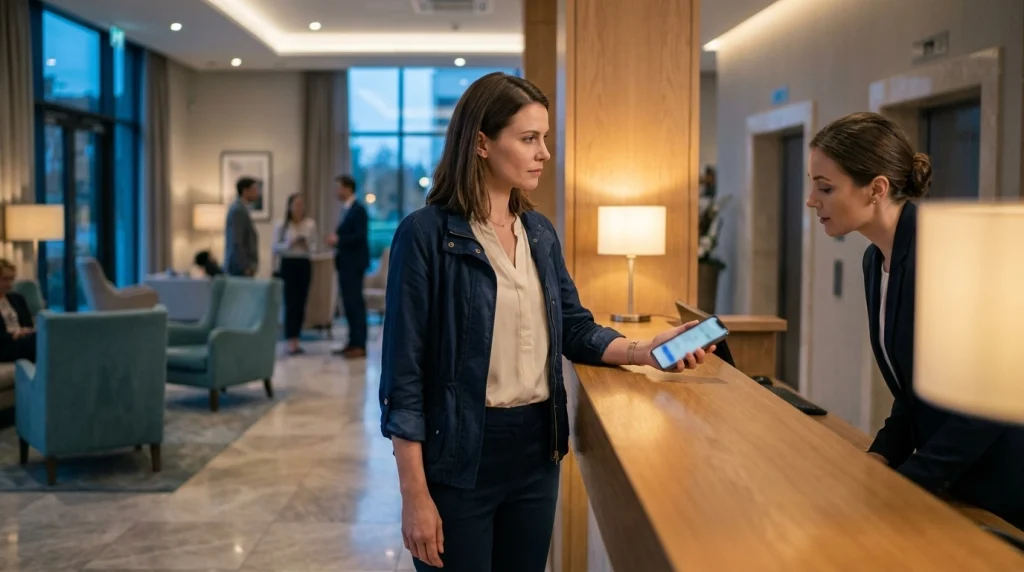
First, assess whether the disclosure creates an actual safety concern. Then reduce exposure, tell hotel staff when appropriate, and seek immediate help if someone threatens or follows you.
If you accidentally reveal your hotel online
Remove or restrict the post as soon as you notice the mistake. Check whether related stories, tags, or shared images also identify the property.
Then consider these steps:
- Review who could access the information.
- Remove unnecessary public location tags.
- Check active location-sharing permissions.
- Inform reception if you expect unwanted contact.
- Adjust your plans if there is a credible concern.
Deleting a post doesn’t guarantee every copy disappears. Someone may already have viewed or saved it.
If someone repeatedly asks about your room
Repeated requests for private information can justify setting a firm boundary. You can end the conversation without explaining your decision.
If the person continues contacting you, keep relevant messages and notify hotel security. Block unwanted communication when safe and appropriate.
If someone follows you to the hotel
Don’t lead a suspected follower to your room. Move toward a staffed, public area where you can request help.
Tell reception or security clearly what happened. If you believe you’re in immediate danger, contact local emergency services.
A room change may help in some situations, but it might not solve a threat involving someone who knows the property. Consider moving hotels with help if necessary.
If someone claims to be hotel staff
Don’t open your room door automatically for an unexpected visitor. Contact reception using a verified hotel number to confirm the person’s identity and purpose.
If something seems wrong, remain behind a locked door while you seek help. Avoid confronting a suspicious person alone.
The UK government’s solo and independent travel guidance recommends checking room access, verifying visitors, and seeking assistance when feeling unsafe.
Keep an emergency backup plan
Your backup plan doesn’t need to be complicated. It should work when you’re tired, stressed, or without reliable internet.
- Save the hotel’s contact information offline.
- Keep your phone charged and carry a suitable power bank.
- Know the local emergency number.
- Identify an alternative reputable accommodation.
- Keep essential documents and payment options accessible.
- Tell your trusted contact when your accommodation changes.
Section Takeaway: An accidental disclosure isn’t always an emergency, but unwanted attention, threats, or stalking deserve prompt action and professional assistance.
Frequently Asked Questions About Hotel Privacy for Women
Can a hotel tell someone which room I’m staying in?
Hotel practices and applicable laws vary. Reputable properties commonly restrict guest-information disclosures, but you shouldn’t assume every hotel follows identical procedures. Ask reception directly about confidentiality, identity verification, and how staff handle outside callers or visitors.
Should I use a fake name when booking a hotel?
Generally, no. Hotels may need accurate identification for legal registration, payment, and security purposes. Instead, use legitimate booking details and request discreet communication. You can also ask how the property handles reservations when guests have specific privacy concerns.
Is it safe to post hotel pictures on Instagram?
You can share hotel photographs more privately by waiting until checkout, removing location tags, and checking for identifying details. Avoid showing room numbers, booking documents, or recognizable views while you’re still staying there. A delayed post reduces real-time exposure.
Can someone track my hotel through my phone?
Someone may learn your location through active sharing permissions, connected accounts, published routes, or other exposed information. Ordinary strangers don’t automatically gain your precise location simply because you carry a phone. Review permissions and account access regularly.
Should I tell a taxi driver I’m traveling alone?
There’s generally no need to volunteer that information. Share the destination required for the journey, verify the driver when possible, and use reputable transport services. If you feel threatened, prioritize reaching a safe staffed location and requesting assistance.
Is staying in a hotel safer than staying in an Airbnb?
Neither option guarantees safety or privacy. A staffed hotel may offer easier access to security assistance, while an entire rental may offer more personal space. Compare verified reviews, access controls, host or staff procedures, neighborhood conditions, and emergency support before booking.
What if someone I met while traveling knows my hotel?
Knowing your hotel doesn’t automatically mean someone poses a threat. Set boundaries and avoid disclosing your room number or schedule. If the person repeatedly appears, threatens you, or ignores requests to stop contacting you, inform hotel security and seek help.
Final Thoughts: Protect Your Privacy Without Losing Your Freedom
Keeping your hotel location private doesn’t mean avoiding people or worrying about every conversation. It means deciding which details belong in public and which should stay personal.
As of 2026, my recommended approach remains practical: delay identifiable posts, protect room information, choose trustworthy accommodation, and maintain one reliable emergency contact.
Before your next solo trip, review your phone’s location settings and ask your hotel about guest confidentiality. Those two small preparations can make the rest of your privacy routine much easier.
Travel confidently, share thoughtfully, and keep control of your personal information.