How Do I Stay Safe in a Hotel When Traveling Alone as a Woman?
Quick Answer
To stay safe in a hotel when traveling alone as a woman, choose a well-reviewed property in a practical location, protect your room number, inspect your room before unpacking, test every lock, locate the nearest exit, and keep someone you trust informed of your plans. I also recommend checking current destination guidance through the U.S. Department of State travel website before an international trip.
My essential hotel safety routine
- Choose carefully: Research the hotel and surrounding area before paying.
- Guard your room number: Avoid saying it aloud or sharing it with people you just met.
- Check the room: Test the main door, windows, balcony door, and connecting doors immediately.
- Know your exit: Find the nearest stairwell before you settle in for the night.
- Verify visitors: Call reception before opening the door for unexpected staff or deliveries.
- Trust discomfort: Ask for another room or leave if something does not feel right.
One rule worth remembering
- Do your room safety check before unpacking. Changing rooms is much easier while your suitcase is still closed.
Staying alone in a hotel can feel unsettling the first few times. The good news is that hotel safety usually comes down to a handful of repeatable habits.
I don’t try to turn a hotel room into a fortress. I focus on controlling access, protecting my privacy, knowing how to leave, and having a backup plan.
As of 2026, those basics remain some of the most useful solo female travel safety habits. This guide covers what to do before booking, at check-in, inside your room, around the hotel, and when something feels wrong.
In This Guide
- What Does Hotel Safety Mean for a Woman Traveling Alone?
- How Do I Choose a Safer Hotel Before I Book?
- What Should I Do When Checking Into a Hotel Alone?
- How Do I Secure My Hotel Room at Night?
- How Can I Stay Safe Around the Hotel and When Returning Late?
- What Should I Do If Someone Knocks or Something Feels Wrong?
- Hotel Safety FAQ for Solo Female Travelers
What Does Hotel Safety Mean for a Woman Traveling Alone?
Hotel safety for a solo female traveler means reducing unnecessary exposure while keeping control over who can reach you. It also means knowing how to get help or leave quickly.
Simple definition: A safe hotel routine protects your location, your room access, your belongings, your communication options, and your escape route.
No hotel can promise zero risk. Your goal is to remove easy opportunities for problems and notice warning signs early.
I think about hotel safety in five layers:
- Location: Can you reach the property without navigating an isolated area?
- Property access: Can anyone walk straight from outside to guest-room corridors?
- Room security: Do the doors and windows lock properly?
- Privacy: Can you keep your room number and solo status discreet?
- Backup planning: Do you know whom to contact and where you would go if you needed to leave?
This approach is useful because it does not rely on expensive safety gadgets. It creates several small layers instead of depending on one lock or one hotel employee.
Safety also varies by destination. Local crime patterns, transportation, cultural expectations, emergency response, and hotel standards can differ widely.
Pro tip: Before an international trip, check current government travel guidance for your destination. Hotel reviews should supplement official information, not replace it.
How Do I Choose a Safer Hotel Before I Book?
Start with location, recent reviews, and basic access controls. A glamorous room is less useful if reaching it requires an uncomfortable walk through an unfamiliar area after dark.
Look at the area before the room photos
Open a map and examine what surrounds the property. Look for transit, restaurants, pharmacies, busy streets, and places you could enter if you needed assistance.
I also check how I will arrive. A hotel that feels convenient at noon may feel different after a 10:30 p.m. flight.
For example, if my airport transfer would drop me several blocks away late at night, I would compare that hotel with one offering a simpler door-to-door arrival.
Read recent reviews differently
Don’t only scan the overall star rating. Search recent reviews for comments about security, reception staffing, street noise, door locks, unwanted visitors, elevators, and the surrounding area.
One strange review does not prove a hotel is unsafe. Repeated comments about the same issue deserve more attention.
General destination resources such as Lonely Planet can also help you understand neighborhoods before choosing accommodation.
Compare practical hotel safety features
| Feature | What I Prefer | What to Check |
|---|---|---|
| Reception | Staffed during the hours I expect to arrive | Late check-in procedure and overnight contact |
| Guest access | Controlled entry to guest floors where available | Whether elevators or corridors require guest access |
| Room door | Working primary lock plus an interior secondary lock | Deadbolt, latch, peephole, and connecting door |
| Windows | Windows or balcony doors that secure properly | Test them immediately after entering |
| Emergency route | Clearly marked stairs and exits | Locate them before going to sleep |
| Communication | Easy contact with reception or security | Know how to reach the desk from your room or phone |
Have a backup before arrival
Save one or two alternative hotels nearby. You may never use them, but having options makes it easier to leave a situation you dislike.
I also screenshot the hotel’s address and booking details. That helps if my data connection disappears during arrival.
Section Takeaway: Choose your hotel for the whole journey, not just the room. Location, arrival logistics, access controls, and recent reviews matter together.
What Should I Do When Checking Into a Hotel Alone?
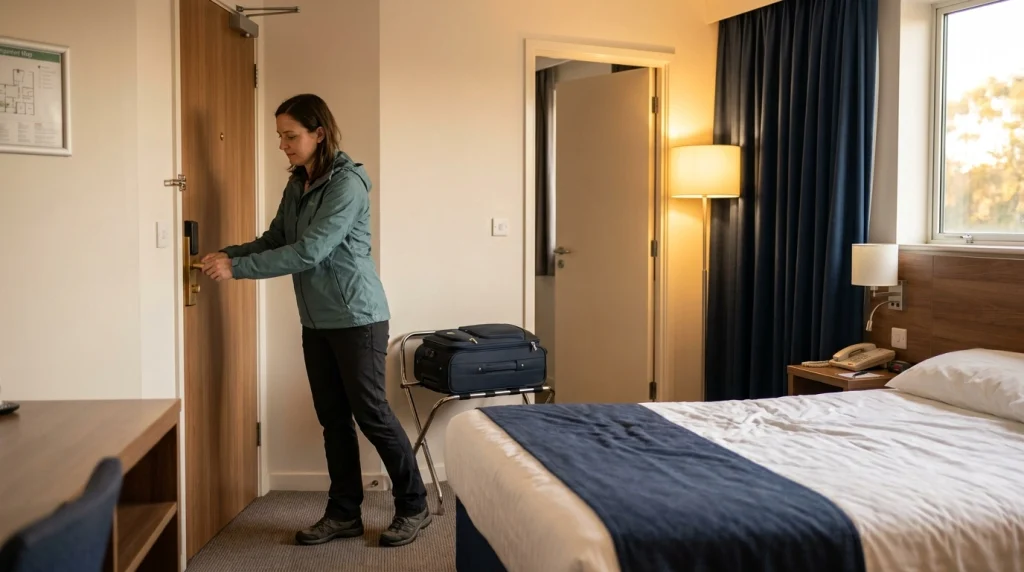
Keep your room number private, stay aware of who is nearby, and inspect the room before unpacking. The first few minutes are the easiest time to correct a problem.
Keep your solo status discreet
You do not need to announce that you’re traveling alone. Avoid casual conversations that reveal your room number, exact itinerary, or how long you will be alone.
If a staff member says your room number loudly, you can politely ask them to write it instead. You can also request a different room if the disclosure makes you uncomfortable.
Do a five-minute room check
Before opening your suitcase, walk through the room. I use the same order each time so I am less likely to forget something.
- Look through the room and bathroom.
- Test the main door lock.
- Check the deadbolt or interior latch.
- Test any connecting door.
- Check windows and balcony doors.
- Make sure curtains close fully.
- Confirm your phone is charged.
- Know how to contact reception.
- Find the emergency-exit diagram.
- Walk far enough into the hallway to identify the nearest stairs.
The U.S. State Department’s lodging guidance also emphasizes checking room security and knowing your emergency route. That makes this more than a comfort ritual.
Check the fire-safety basics
Look for a smoke alarm and review the posted evacuation map if one is available. Don’t assume you will remember the corridor layout after waking suddenly at night.
If you’re traveling internationally, health and emergency preparation can vary by destination. The CDC Travelers’ Health section is a useful starting point for destination-specific health planning.
Pro tip: Emergency numbers differ by country. Save the correct local emergency number before your trip instead of assuming 911 works everywhere.
How Do I Secure My Hotel Room at Night?
Use every functioning built-in lock, maintain privacy, and keep essential items within easy reach. Avoid routines that would slow you down if you needed to leave.
Use the locks already provided
Engage the main lock and the interior secondary lock whenever you’re inside. If a lock does not work properly, contact reception and request a repair or another room.
A portable door alarm can add another layer, but it should not replace the hotel’s locks. Check local rules before carrying defensive products across borders.
Keep essentials together
I prefer to keep a small group of essentials in one predictable place at night. The goal is to avoid searching through luggage during an emergency.
- Phone
- Room key
- Identification
- Glasses, if needed
- Medication
- Shoes
- A small light or phone flashlight
Do not block your exit with suitcases or furniture. A security measure that makes evacuation harder creates a different risk.
Protect information as well as belongings
Avoid posting your hotel name, room view, room number, or precise location publicly while you are still staying there. Save detailed social posts until after you leave.
If you use a hotel safe, follow the property’s instructions. Keep backup copies of important travel documents separate from the originals.
For international travel, I also keep emergency contacts stored both in my phone and somewhere available offline.
Privacy habit: Someone you meet casually does not need your hotel name, room number, floor, or daily schedule.
How Can I Stay Safe Around the Hotel and When Returning Late?
Think beyond the bedroom door. Elevators, hallways, parking areas, hotel bars, and the final walk back to the property are part of your safety plan.
Returning after dark
Plan your return before going out. Know whether you will walk, use public transportation, take a licensed taxi, or use a reputable ride service.
If I expect to return late, I prefer a route that ends directly at the hotel entrance. Saving a few dollars is not always worth adding an isolated walk.
- Keep enough battery for navigation and communication.
- Confirm the destination in your ride app before departure.
- Stay alert during the final part of the journey.
- Have your room key accessible before entering the building.
- Go to the lobby rather than your room if you think someone is following you.
Elevators and corridors
You never have to enter an elevator because politeness makes you feel obligated. If someone makes you uncomfortable, step back and take the next one.
Likewise, don’t lead an unwanted follower directly to your hotel room. Move toward reception, security, or another populated public space.
Meeting new people
Solo travel often becomes social, which is one of its best parts. You can still meet people without giving immediate access to your private space.
Meet new acquaintances in the lobby, café, restaurant, or another public area. The same rule applies to dates arranged through apps.
Travel publications such as Condé Nast Traveler can be useful for broader destination planning, but local conditions can change quickly.
Pro tip: Check current local advisories and transportation guidance rather than relying only on an older blog post or social-media video.
What Should I Do If Someone Knocks or Something Feels Wrong?
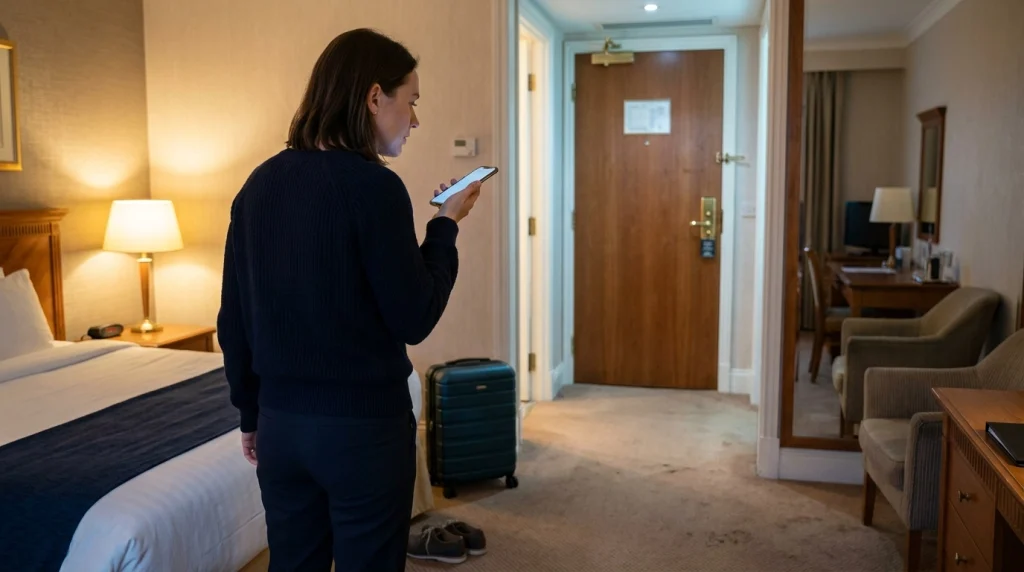
You do not need to open your door for an unexpected visitor. Verify who they are first, and involve the hotel immediately when necessary.
If someone claims to be hotel staff
Keep the door closed. Call reception using the hotel’s known contact method and ask whether they sent someone to your room.
If reception cannot confirm the visit, tell them someone is outside your door. Ask hotel security or staff to handle it.
If someone keeps knocking
Do not argue through the door or disclose that you’re alone. Contact reception or security and explain exactly what is happening.
If you believe there is an immediate threat, contact local emergency services. Move only if you have a safer route and doing so does not place you closer to the threat.
If the room itself makes you uncomfortable
You are allowed to request a room change. You are also allowed to leave the property entirely.
Common reasons to speak up include:
- A lock that does not secure properly
- A damaged connecting door
- Someone repeatedly lingering outside your room
- Staff sharing your room number with another guest
- Repeated unexplained attempts to enter
- A room location that makes you feel isolated
- Serious differences between the property you booked and what you find on arrival
Ask for the manager or security if the first employee does not take the concern seriously. Document the issue once you are somewhere safe.
Tell someone when plans change
If you switch hotels suddenly, send the new property details to a trusted person. A simple update prevents your emergency contact from relying on outdated information.
I also like a basic check-in system on solo trips. It can be as simple as sending a message after I return for the night.
That is different from having someone track every minute. The goal is to create a clear point when a trusted person would notice an unusual silence.
Section Takeaway: Verification beats confrontation. Keep the door closed, contact the hotel, move toward staffed public areas when appropriate, and leave if the property no longer feels secure.
Hotel Safety FAQ for Solo Female Travelers
Is it safe for a woman to stay in a hotel alone?
Yes, women regularly stay in hotels alone, but safety depends on the property, location, local conditions, and your routines. Choose accommodation carefully, protect your room number, test the locks, locate emergency exits, and keep a trusted person informed of your plans.
Should I tell hotel staff that I’m traveling alone?
You usually do not need to volunteer that information. Hotel staff will often know how many guests are registered, but there is no reason to announce your solo status to other guests, drivers, or strangers in the lobby.
Should I use a portable hotel door lock?
A portable lock or door alarm can provide an extra layer of awareness where its use is permitted. It should never block your emergency exit or replace a properly functioning hotel lock, deadbolt, or latch.
What should I do if hotel staff say my room number aloud?
Ask them to write it down instead. If the number was announced where other people clearly heard it and you feel uncomfortable, politely request another room rather than ignoring the concern.
What should I do if someone follows me toward my hotel room?
Do not continue directly to your room. Head toward reception, security, a staffed restaurant, or another populated area and tell an employee what is happening. Contact local emergency services if you believe you are in immediate danger.
Should someone at home know which hotel I’m staying in?
Yes. Give at least one trusted person the hotel’s name, location, booking dates, and a way to reach you. Update them if you change properties or significantly alter your itinerary.
Is it safer to stay near the elevator?
There is no universal room location that guarantees safety. I care more about working locks, clear emergency access, a property with sensible access controls, and a room location where I feel comfortable requesting help if needed.
What Is the Most Important Hotel Safety Habit?
The most useful habit is having a routine you repeat every time. Check the hotel before booking, protect your privacy at check-in, inspect your room before unpacking, and know how you would leave.
You don’t need to spend an entire trip expecting trouble. Good preparation should make you feel freer to enjoy traveling alone, not more afraid of it.
Save this checklist before your next solo trip. Once the routine becomes automatic, those first few minutes in a new hotel become much calmer.