What Emergency Numbers Should a Solo Female Traveler Save?
Quick Answer
A solo female traveler should save the destination’s local emergency number, separate police or ambulance numbers if required, embassy or consulate contacts, travel-insurance assistance, accommodation contact details, and one trusted person’s number. Before an international trip, verify destination-specific information through an official source such as the U.S. State Department’s emergency-abroad guidance or your own government’s equivalent service.
Numbers and contacts worth saving
- Local emergency services: Save the verified number for police, ambulance, and fire response.
- Police contact: Record a separate police emergency number if your destination uses one.
- Embassy or consulate: Save the nearest diplomatic mission and any published after-hours emergency line.
- Travel insurer: Keep its 24-hour assistance number and your policy number together.
- Your accommodation: Save reception, security, or your host’s contact details.
- Trusted person: Keep one reliable family member or friend’s full international-format number available offline.
One rule that matters
- Never assume 911, 112, or another familiar number works everywhere. Verify your exact destination shortly before departure.
When I prepare for a solo trip, emergency contacts go into my phone before restaurant reservations or sightseeing notes. I hope I never use them, but I don’t want to research them while scared, injured, or stranded.
This 2026 guide explains what emergency numbers a solo female traveler should save, where to verify them, and how to keep them available when mobile data fails.
In This Guide
- Which Emergency Numbers Should Every Solo Female Traveler Save?
- Are Emergency Numbers the Same in Every Country?
- What Other Emergency Contacts Should You Save?
- How Should You Store Emergency Numbers While Traveling Alone?
- What Should You Do When You Need Emergency Help Abroad?
- What Should You Check Before Leaving Home?
- Frequently Asked Questions
Which Emergency Numbers Should Every Solo Female Traveler Save?
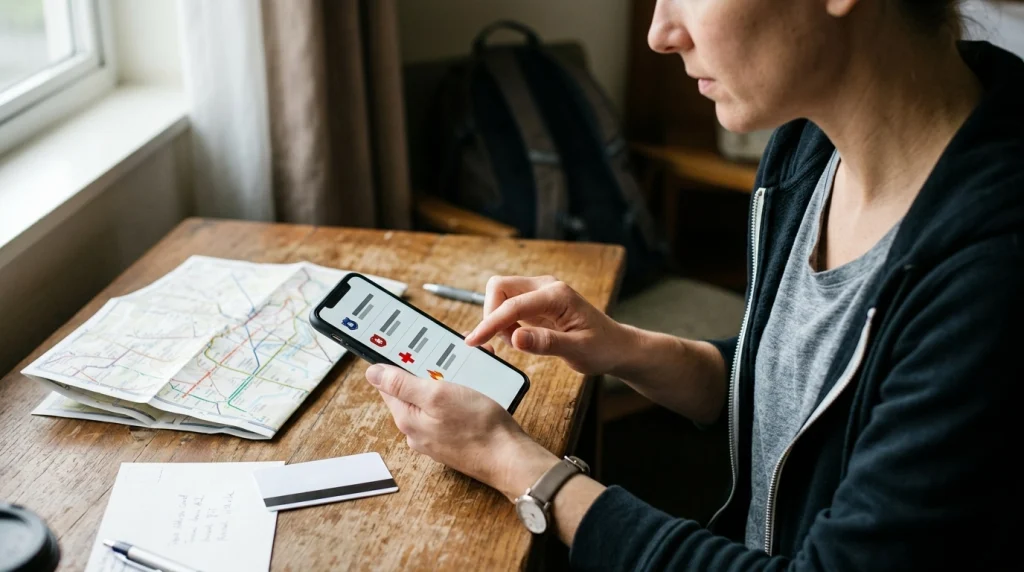
At minimum, save the number that connects you with local emergency services. Then add contacts that could help with medical, legal, financial, accommodation, or document problems.
An emergency contact list is a short collection of verified telephone numbers and essential details you can reach quickly during a safety, medical, financial, or travel crisis.
Which local emergency services matter most?
Your first priority is the destination’s official emergency system. Some countries use one number for police, fire, and ambulance, while others use separate numbers.
- Police: For immediate threats, violent crime, stalking, assault, robbery, or another situation requiring urgent law-enforcement help.
- Ambulance: For serious illness, injury, loss of consciousness, major bleeding, breathing problems, or another medical emergency.
- Fire and rescue: For fires, dangerous building incidents, serious crashes, or rescue situations.
I save these contacts with obvious names such as “Emergency – Police” instead of relying on an unexplained number. That saves thinking time when I’m stressed.
Should you save a non-emergency police number too?
Yes, when an official non-emergency police contact exists. It can help with situations that need police assistance but do not involve immediate danger.
Examples may include reporting theft after the event, asking about a lost item, or getting instructions for filing a police report. The correct use of non-emergency lines varies by destination.
- Do not use a non-emergency line when someone is in immediate danger.
- Do not assume the local tourist police number replaces the main emergency service.
- Verify both numbers through an official government or police source.
What changes when you’re traveling alone?
When you travel alone, there may be nobody beside you to find a number while you manage the emergency itself. A prepared list reduces that dependency.
I also save my accommodation address beside my emergency contacts. Knowing whom to call matters more when I can also explain exactly where I am.
Section Takeaway: Save the contacts that solve the most urgent problems first—local emergency services, police, medical help, and fire response. Verify them rather than relying on a number you remember from home.
Are Emergency Numbers the Same in Every Country?
No. Emergency numbers vary between countries, and sometimes police, ambulance, and fire services use different numbers within the same destination.
This is one reason I never build a trip around the assumption that 911 will work everywhere.
| Destination | Emergency Number | What It Reaches | Official Source |
|---|---|---|---|
| European Union | 112 | Police, ambulance, and fire emergency services across the EU | Your Europe |
| Australia | 000 | Police, fire, or ambulance for life-threatening or time-critical emergencies | Australian Triple Zero |
| Japan | 110 / 119 | 110 for police; 119 for fire or ambulance | Japan National Tourism Organization |
The table is an illustration, not a worldwide directory. Your job is to check the country—and sometimes the region—you will actually visit.
Why shouldn’t you depend on roaming behavior?
Some mobile systems may redirect certain emergency calls, but you should not make that your travel plan. Phone networks, device behavior, service availability, and local procedures can differ.
Save the official local number instead. It takes less than a minute.
Should you check the number again before departure?
Yes. I recheck important emergency details shortly before leaving, especially when I saved them months earlier during trip planning.
Government procedures, local helplines, diplomatic contacts, and accommodation telephone numbers can change.
Pro tip: Verify destination-specific emergency information through the destination’s government, your government’s current travel advisory, or an official police, health, or emergency-service website.
Section Takeaway: There is no single emergency number you should assume will work on every international trip. Research your actual destination and keep its verified information offline.
What Other Emergency Contacts Should You Save?
Your emergency-services number is only the beginning. Many travel problems need help from an insurer, embassy, hotel, bank, or trusted person rather than an ambulance or police response.
When should you save embassy or consulate information?
Save your nearest embassy or consulate whenever you travel internationally and diplomatic representation is available. Include any published after-hours emergency instructions.
Consular services can be useful during serious passport problems, arrests, crises, or certain situations involving victims of crime. They do not replace local police, ambulance, or fire services.
- Mission name
- Main telephone number
- Emergency or after-hours number, if officially provided
- Street address
- Official website
If your country has a traveler-registration or alert program, consider using it when appropriate. Check your own government’s foreign-affairs service for eligibility and current instructions.
Why save your travel insurer’s assistance line?
Travel insurance becomes much more useful when you know how to reach the assistance team. Save the emergency number and policy number together.
The CDC’s travel-insurance guidance notes that ordinary health coverage may not fully cover care abroad, while travel-health and medical-evacuation policies serve different purposes.
- Insurer name
- 24-hour assistance number
- Policy number
- Instructions for getting treatment
- Medical evacuation contact, when included
What everyday contacts belong on the list?
I add several contacts that rarely appear on traditional emergency-number checklists. They can solve a problem before it becomes a crisis.
- Accommodation: Reception, security, host, or property manager.
- Trusted person at home: Someone who has your basic itinerary and can act if you miss an agreed check-in.
- Bank or card issuer: The official number for reporting a lost or stolen card.
- Airline or transport provider: Useful during major disruptions or lost travel documents.
- Nearby medical facility: Save the name, address, and telephone number of a suitable hospital or clinic.
For the bank, use the number published by the financial institution or printed on the card. Never trust a random number sent by text or found in an unverified social-media post.
Section Takeaway: Your emergency list should cover more than police and ambulances. Add consular help, insurance assistance, accommodation, medical care, financial contacts, and one person you trust.
How Should You Store Emergency Numbers While Traveling Alone?
Keep the information in at least two places. One copy should remain usable if your phone is lost, stolen, damaged, or offline.
What should go in your phone?
I create one note called “Trip Emergency Info” and pin it where I can reach it quickly. I also save the most important numbers as contacts.
- Local emergency number
- Separate police or ambulance number when applicable
- Embassy or consulate
- Insurance assistance line and policy number
- Accommodation name, address, and telephone number
- Nearby hospital or clinic
- Trusted personal contact
- Bank’s official lost-card number
Store telephone numbers in international format when useful. That usually means including the country code for contacts outside the country you are visiting.
What should you keep offline?
A tiny printed card can be more useful than another travel app when your battery is dead. Mine is intentionally boring and easy to scan.
- Your name
- One emergency contact
- Important local numbers
- Accommodation address
- Insurance provider and policy number
- Embassy or consulate details
I avoid putting unnecessary financial passwords, full card details, or sensitive account information on the card. The goal is emergency access, not creating a new security risk.
Should you save addresses as well as numbers?
Absolutely. An operator, taxi driver, hotel employee, or medical worker may need to know where you are staying or where you need to go.
- Save your accommodation in your map app.
- Download an offline map when available.
- Keep the written address in the local language when useful.
- Screenshot important routes or medical locations.
One habit I find useful is keeping the accommodation address available before I leave the airport. That removes one small but important problem when I’m tired and navigating alone.
Section Takeaway: A good emergency list survives a bad phone connection. Keep one digital version and one offline backup with numbers, addresses, insurance details, and a trusted contact.
What Should You Do When You Need Emergency Help Abroad?
Start with immediate safety. If you face a serious threat, medical emergency, fire, or other urgent danger, use the destination’s official emergency service rather than trying to solve everything yourself.
What if you feel threatened or followed?
Move toward a staffed, well-lit, public place whenever doing so is safe. Hotel desks, airport staff, transport employees, security personnel, police stations, shops, and busy businesses may provide a place to seek help.
- Do not lead someone directly to your accommodation if you believe you’re being followed.
- Do not worry about appearing rude when you need to leave an uncomfortable situation.
- Contact local emergency services if you believe the threat is immediate.
- Tell staff clearly that you need help rather than hoping they understand from context.
If language is a problem, show your saved hotel address, map location, or translated emergency phrase. Simple information can be easier to communicate under stress.
What if you’re seriously ill or injured?
Use local emergency medical services when the situation is urgent. For less immediate problems, contact your insurer or a suitable medical facility for guidance.
Bring your passport or identification, insurance details, medication information, and important medical details when practical. Do not delay urgent care just to organize paperwork.
Pro tip: For destination-specific health risks, medical guidance, vaccines, or disease notices, verify current information through an official public-health authority before traveling.
What if your passport or wallet disappears?
First protect yourself from further loss. Freeze or report affected payment cards through your bank’s official channel and contact local police when a report is appropriate.
For a lost or stolen passport abroad, contact your embassy or consulate for instructions. Procedures depend on your nationality and destination.
What information should you give an emergency operator?
Start with the information needed to send help. Speak slowly and answer the operator’s questions.
- Your location or nearest landmark
- The type of emergency
- Whether anyone is injured or in immediate danger
- The emergency service you need, when asked
- Your callback number
Exact procedures vary, so follow the local operator’s instructions. Stay on the line until you are told what to do next.
Section Takeaway: When something serious happens, prioritize safety, location, and clear communication. Your saved contacts are there to reduce decisions at the moment you have the least attention to spare.
What Should You Check Before Leaving Home?
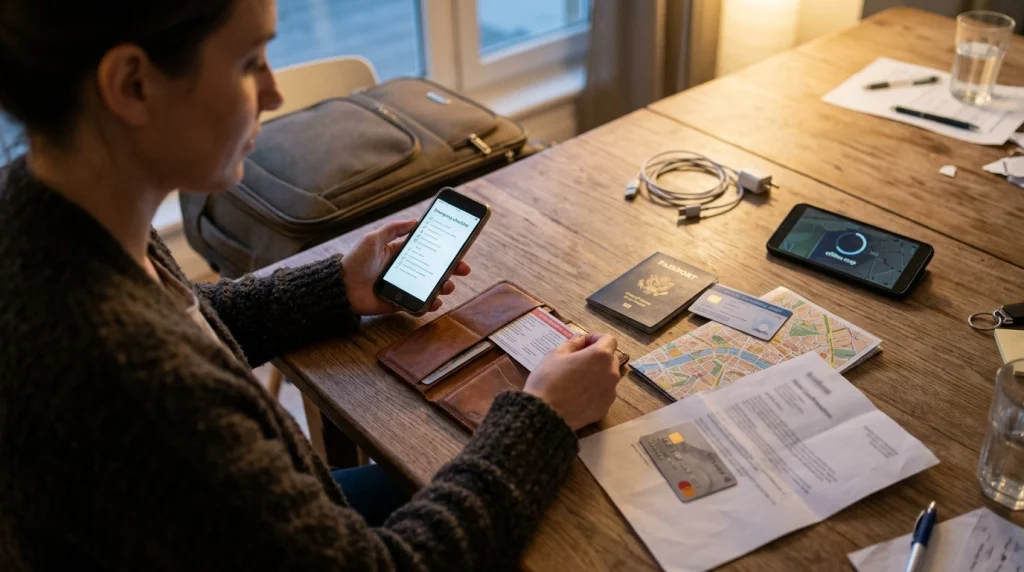
You can build a useful emergency plan in about ten minutes once your accommodation and destination are confirmed. Keep it short enough that you will actually maintain it.
- Verify the local emergency number. Check whether police, ambulance, and fire share one number or use separate lines.
- Find your diplomatic mission. Save your embassy or consulate and its official emergency instructions.
- Check your insurance. Record the assistance number, policy number, and medical-evacuation details if you have that coverage.
- Save your accommodation. Keep its telephone number and full address offline.
- Identify medical care. Save at least one suitable facility near the area where you are staying.
- Add one trusted contact. Make sure the person knows your destination and general dates.
- Save your bank’s official number. Know how to freeze cards quickly if your wallet disappears.
- Create an offline copy. Print a small card or save screenshots that don’t require mobile data.
- Download offline maps. Include your accommodation and other essential locations.
- Recheck before departure. Confirm the important details have not changed.
How much emergency planning is enough?
The goal isn’t to spend your trip expecting something terrible. Good preparation should make travel feel simpler, not more frightening.
I treat an emergency-contact list like a charger or passport copy. It’s a practical backup I prepare once and then stop thinking about unless I need it.
For solo female travel safety, that distinction matters. Preparation gives you options without asking you to live in a constant state of alert.
Section Takeaway: Build a short system you can use under pressure. Ten verified contacts and details are more valuable than pages of emergency advice you cannot quickly find.
Frequently Asked Questions
Should a solo female traveler save 911 before traveling internationally?
Only if 911 is the verified emergency number for your destination. Do not assume it works worldwide. Check the destination’s official police, emergency-service, government, or travel-advisory information before departure and save the correct local number.
Is 112 the international emergency number everywhere?
No. Although 112 is the common emergency number throughout the European Union and works in some other places, it is not a universal replacement for every country’s official emergency system. Always verify the destination you will visit.
Should I save my embassy number when traveling alone?
Yes, for an international trip where your country has diplomatic representation. Save the main contact, address, and any official after-hours emergency instructions. Remember that consular services do not replace local police, ambulance, or fire services during an immediate emergency.
What medical numbers should a solo traveler save?
Save the destination’s emergency medical number, your travel insurer’s assistance line, and a suitable nearby hospital or clinic. If your policy includes medical evacuation, keep that assistance information with your insurance details.
What if my phone dies during an emergency?
Keep an offline backup. A small printed card can include the local emergency number, accommodation details, insurance information, embassy contact, and one trusted person’s number without depending on battery power or mobile data.
Should I give emergency contacts to someone at home?
Yes. Give one trusted person your broad itinerary, accommodation information, travel dates, and a way to contact you. Agree in advance on what they should do if you miss an important check-in and cannot be reached.
How often should I update my emergency travel information?
Check it before each trip and again shortly before departure. Update changed accommodation, insurance, embassy, bank, or local emergency information instead of reusing an old travel note without reviewing it.
Final Takeaway: The best emergency-number list for a solo female traveler is short, verified, destination-specific, and available offline. Save it before you leave so that if something goes wrong, your next step is already clear.