How Can a Woman Organize Toiletries for a Solo Trip?
Quick Answer
A woman can organize toiletries for a solo trip by packing only her daily essentials, separating liquids from dry items, keeping medicines accessible, and using small pouches based on when each item is needed. If you’re flying from or within the United States, check the current TSA carry-on rules before packing liquids.
Organize toiletries in six simple steps
- List daily essentials: Pack what you normally use rather than creating an oversized travel routine.
- Separate liquids: Put shampoo, cleanser, creams, and other liquids together for easier airport screening.
- Use small containers: Decant ordinary toiletries into containers sized for the length of your trip.
- Create mini zones: Separate shower, dental, skincare, menstrual, and health items instead of using one messy pouch.
- Protect against leaks: Close bottles tightly and place leak-prone products inside waterproof pouches.
- Keep essentials accessible: Pack medication and your first-night toiletries where you can reach them without unpacking everything.
Learning how can a woman organize toiletries for a solo trip sounds like a small packing problem. In practice, a good system can make airports, hostel bathrooms, hotel check-ins, and early departures much easier.
I prefer a toiletry system that I can understand half-asleep. Everything has a place, and I don’t need to empty my suitcase just to find toothpaste.
In This Guide
- What Toiletries Should a Woman Pack for a Solo Trip?
- How Should You Divide Toiletries Between Carry-On and Checked Luggage?
- What Is the Best Way to Organize Liquids and Prevent Leaks?
- How Can You Organize Skincare, Haircare, Makeup, and Menstrual Products?
- How Should Medications and Health Items Be Packed?
- How Do You Keep Toiletries Organized During the Trip?
- Frequently Asked Questions
What Toiletries Should a Woman Pack for a Solo Trip?
Pack toiletries around your normal routine, trip length, destination, and accommodation. The goal isn’t to prepare for every possible situation.
It’s to have what you’ll genuinely use without carrying a bathroom cabinet around the world.
Travel toiletry organization means grouping personal-care and health items by function, accessibility, and transport rules so you can find what you need quickly without overpacking.
Start with your daily routine
I work through an ordinary morning and evening at home before packing. That catches the small things that generic packing lists often miss.
My basic categories usually look like this:
- Dental: Toothbrush, toothpaste, floss, retainers, or other dental items you regularly use.
- Shower: Shampoo, conditioner, body wash, soap, and shaving items when needed.
- Skincare: Cleanser, moisturizer, sunscreen, and any products your skin depends on.
- Hair: Brush or comb, hair ties, clips, styling products, and essential tools.
- Personal care: Deodorant, menstrual products, contact-lens supplies, and intimate-care essentials.
- Health: Prescription medicine, regular over-the-counter medicine, and a compact first-aid selection.
- Cosmetics: Only the makeup you expect to wear during the actual itinerary.
Then I remove the products I’m unlikely to use. A three-night city break rarely needs the same routine as a two-week trip.
Pack for your destination, not your anxiety
A humid beach destination may justify extra sunscreen or hair products. A cold city may make moisturizer and lip balm more useful.
Remote travel also changes the calculation. Items that are easy to buy in a major city may be harder to replace elsewhere.
The CDC recommends preparing a travel health kit based on your destination, activities, trip duration, and personal needs. Its Pack Smart guidance is useful when deciding which health-related items deserve space.
Separate essentials from conveniences
I divide my list into “must have” and “nice to have.” That makes cutting weight much easier.
- Must have: Prescription medicine, toothbrush, sunscreen when needed, menstrual products, contact supplies, and products that are difficult for you to replace.
- Nice to have: Extra styling products, duplicate cosmetics, large bottles, specialty masks, and backup products you rarely use at home.
If my toiletry bag won’t close comfortably, I cut from the second group first.
How Should You Divide Toiletries Between Carry-On and Checked Luggage?
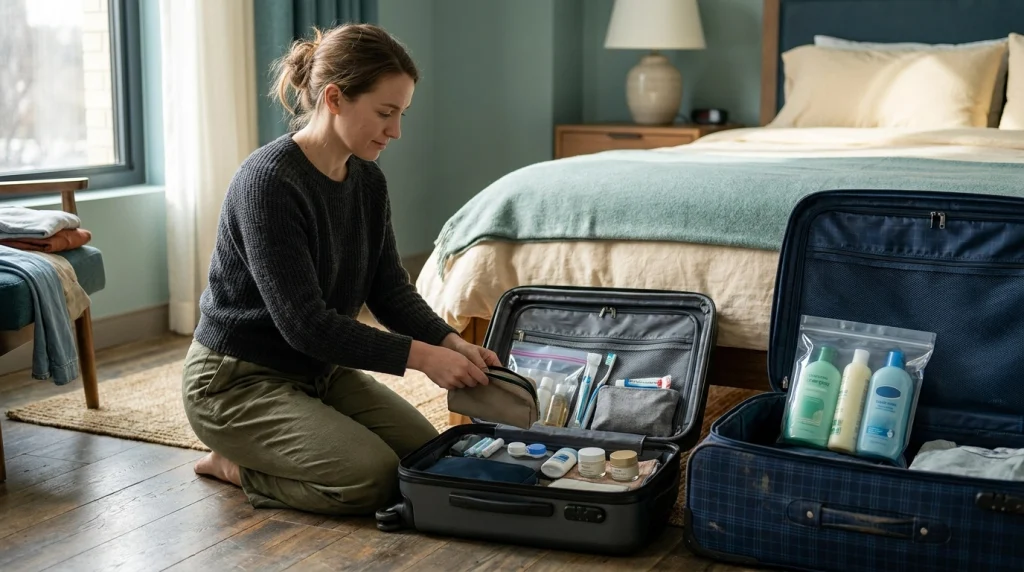
Keep irreplaceable and first-day essentials with you whenever practical. Put bulky, replaceable products in checked luggage if you’re checking a bag.
This matters more when traveling alone because nobody else is carrying your backup.
What should stay in your carry-on?
I want enough in my carry-on to handle a delayed checked bag or unexpected overnight stay. That doesn’t mean carrying every toiletry twice.
- Prescription medication
- Toothbrush and small toothpaste
- Contact lenses and essential lens supplies
- Menstrual products
- Small deodorant
- Basic skincare
- Any difficult-to-replace personal item
For ordinary U.S. airport screening, many liquids, gels, and aerosols in carry-on baggage are limited to containers of 3.4 ounces or 100 milliliters or less. Always check current rules before departure because regulations can change.
Carry-on toiletry organization at a glance
| Item Type | Best Packing Zone | Organization Method | Main Reason |
|---|---|---|---|
| Regular liquids and gels | Carry-on liquids pouch | Small, clearly closed containers | Faster security access |
| Solid toiletries | Dry toiletry pouch | Separate from leak-prone items | Keeps the liquid bag less crowded |
| Prescription medicine | Accessible carry-on area | Keep organized with documentation when applicable | Reduces problems if checked luggage is delayed |
| First-night essentials | Small quick-access pouch | Pack together | No full unpacking after a late arrival |
| Large replaceable bottles | Checked bag or leave at home | Seal inside a leak-resistant pouch | Saves carry-on space |
One habit helps more than almost anything else: don’t bury your liquids underneath clothing. Make anything needed during screening easy to remove.
What Is the Best Way to Organize Liquids and Prevent Leaks?
The simplest system is one liquids pouch plus one dry toiletry pouch. Separating them makes leaks easier to contain and everyday items easier to find.
I also avoid filling travel bottles to the absolute top.
Use the smallest useful container
A full-size shampoo bottle makes little sense for a weekend trip. Decant only what you expect to use, with a small margin for delays.
Before leaving, label similar containers. Conditioner and body lotion can look surprisingly alike at 6 a.m.
Protect the items most likely to leak
- Check every cap: Screw caps down firmly before putting bottles into the bag.
- Use secondary containment: Put leak-prone products inside a waterproof or resealable pouch.
- Keep bottles upright: Arrange them vertically when your luggage design allows it.
- Avoid fragile containers: Leave unnecessary glass bottles at home.
- Clean bottle threads: Product around the neck can stop some caps from sealing properly.
I once learned how useful separate pouches are after a small conditioner leak coated everything beside it. Cleaning one pouch is annoying; cleaning an entire packed suitcase is worse.
Choose solids when they genuinely work for you
Solid shampoo, bar soap, solid deodorant, and cleansing bars can reduce the number of liquid containers you carry. They aren’t automatically better, though.
If a solid product irritates your skin or doesn’t suit your hair, saving a little packing space isn’t worth changing a routine that works.
For solo travel, reliability wins. I test unfamiliar products at home rather than discovering problems halfway through a trip.
How Can You Organize Skincare, Haircare, Makeup, and Menstrual Products?
Organize personal-care items by routine instead of brand or bottle size. You want to know exactly where to reach during a rushed morning or shared-bathroom visit.
Keep skincare simple
Travel isn’t the best time for a complicated twelve-step skincare experiment. I keep my routine close to what my skin already knows.
- Cleanser
- Moisturizer
- Sunscreen
- Any prescribed or genuinely essential treatment
- One optional product if I know I’ll use it
This approach reduces both luggage weight and the chance of leaving expensive products behind.
Use one compact hair kit
Hair products expand quickly because every bottle feels individually small. Together, they can consume half a toiletry bag.
I group hair ties, pins, clips, and a folding or compact brush together. Styling liquids go with the main liquid pouch.
Large tools need a harder decision. If accommodation provides a hair dryer, I usually don’t carry another one without a specific reason.
Create a small makeup capsule
A travel makeup capsule should match your actual plans. A hiking weekend and an evening-heavy city trip don’t require the same products.
- One base product if you use one
- One concealer
- One mascara
- One compact cheek product
- One or two lip options
- A small set of multipurpose tools
Pack powder products so they can’t bounce loosely around your bag. I place delicate compacts between softer items rather than against shoes or chargers.
Give menstrual products their own pouch
Menstrual products should be easy to reach without opening your entire toiletry kit. I keep a small supply in my day bag and the rest with my toiletries.
For a longer trip, pack around your normal cycle plus a modest backup amount. Availability, brands, sizes, and product styles can differ by destination.
How Should Medications and Health Items Be Packed?
Medication deserves its own system. Don’t treat essential medicine like ordinary shampoo or cosmetics.
The priority is access, correct storage, adequate supply, and compliance with the rules of your destination.
Keep important medicine accessible
The CDC advises travelers to carry needed medication for their trip, plus extra for possible delays. It also recommends keeping medicines in carry-on luggage when practical in case checked baggage is lost or delayed.
Its traveling abroad with medicine guidance also recommends keeping medicines properly labeled and checking storage requirements.
Check destination rules before international travel
A medicine that is ordinary at home may be restricted somewhere else. This matters with some controlled medicines, sleeping medications, stimulants, and other prescriptions.
The U.S. Department of State advises travelers to check with the relevant foreign embassy because medication rules differ between countries. Its medicine and international travel guidance is a useful starting point.
Pro tip: Before an international trip, verify medication rules with official government or embassy sources for your exact destination rather than relying on social-media advice.
Build a small health pouch
Your health kit should reflect your body and itinerary. Don’t pack medication simply because another traveler’s checklist includes it.
- Regular prescription medicine
- A small supply of personal over-the-counter essentials
- Bandages or basic first-aid supplies when appropriate
- Allergy items you normally carry
- Contact-lens supplies if applicable
- Relevant prescription information or medical documentation
If medicine needs refrigeration or special handling, plan that before departure. Don’t assume every hotel room will have suitable storage.
How Do You Keep Toiletries Organized During the Trip?
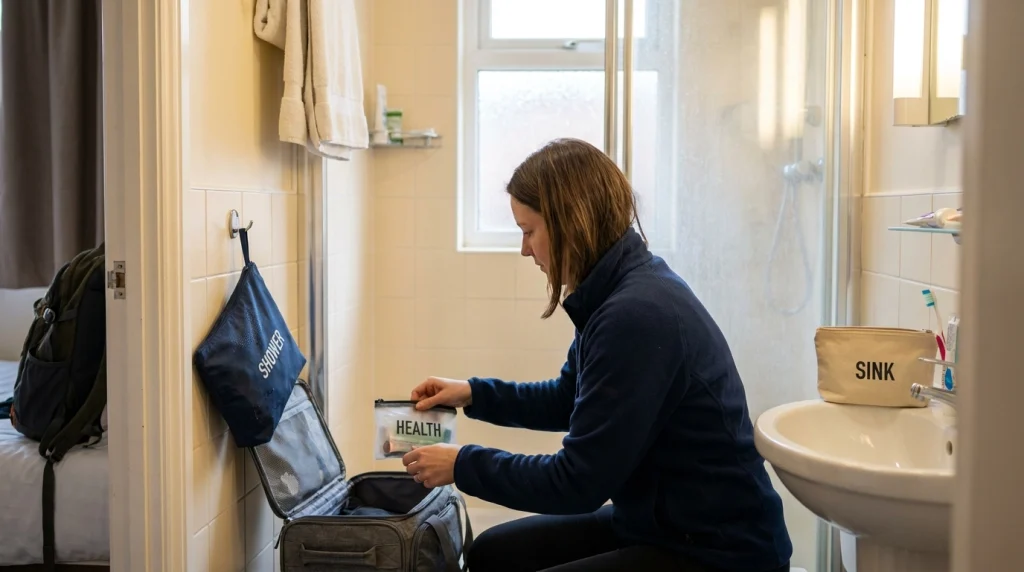
A good toiletry system should work after you arrive, not only while your suitcase looks perfect at home. I organize around how I will use the bathroom.
Use a three-zone system
Three small zones work better for me than one oversized toiletry bag.
- Shower zone: Shampoo, conditioner, body wash, razor, and shower-specific items.
- Sink zone: Toothbrush, dental care, cleanser, skincare, deodorant, and basic cosmetics.
- Health zone: Medication, first-aid items, menstrual products, and personal health supplies.
In a private hotel bathroom, these zones can stay together. In a hostel or shared bathroom, the shower zone can travel separately without exposing everything else.
Hanging bag vs. small pouches
A hanging toiletry bag works well when counter space is limited. It can also keep products away from wet shared-bathroom surfaces.
Small modular pouches are more flexible. You can take only the pouch you need and distribute them around oddly shaped luggage spaces.
| System | Best For | Main Trade-Off |
|---|---|---|
| Hanging toiletry bag | Hostels, small bathrooms, longer stays | Can be bulky when only partly filled |
| Two-pouch system | Carry-on travel and short trips | Less category separation |
| Three-zone pouches | Solo travelers who move frequently | Requires remembering which pouch holds each category |
Reset the bag every night
My best organization habit takes about two minutes. Before bed, I return products to their normal pouch instead of leaving them across the bathroom.
This reduces the risk of forgetting a bottle in the shower when leaving early the next morning.
Do a bathroom sweep before checkout
I check the shower, sink, shelves, hooks, drawers, and outlets before closing my suitcase. Chargers and toiletries are among the easiest things to leave behind.
Then I repack wet items separately until they’re dry.
For an early departure, I pack almost everything the night before. Only my toothbrush, morning skincare, medication, and a few essentials stay out.
Section Takeaway: A useful solo-travel toiletry system should make both unpacking and repacking easier. Organize around when and where you use each item, not just how neatly it fits at home.
Frequently Asked Questions
How many toiletry bags should a woman take on a solo trip?
Two or three small pouches work well for most trips. Use one for liquids, one for dry daily-care items, and an optional third for medication, health supplies, or shower products.
Should toiletries go in a carry-on or checked bag?
Keep essential medication, first-night basics, and difficult-to-replace items in your carry-on when possible. Larger replaceable toiletries can go in checked luggage if you are checking a bag.
How do I stop toiletries from leaking in my suitcase?
Tighten caps, clean product from bottle threads, avoid overfilling travel containers, and place leak-prone items inside a waterproof secondary pouch. Keep bottles upright when your bag allows it.
Is it better to use travel-size bottles or buy toiletries after arrival?
Travel bottles are useful for products your skin or hair depends on. Buying after arrival can work for basic replaceable items, especially on longer trips, but don’t assume your preferred brand or formula will be available.
What toiletries should stay in a personal item during a flight?
Prioritize medication, dental basics, contact supplies, menstrual products, a small deodorant, and enough skincare for an unexpected delay. Keep standard liquids within the applicable airport-security requirements.
Should prescription medicine go inside the normal toiletry bag?
I prefer a separate, accessible health pouch. Keep medicines organized according to official travel guidance, and check destination restrictions before international travel because some medicines require extra documentation or permission.
How can I avoid overpacking toiletries for a solo trip?
Write your normal routine first, estimate what you’ll actually use, and remove duplicate or “just in case” products. Packing for your real itinerary is more effective than copying an oversized generic checklist.
The easiest toiletry system is the one you can maintain throughout the trip. Keep liquids controlled, medicines accessible, daily items easy to reach, and unnecessary extras at home.
Once every item has a simple place, packing becomes faster and solo travel feels a little less chaotic. That’s exactly what a good travel organization system should do.