How Do I Stop Being Scared Before My First Solo Trip as a Woman?
Quick Answer
You do not need to eliminate every fear before your first solo trip. The goal is to turn vague fear into specific plans you can control: choose an easy first destination, book your first nights, plan your arrival, share your itinerary, and check the official travel advisory for your destination. Confidence usually grows after you start doing small things independently, not while waiting at home to feel completely fearless.
What to do before you leave
- Name the fear: Separate worries about safety, loneliness, flying, getting lost, or being judged.
- Start smaller: Practice eating, sightseeing, or taking a day trip alone before departure.
- Plan your arrival: Know exactly how you will get from the airport or station to your accommodation.
- Create backups: Keep offline maps, emergency contacts, payment backups, and document copies.
- Set check-ins: Tell one trusted person when they should expect to hear from you.
- Expect nerves: Feeling anxious before a first solo trip does not automatically mean the trip is a bad idea.
If you are asking, “How do I stop being scared before my first solo trip as a woman?” you are already doing something useful: identifying the fear instead of pretending it is not there. First-time solo female travel can feel exciting and intimidating at the same time.
My approach is to make the trip predictable where it matters and flexible where it does not. This guide covers travel anxiety tips, solo female travel safety, planning, family concerns, arrival-day confidence, and what to do when nerves suddenly spike.
In This Guide
- Why am I so scared to travel alone?
- How can I make my first solo trip feel less overwhelming?
- What safety planning actually helps before traveling alone?
- What can I do when travel anxiety suddenly spikes?
- What should my first solo trip look like?
- Frequently asked questions
- What should I remember the night before I leave?
Why Am I So Scared to Travel Alone?
Being scared before your first solo trip often comes from uncertainty rather than one single danger. Your brain is trying to solve transportation, safety, loneliness, navigation, unfamiliar customs, and dozens of small decisions at once.
Once you separate those concerns, they become much easier to handle.
Solo female travel means traveling without a companion responsible for sharing your itinerary, navigation, accommodation decisions, or everyday problem-solving. Independence is part of the appeal, but it also explains why a first trip can feel mentally demanding.
Find out what you are actually afraid of
Do not settle for “I am scared.” Write down the exact situations playing in your head.
- Personal safety: “What happens if someone follows or bothers me?”
- Getting lost: “What if I cannot find my hotel?”
- Loneliness: “What if I hate eating dinner alone?”
- Transportation: “What if I take the wrong train?”
- Emergencies: “What if my phone, passport, or bank card disappears?”
- Social pressure: “What if people think traveling alone is strange?”
Each question needs a different solution. A backup bank card will not solve loneliness, and joining a hostel event will not solve an unsafe airport transfer.
This sounds obvious. Yet separating fears is one of the fastest ways to stop them becoming one giant imaginary disaster.
Do not wait for complete confidence
Confidence is usually evidence-based. You trust yourself more after you have handled situations successfully.
That is why small solo experiences before departure matter.
- Have lunch alone in a busy café.
- Spend two hours exploring an unfamiliar neighborhood.
- Visit a museum without inviting anyone.
- Take public transportation somewhere new.
- Plan a full local day trip by yourself.
These exercises are not identical to international travel. They still teach you that being alone does not mean being helpless.
My rule is simple: make independence familiar before asking yourself to handle it thousands of miles from home.
How Can I Make My First Solo Trip Feel Less Overwhelming?
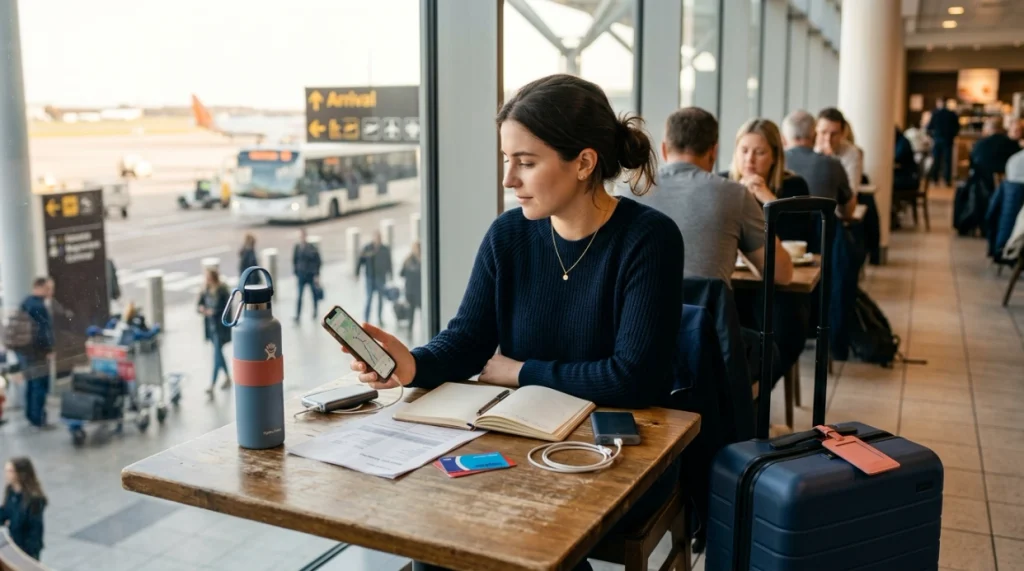
Reduce the number of unknowns during your first 24 hours. You do not need a minute-by-minute solo trip itinerary, but your arrival should feel almost boringly clear.
Plan the first day more carefully than the rest
Your first day combines travel fatigue with a new environment. It is not the ideal moment for complicated improvisation.
Before departure, know:
- Where you are sleeping: Save the accommodation name, address, telephone number, and reservation offline.
- How you are getting there: Research the airport, railway, taxi, shuttle, or public-transit route.
- When you can check in: Know what happens if you arrive early or late.
- How you will get online: Check roaming, eSIM, SIM card, or Wi-Fi options before landing.
- Where you can get food: Save one easy option near your accommodation.
When possible, I prefer a first-day schedule with only one real objective: arrive, settle in, eat, and learn the immediate area. Sightseeing can wait.
Give yourself permission to choose the easier option
Your first solo trip is not an exam. You do not earn extra points for making every part difficult.
- Choose a direct flight if the price difference is manageable.
- Stay centrally rather than saving a little money far outside town.
- Book a daytime arrival when practical.
- Reserve the first few nights before departure.
- Use a reputable transfer when late-night transport feels confusing.
- Choose a private room if a dorm would keep you awake with anxiety.
You can become more spontaneous later. A beginner-friendly trip should help you learn how you behave alone.
The purpose is not proving how adventurous you are.
Create a small routine
Familiar habits can make an unfamiliar destination feel less chaotic. Mine would include checking the next day’s transport, charging my phone, and reviewing the route home before leaving accommodation.
- Charge your phone and power bank each night.
- Download tomorrow’s map while you have Wi-Fi.
- Check your bank cards and essential documents.
- Send your planned check-in message.
- Review how you will return to your accommodation.
Section Takeaway: Make your first 24 hours predictable. You can leave the rest of the trip flexible once you feel settled.
What Safety Planning Actually Helps Before Traveling Alone?
Good solo female travel safety planning focuses on practical backups instead of trying to predict every bad thing that could happen. You want a system that still works when you are tired, offline, lost, or dealing with a changed plan.
Build a simple personal safety system
Keep important information in more than one place. Losing one item should not remove your access to everything else.
- Phone: Save accommodation details and emergency contacts.
- Offline copy: Download maps and important reservation information.
- Paper backup: Keep one small card with essential addresses and numbers.
- Money: Store a second payment method separately from your main wallet.
- Documents: Keep secure copies of your passport and important bookings.
- Trusted contact: Give someone at home your main itinerary and accommodation details.
For U.S. citizens traveling internationally, the State Department’s Smart Traveler Enrollment Program can provide destination alerts and help an embassy or consulate contact travelers or emergency contacts during certain emergencies.
If you are not a U.S. citizen, check whether your own government provides a traveler-registration or travel-advisory service.
Share information without surrendering your independence
Some families want constant location updates when a woman travels alone. That can become exhausting instead of reassuring.
Create a simple check-in agreement before departure.
- Send a message after arriving in the destination.
- Check in once daily at an agreed time.
- Tell your contact when you make a major itinerary change.
- Agree on what they should do if you miss a check-in.
This gives someone useful information without turning your holiday into continuous reporting.
Do the health planning too
Safety is wider than crime prevention. Illness, medication problems, heat, transportation accidents, and unexpected medical care can disrupt a trip.
The CDC’s pre-travel guidance recommends checking destination-specific health information, planning for emergencies, and considering your health needs before travel.
Pro tip: Before an international trip, verify current destination information using your government’s official travel advisory and an authoritative travel-health source. Requirements and local conditions can change.
Section Takeaway: Useful safety planning creates backups. It should make you feel more capable, not force you to spend the entire trip anticipating danger.
What Can I Do When Travel Anxiety Suddenly Spikes?
When anxiety spikes, bring your attention back to the next controllable action. Do not try to mentally complete the entire trip while standing in your bedroom three days before departure.
Use the “next step only” rule
Ask yourself what needs to happen next, not everything that could happen later.
- Finish packing the item in front of you.
- Check one reservation.
- Save one address.
- Complete online check-in.
- Go to the airport.
- Find the correct counter or gate.
You can solve tomorrow’s problem tomorrow. Your brain does not need to rehearse every possible scenario tonight.
Use a short grounding routine
Slow breathing and mindfulness practices can help some people manage stress and bring attention back to the present moment. The Mayo Clinic’s mindfulness guidance includes focused breathing and paying deliberate attention to your surroundings.
- Put both feet on the floor.
- Relax your shoulders.
- Take several slow breaths.
- Notice what you can see and hear.
- Name the next action you can control.
This is not about convincing yourself that nothing difficult can happen. It is about returning from imagined situations to the situation you are in now.
Stop feeding yourself frightening travel content
Research can help until it turns into compulsive searching. Reading endless worst-case stories the night before departure rarely gives you proportionate information.
Set a research cutoff.
- Check official advisories.
- Review recent practical destination information.
- Confirm transportation and accommodation.
- Write down actions for risks that are relevant.
- Then stop researching.
If your anxiety is severe, persistent, or interfering with everyday life beyond this trip, consider talking with a qualified health professional. Travel preparation is not a substitute for individualized mental-health care.
What Should My First Solo Trip Look Like?
Your first trip should be challenging enough to feel meaningful but simple enough that you can recover easily from mistakes. A shorter, logistically straightforward trip often teaches you more than an ambitious itinerary across several cities.
| Trip format | Typical length | Planning load | What it helps you practice |
|---|---|---|---|
| Local solo day trip | 6-12 hours | Low | Navigation, eating alone, independent decisions |
| Nearby overnight trip | 1-2 nights | Low to moderate | Accommodation, evening routines, packing alone |
| Single-city break | 2-4 nights | Moderate | Arrival logistics, sightseeing, social confidence |
| International one-city trip | 4-7 nights | Moderate to higher | Airports, cultural differences, longer independence |
| Multi-city international trip | 7+ nights | Higher | Transfers, itinerary changes, repeated check-ins |
Choose fewer moving parts
If you are already nervous, changing hotels every second day adds unnecessary decisions. Staying in one base gives you time to learn the neighborhood and create familiar routines.
A three-night city break can be enough to answer an important question: “Do I enjoy traveling alone?”
Build social opportunities into the itinerary
Solo does not mean isolated. You can travel independently while intentionally putting yourself around other people.
- Join a walking tour.
- Book a small-group food tour.
- Choose a hostel with organized social events.
- Take a group cooking class.
- Use established Meetup groups where appropriate.
- Spend part of the day in busy public spaces instead of staying in your room.
Lonely Planet’s solo travel guidance for women also suggests easing into independent travel rather than forcing yourself far outside your comfort zone immediately.
Give yourself an exit option
One underrated confidence booster is knowing that you are allowed to change your mind. You can skip an activity, take a taxi, move accommodation, call someone, or return home early if circumstances genuinely require it.
Having options usually makes me feel more independent, not less.
Section Takeaway: A good first solo trip is not the most impressive itinerary. It is the one that gives you enough independence to build confidence without burying you in logistics.
Frequently Asked Questions
Is it normal to be scared before your first solo trip?
Yes. A first solo trip involves unfamiliar decisions, responsibility, and uncertainty, so some nervousness is understandable. Focus on identifying specific concerns and building practical plans for them instead of treating all fear as proof that you should cancel.
Should I cancel my solo trip if I feel anxious?
Anxiety alone does not automatically mean cancellation is necessary. Reassess the actual destination conditions, your health, your travel plans, and whether your concerns can be reduced through preparation. If circumstances have genuinely changed or you feel unsafe for a specific reason, adjust your plans accordingly.
How many days should my first solo trip be?
There is no universal ideal length, but two to four nights can be a manageable starting point for many first-time travelers. It is long enough to experience solo routines without committing to a complicated multi-week itinerary.
How do I stop feeling lonely when traveling alone?
Plan some structured social contact. Walking tours, classes, social hostel events, small-group excursions, and calls home can break up long stretches alone while still letting you control your schedule.
Is staying in a hostel better for a nervous solo female traveler?
It depends on what makes you comfortable. A social hostel may make meeting people easier, while a private hotel or guesthouse room may feel calmer. Check location, recent reviews, transport access, reception arrangements, and room options before booking.
What if I get lost while traveling alone?
Download offline maps, keep your accommodation address saved in your phone, and carry a written backup. If you become confused, move to a well-lit public place such as a hotel, café, station, or staffed business before working out your next step.
How do I reassure my family about traveling alone?
Show them the preparation you have already done. Share your accommodation, transport details, emergency contacts, and check-in schedule, while setting reasonable boundaries so you can enjoy the trip without reporting your location every few minutes.
What Should I Remember the Night Before I Leave?
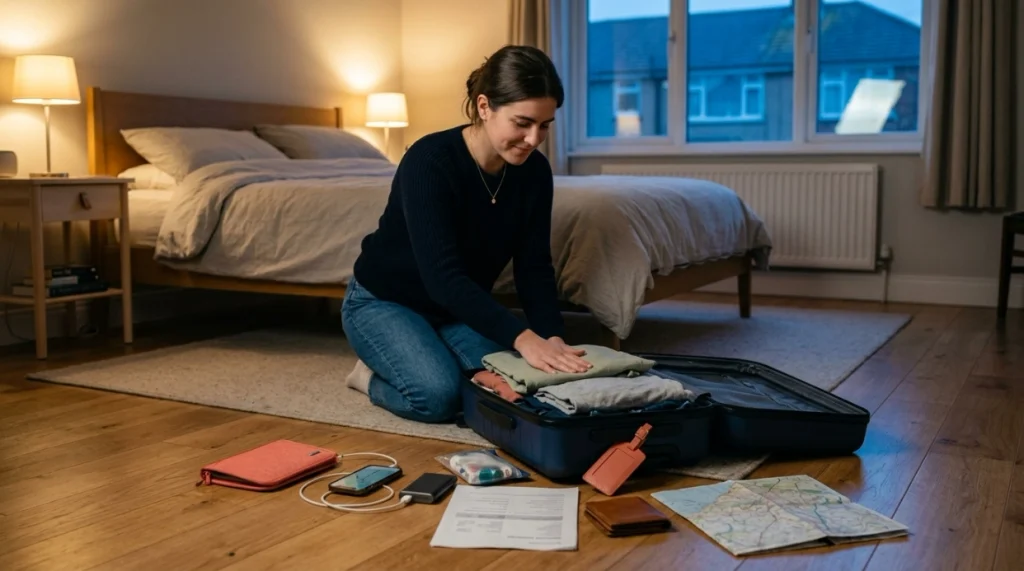
You do not have to feel fearless when you close your suitcase. You only need enough preparation to take the next step.
Check the essentials once, then stop trying to perfect the trip.
- Passport or identification
- Tickets and reservations
- Money and backup payment method
- Phone, charger, and power bank
- Medication and essential health items
- Accommodation address
- Arrival transportation plan
- Offline maps
- Emergency and family contacts
- First check-in time with someone at home
Then get some sleep. Your future self can deal with the café you cannot find, the platform you misread, or the afternoon when your original plan changes.
That is part of solo travel too.
Your first independent trip does not need to prove that you are fearless. Let it prove something more useful: that you can prepare, adapt, ask for help when necessary, make your own decisions, and keep going when a small thing does not work as planned.
Start with the next manageable step. Confidence can catch up with you on the way.