How Can a Woman Plan a Safe Late-Night Arrival When Traveling Alone?
Quick Answer
A woman can plan a safer late-night solo arrival by booking accommodation before departure, arranging reputable airport or station transport, saving the full hotel address offline, keeping her phone charged, and sharing her arrival plan with someone she trusts. I also recommend checking the current U.S. State Department guidance for women travelers before an international trip because transportation risks vary by destination.
Plan Your Late-Night Arrival in Six Steps
- Book ahead: Reserve accommodation that confirms late check-in and has a clear way to enter after hours.
- Arrange transport: Prefer a hotel transfer, licensed airport taxi, or reputable app-based ride over finding an unknown ride after landing.
- Save details offline: Keep the hotel name, address, phone number, booking confirmation, and route on your phone without needing mobile data.
- Protect your battery: Land with enough charge to navigate, contact your accommodation, and request backup transportation.
- Share your plan: Give one trusted person your flight or train details, hotel information, and expected arrival window.
- Keep a backup: Know what you will do if your flight is delayed, your driver does not appear, or the accommodation cannot admit you.
One Rule I Use
- I try to solve transportation, accommodation access, communication, and payment before the journey begins rather than after I arrive tired.
Late-night arrivals are sometimes unavoidable when you travel alone. Flights get cheaper at awkward hours, trains run late, and delays can turn an afternoon arrival into midnight.
I plan these arrivals differently from daytime trips. My goal is simple: remove as many decisions as possible before I step outside the terminal.
Definition: A safe late-night arrival plan is a pre-arranged system for getting from your arrival point to secure accommodation while keeping transportation, communication, payment, and backup options under your control.
In This Guide
- What Should You Arrange Before a Late-Night Solo Arrival?
- What Is the Safest Way to Leave an Airport or Station at Night?
- How Should You Choose Accommodation for a Late Arrival?
- What Should You Prepare on Your Phone, With Money, and for Check-Ins?
- What Should You Do If Your Late-Night Arrival Plan Fails?
- Which Late-Night Arrival Option Makes the Most Sense?
- Late-Night Solo Arrival FAQ
What Should You Arrange Before a Late-Night Solo Arrival?

The most useful safety work happens before departure. I want my first hour on the ground to involve following a plan, not researching one.
As of 2026, I still use the same basic system whether I am arriving by plane, train, or long-distance bus.
Confirm exactly how you will reach your accommodation
Write down your primary transport choice and one backup. Do not rely on finding “something” when you arrive.
- Primary option: Hotel transfer, licensed taxi, official airport transport, or a reputable ride service.
- Backup option: A second licensed provider, airport taxi desk, or hotel-arranged vehicle.
- Destination details: Full accommodation address, phone number, entrance instructions, and booking number.
- Route: Save the journey in an offline map before departure.
The U.S. State Department specifically advises women traveling alone to research transportation beforehand and consider arranging airport transport from a licensed, reputable company.
That is especially useful at night, when fewer businesses may be open and public transport may run less frequently.
Tell the accommodation when you expect to arrive
I always message the property when my arrival will be late. A booking confirmation does not automatically mean reception operates around the clock.
Ask clear questions before leaving home:
- Is reception staffed at my expected arrival time?
- Will the main entrance still be open?
- Is there a door code, key box, or security desk?
- Who should I call if my flight or train is delayed?
- Can the property arrange a pickup?
Save the reply somewhere you can access without internet service.
Section Takeaway: Plan the first hour before you leave home. Know where you are going, how you will get there, and what your backup will be.
What Is the Safest Way to Leave an Airport or Station at Night?
There is no single transport type that is safest everywhere. Local regulation, availability, and reliability matter more than the label on the vehicle.
I usually prioritize transportation that gives me a clear booking record and identifiable driver or operator.
Use official or pre-arranged transportation when possible
A hotel transfer is often the simplest choice because the destination and passenger details are arranged beforehand. It can cost more, but simplicity has value after a long journey.
An official airport taxi desk can also work well where airports regulate taxis. Follow airport signs rather than accepting unsolicited offers inside the terminal.
App-based rides may provide useful features such as driver details, vehicle information, trip records, location sharing, or pickup verification. Available features differ by provider and country.
- Check the driver’s name and vehicle details before entering.
- Compare the license plate with the booking.
- Use a pickup PIN when the service provides one.
- Share the live trip with someone you trust when available.
- Keep your luggage with you until you identify the correct vehicle.
Do not let a stranger change your transport plan
Busy arrival halls can feel confusing when you are tired. That is when I stick closely to the plan I made earlier.
If someone says your taxi is cancelled or offers a “better” ride, verify that information independently. Contact the hotel or transportation company yourself.
There is no prize for leaving the terminal quickly. A staffed terminal is usually a better place to solve a transport problem than an unfamiliar street.
Pro tip: Check your destination’s current government travel advisory and official airport transportation guidance before departure. Conditions and recommended transport methods can change.
How Should You Choose Accommodation for a Late Arrival?
For a late arrival, location and access matter as much as room quality. I would rather have an easy first night than save a small amount on an inconvenient property.
The U.S. State Department recommends booking accommodation ahead and considering properties with security measures such as staffed lobbies, gates, or security personnel.
Look for practical arrival features
- Late check-in: Confirm that you can enter at your actual arrival time.
- Staff presence: A staffed reception desk can simplify unexpected problems.
- Simple transfer: Prefer a property that drivers can locate easily.
- Useful surroundings: Consider access to transportation and essential services.
- Recent reviews: Look for comments about the neighborhood, entrance, staff, and nighttime arrivals.
I also avoid creating an unnecessary walk with luggage after midnight. A hotel that looks close on a map can still involve dark streets, hills, confusing entrances, or pedestrian-unfriendly roads.
Check the room before settling in
Once inside, I spend a few minutes checking the room before unpacking.
- Confirm the door and windows lock correctly.
- Locate the nearest emergency exit.
- Check that the room phone or reception contact works.
- Make sure curtains close properly.
- Keep your room number private.
If the room, building, or location feels unsuitable, speak to reception before unpacking. Changing rooms is easier while your belongings are still together.
What Should You Prepare on Your Phone, With Money, and for Check-Ins?
Your phone is useful only if it has power, connectivity, and the information you need. I prepare for losing mobile data as well.
Before traveling, I save the essential details offline.
- Accommodation address and phone number
- Booking confirmation
- Offline map of the arrival area
- Transport booking details
- Airline or train information
- Travel insurance contact information
- Local emergency number
- Embassy or consular details when relevant
Keep enough battery for the entire transfer
I try not to spend the final hour of a flight draining my battery on videos. Navigation and communication matter more after landing.
A charged power bank is useful on long travel days. Keep the charging cable accessible rather than buried in checked luggage.
Carry more than one payment method
A card can fail, a ride app may reject a payment, or an ATM may be unavailable. I carry a modest amount of usable cash plus a separate backup card.
Keep the backup separate from your primary wallet. The point is not carrying lots of money; it is maintaining options.
Give one trusted person useful information
Share information that someone could use if your plans change unexpectedly.
- Your flight, train, or bus number
- Your accommodation name and address
- Your planned transport method
- Your approximate arrival window
- When you expect to send an “arrived” message
You do not need to broadcast your live location publicly. Share sensitive travel details privately with someone you trust.
What Should You Do If Your Late-Night Arrival Plan Fails?
A good arrival plan includes failure. Flights get delayed, drivers cancel, phones lose signal, and reception desks sometimes misunderstand bookings.
I decide my responses before those problems happen.
If your flight or train is delayed
- Notify your accommodation as soon as the delay becomes clear.
- Confirm that late entry will still be possible.
- Update your transport booking.
- Message your trusted contact with the revised arrival time.
If a small delay pushes your arrival deep into the night, compare the cost of changing your plan with the stress of continuing it.
Sometimes spending more on a direct taxi or airport hotel is the sensible choice.
If your driver does not appear
Stay inside the staffed arrival area while solving the problem when possible. Contact the booked company through its official number or app.
Move to your pre-planned backup rather than accepting a random offer simply because you are tired.
If you cannot enter your accommodation
Call the official accommodation number and check your booking instructions. If you still cannot enter, move to a staffed public place while arranging another property.
This is why I keep emergency accommodation money available. Backup money buys choices when the original plan stops working.
Section Takeaway: A backup plan should tell you what to do, not merely remind you to “be careful.” Decide your second transport and accommodation options before departure.
Which Late-Night Arrival Option Makes the Most Sense?
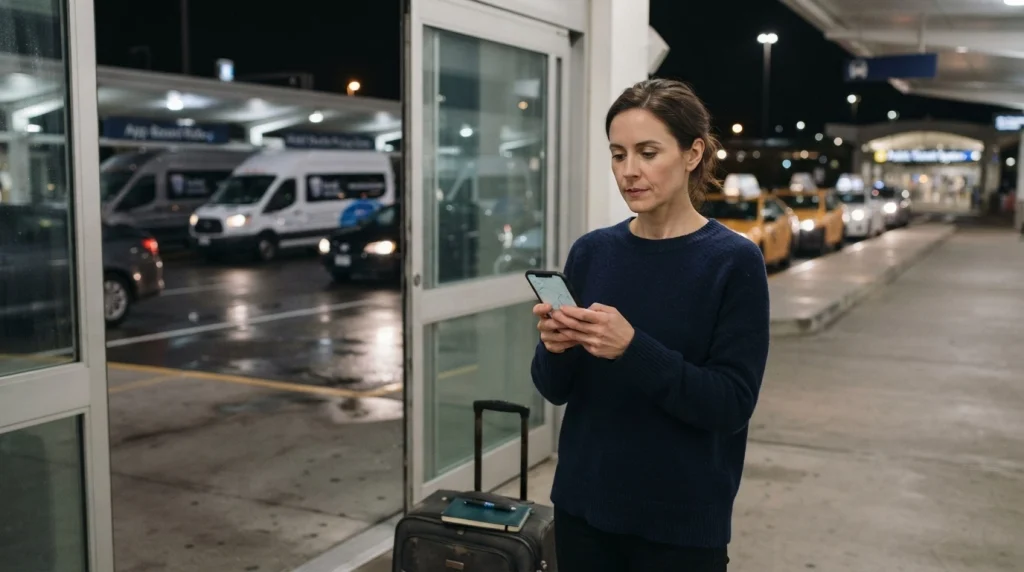
The best option depends on the destination and your arrival conditions. I compare convenience, verification, availability, and how many decisions I must make after landing.
| Arrival Option | Main Advantage | Check Before Using | Useful When |
|---|---|---|---|
| Hotel transfer | Pre-arranged destination and pickup | Price, meeting point, driver identification | You want the simplest late arrival |
| Licensed airport taxi | Usually available from an official pickup area | Official taxi system and fare method | Your destination regulates airport taxis |
| App-based ride | Digital trip and driver record | Local legality, coverage, pickup area, data access | The service is reputable and commonly used locally |
| Public transport | Often inexpensive | Operating hours, transfers, walking distance | Service is still frequent and the route is straightforward |
I do not choose purely by price. At 1:00 a.m., one direct and well-understood journey can be worth more than saving a few dollars through several transfers.
If every available option feels confusing, consider changing the arrival itself. An earlier flight, airport hotel, or extra night’s accommodation can sometimes simplify the entire trip.
Late-Night Solo Arrival FAQ
Is it safe for a woman to arrive alone at night?
A late-night solo arrival can be planned to reduce avoidable risks, but no arrival is risk-free. Arrange transport and accommodation beforehand, verify current destination guidance, keep communication working, and maintain a backup option if the original plan changes.
Should I tell my hotel I am traveling alone?
You usually only need to provide the information required for your booking. More importantly, tell the property your expected arrival time and confirm its late check-in procedure so you know exactly how you will enter.
Is a taxi or rideshare better for a woman arriving alone at night?
Neither is automatically better everywhere. Use whichever reputable, legal option is well established at your destination and gives you a reliable way to identify the driver, vehicle, fare, and trip record.
Should I avoid public transportation after a late flight?
Not necessarily. Public transport may be practical where service remains frequent and the route to your accommodation is simple. Check operating hours, station conditions, transfers, and the final walking distance before deciding.
What if my phone has no signal when I land?
Use information saved offline, connect to official airport Wi-Fi if appropriate, or seek help from an official information or transport desk. Keep your hotel address and important phone numbers available offline rather than depending entirely on mobile data.
What should I do if I feel uncomfortable with my driver?
Do not enter a vehicle if its driver or details do not match your booking. If concerns start during the journey, use available in-app safety features and move to a staffed public place when it is safe to do so.
Should I share my live location with someone?
It can be useful during a late transfer if you are comfortable doing it. Share location or trip details privately with someone you trust rather than posting your accommodation, route, or real-time location publicly.
A safe late-night arrival is less about being fearless and more about reducing last-minute decisions. I want the route, hotel entrance, backup transport, phone setup, and check-in message decided before my journey begins.
If your arrival feels unnecessarily complicated, simplify it. Paying for an easier transfer, changing a flight, or staying near the airport can be a practical solo-travel decision.
Pro tip: Before any international trip, review the latest official travel advisory for your destination and check local emergency, transport, and accommodation information. Conditions can change after an article is published.