How Can a Woman Plan a Solo Trip When She Has a Limited Budget?
Quick Answer
A woman can plan a solo trip on a limited budget by setting her maximum trip cost first, choosing a destination that fits that number, and pricing the complete journey before booking anything. I would protect money for safe accommodation, reliable transportation, and emergencies before spending on optional activities, while checking current guidance for women travelers when planning an international trip.
Plan a Budget Solo Trip in Seven Steps
- Set your ceiling: Decide the maximum amount you can spend without using money needed for bills or everyday life.
- Choose affordable dates: Compare several dates before deciding where and when to travel.
- Price the whole trip: Include transport, accommodation, food, local travel, activities, fees, and preparation costs.
- Protect safety spending: Keep enough money for accommodation and transportation choices you feel comfortable using alone.
- Cut optional costs: Save on extras before compromising on essential logistics.
- Keep emergency money: Separate backup funds from your normal daily spending.
- Track as you travel: Check your remaining budget every day or two so small purchases don’t quietly derail the plan.
Planning solo travel with a limited budget isn’t about making every decision as cheaply as possible. It’s about deciding where your money matters most and cutting the expenses that add the least value.
I’ve found that budget solo travel becomes much easier when I work backward from a firm spending limit. Instead of choosing a dream itinerary first and worrying about money later, I build a trip I can comfortably afford from the beginning.
In This Guide
- How Much Can You Afford to Spend on a Solo Trip?
- How Do You Choose a Destination When Your Budget Is Limited?
- How Do You Build a Realistic Solo Travel Budget?
- Where Can You Save Money Without Making the Trip Harder?
- How Should Safety Affect a Woman’s Solo Travel Budget?
- What Does a Limited-Budget Solo Trip Look Like?
- Frequently Asked Questions
How Much Can You Afford to Spend on a Solo Trip?
The first step is deciding how much money you can spend comfortably. Your budget should come from money available for travel, not from money you still need for rent, groceries, debt payments, or other normal expenses.
I treat this number as a ceiling. It stops a cheap-looking trip from slowly becoming an expensive one after I start adding extras.
Definition: A solo travel budget is the total amount available for transportation, accommodation, meals, local travel, activities, preparation costs, and unexpected expenses during a trip taken independently.
Separate the trip budget from your everyday money
Suppose you have $1,200 available. That doesn’t automatically mean you should plan a $1,200 itinerary.
I would leave part of that amount untouched so one delayed train or unexpected taxi doesn’t create financial stress.
- Core trip fund: Transportation, accommodation, food, local transport, and planned attractions.
- Flexible spending: Small upgrades, spontaneous activities, cafés, souvenirs, or price changes.
- Emergency reserve: Money for genuine disruptions such as replacement transportation or an unexpected extra night.
The emergency reserve is not another spending category. I plan as though that money doesn’t exist unless something goes wrong.
Choose the trip length after setting your budget
Trip length changes almost every daily cost. Five comfortable days can be far better than ten days spent worrying about every meal and bus ticket.
When money is tight, I prefer shortening the trip before weakening the parts that make the journey manageable.
- Stay fewer nights.
- Choose one city instead of three.
- Take fewer long-distance transfers.
- Pick one or two paid attractions.
- Leave enough money for comfortable everyday decisions.
A shorter trip can also reduce transportation between destinations. That saves both money and travel time.
Section Takeaway: Start with the amount you can comfortably spend, then build the trip around that number. Don’t choose an itinerary first and hope your money somehow stretches far enough.
How Do You Choose a Destination When Your Budget Is Limited?

Choose a destination based on total trip cost, not one attractive airfare or hotel price. A cheap flight doesn’t help much if accommodation, airport transfers, and daily transportation are expensive.
I usually shortlist three destinations and price each one using the same categories. That makes the comparison much clearer.
Compare total cost instead of daily cost
A destination with cheap meals might require an expensive international flight. Another place may cost more each day but be much cheaper to reach.
Look at the complete journey.
- Round-trip flight, bus, train, or fuel
- Baggage charges
- Airport or station transfers
- Accommodation plus mandatory taxes or fees
- Meals and drinking water
- Public transportation and occasional taxis
- Attractions and tours
- SIM, eSIM, or roaming
- Visa or entry-related costs when applicable
- Travel insurance if you choose or need it
- Emergency money
Research your exact dates whenever possible. Generic destination averages can’t tell you what your room or transportation will cost during your actual trip.
Look for destinations where everyday logistics are simple
The cheapest destination on paper isn’t always the cheapest destination for a woman traveling alone. Complicated logistics can create costs that aren’t obvious during initial research.
I give extra value to places where I can walk or use straightforward public transportation.
- Central accommodation: You may spend less on taxis and transfers.
- Reliable public transport: You have a lower-cost alternative to private transportation.
- Affordable food nearby: You don’t need expensive tourist restaurants for every meal.
- Plenty of free sights: Parks, markets, neighborhoods, beaches, and public spaces can fill whole days.
- One practical base: Staying put can remove several transfer days from the budget.
Lonely Planet’s travel budgeting guidance can also help you identify common areas where travelers can adjust their spending.
Use flexible dates before chasing the cheapest destination
If your dates can move, compare several departure days or weeks. Transportation and accommodation prices can change considerably around weekends, holidays, festivals, and busy travel periods.
I often test the same itinerary using two or three date ranges before deciding whether a destination fits.
- Compare weekday and weekend departures.
- Look just before or after peak travel periods.
- Check whether a major event is raising hotel prices.
- Compare four nights with five or six nights.
- Check the cost of arriving at different airports or stations only when onward transportation remains practical.
Don’t choose inconvenient overnight transportation just to save a small amount. A bargain stops being useful when it creates expensive or uncomfortable arrival logistics.
Section Takeaway: Compare destinations using the complete cost of the same style of trip. The destination with the lowest room price is not automatically the destination that costs you least overall.
How Do You Build a Realistic Solo Travel Budget?
Build your budget using real prices for your dates and travel style. Give every important expense a category before you book.
I prefer a simple spreadsheet or phone note. Complicated budgeting systems aren’t necessary if the categories are complete.
Start with fixed costs
Fixed costs are expenses you can estimate before departure. These usually deserve attention first because they can consume a large part of a limited budget.
- Transportation to and from the destination
- Accommodation
- Travel insurance, when applicable
- Visa or entry costs, when applicable
- Pre-booked transportation
- Pre-booked attractions or tours
Don’t forget taxes and mandatory property fees. A room advertised at one rate may have a different final checkout price.
Estimate one normal day
Next, calculate what an ordinary day will cost. Don’t build the estimate around surviving on the cheapest possible meal and walking everywhere.
Your normal day should resemble the way you genuinely expect to travel.
| Budget Category | What to Price | Easy-to-Miss Cost |
|---|---|---|
| Accommodation | Room or hostel you would genuinely book | Taxes and local fees |
| Food | Breakfast, lunch, dinner, drinks, snacks | Airport meals and bottled water |
| Local transport | Metro, bus, train, taxi, rideshare | Airport and late-evening transport |
| Activities | Admissions, tours, classes, day trips | Booking or guide fees |
| Connectivity | SIM, eSIM, roaming, Wi-Fi needs | Extra data |
| Preparation | Documents, insurance, basic supplies | Transport to appointments |
Remember that solo travel changes the math
Solo travelers don’t automatically split rooms, airport taxis, rental cars, or private transfers with someone else. A cheap option advertised per room may therefore be less impressive when you’re paying alone.
At the same time, traveling solo gives you complete control over optional spending.
- You choose where to eat.
- You decide which attractions are worth paying for.
- You can use public transportation without negotiating with a travel partner.
- You can shorten or simplify the itinerary.
- You don’t need to match someone else’s spending habits.
That flexibility can be one of the biggest advantages of budget solo travel.
Section Takeaway: Build your budget from fixed costs plus a realistic normal day. Include costs that behave differently when you’re paying as one traveler rather than splitting expenses.
Where Can You Save Money Without Making the Trip Harder?
Save first on flexibility, convenience upgrades, and optional entertainment. Be more cautious about cutting accommodation quality, transportation reliability, communication, or emergency funds.
The goal isn’t spending as little as possible. It’s spending less without making the trip unnecessarily difficult.
Save on accommodation by changing the room, not blindly changing the area
Accommodation is often one of the largest costs, so small changes can make a noticeable difference. I compare hostels, guesthouses, simple hotels, and private rooms before deciding.
Location still matters.
- Compare a hostel dorm with a basic private room.
- Check properties one or two transit stops outside the main tourist zone.
- Look for accommodation with a kitchen or included breakfast.
- Compare refundable and non-refundable rates carefully.
- Check recent reviews and transportation before choosing the cheapest listing.
A room that saves $15 but requires $20 in extra daily transportation isn’t saving money.
Make transportation part of your destination strategy
A compact itinerary can save more than hunting for tiny discounts on individual tickets. Every time you change cities, you may add a ticket, transfer, baggage handling, and another arrival journey.
I often use Rome2Rio during early planning to understand possible transportation connections, then verify schedules and fares with the actual transport operator before booking.
- Stay in one city longer.
- Group nearby sights on the same day.
- Walk when the route feels practical and appropriate.
- Use public transport passes only when the math works for your itinerary.
- Avoid crossing the city repeatedly for scattered attractions.
Set a food budget that you can enjoy
You don’t need to survive on instant noodles to travel cheaply. Food budgeting works better when you mix inexpensive everyday meals with a few meals you care about.
My usual approach is simple.
- Buy breakfast from a bakery or grocery store when practical.
- Make lunch the larger restaurant meal if daytime menus offer better value.
- Carry water and a small snack.
- Choose accommodation with simple cooking facilities for longer trips.
- Pick a few restaurants deliberately instead of eating every meal in the busiest tourist streets.
Don’t under-budget food so aggressively that you spend the trip hungry or anxious. A realistic allowance is easier to follow than an unrealistic one.
Use free activities to create full travel days
Many memorable solo travel days don’t need an expensive tour. I like building days around neighborhoods, parks, markets, viewpoints, beaches, architecture, public spaces, and self-guided walks.
Then I choose the paid experiences that matter most.
- One museum you genuinely want to see
- One food or walking tour
- One performance or cultural activity
- One day trip that would be difficult independently
This works better than buying admission everywhere simply because you’re already there.
Section Takeaway: Cut optional costs before cutting the parts of the trip that protect your comfort and flexibility. A budget trip should still function well when plans change.
How Should Safety Affect a Woman’s Solo Travel Budget?
Safety should have its own place in your budget. I want enough financial flexibility to change transportation, accommodation, or plans when I feel I need a different option.
Women travelers can face destination-specific security, cultural, legal, and health considerations, so current official information matters more than a general claim that somewhere is “safe.”
Don’t make the cheapest room your only affordable option
I compare the accommodation itself and its location. A comfortable room in a practical area may reduce several other costs.
- Check recent guest reviews.
- Look at nearby public transportation.
- Study the route from your arrival point.
- Check reception or check-in arrangements.
- Look at nearby food and basic services.
I would rather simplify my sightseeing than choose accommodation purely because it is the lowest price available.
Keep money for transportation changes
Sometimes the public transport option you planned doesn’t suit the situation you encounter. A delayed arrival, changed schedule, or unfamiliar route can make another option more practical.
Your budget should leave space for that decision.
- An airport taxi or licensed transfer
- A rideshare where appropriate and available
- An earlier train
- A replacement ticket
- Transportation back to your accommodation
You may never use that money. Having it available still matters.
Keep emergency funds separate
Don’t store all your money in one physical place or depend on one payment method. I prefer having a primary payment option and an independent backup.
Your exact setup depends on the destination and the financial services available to you.
- Primary card or payment method
- Backup payment method
- A modest amount of local cash when useful
- Emergency funds that aren’t part of daily spending
Before international travel, review destination-specific laws, customs, and current conditions through official sources. The U.S. State Department provides specific guidance for women travelers and destination travel information.
Pro tip: Health risks also vary by destination. Check the CDC Travelers’ Health destination pages before international travel, and use the equivalent official health authority for your country when appropriate.
Section Takeaway: A limited budget should still contain financial room for safer or more practical choices. Save money by simplifying the trip rather than eliminating your ability to change plans.
What Does a Limited-Budget Solo Trip Look Like?
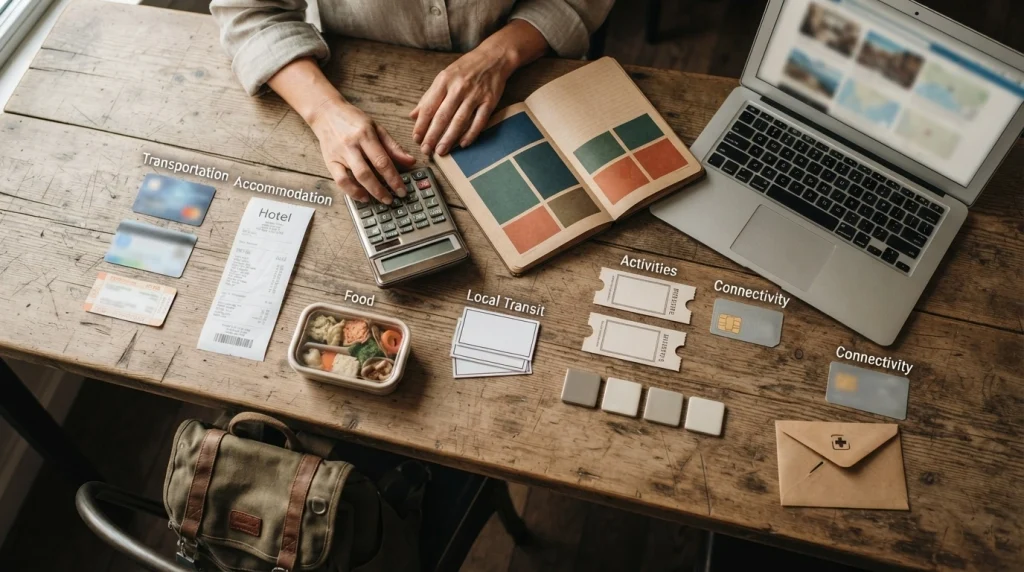
A limited-budget trip becomes easier to understand when you assign actual amounts to each category. The example below shows how I might divide a hypothetical $1,200 budget for a five-night trip.
These aren’t destination price estimates. They’re a planning example showing how a fixed budget can be divided before booking.
| Category | Example Amount | Planning Approach |
|---|---|---|
| Round-trip transportation | $300 | Compare several dates before booking |
| Accommodation | $350 | Five nights at an average of $70 |
| Food | $150 | Mix inexpensive meals with selected restaurants |
| Local transportation | $70 | Public transport plus limited backup transport |
| Activities | $100 | Mix free sights with a few priorities |
| Connectivity and small expenses | $50 | Data and miscellaneous essentials |
| Emergency reserve | $180 | Keep separate unless needed |
| Total | $1,200 | Complete hypothetical budget |
What if the trip costs more than your maximum?
Don’t immediately remove the emergency fund. Change the trip itself first.
- Try different dates. Reprice the same trip during another week or travel period.
- Shorten the stay. Removing one or two nights can reduce accommodation, food, and daily spending together.
- Reduce destination changes. Stay in one base instead of paying for several transfers.
- Change accommodation type. Compare a hostel, guesthouse, or simpler hotel in a practical area.
- Remove low-priority paid activities. Keep the experiences you care about most.
- Choose another destination. If the trip still doesn’t fit, changing the destination may be the better decision.
Track spending during the trip
A good pre-trip budget can still fail if you stop paying attention after arrival. I spend one minute each evening recording roughly what I spent.
It doesn’t need to be perfect.
- Accommodation already paid
- Food today
- Transportation today
- Activities today
- Miscellaneous spending
- Remaining flexible money
If I spend more than planned one day, I adjust an optional category later. I don’t treat the emergency reserve as the automatic solution.
Book the expensive anchors first
Once you’ve tested the budget, secure the expenses that could change the entire plan. These often include transportation to the destination and accommodation.
I avoid booking a collection of small non-refundable activities before the main trip logistics are settled.
- Confirm your trip dates.
- Confirm how you’ll reach the destination.
- Confirm where you’ll stay.
- Confirm arrival transportation.
- Then book priority activities.
This order makes it easier to change your plan while the trip is still taking shape.
Section Takeaway: When your planned trip exceeds your budget, simplify the itinerary before cutting emergency flexibility. Fewer nights, fewer transfers, and fewer optional activities can protect the parts that matter most.
Frequently Asked Questions
Can a woman travel alone on a small budget?
Yes. A small budget can work when the destination, trip length, accommodation, transportation, and activities match that budget. Start with a firm spending limit, protect money for essential logistics and emergencies, then use free activities and simple everyday choices to reduce optional costs.
What is the cheapest way to plan a first solo trip?
A short trip close to home can reduce airfare, long transfers, and complicated logistics. One destination and one accommodation base also make costs easier to predict. Compare the full trip price rather than choosing a destination only because one flight or hotel appears cheap.
Should I stay in a hostel to save money when traveling alone?
A hostel can lower accommodation costs, but it isn’t automatically the best choice. Compare location, reviews, room type, transportation, lockers, reception arrangements, and total price. A simple guesthouse or hotel can sometimes offer better overall value for your itinerary.
How much emergency money should I take on a solo trip?
There is no universal amount because destinations and trip lengths differ. Keep enough accessible backup money for realistic problems such as replacement transportation or an unexpected night of accommodation, and keep it separate from your normal food, sightseeing, and shopping budget.
Is it cheaper to book a solo trip early?
Booking earlier can sometimes give you more choice, but there is no single booking window that guarantees the lowest price. Compare several dates and cancellation conditions before paying. Focus on the final trip cost rather than assuming that either early or last-minute booking is always cheapest.
What should I never cut from a limited solo travel budget?
Don’t build a trip that leaves no room for important transportation, appropriate accommodation, basic communication, required documents, health needs, or unexpected changes. Optional tours, restaurant meals, shopping, and itinerary length are usually easier places to reduce spending first.
How can I stop myself from overspending during the trip?
Set a daily flexible-spending amount and record expenses every evening. Pre-book only the activities you consider priorities, and keep emergency money separate. If one day costs more than expected, reduce a later optional expense instead of abandoning the entire budget.
Plan the Trip Your Budget Can Support
A limited budget doesn’t mean you need to give up on solo travel. It means your trip needs a clear financial boundary.
Start with your maximum spending amount, compare several destinations, and price the entire journey before booking. Protect accommodation, transportation, communication, and emergency flexibility first.
- Choose fewer destinations.
- Stay a little longer in one place.
- Use public transportation where practical.
- Mix free experiences with a few paid priorities.
- Keep backup money separate.
- Track spending during the trip.
As of 2026, my favorite budget rule is still simple: I would rather take a shorter solo trip that I can comfortably afford than a longer one that leaves me worrying about money every day.
Build the trip around what you have. You can always make the next one longer.