Should a Woman Rent a Car for Solo Travel?
Quick Answer
Yes, renting a car can be a smart choice for a woman traveling alone when her itinerary includes remote attractions, scattered destinations, or places with limited public transportation. However, a rental car isn’t automatically safer, cheaper, or more convenient than trains, buses, and reputable ride-hailing services. Compare your route, driving confidence, total costs, and local road conditions before booking.
When renting a car makes sense
- Remote destinations: A car can help you reach beaches, national parks, villages, and trailheads that public transport doesn’t serve well.
- Flexible timing: You can leave early, change your plans, and avoid waiting for infrequent connections.
- Comfortable driving: Familiar road rules, manageable traffic, and good navigation make independent driving easier.
- Reasonable total cost: Rental fees, fuel, insurance, parking, and tolls fit your budget.
- Reliable support: The rental company provides clear insurance terms, roadside assistance, and an accessible emergency contact.
When another transport option may be better
- Choose trains or public transportation when routes are frequent, affordable, and convenient.
- Consider a reputable driver or organized excursion if unfamiliar roads, nighttime driving, or local traffic feel overwhelming.
- Check local driving laws, your license requirements, insurance exclusions, and official travel advice before making the final decision.
Should a woman rent a car for solo travel, or is it better to rely on public transportation? It’s a practical question that affects your budget, independence, comfort, and personal safety.
When planning a trip alone, I would judge a rental car by what it makes possible, not simply by the freedom it promises. The best choice depends on where you’re going, how confident you feel behind the wheel, and what happens if something goes wrong.
This guide compares rental cars with other transport options, explains the costs and safety considerations, and helps you decide whether driving alone fits your next trip.
In This Guide
- Should a woman rent a car for solo travel?
- When does renting a car make sense for a solo woman?
- Is a rental car safer or better than public transportation?
- How much does a rental car really cost for one traveler?
- How can a woman stay safe when driving alone?
- What should you check before booking a rental car?
- Frequently asked questions
Should a Woman Rent a Car for Solo Travel?

A woman should consider renting a car for solo travel when it solves a real transportation problem without creating excessive cost or driving stress. If trains and buses already connect your destinations conveniently, you may gain little from renting one.
Solo female travel means traveling independently without a companion or organized group, making your own decisions about transportation, accommodation, activities, and daily plans. Driving is one way to maintain that independence, but it isn’t a requirement for a successful solo trip.
Look at the itinerary before deciding
Start by mapping your actual destinations instead of assuming a car will be useful everywhere. A city break with museums, restaurants, and central accommodation usually presents different transportation needs from a countryside road trip.
For example, imagine spending four days in a city with frequent trains, followed by three days exploring villages and hiking trails. Renting for the entire week might waste money while the car sits in a city parking garage.
A more practical plan could be:
- Days 1–4: Use public transportation and walk between central attractions.
- Day 5: Collect a rental car for the countryside portion.
- Days 6–7: Visit less accessible places, then return the car before continuing by train.
This hybrid approach preserves flexibility without paying for a vehicle you don’t need every day.
Consider your confidence, not just your ambition
Driving alone can feel empowering when the route is familiar and well planned. It can also become tiring when you’re navigating an unfamiliar city, interpreting road signs, watching for motorcycles, and searching for parking simultaneously.
Be honest about your comfort level. You don’t need to prove your independence by tackling difficult roads on your first solo trip.
Section takeaway: Rent a car when it makes your itinerary easier and your driving conditions manageable. If it adds more stress than freedom, choose another option.
When Does Renting a Car Make Sense for a Solo Woman?
A rental car is most useful when destinations are spread out, public transportation is infrequent, or you need control over departure times. The decision becomes less attractive when parking is difficult, roads are unfamiliar, or your trip centers on one walkable city.
Situations where a rental car is worth considering
- National parks and nature trips: A car may connect trailheads, scenic viewpoints, and accommodation outside transit routes.
- Small towns and rural villages: Limited bus schedules can make independent day trips difficult without a vehicle.
- Multi-stop itineraries: Driving can simplify a route that would otherwise require several transfers.
- Travel with bulky equipment: Hiking gear, photography equipment, or several bags may be easier to transport in a suitable vehicle.
- Early starts: Driving can help you reach an attraction before opening time or a trail before the busiest period, provided the road and parking arrangements are safe.
- Flexible exploration: You can adjust your schedule when weather changes or an attraction takes longer than expected.
When renting is likely to be unnecessary
A rental car often makes less sense for a short city break with reliable public transportation. Congestion, parking charges, restricted driving zones, and one-way streets can turn a convenient-looking rental into an expensive inconvenience.
It may also be a poor choice if you would need to drive long distances after a full day of sightseeing. Fatigue can affect concentration, reaction time, and judgment.
Consider these examples when planning your route:
- Three days in central Paris: Walking and public transportation may cover most activities without parking costs.
- Five days exploring rural villages: A rental may be practical if bus connections are sparse and the roads suit your experience.
- A one-night airport stopover: A prearranged transfer or licensed taxi may be simpler than collecting and returning a car.
- A hiking holiday with remote trailheads: Compare rental availability, trailhead parking, weather, and the return journey before deciding.
Think about the whole journey
A car is only helpful if the pickup location, route, accommodation, and return arrangements work together. An inexpensive rental from an airport far outside town may not save money after you add transfers and lost time.
Check whether your accommodation has secure, convenient parking. If you must leave a vehicle on an isolated street overnight, the location may undermine the convenience you wanted.
Section takeaway: Match the vehicle to the hardest part of your itinerary. Renting for a specific rural segment can be more useful than keeping a car throughout your trip.
Is a Rental Car Safer or Better Than Public Transportation?
A rental car can offer privacy and control, but it isn’t inherently safer than a train, bus, or reputable ride-hailing service. Each option carries different risks, so compare the transport method with the destination, time of day, road conditions, and your own experience.
Compare your main transportation choices
| Transport option | Best suited to | Main drawback | Solo travel consideration |
|---|---|---|---|
| Rental car | Rural routes and multiple stops | Driving, insurance, and parking costs | You manage navigation, emergencies, and the vehicle yourself. |
| Train | Intercity journeys and connected urban areas | Fixed schedules and station transfers | You can avoid driving fatigue but still need to plan station access and late arrivals. |
| Bus | Budget travel and established routes | Possible delays and limited departure times | Check the operator, stop location, arrival time, and local safety guidance. |
| Licensed taxi or ride-hailing | Airport transfers and short trips | Repeated fares can add up | Verify the driver and vehicle, and share the journey with someone you trust when possible. |
| Organized day tour | Remote attractions and unfamiliar routes | Less flexibility and a fixed itinerary | A reputable operator can remove the burden of driving and route planning. |
These are qualitative comparisons rather than universal safety rankings. Transport quality, operator standards, infrastructure, and local conditions vary significantly between destinations.
What are the safety trade-offs?
With a rental car, you control who enters the vehicle and when you stop. However, you also take responsibility for road hazards, breakdowns, parking decisions, and finding help if you become lost.
Public transportation can reduce the pressure of driving in an unfamiliar place. Yet stations, isolated stops, crowded vehicles, and late-night connections require their own safety planning.
For destination-specific guidance, consult official resources such as the U.S. Department of State’s international travel advice. The guidance can help you assess transportation concerns and local conditions before committing to a route.
Choose the option that reduces your biggest risk
If you drive confidently but need to reach several rural locations, a car may simplify the trip. If unfamiliar traffic makes you anxious, a train or reputable guided excursion may be the better decision.
For some itineraries, combining options offers the best balance. Take a train between cities, use local transport within urban areas, and rent a car only where you need one.
Section takeaway: Compare practical risks rather than assuming a private vehicle guarantees safety. Choose the transport option that fits your destination and your abilities.
How Much Does a Rental Car Really Cost for One Traveler?
The real cost of renting a car includes much more than the advertised daily rate. For a solo traveler, every expense falls on one person, so comparing the complete journey matters more than finding the lowest headline price.
Build a realistic rental budget
For planning purposes, consider this illustrative three-day rental budget in a destination where a compact car costs $45 per day. These are sample figures, not live quotes, and actual prices vary by location, season, vehicle, and insurance terms.
| Expense | Example cost | What to check |
|---|---|---|
| Base rental, 3 days | $135 | Taxes, mileage limits, and included fees |
| Fuel | $35 | Route distance and local fuel prices |
| Additional insurance | $45 | Coverage, exclusions, and excess |
| Parking and tolls | $30 | Paid parking and route charges |
| Estimated total | $245 | About $81.67 per day |
This example excludes any security deposit, which may temporarily tie up money on your card. It also excludes optional extras, airport surcharges, and unexpected expenses.
Compare the $245 total with your realistic alternatives, including public transport tickets, transfers, and any tours needed to reach the same places. A rental can be worthwhile even when it costs more, but you should know what the extra expense buys you.
Understand insurance before you pay
Rental insurance terminology can be confusing, particularly when different countries use different rules. A collision damage waiver (CDW) or loss damage waiver (LDW) generally limits your financial responsibility for certain vehicle damage, subject to the contract and its exclusions.
Before accepting or declining additional cover, check:
- Collision coverage: Which damage is covered, and what excess or deductible remains your responsibility?
- Third-party liability: What protection applies if you injure someone or damage another person’s property?
- Theft protection: Are theft and attempted theft covered, and are there security requirements?
- Glass, tires, and underbody: Are windscreen damage, punctures, and damage beneath the vehicle excluded?
- Travel insurance: Does your policy cover rental-car excess, medical costs, and emergency assistance?
- Credit-card benefits: Does your card provide rental coverage for this country and vehicle, and does it require you to decline the rental company’s waiver?
Don’t assume that buying a waiver removes every possible liability. Read the actual terms, including exclusions and the conditions for making a claim.
The Australian government’s road safety and rental-car insurance guidance explains why excess amounts and policy exclusions deserve careful attention.
Watch for costs that are easy to overlook
- International airport collection fees and one-way drop-off charges.
- Automatic transmission upgrades, additional drivers, or optional navigation equipment.
- Young-driver surcharges, where applicable.
- Cross-border permission fees and restrictions on driving in certain regions.
- Fuel penalties, late-return charges, and cleaning fees under the rental agreement.
- Parking permits, congestion charges, and road tolls.
Also check the payment-card requirements before booking. A rental company may require a credit card in the main driver’s name and a deposit larger than you expect.
Section takeaway: Compare the total cost, not the daily rate. Never choose a rental you cannot afford to insure properly or support financially if an unexpected expense arises.
How Can a Woman Stay Safe When Driving Alone?
Solo driving is easier to manage when you plan the route, limit distractions, and know how to get help. A car can offer independence, but preparation matters more than the vehicle itself.
Plan routes and arrival times in advance
Before leaving your accommodation, review the route and save the destination offline if your navigation app supports it. Check for road closures, tolls, weather alerts, and places where mobile coverage may be unreliable.
Whenever practical, schedule unfamiliar drives during daylight. Avoid building an itinerary that depends on reaching a remote destination late at night, especially when you don’t know the road or parking arrangements.
For longer journeys, identify several sensible stopping points. A fuel station, staffed rest area, or established town gives you more options than an isolated roadside pull-off.
Protect your privacy and belongings
- Keep your doors locked: Follow local advice and keep windows secured when appropriate, particularly in slow traffic or unfamiliar areas.
- Hide valuables before departure: Put luggage and electronics out of sight before reaching a parking area.
- Choose parking carefully: Prefer legal, well-lit, reasonably busy locations with clear access.
- Share your itinerary: Give a trusted person your route, accommodation details, and expected arrival time.
- Keep your phone charged: Carry a charging cable or power bank and know how to contact roadside assistance.
- Trust your judgment: If a stop or route feels unsafe, continue to a suitable public location when it is safe and legal to do so.
Don’t post your live location or accommodation details publicly while traveling. Sharing your itinerary privately with someone you trust is a better way to maintain a safety check-in.
Know what to do if something goes wrong
A flat tire, warning light, minor collision, or unexpected road closure can feel more stressful when nobody is traveling with you. Having a response plan reduces the number of decisions you must make under pressure.
- For a breakdown: Move to a safe location if possible, activate hazard lights, and contact the rental company’s roadside assistance.
- For an accident: Prioritize immediate safety, contact local emergency services when necessary, and follow local reporting requirements.
- For a suspicious encounter: Avoid confrontation, stay in a secure public place if possible, and contact local authorities or a trusted person.
- For a navigation problem: Stop somewhere legal and safe before checking your phone or changing the route.
- For a medical emergency: Contact local emergency services and use the emergency information saved before departure.
Never assume your travel insurance automatically covers every driving situation. Check whether your planned activities, vehicle type, destination, and driving arrangements fall within the policy.
For broader preparation advice, the UK government’s solo and independent travel guidance recommends researching destinations, arranging appropriate insurance, sharing your itinerary, and preparing for emergencies.
Be realistic about unfamiliar driving conditions
Driving on the opposite side of the road, navigating roundabouts, or interpreting unfamiliar signs can take concentration. Mountain roads, winter weather, heavy motorcycles, and narrow rural lanes can add further challenges.
If the destination has difficult driving conditions, consider a short practice drive in a quieter area before committing to a long route. If you remain uncomfortable, use another transport option rather than forcing yourself to continue.
Pro tip: Check your government’s destination-specific travel advice and the destination’s official driving rules before departure. Requirements and safety conditions can change, so review them again shortly before your trip.
Section takeaway: A safe solo road trip depends on sensible timing, privacy, preparation, and a reliable backup plan. If the driving itself feels unsafe or overwhelming, changing transport is a sound travel decision.
What Should You Check Before Booking a Rental Car?
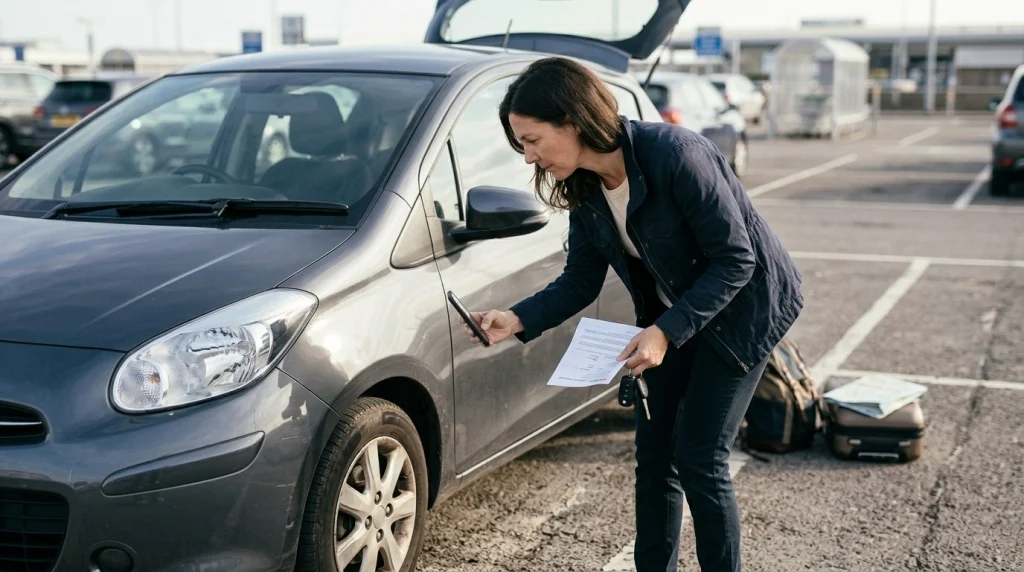
Before you reserve a vehicle, confirm that you’re legally allowed to drive, understand the contract, and can manage the route comfortably. A few checks before payment can prevent expensive surprises after arrival.
Use this pre-booking checklist
- Driving eligibility: Check the minimum age, license validity, required years of driving experience, and whether an international driving permit is needed.
- Local laws: Confirm which side of the road people drive on, applicable speed limits, seat-belt requirements, and rules about phone use.
- Vehicle suitability: Choose a car that fits your luggage and route without being unnecessarily large or difficult to park.
- Rental reputation: Review the company’s terms, pickup process, customer support, and after-hours assistance.
- Insurance details: Confirm liability cover, collision protection, excess, exclusions, and the process for reporting damage.
- Payment requirements: Check the accepted payment method, deposit, cardholder rules, and possible foreign transaction fees.
- Pickup arrangements: Verify the exact collection point, opening hours, documents required, and after-hours procedures.
- Return arrangements: Check the deadline, fuel policy, return location, and procedures for documenting the vehicle’s condition.
- Accommodation parking: Confirm availability, fees, security arrangements, and access times before finalizing your stay.
- Emergency support: Save the rental company’s phone number, roadside assistance details, and local emergency contacts.
Inspect the vehicle before driving away
Take a few minutes to inspect the car before leaving the pickup location. This gives you a record of its condition and a chance to address obvious problems before they become your responsibility.
- Photograph existing scratches, dents, wheel damage, and windscreen marks.
- Check that headlights, indicators, brake lights, mirrors, and seat belts work.
- Confirm the fuel level and the type of fuel the car requires.
- Locate the spare tire or repair kit, warning equipment, and emergency instructions where supplied.
- Make sure you understand how to operate the lights, parking brake, and essential controls.
- Ask the rental agent to record any damage that isn’t already listed on the agreement.
Keep the rental agreement and inspection photos accessible throughout the trip. If you notice a safety issue, ask the company to address it before departing.
Choose the right type of vehicle
A compact car is often easier to maneuver and park in cities, while a larger vehicle may suit bulky luggage or particular road conditions. The right choice depends on the route rather than the idea that a bigger vehicle is always safer.
Consider an automatic transmission if that’s what you’re comfortable driving. Familiar controls can reduce distractions when you are already adjusting to unfamiliar traffic.
For international travel, confirm whether your home driving license is accepted. Some destinations require an international driving permit alongside the original license, and the rules depend on the destination and license-issuing country.
Section takeaway: Book only after verifying eligibility, insurance, payment requirements, and the route. A transparent rental agreement and a suitable vehicle are more valuable than a bargain with unclear conditions.
Frequently Asked Questions About Renting a Car for Solo Travel
Is renting a car worth it for a solo female traveler?
Renting a car can be worthwhile when you need to visit rural destinations, make several stops, or travel on schedules that public transport cannot support. It may be unnecessary in walkable cities with reliable transit. Compare the full cost, driving conditions, and alternatives before booking.
Is it safe for a woman to drive alone in a foreign country?
It can be, provided local laws allow it and the route suits your driving experience. Research destination-specific road conditions, local customs, insurance requirements, and emergency procedures. Avoid driving when tired, unfamiliar with the route, or uncomfortable with the traffic conditions.
Is renting a car cheaper than using taxis?
It depends on the distance, rental period, fuel prices, insurance, parking, and taxi fares. A rental may be economical for several long journeys, while occasional taxis can cost less for a short city break. Compare the total cost of reaching the same destinations.
Should I rent a car for a solo city trip?
Usually, you can skip the rental if the city has convenient public transportation, walkable attractions, and reliable licensed taxis or ride-hailing services. A car becomes more useful when you plan day trips beyond the urban area or need to reach places that transit serves poorly.
What insurance should a solo traveler get for a rental car?
Confirm the required liability coverage and understand collision or loss damage protection, theft coverage, deductibles, and exclusions. Check whether your existing auto policy, credit card, or travel insurance provides relevant benefits. Coverage varies by country, provider, and contract, so verify the terms directly.
Should I rent a car for my entire solo trip or only part of it?
Renting for part of the trip often makes sense when your itinerary combines cities and rural destinations. Use trains or buses for convenient intercity travel, then collect a car for remote areas. This can reduce rental days, parking expenses, and unnecessary driving.
What if I’m nervous about driving alone?
You don’t have to rent a car to travel independently. Start with familiar routes if you want to build confidence, or use public transport, licensed taxis, and reputable guided excursions. Choose the method that lets you explore comfortably without feeling pressured to take risks.
The Bottom Line: Should You Rent a Car?
For solo female travelers, renting a car is a useful option rather than a universal rule. It can make rural exploration easier, but it also adds responsibility, costs, and potential driving stress.
Before booking, ask yourself three questions:
- Will a car help me reach places that would otherwise be difficult to visit?
- Can I comfortably manage the roads, local rules, insurance, and total cost?
- Is driving a better choice than public transportation, a licensed driver, or an organized tour for this particular itinerary?
If your answers point toward renting, book a suitable vehicle, verify the terms, and plan your driving days carefully. If they don’t, choose another option without feeling that you’re sacrificing independence.
The best solo trip is one that gives you room to explore while allowing you to make confident, informed decisions at every stage.
Travel-planning note: Recheck official destination advice, driving rules, and insurance terms before departure, since conditions and requirements can change.