How Can a Woman Choose Between Taxi and Public Transportation Alone?
Quick Answer
A woman traveling alone should choose between a taxi and public transportation based on local safety conditions, time of day, route familiarity, cost, and the reliability of the service. A verified, licensed taxi or reputable app-based ride may be preferable late at night, on unfamiliar routes, or when carrying luggage, while reliable public transportation can be a practical daytime option on well-used routes. Neither option is automatically safer everywhere, so check your destination’s official guidance for women travelers before deciding.
What to compare before choosing
- Personal safety: Check driver verification, station conditions, crowding, lighting, and local crime warnings.
- Time of day: Prefer a trusted, prearranged ride when late-night transit is limited or local guidance warns against traveling alone.
- Total cost: Compare the full taxi fare with transit tickets, transfers, and any additional fees.
- Route convenience: Consider walking distance, waiting time, luggage, and whether you must change vehicles.
- Backup options: Choose transport that lets you reach a staffed, public location or contact someone you trust if plans change.
One important rule
- Never board an unverified vehicle just because its driver offers a convenient or cheaper ride.
- Share your route with a trusted contact and change your plan if the situation feels unsafe.
Choosing between a taxi and public transportation alone can feel like a small decision with big consequences, especially when you’re exploring an unfamiliar city. I believe the best choice comes from weighing practical details rather than relying on blanket rules about which option is safest.
This guide explains how to compare both options, recognize warning signs, manage your budget, and make confident transportation decisions during a solo trip. The goal is to help you move independently without taking unnecessary risks.
In This Guide
What Makes a Taxi or Public Transportation Safer?

Neither taxis nor public transportation guarantee personal safety for women traveling alone. The better option depends on the destination, the specific service, the route, and the circumstances of your journey.
Understand the meaning of safe transportation
For solo female travelers, safe transportation means choosing a reasonably reliable way to reach a destination while reducing exposure to preventable risks. These include harassment, theft, unlicensed drivers, unsafe driving, isolation, and difficulty getting help when something goes wrong.
Safety also involves the journey before and after the ride. A well-reviewed taxi may still leave you on an isolated street, while a train ride may require a long walk through a poorly lit station after dark.
Check the destination before choosing
Local conditions matter more than general travel advice. A city with dependable trains, clear signage, and busy stations may be easy to navigate by public transport, while another destination may have limited nighttime service or serious concerns about particular routes.
Before leaving, check these details:
- Official travel advice: Look for warnings about transport-related crime, harassment, road safety, and nighttime travel.
- Local transport rules: Find out which taxi companies, ride-hailing services, trains, or buses authorities recommend.
- Service availability: Check operating hours, station access, and whether your return journey is practical.
- Recent disruptions: Look for strikes, demonstrations, severe weather, or other conditions that could affect your route.
The U.S. Department of State provides a useful starting point through its country-specific travel guidance. Other national travel advisory services can provide additional perspectives.
Pro tip: Review the transport and personal-safety sections of an official travel advisory, then confirm local conditions with your accommodation or transport provider before departure.
Consider how the journey feels in practice
Distance alone doesn’t determine which option is best. A short taxi ride with an unknown driver can present different concerns from a longer journey on a well-established metro line.
Similarly, a crowded bus may make you more vulnerable to unwanted contact or pickpocketing, while a taxi can create risks if you cannot verify the vehicle or driver. Assess the complete journey instead of judging transport by its label.
The practical takeaway
Choose the option with the strongest combination of local reliability, verifiable service details, manageable surroundings, and a clear backup plan.
Taxi vs. Public Transportation: Which Should You Choose?
A taxi is often more convenient for direct, door-to-door travel, while public transportation can be more economical and predictable on established routes. Your choice should depend on the actual services available rather than assuming one option is always safer.
The following comparison can help you evaluate a typical journey. These are general considerations, not guarantees about every destination.
| Factor | Taxi or ride-hailing | Public transportation |
|---|---|---|
| Personal safety | Depends on driver verification, licensing, and trip monitoring. | Depends on route, crowding, station conditions, and service reliability. |
| Cost | Usually costs more per passenger for a short solo journey. | Often costs less, particularly on frequent urban routes. |
| Convenience | Can provide direct pickup and drop-off. | May require transfers and walking to stops. |
| Night travel | May suit the journey if the service is trusted and locally recommended. | Can be unsuitable if service is limited or local guidance warns against it. |
| Luggage | Generally easier for heavy bags or several pieces of luggage. | Can be awkward on stairs, crowded vehicles, or multiple transfers. |
| Navigation | Requires checking the driver, destination, and route. | Requires understanding routes, stops, tickets, and connections. |
| Best potential fit | Airport transfers, heavy luggage, direct routes, or unsuitable transit conditions. | Familiar daytime routes with dependable service and manageable station access. |
Compare the full cost, not just the ticket price
Public transport usually offers a budget advantage, but the cheapest ticket doesn’t always mean the lowest overall travel cost. Consider extra transfers, station-to-hotel walking, luggage storage, and the possibility of needing a taxi for the final stretch.
For example, imagine that a metro ticket costs $3 and a verified taxi costs $24. If the metro runs directly to your destination during the day, the savings may make it an easy choice.
However, if that same metro journey ends after service hours or requires a long walk through an unfamiliar area, the taxi may offer better overall value. These figures are illustrative, not current fares for a specific city.
Balance convenience with control
Public transportation gives you access to established stops and predictable routes when services operate reliably. Taxis can reduce walking and transfers, but you need to verify the driver and monitor the journey.
For women traveling alone, the useful question isn’t simply, “Which is safer?” It’s, “Which available option gives me the best combination of safety, convenience, and control for this particular trip?”
When Should a Woman Choose a Taxi?
A taxi or reputable ride-hailing service may be the better choice when it reduces exposure to an identified local risk or makes a difficult journey easier to manage. The important distinction is between a verified service and an unlicensed or unknown driver.
When arriving at an airport with luggage
Airport arrivals can be tiring, especially after a long flight or when you’re navigating a new country for the first time. Heavy luggage, unfamiliar signs, and limited local knowledge can make arranging transport more complicated.
Consider booking an airport transfer through your accommodation or an established transport provider. Confirm the pickup location, vehicle details, and price before you travel.
Avoid accepting unsolicited offers from people who approach you inside the terminal or outside the official pickup area. If a driver claims to represent your booking, verify the details through the company’s official channel.
When traveling after dark
A verified taxi may be preferable when public transport has stopped running, stations are isolated, or local authorities advise against traveling alone at night. However, nighttime doesn’t automatically make every taxi safe.
Before accepting a ride, check that the vehicle and driver match the booking. If you cannot verify them, don’t get in simply because you’re tired or in a hurry.
For a late arrival, arranging transport in advance can reduce the time you spend waiting outside. Keep your accommodation informed about your expected arrival when appropriate.
When your route involves several transfers
Multiple transfers can become stressful when you don’t know the local language, your phone battery is low, or you need to navigate a complicated station. A direct taxi can simplify the journey if the service is trustworthy and the fare fits your budget.
Compare the actual alternatives first. A single direct train may be easier than a taxi through unfamiliar streets, while a train followed by two buses might create unnecessary complexity.
When local travel guidance raises concerns
Some destinations have specific warnings about certain buses, informal taxis, nighttime journeys, or particular areas. In these cases, follow the destination-specific guidance instead of applying a universal rule.
For example, the UK’s official Bangladesh travel advice warns against solo public transport use in its current guidance, particularly in relation to nighttime travel. That is a destination-specific warning, not a rule that applies to every country. Read the Bangladesh safety and security advice if you’re planning to visit.
Even where a taxi is the recommended alternative, verify the provider and arrange the journey through a trusted channel. Local guidance may distinguish between registered taxis, app-based services, and informal vehicles.
Taxi decision checklist
- The company or booking channel is reputable.
- The vehicle registration, model, and driver details match your booking.
- The pickup point is suitable and the destination is confirmed.
- You can share the journey details with someone you trust.
- The fare or payment arrangement is clear before departure.
Section takeaway: Choose a taxi when it offers a verifiable service and solves a genuine problem with your route, timing, luggage, or local safety conditions.
When Is Public Transportation a Better Choice?
Public transportation can be an excellent option for women traveling alone when the service is reliable, the route is manageable, and local safety guidance supports its use. Trains, metros, and buses can help you explore independently without paying for a private ride each time.
When the route is familiar and straightforward
A direct train or bus between well-used stops can remove the uncertainty of negotiating a fare or explaining directions to a driver. It can also make your travel time easier to estimate when services run frequently.
Before setting out, check the correct direction, stop name, ticket requirements, and final departure time. Download an offline map or save your route details if you may lose mobile coverage.
When you want to protect your travel budget
Transport costs can add up quickly during a solo trip because you pay the full cost of each private ride yourself. Using public transportation for suitable journeys can free up money for accommodation, meals, sightseeing, or emergency expenses.
Compare a daily or multi-day transit pass with individual fares before purchasing one. A pass is worthwhile only if you expect to make enough eligible journeys to justify its price.
For budget planning, include the cost of getting to and from stations. A cheap ticket may be less useful if it leaves you with expensive last-mile transport at the end of the route.
When you can travel during busy daytime hours
Well-used daytime routes may feel easier to navigate because shops, staffed stations, and other passengers are nearby. This can be reassuring when you’re learning how a city’s transport network works.
However, busy spaces can also create opportunities for pickpocketing, unwanted physical contact, or harassment. Crowds should never be treated as a guarantee of safety.
Choose a carriage or seating area where you feel comfortable, keep your belongings secure, and move away if another passenger behaves inappropriately. If a vehicle or station feels unsafe, consider changing your route or choosing another transport option.
When local services have useful safety features
Some transport networks provide features that help solo travelers manage their journeys. Depending on the destination, these may include staffed stations, clear emergency procedures, live arrival information, reserved seating, or designated passenger areas.
Check whether these features exist on the route you intend to use rather than assuming they are available throughout the network. A well-supported route may be a better choice than one with long waits and poorly connected stops.
For additional advice, Smartraveller’s guidance for solo travelers covers practical precautions for public transport and other journeys.
When a mixed approach works best
You don’t have to choose one transportation method for your entire trip. Many solo travelers can use public transport for straightforward daytime journeys and reserve taxis for airport transfers, late arrivals, or routes where transit is impractical.
This flexible approach helps control costs without making budget savings the only consideration. It also allows you to adjust as your knowledge of the destination improves.
Section takeaway: Use public transportation when local guidance supports it and the route offers a manageable balance of convenience, cost, and personal safety.
How Can You Make Either Option Safer?
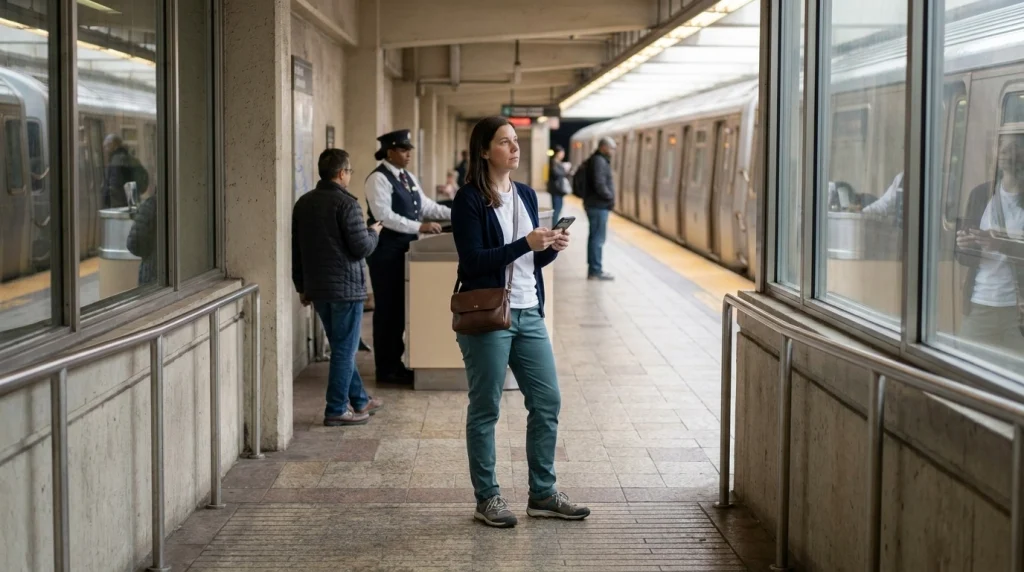
Good preparation can reduce avoidable transport risks, regardless of whether you take a taxi, train, metro, or bus. Focus on verifying the service, protecting your belongings, and maintaining a realistic backup plan.
How to take a taxi or ride-hailing service safely
Choose a licensed taxi company or reputable ride-hailing service recommended for your destination. When possible, book through an official app, your accommodation, or an authorized taxi stand.
Before getting in, follow these steps:
- Check the vehicle: Match the registration number, make, and model with the booking details.
- Verify the driver: Compare the driver’s photo and identifying information when the service provides them.
- Confirm the destination: Make sure the driver understands where you’re going before the journey starts.
- Share the trip: Send the journey details or enable live location sharing with a trusted contact when possible.
- Monitor the route: Follow the trip on your own map and speak up if the driver takes an unexplained detour.
These precautions are particularly useful when you arrive somewhere unfamiliar or book a ride at night. Official guidance from the U.S. Department of State also recommends researching reputable transport providers and considering app-based services with trip records.
How to use buses, trains, and metros more confidently
Public transport safety begins before you board. Learn the route and identify the stop where you need to get off, especially if announcements are unfamiliar or you don’t speak the local language.
Use these precautions throughout your journey:
- Choose your waiting area carefully: Stay in designated, reasonably well-lit areas and use staffed facilities where available.
- Keep valuables secure: Close bags and keep phones, wallets, and passports out of easy reach.
- Manage crowding: Avoid packed vehicles when practical, particularly when you cannot protect your belongings or maintain personal space.
- Stay alert: Keep track of your stop and avoid becoming completely absorbed in your phone.
- Know your exit: Identify a suitable place to get off or seek assistance if you become uncomfortable.
On overnight journeys, consider reserved seating where available and avoid isolated carriages. If a fellow passenger makes you uncomfortable, move toward staff or other people rather than feeling obliged to remain in place.
What should you do if a journey feels unsafe?
You don’t need proof of danger before changing your plans. If something feels wrong, prioritize reaching a safer location over saving money or avoiding embarrassment.
Depending on the situation, you can:
- Decline a taxi if the driver or vehicle does not match your booking.
- Leave a station or waiting area where you feel threatened, if you can do so safely.
- Move toward transport staff, security personnel, an open business, or another staffed public place.
- Contact a trusted person and explain your location and concern.
- Call local emergency services if you face an immediate threat.
Keep your phone charged and carry enough money to change your transport plan if necessary. Save the local emergency number before traveling, because emergency numbers and response arrangements differ between countries.
Protect your personal information
Share your journey details with someone you trust, but avoid posting your live location publicly. Don’t tell unfamiliar people where you’re staying or reveal your full accommodation details unnecessarily.
When booking transport, use legitimate services and avoid sharing unnecessary personal information with a driver. If a driver asks intrusive questions that make you uncomfortable, you can keep your answers brief.
Pro tip: Review the destination-specific advice from your government and local authorities before travel. Official guidance is more useful than relying exclusively on social media anecdotes or generic safety rankings.
Section takeaway: Verify the service, protect your belongings, and keep an exit strategy ready. You can change your transportation choice at any point when circumstances change.
How Do You Decide for Each Trip?
The easiest way to choose between a taxi and public transportation is to assess the journey before leaving. A short decision process helps you weigh safety, timing, convenience, and cost without overthinking every ride.
Use this five-step decision process
- Check local advice: Identify any transport restrictions, warnings, or recommended providers for your destination.
- Compare the route: Check travel time, transfers, walking distance, station conditions, and pickup arrangements.
- Consider the timing: Account for daylight, service hours, expected crowds, and how you’ll reach your final destination.
- Review your circumstances: Factor in luggage, fatigue, familiarity with the area, phone battery, and your comfort level.
- Choose a backup: Identify another reasonable option in case your first choice becomes unavailable or feels unsafe.
This process doesn’t require you to calculate a perfect safety score. It helps you recognize when one option offers clear advantages over the other.
How would the decision change in common situations?
| Situation | Option to consider first | Reason |
|---|---|---|
| Daytime sightseeing on a direct metro route | Public transportation | It may be economical and easy to navigate. |
| Late airport arrival with heavy luggage | Prearranged, verified transfer | It can reduce waiting, transfers, and luggage handling. |
| An unfamiliar journey with several transfers | Compare both options | A direct, trusted ride may simplify navigation. |
| Destination warns against solo bus travel | A locally recommended alternative | Destination-specific safety advice takes priority. |
| Unverified taxi driver approaches you | Decline and find a verified service | Convenience isn’t worth boarding an unverified vehicle. |
Build flexibility into your travel budget
Planning for an occasional taxi can make a solo trip more manageable without requiring you to use private transport for every journey. Set aside a reasonable contingency amount based on the destination and the cost of local rides.
You can then use public transportation when it makes sense and switch to a trusted taxi when conditions warrant it. This approach gives you options instead of forcing you to make every decision based on the lowest price.
For broader trip planning, check your government’s solo-travel guidance and the destination’s official transport information. The UK government’s solo and independent travel guidance offers additional advice on preparing for journeys and handling unexpected problems.
Section takeaway: Make transport decisions one journey at a time. The right choice can change with the route, time, local conditions, and your own needs.
Frequently Asked Questions
1. Is a taxi safer than public transportation for a woman traveling alone?
Not necessarily. A licensed taxi or reputable ride-hailing service can offer convenient, trackable travel, while a reliable public transport network can be practical on established routes. Compare local safety advice, service verification, timing, and route conditions before deciding.
2. Should women traveling alone avoid public transportation at night?
There is no universal rule for every destination. Check official local guidance, service hours, station conditions, and nighttime crime warnings. If authorities advise against solo nighttime transit, follow that advice and arrange a reputable alternative rather than assuming a busy bus or train will be safe.
3. Are ride-hailing apps safer than regular taxis?
Ride-hailing apps may provide driver details, vehicle registration, trip records, and location sharing. These features can improve accountability, but they don’t guarantee safety. A reputable licensed taxi booked through a trusted provider can also be a suitable option, depending on local conditions.
4. How can I avoid taxi scams when traveling alone?
Book through an official app, authorized taxi stand, accommodation, or reputable transport company. Confirm the vehicle and driver details, clarify the fare or payment method, and avoid unsolicited rides from people claiming to be official drivers. Never board a vehicle that doesn’t match your booking.
5. What should I choose when traveling on a tight budget?
Use reliable public transportation for straightforward journeys when local guidance supports it. Compare single tickets with transit passes and account for transfers and walking distances. Keep some money available for a reputable taxi when safety, luggage, or an unexpected disruption makes it the more practical choice.
6. Is it safe to travel alone by bus or train in an unfamiliar country?
It depends on the country, route, time, and service. Research official travel advice, use established transport providers, secure your belongings, and understand your route before boarding. Avoid isolated carriages when possible and follow local warnings about particular services or nighttime journeys.
7. What should I do if I feel unsafe during a taxi or public transport journey?
If possible, move toward a staffed public area or another suitable place where you can seek assistance. Contact someone you trust and share your location. If you face an immediate threat, contact local emergency services and follow their instructions. Your safety matters more than avoiding inconvenience.
Final Takeaway: Choose the Transport That Fits the Situation
Choosing between a taxi and public transportation alone is about balancing personal safety, convenience, cost, and local knowledge. Neither option is automatically best for every woman or every destination.
Use dependable public transport when the route and local conditions make it a sensible choice. Choose a verified taxi or prearranged transfer when it offers a safer or more manageable alternative for your particular journey.
Most importantly, research before departure, verify your transport, share your plans with someone you trust, and give yourself permission to change course. Solo travel becomes easier when you prepare thoughtfully and trust yourself to make adjustments along the way.
Before your next trip, review the destination’s official travel guidance and save a few reliable transport options. A little preparation can help you travel with greater confidence and independence.