How Can a Woman Verify a Taxi Before Getting In Alone?
Quick Answer
A woman traveling alone can verify a taxi by checking its registration plate, confirming the driver’s identity, inspecting official taxi markings, and matching the vehicle to her booking before entering. Choose a licensed taxi, an authorized taxi stand, or a reputable ride-hailing service whenever possible, and reject any ride that fails basic checks. For destination-specific advice, consult the U.S. State Department’s international travel safety guidance.
Five checks before entering
- Vehicle identity: Match the registration plate, make, model, and color to your booking.
- Driver identity: Compare the driver with the app profile or official identification where available.
- Legitimate service: Use a licensed taxi, recognized operator, or authorized pickup point.
- Journey details: Confirm the destination and fare arrangement before departing.
- Personal judgment: Decline the ride if details do not match or the driver pressures you to ignore a safety check.
One rule to remember
- Stay somewhere staffed and well-lit while arranging another ride if verification fails.
- Share your trip details with a trusted person and keep your phone accessible.
Knowing how can a woman verify a taxi before getting in alone is an important part of solo female travel safety. Whether you’re leaving an airport, returning from dinner, or exploring an unfamiliar city, a few simple checks can help you make a more informed transportation decision.
I recommend treating taxi verification as a normal part of every journey, not something you do only when a situation feels suspicious. This guide explains what to check, which warning signs matter, and how to respond when a ride doesn’t seem right.
In This Guide
What Should a Woman Check Before Entering a Taxi?
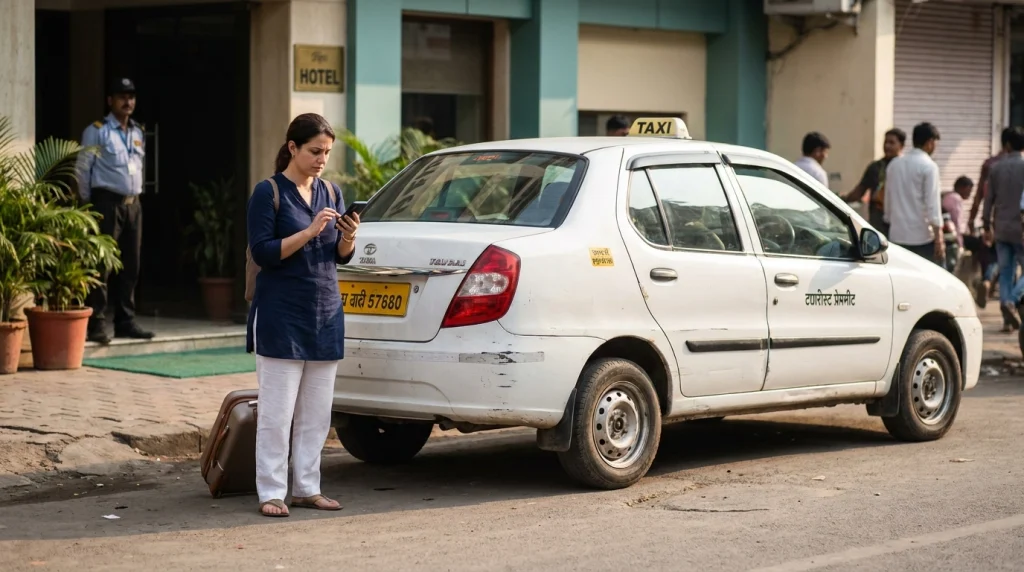
A woman should verify the vehicle, driver, service credentials, and journey details before opening the door. These checks help establish whether the car is the transportation she intended to use.
Taxi verification means checking the available evidence that a vehicle and its driver belong to a legitimate transportation service or confirmed booking. It reduces avoidable uncertainty, although it cannot guarantee personal safety.
1. Match the registration plate
Start with the vehicle’s registration plate, sometimes called a license plate. If you booked through an app, compare every visible character with the registration number displayed in your booking.
Check the front or rear plate, depending on local vehicle design and visibility. If the number differs, don’t assume it’s a harmless mistake; contact the operator through its official channel.
2. Confirm the vehicle’s make, model, and color
A matching plate is important, but the rest of the vehicle should match too. Compare its make, model, color, and any other identifying details shown in your reservation.
Several cars may look similar at a busy airport or hotel entrance. Never enter the first vehicle that stops simply because its driver claims to be your taxi.
3. Look for legitimate taxi identification
Licensed taxis may display a taxi sign, company branding, an official permit, or a driver identification card. The exact requirements vary by country and city, so research what legitimate taxis look like at your destination.
A plain vehicle isn’t automatically unsafe because some authorized services use unmarked cars. However, an unknown driver approaching you without a verifiable booking deserves more caution than a ride arranged through a recognized service.
4. Check the vehicle’s condition
Look for obvious problems that could affect the journey, including damaged doors, unsafe tires, missing seat belts, or doors that don’t open properly. A vehicle that appears mechanically unsafe is a reason to choose another ride.
Once inside, buckle your seat belt. If the car has no usable seat belt where you need to sit, consider another transportation option.
Practical tip
Complete your checks before entering the vehicle, preferably from a staffed, well-lit location. You don’t need to stand close to traffic or approach an unfamiliar driver to inspect a plate.
How Can You Verify the Driver and Booking?
You can verify a driver by comparing their identity with the booking details, confirming the trip through the official service, and checking that the driver knows the correct pickup arrangement. If any important detail conflicts, pause the journey until the operator resolves it.
Compare the driver with the app profile
For app-based rides, check the driver’s name and profile photo against the person arriving. Ask the driver to confirm the passenger’s name rather than announcing your name first.
Some services use additional verification features, such as PINs or ride codes. Use them when available, and never share a code with someone whose identity or booking you haven’t confirmed.
Verify the booking independently
Open the original app or confirmation message to review the trip. Check that the booking is active and that the driver, vehicle, pickup location, and destination correspond to your reservation.
If a driver says the app is broken or asks you to cancel the booking and pay privately, stop and assess the situation. Contact customer support through the official app or website instead of relying on a number supplied by the driver.
Confirm the destination and fare
Before departing, make sure the driver understands your intended destination. For metered taxis, ask how the meter works; for fixed-price or app-based journeys, confirm the agreed fare and any applicable fees.
You don’t need to disclose your accommodation details beyond what’s necessary to complete the trip. If you’re concerned about revealing your hotel, consider a nearby staffed entrance or another safe, convenient drop-off point.
Share the journey details
Send a trusted contact the vehicle registration, driver’s name, booking information, and expected arrival time when practical. If your service supports live location sharing, enable it for the trip.
Keep your phone charged and save the destination address in advance. The U.S. State Department also recommends offline navigation, sharing your itinerary with someone you trust, and researching transportation options before travel.
Pro tip: Check the official travel advice for your destination before arrival, because taxi licensing, booking systems, and transport risks differ by location. The UK government’s foreign travel advice service is one resource for checking destination-specific safety guidance.
What Are the Warning Signs of an Unsafe Taxi?
Warning signs include mismatched vehicle details, an unverified driver, pressure to abandon a confirmed booking, unexplained extra passengers, or refusal to follow the agreed destination. One concern doesn’t automatically prove criminal intent, but you don’t have to accept a ride you cannot verify.
Pay attention to behavior as well as paperwork. A professional driver should allow reasonable checks without pressuring you to ignore them.
Warning signs to take seriously
- Incorrect registration: The vehicle’s plate doesn’t match your booking.
- Different driver: The person arriving doesn’t match the app profile or confirmed driver information.
- Unexpected payment demands: The driver insists on cash or a private payment that contradicts the booking terms.
- Pressure to hurry: The driver urges you to enter before you can check the vehicle.
- Unplanned passengers: Other people are inside a vehicle booked for a private ride, without your agreement.
- Unclear credentials: A driver claims to be an official taxi but cannot satisfy the relevant local verification requirements.
- Unexplained route changes: The driver refuses your destination or proposes an unexpected detour without a reasonable explanation.
- Boundary violations: The driver makes threatening comments, repeatedly asks intrusive questions, or ignores your requests.
Trust the facts you can verify rather than relying only on a driver’s confidence or friendly manner. Equally, don’t assume that a particular accent, appearance, or nationality proves someone is dangerous.
When should you refuse the ride?
Refuse a ride if essential booking details don’t match, the driver pressures you to bypass verification, or the vehicle appears unsafe. You can also decline simply because you’re uncomfortable with the circumstances.
You don’t need to prove that a driver has bad intentions before choosing another option. Move toward a staffed business, hotel reception, airport information desk, or authorized taxi stand and arrange a replacement ride.
Which Taxi Option Is Easier to Verify?
For many solo travelers, an app-based ride with identifiable driver and vehicle details or a licensed taxi arranged through a reputable hotel or official taxi stand offers a clearer verification process. The best option depends on local regulation, the service’s reliability, and conditions at your destination.
Here is how common transportation choices compare when your priority is checking who will drive you.
| Transport option | What you can check | Main limitation |
|---|---|---|
| App-based ride | Driver profile, vehicle details, registration, and booking record when provided. | App information can be inaccurate or a vehicle can arrive that doesn’t match. |
| Licensed street taxi | Official markings, permits or identification where required, meter, and registration. | Driver details and trip tracking may be limited. |
| Hotel-arranged taxi | Pickup arrangements, operator information, and a hotel record of the booking. | You should still confirm the arriving vehicle and driver. |
| Official airport taxi | Authorized dispatch or queue arrangements, fare information, and vehicle identification. | Procedures and reliability vary between airports. |
| Unsolicited private ride | Often fewer independently verifiable details. | Identity, authorization, fare, and accountability may be unclear. |
This comparison describes typical verification opportunities, not a universal safety ranking. An official taxi may be preferable in one city, while a reputable app-based service may be more practical in another.
How should you choose at an airport?
Airports can be confusing after a long flight, especially when several people offer transportation near the arrivals exit. Decide how you’ll reach your accommodation before landing whenever possible.
- Use official channels: Follow airport signs to an authorized taxi rank or booking desk.
- Confirm the meeting point: Check the terminal, pickup zone, and driver’s instructions before leaving the building.
- Check the fare: Establish whether the trip uses a meter, a published fixed rate, or an app estimate.
- Keep a backup: Know where to find airport staff or how to book another legitimate service.
For longer trips, late arrivals, or destinations with limited transport options, a prearranged transfer may reduce the need to negotiate transportation on arrival. However, verify the provider and vehicle even when the ride was arranged in advance.
What Should You Do If Something Feels Wrong?

If a taxi fails a safety check, don’t get in; if you’re already inside and feel threatened, prioritize reaching a safe, populated location and contacting local emergency services when necessary. Your immediate goal is to preserve your options, not to confront the driver or prove that something is wrong.
Before entering the vehicle
- Pause the pickup: Stay at a safe distance while you review the booking details.
- Contact the service: Use the official app, booking desk, or operator telephone number to resolve discrepancies.
- Cancel if needed: Decline the ride when verification fails or the circumstances remain uncomfortable.
- Move to safety: Wait inside a staffed building or in a well-lit, populated area.
- Arrange another ride: Request a replacement vehicle or ask trusted accommodation staff for help.
Don’t feel obliged to explain your decision in detail. A simple statement that the booking doesn’t match is enough, and you can leave without further discussion if it is safe to do so.
If you’re already in the taxi
If the driver takes an unexpected route or changes the arrangements, ask calmly for clarification when doing so is safe. Compare the route with your navigation app, and tell the driver clearly if you want to return to the agreed route or stop at a suitable public location.
If the situation escalates, avoid arguing or physically confronting the driver. Contact local emergency services if you face an immediate threat, and use available ride-service safety features or location sharing when possible.
- Stay connected: Contact a trusted person and share your location if you can do so safely.
- Choose a public destination: Where practical, request a stop at a staffed business, hotel, or other populated place.
- Seek immediate help: If you’re threatened, prevented from leaving, or believe you’re in immediate danger, contact local emergency services.
- Report the incident: Once safe, save booking details and report the driver’s behavior to the operator or appropriate local authority.
The U.S. National Highway Traffic Safety Administration also recommends confirming a ride’s registration and driver identity, waiting in a safe pickup location, and using a seat belt. Its ride-hailing and taxi safety guidance offers additional practical reminders.
Prepare a simple taxi safety plan
A short routine is easier to follow when you’re tired, distracted, or arriving somewhere unfamiliar. Prepare these essentials before you need them.
- Save your accommodation address and a map of the destination.
- Keep your phone charged and have a backup charging option for longer journeys.
- Save local emergency numbers and the official contact details for your transport provider.
- Tell someone you trust when you’re taking a longer or late-night ride.
- Identify an alternative transport provider or a staffed place where you can wait safely.
Section takeaway: Verify the driver and vehicle before boarding, and keep a backup plan throughout the journey. If something changes in a way you cannot reasonably explain, reassess the ride rather than ignoring the concern.
Frequently Asked Questions
1. Should I ask a taxi driver to show identification?
Yes, when identification is part of the local licensing system or your booking requires it. Compare the driver’s information with your reservation or official taxi credentials, and contact the operator if the details conflict.
2. Is it safe to get into a taxi without an app?
It can be reasonable to use a licensed taxi booked through an official stand, reputable operator, or accommodation provider. Check its registration, required taxi identification, driver credentials where available, and fare arrangement before entering.
3. What if the taxi’s license plate doesn’t match the app?
Don’t enter the vehicle. Check the booking again and contact the service through its official app or support channel. Request a correctly identified replacement, and wait somewhere safe while the issue is resolved.
4. Should I sit in the back seat when traveling alone?
The back seat can give you more personal space, but seating position alone doesn’t establish whether a ride is safe. Prioritize a verified driver and vehicle, a working seat belt, an appropriate route, and a seat from which you can communicate or exit safely.
5. What should I do if a taxi driver asks personal questions?
You don’t have to share your accommodation, travel schedule, or personal details beyond what’s necessary for the ride. If questions become intrusive or threatening, keep your response brief, share your location when safe, and consider ending the journey at a suitable public location.
6. Is a hotel-arranged taxi always safe?
No transport arrangement guarantees safety. A hotel-arranged ride may provide a useful booking record and an identifiable operator, but you should still confirm the arriving vehicle, driver, destination, and fare before getting in.
Final Takeaway: Verify First, Then Get In
Knowing how can a woman verify a taxi before getting in alone makes it easier to approach unfamiliar transportation with a clear plan. Check the registration plate, match the driver to the booking, confirm the destination, and choose a legitimate service with information you can independently verify.
Most importantly, give yourself permission to decline a ride that doesn’t meet your expectations. You don’t need to be certain that danger exists before choosing another option.
Before your next solo trip, research local taxi practices, save emergency contacts, and decide how you’ll reach your accommodation. A few minutes of preparation can make your transportation decisions more informed and less stressful.