How Can a Woman Plan Around Unpredictable Weather on a Solo Trip?
Quick Answer
A woman can plan around unpredictable weather on a solo trip by building flexibility into her itinerary, checking short-range forecasts each day, and preparing one indoor backup for important outdoor plans. I also recommend checking official international travel guidance before departure when severe weather could affect safety or transportation.
My Simple Weather-Proof Planning Method
- Keep days flexible: Avoid locking every activity to one exact hour when weather could change.
- Check twice daily: Review the forecast before bed and again before leaving your accommodation.
- Create Plan B: Pair important outdoor activities with nearby indoor alternatives.
- Pack adaptable layers: Choose clothing that handles temperature changes, wind, and light rain without filling your bag.
- Protect transport time: Leave extra time before flights, trains, ferries, and long-distance buses when bad weather is possible.
- Know your stop point: Cancel or move an activity when official warnings or unsafe conditions appear.
Unpredictable weather can make solo travel feel harder because every decision lands on you. I have found that the answer isn’t planning every possibility; it’s creating a trip that can bend without falling apart.
In 2026, my approach is simple. I separate the parts of my itinerary that must happen from the parts I can move when rain, heat, wind, snow, or storms change the day.
In This Guide
- How do you build a solo itinerary that survives bad weather?
- How often should you check the weather during a solo trip?
- What should a solo woman pack for changing weather?
- How should weather affect bookings and transportation?
- When should you change your plans because of weather?
- Frequently asked questions
- Final takeaway
How Do You Build a Solo Itinerary That Survives Bad Weather?
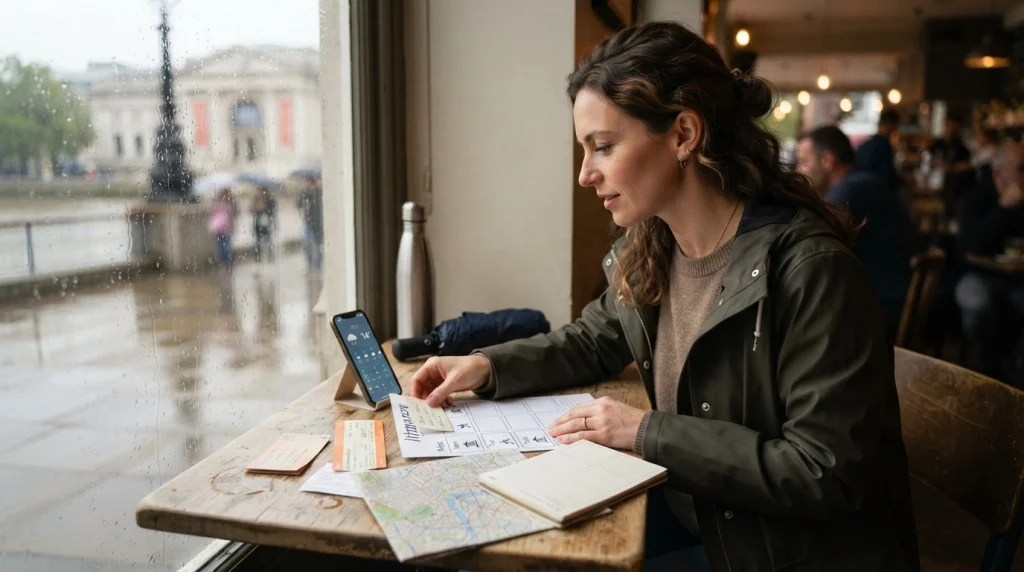
The best weather-proof solo itinerary has priorities instead of a rigid hourly schedule. Decide what must happen, what can move, and what you can skip without ruining the trip.
Weather-flexible solo travel means planning a trip so activities, transportation, clothing, and bookings can adapt when actual conditions differ from the forecast.
Separate fixed plans from movable plans
I start by marking anything with a strict reservation time. Flights, timed museum tickets, guided tours, and long-distance trains usually belong here.
Then I list flexible activities separately:
- Neighborhood walks
- Viewpoints and outdoor photography
- Beaches and parks
- Markets
- Self-guided sightseeing
- Cafés and shopping streets
- Museums with walk-in entry
If Tuesday looks rainy but Wednesday looks clear, I can swap those two days. Nothing needs to be rebuilt from scratch.
Give important outdoor activities more than one chance
I avoid scheduling my most weather-dependent experience on my final day. There is nowhere to move it if the conditions turn bad.
For a four-day city break, I might place an important viewpoint on day two. Day three then becomes a natural backup window.
The same principle works for:
- Mountain hikes
- Boat trips
- Beach days
- Scenic cable cars
- Outdoor observation decks
- Sunrise or sunset excursions
Use geographic clusters
One of my favorite tricks is grouping indoor and outdoor places in the same neighborhood. That makes weather changes much easier to handle alone.
For example, I might pair a riverside walk with a museum ten minutes away. If rain starts, I don’t need to cross an unfamiliar city while searching for something else to do.
| Weather situation | Original plan | Flexible alternative |
|---|---|---|
| Steady rain | Walking tour | Museum, market hall, café route |
| Extreme afternoon heat | Outdoor sightseeing | Early walk, indoor midday break, evening sightseeing |
| Strong winds | Boat or exposed viewpoint | Protected neighborhood or indoor attraction |
| Snow or ice | Long day trip | Stay local and reduce unnecessary transport |
| Thunderstorms | Outdoor attraction | Move indoors and reassess after official alerts |
Section Takeaway: Build spare options into the itinerary before bad weather appears. Moving an existing Plan B is much easier than inventing one while standing alone in the rain.
How Often Should You Check the Weather During a Solo Trip?
I use long-range forecasts for packing and short-range forecasts for decisions. A forecast ten days before departure helps me prepare, but it shouldn’t dictate every hour of the trip.
About one week before departure
Look at the general temperature range and weather pattern. This is the stage for adjusting clothing, footwear, luggage, and major transportation plans.
I check for:
- Expected daytime and nighttime temperatures
- Rain or snowfall patterns
- Heat or cold extremes
- Storm systems
- Strong wind risks
- Destination-specific seasonal hazards
For international travel, I also check destination guidance before leaving. The U.S. State Department’s travel-planning resources include travel advisories and information about weather or natural-disaster alerts.
The night before
This is when I make my practical schedule. Hourly forecasts become more useful than a broad daily rain icon.
A day labeled “rain” might mean showers between 3 p.m. and 5 p.m. That still leaves most of the morning available.
Check again before leaving
Weather can change overnight. I look again while eating breakfast or getting ready.
For trips in the United States, National Weather Service forecasts and alerts are a useful official source. Outside the United States, I look for the destination’s national meteorological service or another official local authority.
Watch alerts, not only forecast icons
A forecast tells you what may happen. An official warning tells you when conditions could require action.
Pay particular attention to alerts involving:
- Severe thunderstorms
- Flash flooding
- Tropical storms or cyclones
- Extreme heat
- Blizzards or heavy snow
- High winds
- Wildfire conditions
- Dangerous coastal or marine conditions
If I’m traveling internationally and eligible to use it, I also consider government traveler-alert services. U.S. travelers, for example, can use the Smart Traveler Enrollment Program for relevant embassy messages.
Pro tip: For severe weather or natural-disaster decisions, confirm conditions through the destination’s official meteorological agency, emergency authority, or government travel advisory rather than relying only on a general weather app.
Section Takeaway: Use forecasts to organize your day, but use official warnings to make safety decisions. The closer you get to an activity, the more weight you should give current conditions.
What Should a Solo Woman Pack for Changing Weather?
The goal isn’t packing for every imaginable disaster. It’s carrying a small set of items that can handle several conditions.
I prefer adaptable clothing because I still have to carry my own luggage. An overloaded suitcase creates its own problems when I am changing trains or walking to accommodation.
Build a layering system
Layers work better than one bulky outfit when temperatures swing during the day. I can add or remove one piece without returning to my room.
- Base layer: A comfortable top suitable for the expected temperature.
- Mid layer: A sweater, fleece, or light insulating layer.
- Outer layer: A packable weather-resistant jacket appropriate for the destination.
For cold destinations, I add proper insulation rather than depending on thin travel layers alone. In wet cold, staying dry becomes especially important.
Choose shoes for the actual conditions
I care more about traction and comfort than getting the perfect travel photo. Slippery streets become much more stressful when I’m navigating them alone.
If meaningful rain is likely, I choose footwear that handles wet pavement. For snow or ice, I research destination-specific footwear needs before departure.
Keep a small weather kit in your day bag
I don’t want every weather item buried inside my suitcase at the hotel. The useful things stay where I can reach them.
- Compact rain protection
- Light extra layer
- Water bottle
- Sunscreen
- Portable phone battery
- Water-resistant pouch for documents or electronics
- Any destination-specific protective gear
Heat deserves as much planning as rain. The CDC’s travel health resources advise travelers to prepare for destination conditions and pay attention to risks such as heat exposure.
When I expect a hot day, I move long walks to cooler hours. I also plan water and indoor rest stops before leaving.
Don’t forget your phone
A charged phone matters more during a weather disruption. It may be your map, boarding pass, translation tool, alert source, ride app, and way to contact your accommodation.
I usually charge mine overnight and carry a small power bank on long sightseeing days. Before leaving Wi-Fi, I also save important addresses and transport details.
Section Takeaway: Pack for adaptability, not every theoretical possibility. A few useful layers, weather-ready shoes, and a charged phone solve more problems than a heavy suitcase full of rarely used gear.
How Should Weather Affect Bookings and Transportation?
I protect the parts of my solo trip that are expensive or difficult to replace. That means treating weather-dependent bookings differently from ordinary sightseeing.
Avoid tight connections when disruption is plausible
A 20-minute delay doesn’t matter much on a café day. It can matter a lot when you’re catching the last ferry or connecting to an international flight.
I build extra time around:
- Airport transfers
- Separate airline tickets
- Train-to-flight connections
- Ferry departures
- Remote day trips
- Mountain transportation
How much buffer you need depends on the route. I don’t use one universal number because a major airport connection and a remote island ferry are completely different situations.
Read cancellation terms before paying
Weather-dependent activities deserve closer attention. A cheap non-refundable booking isn’t always cheap if poor conditions make it unusable.
Before booking, I check:
- Cancellation deadline
- Weather cancellation policy
- Rescheduling options
- Refund method
- Who decides whether conditions are safe
- How the operator sends cancellation notices
Choose accommodation that gives you options
Location matters more when the weather turns unpleasant. I like accommodation with food, transit, and at least one indoor activity within an easy distance.
This doesn’t mean staying in the most touristy neighborhood. It means avoiding a location that leaves me dependent on one exposed walking route or infrequent transport.
Have an arrival backup
I pay extra attention to the weather when arriving after dark. Heavy rain, storms, or snow can make an unfamiliar transport system harder to navigate.
Before landing or reaching the station, I save:
- Accommodation address
- Check-in instructions
- Primary transport route
- One alternative transport option
- Accommodation contact details
If conditions make my original arrival plan uncomfortable, I can switch quickly. I don’t need to solve the entire problem while carrying luggage.
Section Takeaway: Protect the expensive and time-sensitive parts of your itinerary first. Flexible bookings, realistic connections, and a backup arrival route reduce the biggest weather-related headaches.
When Should You Change Your Plans Because of Weather?

Change the plan when weather shifts from inconvenient to potentially unsafe. A ruined sightseeing schedule is cheaper and easier to replace than taking a preventable risk.
Use a simple green, yellow, red system
I find this easier than debating every forecast percentage. It creates a decision before emotions or sunk costs start influencing me.
| Level | Typical situation | My response |
|---|---|---|
| Green | Ordinary rain, manageable temperature change, light wind | Adjust clothing or timing and continue |
| Yellow | Worsening weather, transport delays, uncomfortable heat or cold | Shorten the activity, stay closer to shelter, and reassess |
| Red | Official severe-weather warning or conditions judged unsafe locally | Cancel or relocate and follow official instructions |
Don’t let money already spent make the decision
This one can be difficult. After paying for a tour, it’s tempting to think, “I’ve come this far.”
I try to separate the money from the decision. The booking cost has already happened; the question now is whether continuing makes sense under current conditions.
Be more conservative when you’re isolated
A weather problem becomes harder when you’re far from transportation, shelter, or other people. I lower my threshold for turning back on remote solo activities.
That applies especially to:
- Mountain trails
- Remote beaches
- Desert routes
- Small-boat trips
- Exposed viewpoints
- Areas with weak phone coverage
The State Department advises travelers to consider local conditions and prepare for emergencies abroad. Its travel-planning resources also recommend reviewing destination information and official alerts.
For outdoor travel, changing conditions can also affect health. CDC travel guidance recommends staying alert to changing weather and adjusting plans when conditions become unsafe.
Pro tip: If weather creates an immediate safety concern, follow local emergency authorities and official weather warnings. Don’t rely on this or any general travel guide for real-time emergency instructions.
Tell someone when your route changes
If I’ve shared a hiking route, day-trip destination, or return time with someone back home, I update them after a significant change. A simple message keeps the information useful.
I also tell my accommodation or tour provider when relevant. Local staff often know which transport services, roads, or attractions are being affected.
Section Takeaway: Weather doesn’t need to be perfect for solo travel, but your plan should change when conditions affect safety, transportation, or your ability to reach shelter. Give yourself permission to abandon the original schedule.
Frequently Asked Questions
Should I cancel a solo trip if the forecast shows rain every day?
Not automatically. Daily rain icons can represent anything from brief showers to all-day rain, so check timing and intensity closer to departure. However, severe-weather warnings, flooding, storms, or major transportation disruption deserve separate consideration using official local guidance.
How far in advance should I trust a weather forecast?
Use forecasts farther out for broad packing and planning decisions, then rely more heavily on updated short-range forecasts as the activity approaches. I normally recheck conditions the night before and again before leaving each morning.
Is it safe to hike alone when rain is forecast?
That depends on the trail, terrain, rainfall, flood or lightning risk, temperature, visibility, and local warnings. For a solo hike, check official forecasts and trail guidance, and choose a safer alternative if conditions could affect navigation or emergency access.
What can I do alone on a rainy travel day?
Good options include museums, galleries, food halls, cafés, cooking classes, historic interiors, covered markets, spas, shopping areas, and short neighborhood routes near shelter. I usually save two or three indoor choices on my map before the trip.
Should I buy travel insurance because of unpredictable weather?
Insurance can be useful, but policies vary widely. Read the exact terms for trip delay, cancellation, missed connections, natural disasters, and weather-related exclusions before buying rather than assuming every disruption will be covered.
How can I avoid overpacking for uncertain weather?
Pack layers and items that work in several conditions instead of carrying a separate outfit for every forecast. A light insulating layer, appropriate outer layer, practical footwear, and a few day-bag essentials usually provide more flexibility.
What should I do if bad weather strands me during a solo trip?
Move to a safe location, follow local emergency instructions, and confirm transportation updates directly with the relevant operator. Keep your phone charged, update someone you trust, and contact your accommodation or appropriate local authorities if you need assistance.
Final Takeaway: Plan for Flexibility, Not Perfect Weather
You don’t need to predict the weather perfectly to have a good solo trip. You need enough flexibility to make a calm decision when the forecast changes.
I focus on movable activities, realistic transportation buffers, adaptable clothing, indoor alternatives, and official alerts. That small amount of preparation gives me far more confidence than trying to control every hour.
Bad weather may change the version of the trip you imagined. It doesn’t automatically make the trip a failure.
Sometimes the rainy museum afternoon, slower café morning, or unexpected change of route becomes the part I remember most. Stay flexible, keep safety ahead of the schedule, and let the trip change when it needs to.