What Should a Woman Pack in a Carry-On for Solo Travel?
Quick Answer
A woman traveling solo should pack her carry-on around three priorities: essentials she cannot afford to lose, enough clothing and toiletries for at least the first day, and the technology, medication, documents, and money needed to travel independently. Keep valuables and critical items with you, pack liquids according to the rules at your departure and transit airports, and check the TSA carry-on item guidance if your journey includes U.S. airport screening.
Carry-on essentials at a glance
- Documents: Passport or ID, boarding information, visas when required, accommodation details, and essential travel records.
- Money: Your main payment method plus a backup card or emergency cash stored separately.
- Medication: Prescription medicine and other health items you may need before reaching a pharmacy.
- Technology: Phone, charging cable, approved power bank, headphones, and any required plug adapter.
- First-day clothing: Underwear, socks, a clean top, and one useful layer in case checked luggage is delayed.
- Personal care: Travel-size toiletries, menstrual products when needed, tissues, and a small hygiene kit.
My simplest packing rule
- Ask yourself, “Could I manage the next 24 hours with only this bag?” If the answer is yes, your carry-on is doing its job.
When I pack for solo travel, I care less about squeezing in another outfit and more about staying independent if something goes wrong. My carry-on holds the items that keep me moving, communicating, paying, and checking in without help.
That matters even more when you travel alone. This 2026 guide covers what a woman should pack in a carry-on for solo travel, what belongs within easy reach, and what you can safely leave behind.
In This Guide
- What Should a Woman Pack in a Carry-On for Solo Travel?
- How Should You Organize a Carry-On When Traveling Alone?
- Which Documents, Money, and Tech Should Stay in Your Carry-On?
- What Toiletries, Medication, and Health Items Should You Pack?
- How Much Clothing Should a Woman Pack in a Carry-On?
- What Should You Leave Out of a Solo Travel Carry-On?
- Frequently Asked Questions
What Should a Woman Pack in a Carry-On for Solo Travel?
A solo female travel carry-on should contain everything you need to stay mobile for the first 24 hours, even if the rest of your luggage disappears. Start with documents, payment, medicine, communication, basic clothing, and personal care.
Definition: A solo travel carry-on is the cabin bag containing the essential clothing, documents, health supplies, valuables, and travel tools you need to manage your journey independently.
I divide my packing into “must work” items and “nice to have” items. That single distinction keeps the bag lighter.
Pack the things you cannot easily replace
Your passport matters more than a third pair of shoes. Prescription medicine matters more than a full-size skin-care routine.
- Passport or required photo ID
- Visa or entry documents when applicable
- Boarding information available on your phone and offline when practical
- Accommodation address saved where you can access it without mobile data
- Prescription medicine
- Phone and charging cable
- Wallet and payment cards
- Backup payment method stored separately
- Travel insurance information when you have coverage
- Glasses or contact-lens essentials if you depend on them
These items should not disappear into the bottom of an overhead-bin suitcase. Keep the most critical pieces in a smaller personal item or secure inner pocket.
Pack one day of clothing even if you check a suitcase
A delayed suitcase is inconvenient. It becomes far easier when you can shower, change, and sleep comfortably after arrival.
- One clean top
- Underwear
- Socks
- Sleepwear if you have room
- A light layer
- Any destination-specific clothing you need immediately
For warm destinations, this takes little space. For colder trips, wear the bulky layer onto the aircraft instead of stuffing it into your bag.
Build a small arrival kit
My arrival kit contains whatever helps me get from the airport to my accommodation without opening the entire suitcase. I want it reachable with one hand.
- Phone
- Accommodation address
- Airport-transfer details
- Payment method
- Earbuds or headphones
- Tissues
- Lip balm
- Pen
- Charging cable
This is especially useful after a long flight. Tired travelers make slower decisions, so I remove as many small decisions as possible.
Section Takeaway: Build your carry-on around the first 24 hours, not every possible situation. Protect the things that keep you mobile, connected, healthy, and able to pay.
How Should You Organize a Carry-On When Traveling Alone?
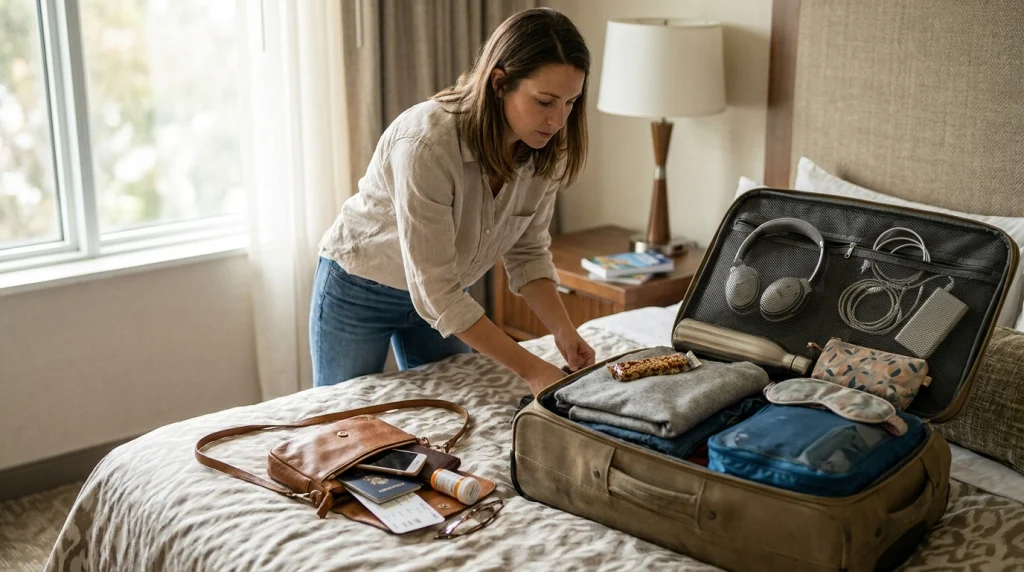
Organize a solo travel carry-on by access level. Keep documents, money, your phone, medication, and arrival information closest to you, while clothing and less urgent items can sit deeper in the bag.
I use three zones. The system works better for me than organizing only by product category.
Zone 1: Keep-on-you essentials
These are the things I would not want separated from me if an overhead bag had to be gate-checked. They belong in a personal item, crossbody bag, or secure inner pocket.
- Passport or ID
- Phone
- Wallet
- Backup payment card
- Essential medication
- Boarding information
- Accommodation details
- Glasses if required for travel
Zone 2: In-flight and transit items
Put anything you may need during the flight where you can reach it without pulling the whole bag apart. This is the difference between organized packing and luggage Tetris.
- Headphones
- Charging cable
- Power bank
- Water bottle, empty before security when required
- Snack
- Warm layer
- Eye mask
- Travel-size hygiene items
Zone 3: Clothing and backup supplies
Use the deepest part of the bag for items you probably will not need until arrival. Packing cubes can help, but they are optional.
| Item Type | Best Location | Reason |
|---|---|---|
| Passport, phone, wallet | Personal item or secure pocket | You need immediate access and should keep them with you. |
| Prescription medicine | Personal item | It may be difficult to replace during delays. |
| Power bank | Accessible cabin baggage | Spare lithium batteries and power banks have special aviation rules. |
| Toiletries | Easy-access pouch | Security screening rules may require separate handling. |
| Spare clothing | Main carry-on compartment | You usually will not need it until arrival. |
Always check your airline’s cabin-baggage size and weight limits before leaving. There is no single carry-on allowance that applies to every airline or ticket.
Section Takeaway: Organize by urgency. The harder an item would be to lose or replace, the closer it should stay to you.
Which Documents, Money, and Tech Should Stay in Your Carry-On?
Your passport, required travel documents, essential payment methods, phone, charging equipment, and important booking information should remain in your cabin baggage. These are the tools that let you solve problems independently.
Which travel documents should you carry?
I keep digital copies when practical, but I do not rely on my phone as the only place important information exists. Batteries fail and mobile service disappears.
- Passport or government-issued ID
- Required visas or permits
- Boarding passes or booking references
- Accommodation address and contact information
- Travel insurance details
- Prescription information when relevant
- Emergency contact information
- Copies of important documents when appropriate
The CDC also recommends carrying copies of important travel and health documents, with documentation requirements checked for your destination.
How much money should you keep in one place?
I avoid keeping every payment option together. Losing one wallet should not remove every way I have to pay.
- Primary bank or credit card in your regular wallet
- Backup card stored separately
- A modest amount of destination-appropriate cash when useful
- Emergency access to funds that does not depend on the same card
A backup card buried beside your primary card is not much of a backup. Separation matters.
What technology belongs in a carry-on?
For most solo travelers, a phone is the most important piece of travel technology. It handles navigation, transportation, translation, bookings, communication, and payments.
- Smartphone
- Charging cable
- Wall charger
- Power bank
- Plug adapter for your destination
- Headphones or earbuds
- Laptop or tablet only when you expect to use it
The FAA says spare lithium batteries and power banks must stay in carry-on baggage rather than checked luggage under U.S. aviation rules. Review the FAA PackSafe guidance and your airline’s rules, especially for international journeys.
Pack information for a safer arrival
Solo travel safety is easier when your first transport decision is already made. Save your accommodation and transfer information before you fly.
- Hotel or hostel name and address
- Check-in instructions
- Airport or station transfer plan
- Backup transport option
- Offline map or screenshots
- Contact details for someone you trust
Official guidance for women travelers also recommends researching transportation and destination-specific customs before an international trip.
Pro tip: Check your own government’s current travel advice and destination-specific rules before departure. Laws, transport conditions, and entry requirements can change.
Section Takeaway: Your carry-on should preserve your ability to identify yourself, communicate, navigate, pay, and reach your accommodation even when another part of the trip fails.
What Toiletries, Medication, and Health Items Should You Pack?
Pack the health and hygiene items you would struggle to replace quickly, then reduce everything else to travel-size quantities. Medication and destination-specific health needs deserve priority over beauty products.
Keep essential medication accessible
The CDC Pack Smart guidance recommends preparing a travel health kit based on your destination and personal medical needs. It also notes that some countries restrict certain medicines.
- Prescription medication
- Copies of prescriptions when useful
- Pain relief you normally use
- Motion-sickness medication if needed
- Allergy medication if needed
- Glasses or contact lenses
- Small first-aid basics
Do not assume a legal prescription at home is automatically permitted everywhere. Check destination rules before traveling with restricted or controlled medicines.
Pro tip: For international trips, verify medicine rules with the destination’s government, embassy, or other official source rather than relying on a packing blog.
What personal-care products are worth the space?
I pack enough to feel comfortable after landing, but I do not carry my entire bathroom. Most ordinary products can be bought later.
- Toothbrush and toothpaste
- Deodorant
- Face cleanser or wipes
- Moisturizer
- Sunscreen
- Lip balm
- Hairbrush or comb
- Menstrual products when needed
- Small amount of makeup if you use it
- Hand sanitizer where permitted
How should you handle liquids?
If you pass through U.S. security, most carry-on liquids, gels, and aerosols are limited to containers of 3.4 ounces or 100 milliliters or less. TSA rules also include special exceptions for medically necessary liquids.
Do not assume one country’s screening rule applies everywhere. Check the rules for your departure and transit airports before packing.
Women-specific items are destination-specific
Period products, birth control, skin care, hair products, and other personal supplies can be easy to buy in one destination and inconvenient in another. Bring enough of anything you rely on or cannot easily substitute.
- Your preferred menstrual products
- Prescription contraceptives when applicable
- Specialized skin or hair products
- Products needed for allergies or sensitivities
- A small opaque pouch for private health items
You do not need to pack for every theoretical emergency. Pack for your actual body, routine, destination, and trip length.
Section Takeaway: Prioritize medication and difficult-to-replace personal supplies. Downsize ordinary toiletries and verify liquid and medicine rules before flying.
How Much Clothing Should a Woman Pack in a Carry-On?
Pack enough clothing to create several outfits from a small number of interchangeable pieces. For many five-to-seven-day trips, repeating bottoms and layers is far easier than packing a separate outfit for every day.
Use a simple five-to-seven-day formula
This is the kind of starting point I use for a city trip. Weather, laundry access, activities, and cultural expectations can change the numbers.
- Three or four tops
- Two bottoms
- One dress or alternate outfit if useful
- Five to seven pairs of underwear
- Three to five pairs of socks
- One sleep outfit
- One lightweight layer
- One weather-appropriate outer layer
- One main pair of walking shoes
- One optional second pair if your itinerary needs it
Choose colors and pieces that work together. A top that matches only one bottom is using more space than it earns.
Wear the bulky pieces in transit
Jackets, boots, thick sweaters, and other heavy pieces can consume half a small suitcase. Wearing them while traveling often solves the problem.
I also keep a lightweight layer accessible during the flight. Aircraft cabins and airports can feel cold even when the destination is hot.
- Cardigan or thin sweater
- Large lightweight scarf where culturally appropriate
- Packable rain layer if the forecast calls for it
- Comfortable socks for a long flight
Think about local clothing expectations
Some destinations and religious sites have expectations around shoulder, chest, or leg coverage. Research those norms before you decide what counts as a versatile outfit.
A lightweight scarf or overshirt can sometimes add useful coverage without taking much space. The best solution depends on where you are going.
Do you need two pairs of shoes?
Not always. Shoes are among the biggest space-wasters in a carry-on.
- Choose one comfortable pair for long walking days.
- Add a second pair only for a genuine activity need.
- Wear the heavier pair during transit.
- Do not bring new shoes you have never tested on a long walk.
I would rather repeat shoes than spend an afternoon dealing with blisters alone. Comfort becomes part of logistics when nobody else is carrying your bag or changing plans for you.
Section Takeaway: Build a small wardrobe that mixes easily and works for your real itinerary. Comfort, weather, and local expectations matter more than having a different outfit every day.
What Should You Leave Out of a Solo Travel Carry-On?
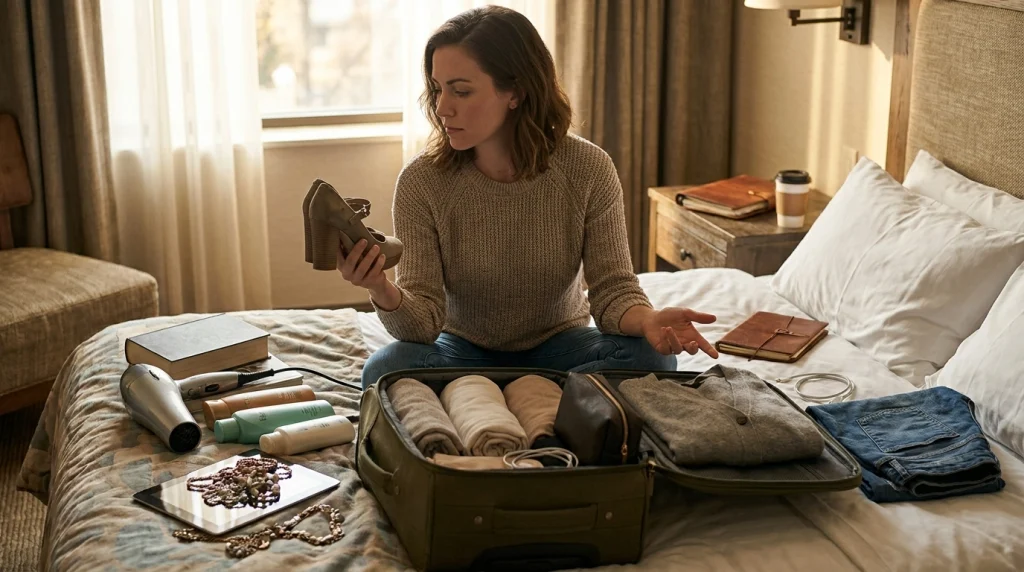
Leave out duplicate clothing, bulky “just in case” items, prohibited objects, valuables you do not need, and products you can easily buy after arrival. A lighter bag is easier to lift, control, and move through crowded stations.
Do not pack for imaginary emergencies
One of the easiest ways to overpack is to create unlikely situations in your head. “What if I suddenly need four formal outfits?” is rarely a useful packing question.
- Too many shoes
- Full-size toiletries
- Multiple heavy books
- Duplicate electronics
- Large hair tools unless genuinely needed
- Excessive jewelry
- Clothes that do not work with anything else
Be careful with self-defense items
Do not assume pepper spray, knives, stun devices, or similar products are legal at your destination or allowed through aviation security. Laws can change across borders, and airline restrictions may be stricter.
For solo female travel safety, I prefer preparation I can use everywhere. That means reliable transportation, charged communication, offline information, backup payment, and knowing where I am sleeping.
Avoid putting every valuable in one bag
A carry-on should protect essentials, but one compartment should not contain every important item you own. Split critical resources where practical.
| Instead of This | Pack This Way |
|---|---|
| All cards in one wallet | Keep one backup payment method separately. |
| Only online booking records | Save key details for offline access. |
| All medication deep in the suitcase | Keep essential doses readily accessible. |
| Every outfit packed individually | Choose interchangeable tops, bottoms, and layers. |
Run the 24-hour test before you zip the bag
Imagine your checked luggage is delayed until tomorrow. Then imagine your phone has only 20% battery when you land.
Could you still reach your accommodation, pay for transport, take your medication, charge your phone, change clothes, and contact someone? If yes, your carry-on is probably prepared well.
Section Takeaway: Smart solo packing is not about carrying more. It is about making sure the bag solves the problems that matter most.
Frequently Asked Questions
What should a woman always keep in her personal item when traveling alone?
Keep your passport or ID, phone, wallet, essential medication, boarding information, accommodation address, and at least one payment method in your personal item. These should remain accessible even if an airline requires your larger carry-on to be gate-checked.
Should I put my passport in my carry-on suitcase?
Your passport should stay close to you rather than inside an overhead-bin suitcase. A secure personal bag or inner pocket is usually more practical because you may need the passport during check-in, immigration, boarding, or arrival procedures.
How many outfits should I pack for a one-week solo trip?
For many trips, three or four tops, two bottoms, underwear, one sleep outfit, and useful layers can cover a week when pieces mix together. Adjust for climate, laundry access, cultural expectations, and special activities rather than packing seven completely separate outfits.
Should prescription medicine go in carry-on luggage?
Essential prescription medicine is best kept accessible in cabin baggage rather than depending on checked luggage arriving with you. Check airline, security, and destination rules before departure, especially for liquids, injectable medicines, or controlled substances.
Can I bring a power bank in my carry-on?
Power banks are generally treated as spare lithium batteries and belong in cabin baggage under U.S. FAA rules. Battery capacity and airline rules still matter, so verify your carrier’s policy and the aviation requirements that apply to your route.
What should I pack for safety when traveling alone as a woman?
Focus on practical safety tools: a charged phone, backup power, offline accommodation details, emergency contacts, backup payment, and a clear arrival plan. Research local transportation and laws before packing defensive items because legality and airline restrictions vary widely.
Is a backpack or rolling carry-on better for solo female travel?
A backpack works well for stairs, trains, and frequent movement, while a rolling suitcase is easier on your shoulders in airports and smooth city streets. Choose the bag you can comfortably control, lift, and carry without depending on someone else.
The best solo travel carry-on is not the one packed with the most things. It is the one that lets you handle the first day of your trip confidently even when plans change.
Before you leave, check your airline’s current baggage allowance, review the security rules for every airport on your route, and remove anything you do not expect to use. Then zip the bag and enjoy traveling lighter.