Where Should a Woman Keep Backup Money While Traveling Alone?
Quick Answer
A woman traveling alone should keep backup money in at least two places separate from her everyday wallet. I prefer a small hidden cash reserve, a backup card stored elsewhere, and most emergency funds kept electronically accessible. If a serious money problem happens abroad, U.S. travelers can also review the State Department’s emergency financial assistance guidance.
Use a three-part backup system
- Daily wallet: Carry only the cash and main card you expect to use that day.
- Hidden backup: Store a second card and emergency cash somewhere separate from your wallet.
- Accommodation reserve: Leave part of your backup in secure accommodation storage when appropriate.
- Electronic reserve: Keep most emergency funds accessible through an account rather than carrying everything as cash.
- Never combine everything: Your passport, cards, and all emergency cash should not disappear in one theft.
My simplest rule
- If losing one bag would remove every way you can pay, your backup money is not separated enough.
When women ask me where should a woman keep backup money while traveling alone, I rarely recommend one perfect hiding place. The safer approach is to split access across several places so one lost wallet does not become a full financial emergency.
I use the same idea whether I am planning a city break or a longer international trip. The exact cash amount changes, but the separation strategy stays simple.
In This Guide
- Where should a woman keep backup money while traveling alone?
- How much backup money should you keep, and how should you split it?
- What are the safest places to store backup cash and cards?
- Where should you never keep all your backup money?
- What should you do if your wallet or card is lost or stolen?
- Frequently asked questions
Where Should a Woman Keep Backup Money While Traveling Alone?
The best setup is to divide backup money between your daily belongings, a separate hidden location, and electronically accessible funds. No single purse, backpack, hotel room, or card should contain your entire financial safety net.
Definition: Backup travel money is emergency cash or account access that stays separate from your normal spending money and can help you pay for essential transport, accommodation, food, communication, or unexpected problems.
Use your everyday wallet only for everyday spending
I treat my normal wallet as expendable. It should contain enough for the day, but losing it should not end my trip.
For example, I might carry one payment card and a modest amount of local currency while sightseeing. My second card never sits beside the first one.
- Main payment card: Keep it in the wallet you normally use.
- Daily cash: Carry enough for expected small purchases and transportation.
- Backup card: Store it separately.
- Emergency cash: Divide it from your daily cash.
Keep a second payment method somewhere separate
A backup card is most useful when it cannot disappear with your main card. I may put mine inside a zipped interior compartment of a different bag or secure it with belongings left at my accommodation.
The exact location matters less than separation. A second card sitting directly behind your main card is not a real backup.
Leave most emergency funds electronically accessible
I do not like carrying my entire emergency reserve as physical cash. Cash can solve immediate problems, but lost cash is difficult to replace.
Instead, I prefer enough cash for short-term needs while keeping a larger reserve accessible through another account or card. This gives me options without turning my bag into a portable bank.
- Emergency transport
- One unexpected hotel night
- Food during a delay
- A pharmacy purchase
- A replacement ticket
- A temporary card problem
Think in layers, not secret hiding spots
Travel advice sometimes focuses on clever places to hide cash. I think redundancy is more important than finding one ingenious hiding place.
On a solo city trip, I want three independent ways to pay. One might be my normal card, another a separately stored card, and the third a small cash reserve.
Pro tip: Before an international trip, check current destination guidance and women’s travel advice from an official government source such as the U.S. State Department’s guidance for women travelers.
Section Takeaway: The safest place for backup money is not one place. Split your payment methods so a single lost or stolen item cannot remove every way you have to pay.
How Much Backup Money Should You Keep, and How Should You Split It?
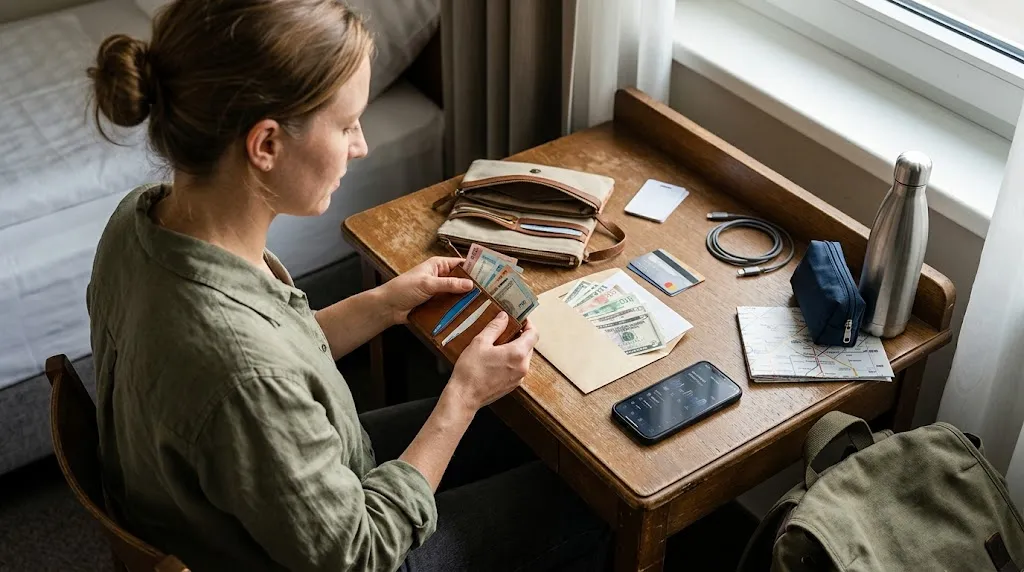
There is no universal amount because destinations, trip lengths, and travel styles differ. I calculate enough to solve one or two realistic disruptions rather than trying to carry cash for every possible emergency.
A short weekend trip close to home needs a different reserve from a two-week international trip. Your accommodation prices and transportation options matter too.
Start with the problems your backup money needs to solve
- Unexpected accommodation: Enough for at least one safe night if plans change.
- Urgent transportation: Enough for a taxi, train, rideshare, or replacement transfer.
- Essential food: Enough for meals during a delay or card problem.
- Communication: Enough for mobile data, charging, or a replacement travel essential.
- Medical uncertainty: A cushion for a pharmacy visit or other immediate expense.
I would not automatically carry that entire amount in cash. I would spread it across several forms.
| Money layer | Example role | Main advantage | Main weakness |
|---|---|---|---|
| Daily cash | Meals, small fares, tips | Works without technology | Can be permanently lost |
| Hidden emergency cash | Immediate backup | Useful after wallet loss | Limited amount |
| Backup card | Hotels and larger expenses | Restores payment access | May fail if stored with main card |
| Electronic reserve | Larger emergencies | Avoids carrying large cash amounts | Requires account access |
A practical example
Imagine you decide that $400 is an appropriate total emergency reserve for your trip. That does not mean walking around with $400 in your purse.
- $40-$60 might sit in your daily wallet.
- $60-$100 might remain as separately stored emergency cash.
- A backup card could cover larger unexpected expenses.
- The rest could remain electronically accessible in your account.
Those figures are only an example, not a rule. A cash-heavy destination could justify more physical currency, while another trip might need less.
As of 2026, I still plan around access rather than one magic number. Money you cannot reach during a problem is not much of an emergency fund.
What Are the Safest Places to Store Backup Cash and Cards?
No storage location is risk-free, so I prefer several ordinary locations rather than one supposedly perfect hiding place. The best choices are discreet, separate, and easy for you to remember.
A secure interior compartment
A zipped compartment deep inside a bag can work for a small backup reserve. Choose a compartment you do not open repeatedly in public.
I avoid putting emergency money in exterior backpack pockets. Those pockets are easy to reach and easy to forget about.
Secure accommodation storage
If your accommodation provides suitable secure storage, you can leave part of your reserve there instead of carrying everything during sightseeing. I often prefer this for a backup card or part of my cash.
A room safe or locker still requires judgment. I would not assume that any storage system is completely theft-proof.
- Check whether the safe or locker closes correctly.
- Do not leave valuables openly visible in the room.
- Keep only part of your financial backup there.
- Remember exactly what you stored before checkout.
A concealed travel pouch during transit
A money belt or concealed pouch can be useful during airports, train journeys, or crowded transit days. I find it less convenient for normal spending because repeatedly reaching into it defeats the point.
Use concealed storage for reserve items, not the card you need every ten minutes. It should stay boring and unnoticed.
A separately stored backup card
Your backup card deserves its own location. I prefer a different bag or secure accommodation storage rather than another slot inside my main wallet.
If you travel with both a personal item and a larger bag, do not automatically put all financial items in the same one. Think about which bag remains under your direct control.
An account-level emergency reserve
The largest part of my emergency money usually does not need to be physically on me. Electronic access reduces the amount of cash that can disappear through one theft.
I also save my bank’s contact method before departure. That becomes important when a card needs to be frozen quickly.
A trusted way to receive money from home
For a serious emergency, it helps to know how a trusted person could send you money. You do not need to arrange a transfer in advance, but knowing your options removes one decision during a stressful situation.
The U.S. State Department explains several ways U.S. citizens may access emergency funds abroad. Available options depend on the situation and nationality.
Section Takeaway: Choose boring, separate storage locations. Your goal is not to hide every dollar brilliantly; it is to make sure one incident cannot remove every financial option.
Where Should You Never Keep All Your Backup Money?
Never keep all your cash, cards, identification, and emergency reserve together. That creates a single point of failure.
The following locations may hold part of your money, but I would not trust any one of them with everything.
Your main wallet
This is the most obvious mistake. Your wallet is also the item you expose most often while paying.
If it disappears, your backup card and emergency cash should still be somewhere else.
The same purse as your passport and cards
A crossbody bag can be convenient, but convenience can tempt you to put everything inside it. Losing one bag should not mean losing every important document and payment method.
Easy-access backpack pockets
Outer pockets are designed for convenience, not long-term emergency storage. I use them for low-value items instead.
- Water bottle
- Tissues
- Snacks
- Other replaceable items
Checked luggage
I would not place essential backup money or the only spare payment card in checked baggage. You may be separated from that luggage during a delay or baggage problem.
Keep essential financial access with you or in a separate secure place you can reach.
One obvious “secret” pouch
A labeled valuables pouch creates the opposite effect you want. Anyone opening the bag immediately knows which item matters.
I prefer normal-looking interior storage. Discretion usually beats a container that announces its purpose.
Your phone as the only backup
Mobile wallets can add another payment option, but your phone can be lost, stolen, broken, or out of battery. I treat digital payment as another layer rather than my entire backup plan.
Pro tip: Keep important bank contacts and your accommodation details available somewhere beyond one phone when possible.
What Should You Do If Your Wallet or Card Is Lost or Stolen?
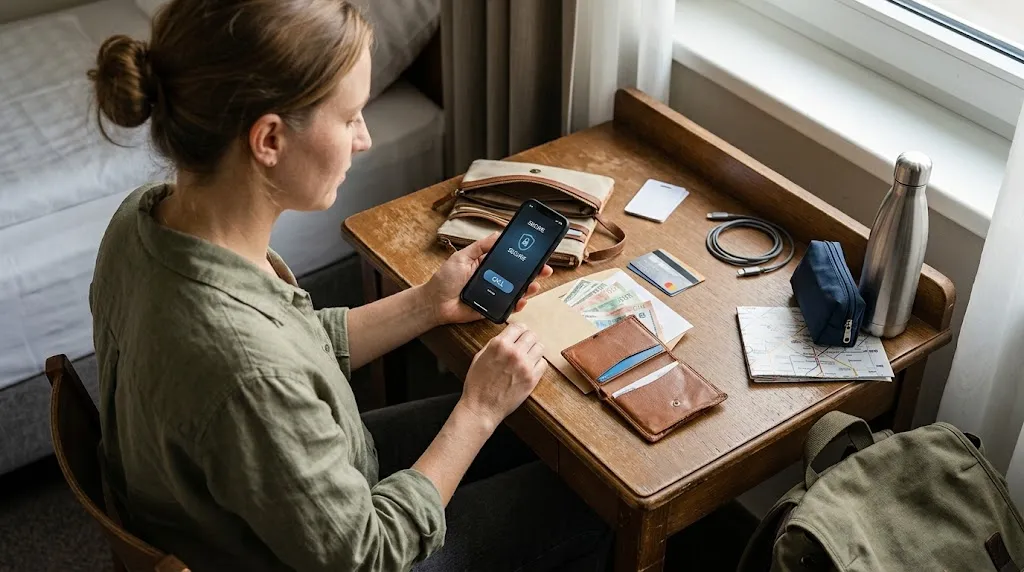
First, protect your accounts and switch to your backup payment method. The reason you separated your money was to make this moment manageable.
1. Freeze or report the missing card
Use your bank’s app or official contact method as soon as possible. The U.S. Federal Trade Commission advises reporting lost or stolen cards promptly.
Check recent transactions while you have access. Follow your card issuer’s instructions for replacement or account protection.
2. Switch to your separately stored backup
This is where preparation pays off. Retrieve the second card or emergency cash without moving every remaining valuable into your main wallet again.
I keep the backup arrangement intact until the problem is fully solved. One loss does not mean I abandon separation.
3. Secure essential needs first
Prioritize the things that keep you safe and functional. Shopping and sightseeing can wait.
- Accommodation
- Food and water
- Safe transportation
- Phone or internet access
- Medication or medical needs
4. Contact your card issuer about replacement options
Some card issuers may offer replacement or emergency assistance depending on the account. Ask what is available instead of assuming you have no options.
The State Department also advises U.S. travelers with lost or stolen cards to contact their card company immediately.
5. Know where official emergency help is available
A consulate is not a replacement bank, but official services may help citizens understand options during serious financial emergencies abroad. Rules vary by nationality and circumstances.
For U.S. citizens, the State Department’s Help Abroad resources cover urgent consular assistance.
6. Do not let urgency push you into a scam
A stressful financial situation can make anyone more willing to trust a stranger. Use official banking channels, known transfer providers, and verified contacts.
Do not share passwords, verification codes, or unnecessary financial information with someone who approaches you offering help.
Section Takeaway: Report the problem quickly, protect your accounts, and use the backup money you deliberately stored elsewhere. Separation turns a stolen wallet from a trip-ending crisis into a problem with a recovery plan.
Frequently Asked Questions
Should I keep backup cash in my hotel room?
You can leave part of your backup money in secure accommodation storage when you are comfortable with the setup. I would still keep another payment option elsewhere rather than placing every reserve item in the room.
Should I carry emergency cash in a money belt?
A concealed money belt can work well for emergency cash during flights, train journeys, and crowded transit. Avoid repeatedly opening it in public because that reveals the location of your backup.
Is it safer to carry cash or a backup credit card?
Neither method solves every problem. A small cash reserve works without technology, while a separately stored backup card gives you access to larger funds without carrying a large amount of physical money.
How many payment methods should a solo female traveler have?
I prefer at least two independent payment methods plus some useful cash when the destination supports that setup. The important part is storing them separately so one loss does not affect everything.
Should I hide cash inside my suitcase?
A discreet interior location may hold part of your reserve, but I would not put all emergency cash there. I also avoid relying on checked luggage for essential money because I may temporarily lose access to the bag.
Should my passport and backup money be stored together?
Not all of them. Keeping every important document, card, and cash reserve together makes one theft or loss much harder to recover from.
Do I need backup money if I have travel insurance?
Yes. Travel insurance and emergency money serve different purposes because you may still need to pay for immediate transport, food, accommodation, medication, deductibles, or other costs before a claim is resolved.
My final rule is simple: split your access, not just your cash. Keep everyday money convenient, emergency money separate, and larger reserves accessible without physically carrying everything.
Before your next solo trip, empty your normal wallet onto a table and ask what would happen if it disappeared tomorrow. If the answer is “I would lose every way to pay,” move one card and part of your backup money somewhere else before you leave.