What Should a Solo Female Traveler Do If She Feels Unsafe in a Hotel?
Quick Answer
If you feel unsafe in a hotel while traveling alone, secure your room, contact reception or security, and move to a staffed public area if you can do so safely. Request another room or leave the property if the concern remains. If someone threatens you or attempts to enter your room, contact local emergency services immediately. The U.S. State Department’s lodging safety guidance also recommends checking locks, identifying exits, and reporting suspicious activity.
What to do immediately
- Secure your door: Use working locks and avoid opening the door to unidentified visitors.
- Assess the danger: Decide whether staying behind a locked door or leaving offers the safer option.
- Contact hotel security: Explain what happened and request specific assistance.
- Move if necessary: Use a safe route to a staffed lobby or another secure location.
- Call for help: Contact local emergency services when you face an immediate threat.
- Update someone trusted: Share your location and ask them to remain available.
One rule worth remembering
- You do not need to prove that a hotel is dangerous before choosing to leave.
Feeling unsafe in a hotel while traveling alone can turn an ordinary evening into a stressful experience. I believe every solo female traveler should know how to respond before deciding whether a situation is serious.
The goal isn’t to become suspicious of everyone. It’s to recognize warning signs, make practical decisions, and know exactly where to get help.
In This Guide
- What Should You Do Immediately If You Feel Unsafe?
- How Can You Tell Whether a Hotel Situation Is Unsafe?
- How Should You Ask Hotel Staff for Help?
- Should You Change Rooms or Leave the Hotel?
- What If Someone Threatens You or Tries to Enter?
- How Can You Reduce Hotel Safety Risks?
- Hotel Safety FAQ for Solo Female Travelers
What Should You Do Immediately If You Feel Unsafe?
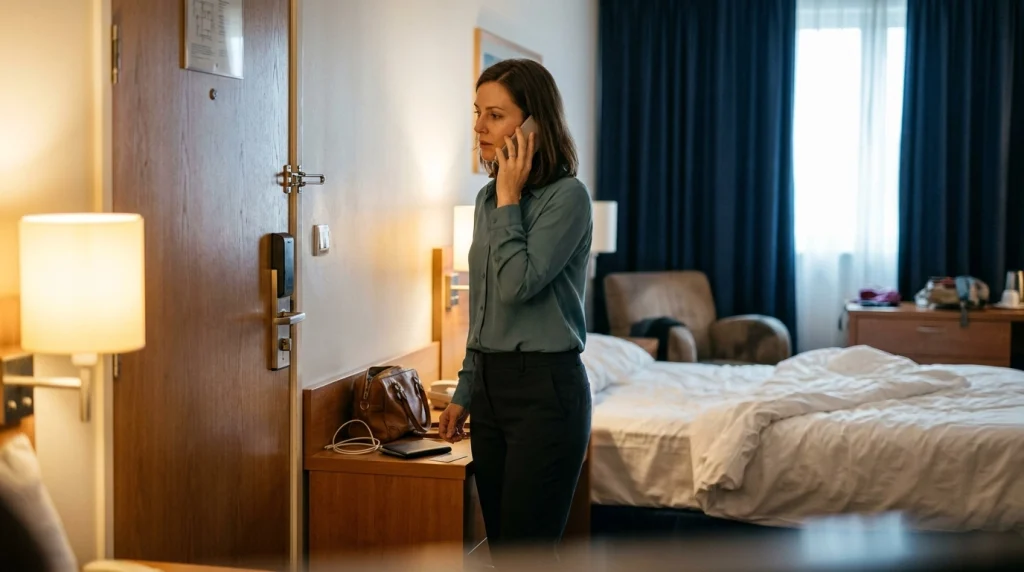
Start by moving away from the possible danger and choosing a secure location. Whether that means staying inside your locked room or reaching the lobby depends on what is happening.
An unsafe hotel situation is one where a threat, access problem, suspicious behavior, or serious hazard may put your well-being at risk. You don’t need to identify the exact cause before taking reasonable precautions.
Step 1: Get somewhere secure
If you’re already inside your room, lock the door and check your surroundings. Keep your phone within reach and avoid opening the door until you’ve verified who’s outside.
If your room is the source of danger, consider leaving through a clear, safe route. A staffed lobby may offer more help than an isolated hallway.
- Move away from a person acting aggressively.
- Avoid deserted corridors and isolated stairwells when possible.
- Never enter an elevator with someone who is threatening you.
- Keep your phone, room key, and essential belongings accessible.
- Use local emergency services if you believe someone may harm you.
Step 2: Contact reception or hotel security
Once you’re secure, explain the problem to hotel staff. Describe observable facts instead of relying only on general statements about feeling uncomfortable.
For example, you might say, “Someone has knocked on my door three times and won’t identify themselves. Please send security to investigate.”
If the concern involves a staff member, contact a manager or another trusted authority. Don’t depend solely on the person causing the concern to resolve it.
Step 3: Tell someone you trust
When I’m planning a solo trip, I like having one trusted person who knows where I’m staying. That contact becomes particularly useful when circumstances change unexpectedly.
Send a short message containing the information they would need to help.
- Your hotel’s name and full address.
- Your current location, when safe to share.
- A brief explanation of what happened.
- Whether you’ve contacted hotel security or emergency services.
- When they should expect your next update.
If possible, share your live location privately through a trusted messaging app. Avoid posting your room number or immediate situation publicly.
Step 4: Decide whether you should stay
Ask yourself whether the concern has been resolved and whether the hotel can provide a secure room. A polite apology isn’t enough when a serious safety problem continues.
If the hotel can’t restore your confidence in its security, consider alternative accommodation. Prioritize a safe departure over resolving a billing dispute immediately.
Section Takeaway: Secure yourself first, communicate the problem clearly, and involve appropriate help. You can address paperwork and refunds after reaching safety.
How Can You Tell Whether a Hotel Situation Is Unsafe?
Not every strange noise or unfamiliar person signals danger. Focus on specific behavior, room access problems, and whether the hotel responds appropriately.
A hotel may feel unfamiliar without being unsafe. The important question is whether you can identify a manageable concern or a risk that requires immediate action.
Warning signs worth taking seriously
Certain problems deserve prompt attention, especially when you’re staying alone. I would treat repeated unwanted contact and failures in room security as reasons to act.
- Repeated unwanted attention: Someone follows you, waits near your room, or continues approaching after you ask them to stop.
- Unexpected room access: A person attempts to enter without a clear reason or your permission.
- Broken locks: Your door, balcony, or connecting-room entrance cannot be secured.
- Inappropriate staff behavior: An employee makes threats, requests unnecessary private contact, or ignores boundaries.
- Serious building hazards: You notice smoke, signs of fire, a gas smell, or another urgent physical danger.
- Unexplained security failures: Unauthorized people appear able to enter guest-only areas repeatedly.
Distinguish discomfort from immediate danger
This distinction helps you choose an appropriate response. However, you don’t have to remain in a situation merely because the warning signs seem uncertain.
| Situation | Suggested response | Urgency |
|---|---|---|
| Unfamiliar hallway noises | Keep the door locked and contact reception if concerned. | Assess |
| Broken door lock | Request a secure room immediately. | Prompt action |
| Repeated unwanted knocking | Keep the door closed and call security. | Prompt action |
| Someone tries to force entry | Call emergency services and move or shelter according to the safest available option. | Emergency |
| Smoke or fire alarm | Follow emergency evacuation instructions and use stairs when safe. | Emergency |
This table is a decision guide, not a substitute for assessing the situation. A seemingly minor issue can become urgent when threatening behavior escalates.
How Should You Ask Hotel Staff for Help?
Tell hotel staff exactly what happened, where it happened, and what assistance you need. Clear requests make it easier to get a practical response.
You don’t need to apologize for reporting suspicious activity. Protecting guest safety is a reasonable expectation of hotel management.
Use specific language
It can be difficult to organize your thoughts when you’re frightened. I recommend keeping your request brief and action-focused.
- For unwanted attention: “A guest keeps following me. Please help me reach a secure area.”
- For a lock problem: “My door doesn’t lock properly. I need another secure room.”
- For an unknown visitor: “Someone claims to be hotel staff. Can you verify this person without opening my door?”
- For a serious threat: “I feel threatened and need immediate assistance. Please contact security or the police.”
What if hotel employees dismiss your concern?
Ask to speak with the duty manager or security supervisor. Explain that the original problem remains unresolved and request a specific remedy.
If an employee is behaving inappropriately, avoid confronting them alone. Contact someone outside the situation, such as local authorities when warranted.
You can also contact your booking platform while arranging alternative accommodation. However, customer support should never delay an emergency call.
Document what happened when you’re safe
Write down the approximate time, location, and behavior involved. Keep booking confirmations, relevant messages, and any incident reference number.
If lawful and safe, save photographs of broken locks or damaged room fixtures. Avoid collecting evidence if doing so could expose you to further danger.
Documentation may help with complaints, insurance questions, and refund discussions. It also gives you a clear record if authorities need a statement.
Should You Change Rooms or Leave the Hotel?
Change rooms when the problem is limited to your room and the property can resolve it. Leave when the threat involves the property more broadly, staff conduct, or continuing security failures.
The right decision depends on where the danger is and whether a safe alternative is available.
When changing rooms makes sense
A room change may solve an isolated access or privacy problem. Before accepting another room, ask how the hotel will prevent the issue from happening again.
- Your original door or window lock is defective.
- A connecting room cannot be secured properly.
- Your room number was exposed to someone behaving suspiciously.
- Unwanted attention appears limited to a particular room or hallway.
- The hotel offers a secure replacement and handles your concern appropriately.
Ask the hotel to issue fresh keys and deactivate previous credentials when relevant. Inspect the replacement room before unpacking.
When leaving is the better option
Leaving becomes more important when you can’t reasonably trust the property’s response. No room upgrade compensates for a continuing serious threat.
Look for another property with reliable reception, secure access, and a practical location. Confirm that your new accommodation can accept you before traveling there, when circumstances allow.
How to leave safely, especially at night
Don’t automatically rush outside into an unfamiliar neighborhood. A poorly planned departure could create another problem.
- Identify a secure destination before departing, if safe to do so.
- Arrange reputable transportation through a verified provider.
- Tell a trusted contact where you’re going.
- Carry your passport, phone, money, medication, and essential documents if accessible.
- Avoid returning to a dangerous room for nonessential belongings.
- Check that the vehicle and driver match your booking details.
If you’re in immediate danger, seek emergency help rather than delaying your departure for reservations. Your safety comes before your suitcase.
Once secure, contact the booking provider about your interrupted stay. Save receipts from replacement accommodation and transportation.
Section Takeaway: A room change works only when it resolves the actual security concern. Leave when a serious risk persists, and arrange a safe route to your next location.
What If Someone Threatens You or Tries to Enter?
If someone threatens you, attempts forced entry, or assaults you, treat the situation as an emergency. Contact local emergency services and protect yourself using the safest available route or secure shelter.
You do not have to wait for hotel management to approve an emergency call.
If someone tries to enter your room
Keep the door locked if it still offers protection. Call emergency services and clearly state your hotel’s address, room location, and what is happening.
Do not open the door to investigate or confront the person. If a safe exit is available away from the threat, use it; otherwise, follow emergency dispatcher instructions.
- Give your exact hotel address and room number to emergency responders.
- Describe the person’s actions rather than guessing their intentions.
- Tell responders whether the door has been opened or damaged.
- Contact hotel security if it can provide additional assistance.
- Keep the emergency call connected when instructed.
If you believe someone is following you
Do not lead the person into an isolated area or reveal your room location. Move toward a busy, staffed space if possible.
Ask a specific employee for help instead of making a vague announcement. Contact local authorities if someone blocks, chases, threatens, or continues pursuing you.
If harassment or assault occurs
Get to a safer location and seek medical care when necessary. You can request police assistance, specialist victim support, and interpretation services where available.
If you experienced sexual assault, a medical professional or sexual assault support service can explain care and evidence-collection options. Your immediate safety and personal choices remain important.
For U.S. citizens overseas, the U.S. State Department’s emergency assistance resources explain what consular officials may be able to do.
Travelers of other nationalities can contact their own embassy or consulate. Consular assistance supplements local emergency response rather than replacing it.
What about fires and building emergencies?
Some hotel emergencies have nothing to do with another person. Fire, smoke, carbon monoxide alarms, and structural hazards require different responses.
Follow the hotel’s emergency plan and instructions from responders. Use designated stairs when evacuating if they are safe, and never use a lift during a fire unless officials direct otherwise.
If a corridor contains heavy smoke or becomes impassable, avoid entering it. Contact emergency services and report your location.
Pro tip: Before departure, check official travel advisories and the local emergency number for your destination. The U.S. State Department travel website provides country-specific information for U.S. travelers.
How Can You Reduce Hotel Safety Risks?
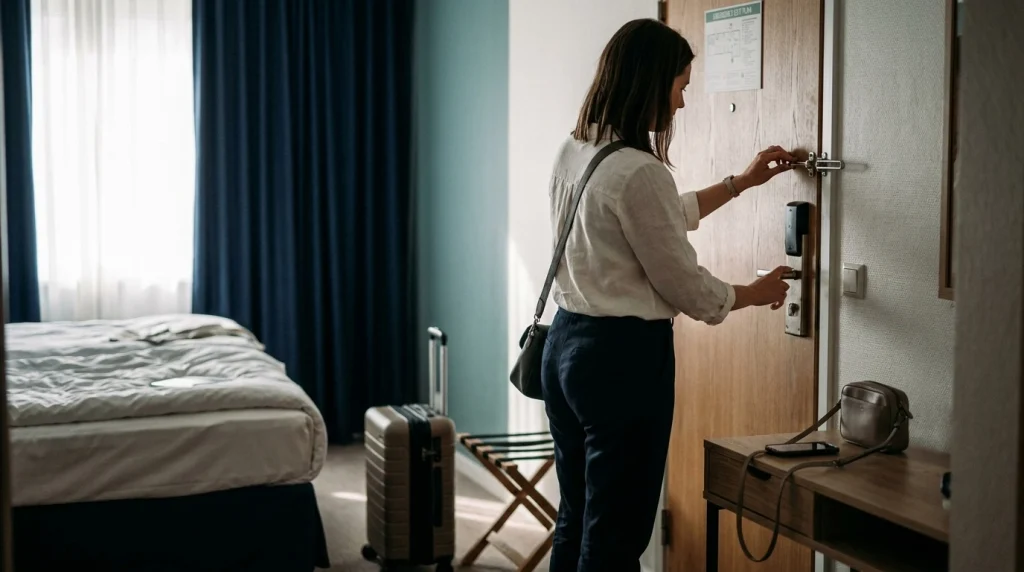
Good preparation can reduce unnecessary hotel risks, although no checklist guarantees complete safety. Focus on secure accommodation, access control, communication, and backup arrangements.
My preferred approach is a short routine rather than an exhausting inspection. The most useful precautions are the ones you’ll remember after a long travel day.
Before booking your hotel
Read recent reviews with special attention to complaints about security and staff behavior. Look for specific details rather than relying only on overall ratings.
- Choose a practical neighborhood near transportation and essential services.
- Check whether reception operates during your arrival hours.
- Look for controlled building access and functioning room locks.
- Review comments from women who traveled alone.
- Understand cancellation terms and keep a backup accommodation option.
- Verify check-in arrangements before a late-night arrival.
During your first five minutes
Inspect the room before unpacking. Check whether you can secure the space and find an emergency exit without confusion.
- Test the main lock, deadbolt, and secondary latch.
- Check windows, balconies, and connecting doors.
- Confirm curtains provide adequate privacy.
- Look for obvious damage or unusual room-access concerns.
- Find the nearest emergency stairwell.
- Confirm how to contact reception and local emergency services.
If a security feature is broken, report it promptly. Don’t treat a decorative latch or portable accessory as a replacement for a secure door.
During your stay
Keep your room number private and verify unexpected visitors before opening the door. Meet unfamiliar people in public areas rather than inviting them directly into your room.
Avoid posting your exact room or live hotel location publicly. You can share travel photographs after leaving the property.
Keep your phone charged and your important contacts accessible offline. Official communication guidance for international travelers recommends preparing multiple ways to stay connected.
Prepare a simple emergency backup plan
Save the information you’ll need if you unexpectedly change hotels. A few minutes of preparation can reduce confusion during a stressful situation.
- The hotel’s address in the local language, when useful.
- The local police or emergency services number.
- A nearby alternative accommodation option.
- A trusted transportation provider.
- Your embassy or consulate contact details.
- Offline copies of important documents and reservations.
As of 2026, I still consider these basic planning habits more useful than relying entirely on hotel safety gadgets. A working lock and an exit plan should come before accessories.
Section Takeaway: Choose accommodation carefully, check the room before settling in, and protect your privacy. Good preparation should make travel easier, not leave you constantly anxious.
Hotel Safety FAQ for Solo Female Travelers
1. Is it normal to feel scared when staying alone in a hotel?
Yes. An unfamiliar building, nighttime noises, or being somewhere new can create anxiety. Check for concrete problems, secure your room, and contact reception when necessary. Feeling nervous doesn’t automatically mean the hotel is dangerous, but you can still request assistance or move.
2. What should I do if someone knocks on my hotel door at night?
Keep the door locked and ask who is there without opening it. Verify unexpected staff visits through the hotel’s known reception number. If the visitor refuses to leave, acts aggressively, or attempts entry, contact security and local emergency services as appropriate.
3. Can I request another hotel room if I feel unsafe?
Yes, you can ask for another room and explain your safety concern. Whether the hotel must provide one without extra charges depends on its policies, circumstances, and applicable law. If a serious concern remains unresolved, consider leaving and documenting the issue.
4. Should I contact the police if hotel staff make me uncomfortable?
Contact local authorities when an employee threatens, assaults, stalks, attempts unauthorized entry, or otherwise creates an immediate safety concern. For less urgent complaints, you can approach management or your booking provider. Avoid confronting a threatening employee alone.
5. What should I do if my hotel room lock doesn’t work?
Contact reception immediately and request a properly secured room. Don’t leave valuables unattended in an unsecured space. If staff can’t repair the problem or provide suitable accommodation, look for another property and arrange a safe departure.
6. Should I leave my hotel immediately if I feel unsafe?
Leave when doing so is safer than remaining inside. If the corridor or surrounding area contains an active threat, staying behind a secured door and contacting emergency services may be safer. Consider the location of the threat before moving.
7. What if I cannot afford another hotel?
Tell hotel management about the safety problem and request a suitable alternative. Contact your booking platform or travel insurer to ask what assistance is available. For serious emergencies abroad, your embassy or consulate may explain available support, although financial help is not guaranteed.
Final Takeaway: You Have the Right to Prioritize Your Safety
Solo travel should give you freedom, not pressure to tolerate situations that feel threatening. You can question a room assignment, ask for assistance, contact authorities, or change accommodation.
Remember the core sequence: secure yourself, assess the threat, ask for help, and move when it’s safer. You don’t need to resolve every uncertainty before protecting yourself.
Before your next solo trip, save your emergency contacts and choose a backup accommodation option. Those small preparations can make an unfamiliar situation much easier to handle.