What Should a Solo Female Traveler Tell Her Bank Before Leaving?
Quick Answer
Before leaving, check whether your bank still wants a travel notice. If it does, provide your travel dates, destination countries, and the cards you plan to use. Also confirm your contact details, international card access, ATM limits, fees, PIN, and emergency support options. Visa’s travel guidance also recommends checking these details with your card issuer before going abroad.
What to confirm before you leave
- Travel-notice policy: Ask whether your bank still accepts or requires international travel notifications.
- International access: Confirm the cards you plan to carry can be used in your destination.
- Contact details: Make sure your mobile number and email are current for fraud alerts and verification.
- Fees and limits: Check foreign transaction fees, ATM charges, and daily withdrawal limits.
- Emergency procedure: Know how to freeze, replace, or report a lost card from abroad.
- Backup access: Carry a second payment method separately from your main wallet.
One important rule
- Do not assume an old travel-notification rule still applies. Check your specific bank or card issuer before departure.
When women ask me what a solo female traveler should tell her bank before leaving, I think the better question is what she should confirm with her bank.
Modern fraud systems have changed the old travel-notice routine. Your real goal is making sure you can still reach your money if a card is declined, lost, stolen, or temporarily blocked.
In This Guide
- What should you tell your bank before traveling?
- Do you still need a bank travel notice in 2026?
- What should you ask your bank before an international trip?
- How should a solo female traveler set up backup money access?
- What should you do if your card stops working abroad?
- What should you do before leaving for the airport?
- Frequently asked questions
What Should You Tell Your Bank Before Traveling?

If your bank accepts travel notices, give it the countries you expect to visit, your travel dates, and the cards you intend to use. You usually do not need to provide your complete day-by-day itinerary.
Travel notice definition: A travel notice is information you give your bank or card issuer about an upcoming trip so unusual transactions are less likely to be mistaken for fraud.
However, the travel notice itself is only one part of the conversation. I care more about confirming that my account will remain usable when I am alone and far from home.
Here is the distinction I use:
| Information or question | Tell your bank | Ask your bank | Why it matters |
|---|---|---|---|
| Travel dates | If travel notices are accepted | Is a notice required? | Helps you follow the issuer’s current policy |
| Destination countries | If requested | Are there country restrictions? | Some cards or services may have limitations |
| Your cards | Identify cards you plan to use | Are they enabled internationally? | Reduces surprises after arrival |
| Phone and email | Update outdated details | How will fraud checks reach me? | You may need to confirm a legitimate purchase |
| Hotel addresses | Usually unnecessary | Only provide if specifically required | Avoid sharing more personal information than necessary |
You also do not need to explain that you are traveling alone unless it is relevant to a specific service request. Your bank needs financial and account information, not personal details about who is accompanying you.
Do You Still Need a Bank Travel Notice in 2026?
Not always. As of 2026, some major card issuers no longer require or even accept traditional travel notices because their fraud systems evaluate transactions in other ways.
Other institutions may still offer a travel-notification feature. Policies can also differ between a credit card and a debit card issued by the same financial institution.
That is why I would never rely on a generic rule from an old travel checklist.
- Open your bank’s app: Search for travel notice, travel plan, card controls, or international use.
- Check the issuer’s website: Look for its current international travel instructions.
- Call if the policy is unclear: Use the number shown inside your banking app or on the back of your card.
- Repeat for each issuer: A backup card from another bank may follow different rules.
A travel notice also does not guarantee every transaction will go through. A card can still be declined because of a spending limit, damaged chip, merchant problem, connectivity issue, account restriction, or fraud alert.
This is why I treat a travel notice as one small task, not my whole money-safety plan.
What Should You Ask Your Bank Before an International Trip?
The most useful bank conversation is a checklist of practical questions. You want to know exactly what happens when you try to pay or withdraw money abroad.
Will my card work in the countries I am visiting?
Confirm international use before departure, particularly for debit cards. If you are visiting several countries, mention each one when speaking with your bank.
What foreign transaction fees will I pay?
A foreign transaction fee can apply when you make certain overseas or foreign-currency purchases. Check your actual card agreement rather than assuming your card is fee-free.
I also check whether my bank charges separate international ATM or out-of-network fees.
What is my ATM withdrawal limit?
Ask for your daily withdrawal limit and whether overseas withdrawals follow the same limit. Visa also recommends knowing your ATM limit before traveling internationally.
I do not automatically increase my limit. A higher limit can be useful, but it can also increase exposure if a debit card and PIN are compromised.
Do I need a PIN?
Make sure you know the correct PIN for any card you expect to use at an ATM. Do not store the PIN beside the physical card.
How will you contact me?
Update your phone number and email before departure. Then confirm whether fraud verification can arrive through text, app notification, email, or another method.
This matters if your normal SIM card will not receive messages overseas.
How do I report a lost or stolen card from another country?
Save the issuer’s international support instructions somewhere separate from your wallet. Do not rely only on a phone number printed on the card that may disappear with it.
The Consumer Financial Protection Bureau recommends reporting unauthorized bank-account activity promptly, and debit-card protections can depend on how quickly a loss or unauthorized transaction is reported.
How Should a Solo Female Traveler Set Up Backup Money Access?
A backup payment plan matters more when you travel alone because there may be nobody beside you who can simply cover the hotel bill or taxi fare. I treat payment redundancy as a safety tool, not just a budgeting trick.
My preferred setup is simple:
- Primary card: The card used for normal daily purchases.
- Backup card: Ideally issued by a different bank and stored separately.
- Debit access: A card for reasonable ATM withdrawals when local cash is needed.
- Small cash reserve: Enough for immediate essentials if electronic payments fail.
- Emergency account access: A secure way to reach additional funds if the trip changes unexpectedly.
Never store both physical cards in the same wallet. Losing one bag should not remove every way you can pay.
For example, imagine arriving alone after dark and discovering that your main card will not work at the transportation kiosk. A separately stored backup card can turn a stressful situation into a minor inconvenience.
I also avoid carrying my entire emergency reserve as cash. Cash cannot be remotely frozen after theft.
If your phone supports a mobile wallet and your issuer allows it, that can provide another payment option at compatible merchants. It should supplement your physical backup plan, not replace it.
Before deciding how much backup money to keep accessible, think about one emergency hotel night, safe transportation, food, and a short delay. The U.S. State Department also maintains emergency financial assistance guidance for U.S. citizens who run into serious money problems abroad.
What Should You Do If Your Card Stops Working Abroad?
If a card is declined once, do not panic. First determine whether the problem is the card, the merchant, the ATM, or the account.
- Try another legitimate merchant or ATM: A single terminal can fail.
- Check your banking app: Look for alerts, locks, balance problems, or fraud-verification requests.
- Switch to your backup method: Do not stand in a public place repeatedly troubleshooting your entire financial setup.
- Contact the issuer securely: Use its official app, website, or verified phone number.
- Report theft immediately: Freeze or cancel a missing card as soon as possible.
- Review recent transactions: Look for charges or withdrawals you do not recognize.
If your wallet was stolen, move somewhere safe before spending several minutes on your phone managing accounts. Your immediate physical safety comes first.
The Federal Trade Commission advises travelers to protect account information and keep only the cards they need with them. Its travel scam guidance also recommends using payment methods that provide appropriate protections.
Pro tip: If a financial problem becomes part of a larger emergency overseas, check verified government information instead of relying only on advice from social media or other travelers.
What Should You Do Before Leaving for the Airport?
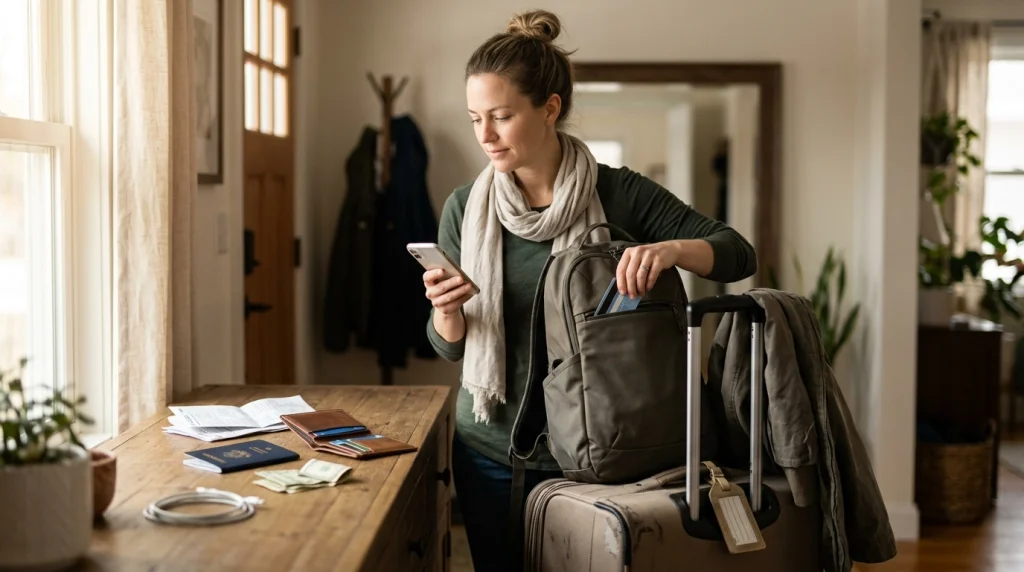
I like to finish banking preparation before travel day. Airport Wi-Fi and a boarding line are bad places to discover that your phone number or debit-card PIN needs updating.
Use this final checklist:
- Check travel-notice requirements. Submit your dates and destinations only if your issuer requests them.
- Confirm international card access. Check every card you plan to carry.
- Review fees. Know foreign transaction, ATM, and cash-advance charges that may apply.
- Check your limits. Review available credit and daily ATM withdrawal limits.
- Update contact information. Make sure fraud alerts can reach you.
- Save emergency contact options. Keep them separately from the physical card.
- Split your payment methods. Put your backup card somewhere other than your main wallet.
- Turn on useful alerts. Transaction notifications can help you spot suspicious activity quickly.
- Check your PIN. Resolve a forgotten PIN before departure.
- Review the destination. Look for cash availability, ATM concerns, common scams, and current travel information.
For an international trip, I also review the U.S. State Department’s international travel checklist before leaving. Travelers from other countries should use their own government’s equivalent travel resources.
The final goal is not to create a complicated banking system. It is to make sure one lost card, blocked transaction, or dead phone cannot immediately trap you without money.
Frequently Asked Questions
Do I need to tell my bank every country I am visiting?
If your bank still accepts travel notices, enter every destination it asks you to report. If it no longer uses travel notices, confirm that your cards work internationally and follow its current security instructions instead.
How early should I notify my bank before international travel?
Check the requirement once your itinerary is reasonably settled and well before departure. Each bank can set its own process, so follow the timing shown in its app, website, or customer-service instructions.
Will my credit card work abroad if I do not submit a travel notice?
It may, particularly if your issuer no longer requires travel notifications. However, international availability, account status, fraud controls, merchant acceptance, and available credit can still affect whether a transaction succeeds.
Should I increase my debit-card withdrawal limit before traveling?
Only if your expected cash needs justify it. I prefer a limit high enough for practical withdrawals but not unnecessarily large, because a debit card gives access to money in your bank account.
Should a solo female traveler carry both a debit and credit card?
Having more than one payment method is useful for solo travel. Store your primary and backup cards separately so one lost or stolen wallet does not remove every way to pay.
What if my bank sends security codes to a phone number that will not work abroad?
Resolve that before departure. Ask what verification methods your bank supports and make sure you can receive required messages or securely access your banking app while overseas.
Does my bank need the address of every hotel where I am staying?
Usually, a traditional travel notice focuses on dates, destinations, and the relevant cards. Do not provide extra itinerary or accommodation details unless your financial institution specifically requests them for a legitimate account purpose.
My final rule is simple: do not leave home knowing only that you have money in your account. Leave knowing how you will access it, protect it, and replace your main payment method if something goes wrong.
That extra preparation takes only a few checks before departure, but it can give you much more freedom when you are navigating a trip on your own.