What Should Be in a Woman’s First Aid Kit for Solo Travel?
Quick Answer
A woman’s first aid kit for solo travel should cover minor cuts, pain, stomach problems, allergies, blisters, personal medications, menstrual needs, and unexpected delays. I also include emergency medical information because traveling alone means nobody beside you automatically knows your allergies, prescriptions, or insurance details. Before packing, compare your list with current CDC travel health guidance.
Core items to pack
- Wound care: Adhesive bandages, sterile gauze, medical tape, antiseptic wipes, and blister treatment.
- Basic medicines: A pain reliever, antihistamine, stomach remedies, and your normal prescription medicines.
- Hydration help: Oral rehydration salts are useful after vomiting, diarrhea, or heavy heat exposure.
- Women’s health: Menstrual supplies, contraception you normally use, and any clinician-approved personal health items.
- Prevention: Hand sanitizer, sunscreen, insect repellent, and other destination-specific protection.
- Emergency information: Insurance details, allergies, medications, emergency contacts, and local medical information.
One important rule
- Keep essential medication and your small core kit in your carry-on rather than putting everything in checked luggage.
When I pack for a solo trip, I don’t try to build a miniature pharmacy. I want enough supplies to handle ordinary problems until I can reach a pharmacy, clinic, or hospital.
That matters more when you’re traveling alone. You may be the only person available to clean a cut, manage a blister, recognize an allergic reaction, or explain your medication history.
A travel first aid kit is a compact collection of medical supplies, personal medicines, preventive health items, and emergency information designed to manage minor problems during a trip. It should support professional care, not replace it.
In This Guide
- What should be in a woman’s first aid kit for solo travel?
- Which medicines should a solo female traveler pack?
- What women-specific health items belong in the kit?
- How should you adapt your first aid kit to the destination?
- Where should you keep first aid supplies while traveling alone?
- What emergency information should travel with your first aid kit?
- Frequently asked questions
What Should Be in a Woman’s First Aid Kit for Solo Travel?
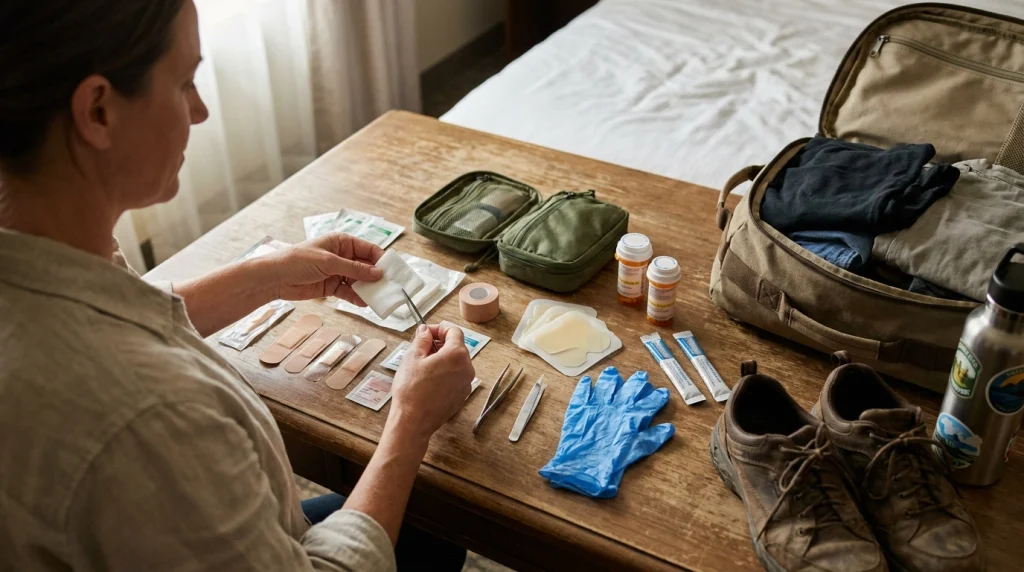
A practical kit should handle the problems you are most likely to manage yourself. Think small cuts, headaches, blisters, mild allergies, stomach trouble, dehydration, and your regular medical needs.
My rule is simple: the kit should help me manage the first 30 minutes of a minor health problem without unpacking my entire suitcase.
Basic wound-care supplies
Small cuts and scrapes are common travel problems. A rough suitcase zipper, a fall on uneven pavement, or a hiking scrape can turn into an annoying problem if you cannot clean and cover it.
- Adhesive bandages: Pack several sizes rather than ten identical strips.
- Sterile gauze pads: Useful for wounds too large for a normal bandage.
- Medical tape: Helps secure gauze or protect irritated areas.
- Antiseptic wipes: Convenient when clean running water is not immediately available.
- Blister bandages: Especially valuable on walking-heavy city trips.
- Tweezers: Useful for splinters and similar minor problems.
- Small disposable gloves: Useful when handling blood or helping another traveler.
For deeper wounds, heavy bleeding, animal bites, serious burns, or wounds showing infection, basic first aid is not enough. Get appropriate medical care.
A practical quantity guide
You don’t need the same kit for a two-night city break and a two-week trekking trip. I scale quantities instead of automatically buying the largest first aid kit available.
| Item | 2–4 Day City Trip | 7–14 Day Trip | Remote/Active Trip |
|---|---|---|---|
| Adhesive bandages | 6–8 | 10–12 | 12–20 mixed sizes |
| Sterile gauze pads | 2 | 3–4 | 4–6 |
| Blister dressings | 2–3 | 4–6 | 6+ |
| Oral rehydration packets | 1–2 | 2–4 | 4+ |
| Personal prescription medicine | Trip supply plus delay buffer | Trip supply plus delay buffer | Trip supply plus clinician-advised backup |
These quantities are practical starting points, not medical requirements. Your health history, destination, activities, and distance from medical care should decide the final kit.
Section Takeaway: Pack enough to manage common minor problems, but don’t let your first aid kit become a substitute for proper medical care.
Which Medicines Should a Solo Female Traveler Pack?
Pack the medicines you already know you can use safely, plus enough prescription medication for the trip and a reasonable delay. Don’t experiment with unfamiliar medication simply because you’re traveling.
As of 2026, medication rules still vary significantly between countries. A medicine that is common at home may require documentation or face restrictions elsewhere.
Your personal prescription medicines come first
- Bring enough for the planned trip plus a sensible delay buffer.
- Keep essential medicine in your carry-on during flights and long transit days.
- Keep prescription medicine properly labeled when required.
- Carry a copy of your prescription or clinician letter when appropriate.
- Check whether your destination restricts the medicine before departure.
- Ask your clinician how to handle dosing across major time-zone changes.
The CDC advises travelers to plan medication carefully and check destination-specific restrictions. I also check official destination guidance through Travel.State.gov before an international trip.
Useful over-the-counter medicines
Your exact list depends on what you can safely take. If you have allergies, chronic conditions, pregnancy considerations, or medication interactions, ask a qualified healthcare professional first.
- Pain and fever relief: Such as acetaminophen/paracetamol or ibuprofen, when medically appropriate for you.
- Antihistamine: For mild allergic symptoms when you normally use one safely.
- Motion-sickness medicine: Useful for travelers who already know they are prone to motion sickness.
- Antacid: Helpful if indigestion is a familiar problem for you.
- Diarrhea medicine: Pack only an option suitable for you and know when symptoms require medical care.
- Oral rehydration salts: Useful for replacing fluids and electrolytes after significant fluid loss.
- Hydrocortisone or soothing skin treatment: Useful for some minor itchy bites or irritation when appropriate.
High fever, severe dehydration, blood in stool, breathing difficulty, fainting, intense abdominal pain, or rapidly worsening symptoms need more than a travel kit. Seek medical care rather than repeatedly self-treating.
Don’t pack prescription drugs “just in case” without guidance
Antibiotics, altitude medications, malaria prevention, epinephrine, inhalers, and other prescription treatments should match your personal needs and itinerary. A clinician or travel-medicine professional can determine when they belong in your kit.
If you have a history of severe allergy, asthma, migraines, urinary infections, or another recurring condition, discuss a travel plan before departure. Carry the treatment you have been prescribed rather than improvising overseas.
Pro tip: For international trips, check official destination guidance and current CDC Travelers’ Health information before packing medicines. Entry rules and health risks can change.
Section Takeaway: Bring medicines you understand, protect your essential prescriptions in transit, and verify destination rules before you leave.
What Women-Specific Health Items Belong in the Kit?
A woman’s travel health kit should include the personal-care items that would be inconvenient, expensive, unfamiliar, or difficult to replace at the destination. The right list varies from woman to woman.
The U.S. State Department also advises women travelers to consider health products that may be difficult to find abroad.
Menstrual supplies
- Your normal pads, tampons, menstrual cup, period underwear, or preferred combination
- A few extra supplies for an unexpected early period or travel delay
- Small disposal bags where appropriate
- Any pain relief you normally use safely for menstrual cramps
- Hand sanitizer for situations where washing facilities are limited
I prefer carrying at least one day’s menstrual supplies in my day bag even when I don’t expect my period. Flight delays, stress, and schedule changes are easier when I don’t need an urgent pharmacy search.
Contraception and sexual health
If you use prescription birth control, bring enough for the entire trip and check medication rules before crossing borders. Keep important medication with you rather than in luggage you may temporarily lose.
- Regular prescription contraception, if used
- Condoms or other barrier protection, if relevant to your trip
- Any clinician-approved reproductive health medication you normally require
- A copy of important prescription information when appropriate
Reproductive health laws and access can vary by destination. Review local laws and health guidance before traveling rather than assuming the same services will be available everywhere.
If you have recurring health problems
Travel is not the best time to create a new treatment plan. If you often experience migraines, severe menstrual symptoms, urinary problems, allergic reactions, or another recurring condition, talk with your healthcare provider before departure.
A written plan can be especially useful when traveling alone. It reduces decision-making when you’re tired, sick, or in an unfamiliar place.
For broader destination research, I use official sources first and travel publications such as Lonely Planet for practical destination context.
Pro tip: If pregnancy, reproductive healthcare, or prescription contraception could affect your trip, verify destination-specific laws and medical access through official sources before departure.
How Should You Adapt Your First Aid Kit to the Destination?
The best solo travel first aid kit is destination-specific. A weekend in a major European city does not require the same setup as trekking far from reliable medical care.
I start by asking three questions: What health problems are more likely here, how quickly could I reach medical care, and what items might be difficult to replace?
For hot or tropical destinations
- Insect repellent appropriate for the destination
- Broad-spectrum sunscreen
- Oral rehydration salts
- Extra blister care if you’ll walk heavily in heat
- Hand sanitizer
- Destination-specific prescription medicines if recommended by a clinician
For hiking or adventure trips
- More wound dressings than you would take on a city break
- Blister treatment and medical tape
- Tweezers
- Disposable gloves
- A compact emergency light or headlamp
- Water-treatment equipment where safe water may not be available
- Any activity-specific medication recommended by a healthcare professional
Distance from help matters. A small problem that is easy to manage two blocks from a pharmacy becomes more complicated several hours from a road.
For cold, dry, or high-altitude trips
- Lip protection
- Moisturizer or skin barrier product
- Sunscreen
- Personal medication protected from extreme temperatures
- Altitude medication only when prescribed or professionally recommended
Don’t assume cold weather eliminates sun risk. Snow, altitude, and long periods outside can still increase exposure.
For city breaks
Keep the kit lean. Major cities often have pharmacies and medical facilities nearby, so I focus on immediate needs rather than carrying large quantities.
- Small wound kit
- Blister treatment
- Personal prescriptions
- Basic OTC medicines
- Menstrual supplies
- Hand sanitizer
- Emergency medical information
Before leaving, I also check pharmacy access near my accommodation and identify a suitable medical facility. Travel publications such as Condé Nast Traveler can add useful destination context, but official health advice should guide medical decisions.
Pro tip: Check official health guidance close to departure because disease risks, medication restrictions, and entry requirements can change.
Section Takeaway: Build your kit around your health, your itinerary, and your distance from reliable care—not around a generic packing list.
Where Should You Keep First Aid Supplies While Traveling Alone?
Don’t place every health item in one bag. If that bag disappears, your entire medical backup disappears with it.
I split my supplies into a small accessible kit and a larger backup pouch.
Keep these items in your carry-on or personal bag
- Essential prescription medicines
- One or two doses of basic medication you may need during transit
- A few adhesive bandages
- Blister treatment
- Menstrual supplies
- Emergency medical information
- Insurance information
This small kit handles common travel-day problems. It also stays with me if checked luggage is delayed.
Put backup supplies in your main luggage
Your larger medical pouch can contain replacement bandages, extra menstrual supplies, non-urgent medicines, and destination-specific gear. Keep liquids and sharp items compliant with transportation rules.
For flights, always check the current security rules that apply to your airport and destination. Don’t assume another country’s rules match those at home.
Use a simple waterproof pouch
A first aid kit doesn’t need an elaborate tactical case. A compact, durable, water-resistant pouch is easier to pack and easier to identify quickly.
I keep wound-care items together and medicines in a separate inner pouch. That prevents me from digging through tablets when I only need a bandage.
Protect medicine from heat and cold
Cars, luggage holds, beaches, and direct sunlight can expose medicines to extreme temperatures. Check storage instructions for anything temperature-sensitive.
If a medicine requires refrigeration or another special condition, plan that before departure. Don’t assume a hotel minibar is medically suitable storage.
Section Takeaway: Keep essential medicines and a small emergency layer with you, then place non-urgent backups elsewhere.
What Emergency Information Should Travel With Your First Aid Kit?
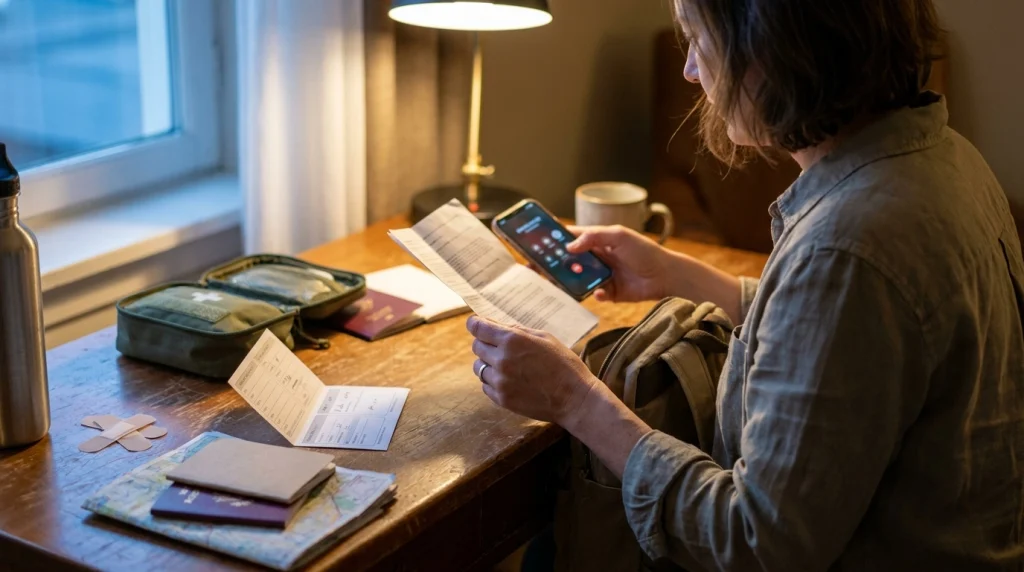
A solo travel health kit should contain information as well as supplies. If you’re sick, injured, panicked, or unable to unlock your phone, a short medical summary can save time.
This is one of the most overlooked parts of solo female travel safety.
Create a one-page emergency health note
- Full name
- Date of birth
- Emergency contact and phone number
- Important medical conditions
- Serious allergies
- Current prescription medicines
- Relevant medication doses
- Travel insurance provider
- Insurance assistance number
- Clinician contact details when appropriate
Keep one secure digital copy and one paper copy. Avoid placing unnecessary sensitive information where anyone can casually see it.
Save local emergency information before arrival
- Local emergency number
- Address of your accommodation
- Nearby suitable hospital or clinic
- Insurance assistance contact
- Embassy or consulate contact when relevant
- Trusted person at home
For U.S. travelers, U.S. Department of State travel guidance is a useful starting point for destination-specific emergency information. Travelers from other countries should use the equivalent official government service.
Know when your kit is not enough
First aid is for immediate care and minor problems. Serious symptoms require professional help.
- Difficulty breathing
- Severe allergic reaction
- Heavy or uncontrolled bleeding
- Loss of consciousness
- Chest pain
- Severe dehydration
- Major head injury
- Serious burns
- Suspected broken bones
- Animal bites with rabies concerns
- High fever with concerning symptoms
- Symptoms that worsen despite basic care
If something feels beyond basic first aid, seek help. Traveling alone is not a reason to wait longer before getting medical care.
Pro tip: Save official emergency numbers and medical facilities before your trip. Don’t rely on finding everything online during an emergency.
Section Takeaway: Your emergency information is part of your first aid kit because solo travel may require you to communicate your medical needs without a companion’s help.
Frequently Asked Questions About Women’s Solo Travel First Aid Kits
How big should a solo travel first aid kit be?
For a normal city trip, it can be small enough to fit inside a compact zip pouch. Carry basic wound supplies, personal medication, a few useful OTC medicines, menstrual essentials, and emergency information rather than packing for every possible illness.
Should I keep my first aid kit in my carry-on?
Keep essential prescription medication and a small core first aid kit in your carry-on or personal bag. Non-urgent backup supplies can go elsewhere, subject to airline, airport, customs, and destination rules.
Should women pack menstrual products even if a period isn’t expected?
Carrying at least a small backup supply is practical. Travel schedules, delays, stress, or an unexpected cycle change can leave you needing supplies before you’ve located a convenient pharmacy or store.
Can I bring prescription medicine on an international flight?
Often yes, but laws differ by destination and medication. Check official government and embassy guidance before departure, keep required documentation, and follow applicable security and customs rules rather than assuming your home country’s rules apply abroad.
Do I need antibiotics in a travel first aid kit?
Not automatically. Antibiotics should only be used when medically appropriate and prescribed for a specific need or travel plan. Ask a clinician or travel-medicine professional whether they are justified for your destination and health history.
What is the most commonly forgotten first aid item for solo travel?
Emergency medical information is easy to overlook. A short note listing allergies, current medicines, important conditions, insurance details, and an emergency contact can become more valuable than another handful of bandages.
Should I buy a premade first aid kit or build my own?
Either can work, but check every premade kit before traveling. Remove items you don’t understand, add your personal medicines and women’s health supplies, and tailor quantities to the trip rather than assuming the manufacturer knows your needs.
Final takeaway: Build a first aid kit that helps you handle common problems quickly while keeping you mobile. For solo travel, personal medication, women’s health supplies, wound care, hydration support, and emergency information matter more than carrying dozens of unfamiliar products.
Review the kit before every trip. Check expiration dates, replace used supplies, confirm destination rules, and make sure your emergency information is still current.