How Can a Woman Create a Solo Travel Emergency Plan?
Quick Answer
A woman can create a solo travel emergency plan by deciding who to contact, how to get medical help, where to keep backup money and documents, and what to do if her phone, transport, accommodation, or original itinerary fails. Before an international trip, review official guidance for women travelers and replace generic advice with destination-specific emergency information.
Build Your Emergency Plan in Six Steps
- Choose your contact: Give one trusted person your itinerary, accommodation details, transport information, and check-in plan.
- Save emergency numbers: Store the local police, ambulance, accommodation, insurer, and embassy or consulate contacts.
- Prepare medical backups: Carry insurance information, medication details, important health information, and a plan for reaching care.
- Separate your money: Keep a second payment method and emergency cash away from your everyday wallet.
- Protect key documents: Keep secure copies of your passport, insurance, reservations, and important addresses.
- Plan your exit: Know what you will do if your hotel feels unsafe, transport stops, your phone fails, or you need to leave quickly.
One Rule to Remember
- Your emergency plan should be short enough to use while you are tired, worried, or standing somewhere unfamiliar.
If you’re wondering how a woman can create a solo travel emergency plan, start with the problems that would be hardest to solve alone. I focus on communication, health, money, documents, accommodation, and a safe way to change plans quickly.
As of 2026, I still prefer a one-page emergency plan over a huge folder of worst-case scenarios. The goal is not to make solo travel feel frightening; it is to give yourself clear next steps when something unexpected happens.
In This Guide
- What Should a Solo Travel Emergency Plan Include?
- How Do You Create an Emergency Contact and Check-In System?
- How Should You Prepare for a Medical Emergency While Traveling Alone?
- How Do You Protect Money, Documents, and Phone Access?
- What Should You Do When Something Goes Wrong on a Solo Trip?
- Frequently Asked Questions
- Final Takeaway: Keep Your Emergency Plan Simple
What Should a Solo Travel Emergency Plan Include?
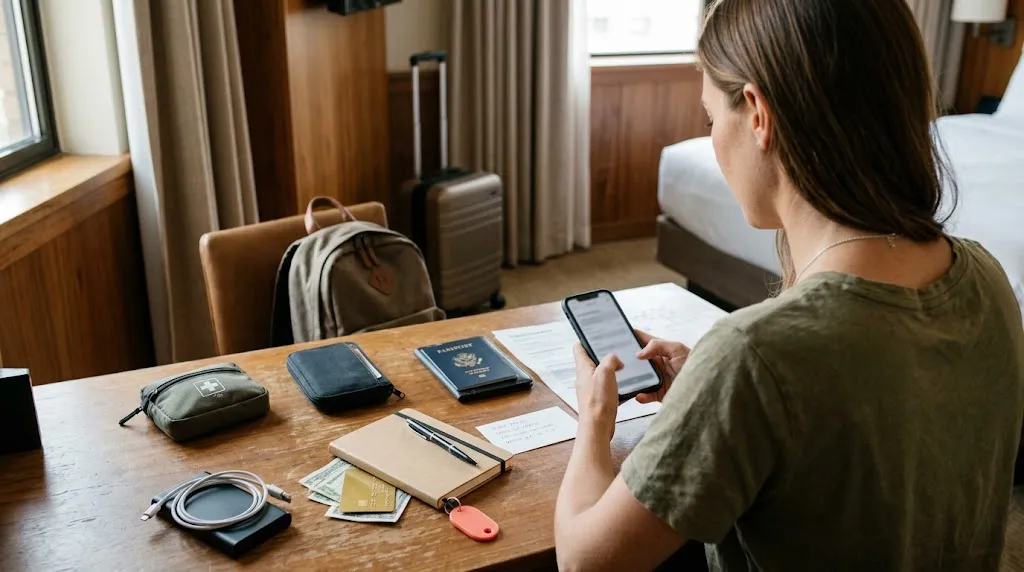
A useful solo travel emergency plan covers the few resources you cannot afford to lose at the same time. Think about people, communication, medical care, money, documents, transport, and somewhere safe to go.
Definition: A solo travel emergency plan is a short set of contacts, backups, documents, and predetermined actions that helps you respond when your normal travel plan stops working.
Build the plan around six backup layers
I use six layers because they cover most of the problems that can turn an ordinary travel disruption into a stressful situation.
- People: One trusted contact at home who knows where you are and what information you have shared.
- Communication: A working phone, charging method, mobile data plan, and important numbers available offline.
- Medical: Insurance information, medication details, allergies, and a realistic route to medical care.
- Money: At least two ways to pay, stored separately, plus a small amount of destination-appropriate emergency cash.
- Documents: Your passport or identification, insurance details, booking information, and secure backup copies.
- Exit options: A second transport choice, alternative accommodation idea, and enough financial flexibility to change plans.
Write down destination-specific information
Generic emergency advice is not enough. Local emergency numbers, transport systems, laws, embassy services, and medical options vary between destinations.
Before leaving, I create one offline note containing the information I would need if my mobile connection suddenly disappeared.
- Local police and ambulance numbers
- Accommodation name, address, and phone number
- Nearest useful hospital or medical facility
- Travel insurance assistance number
- Airline, rail, or main transport provider contact details
- Embassy or consulate information when relevant
- Trusted contact at home
- One backup accommodation option or staffed public place
Plan for likely problems before extreme ones
A delayed train, dead phone, rejected card, or uncomfortable hotel is more likely to affect an ordinary trip than an elaborate disaster scenario. Those situations deserve most of your planning attention.
For example, if I were arriving in Lisbon late at night, I would care first about getting from the airport to my accommodation. I would save the address offline, know my preferred transport, and identify a second way to get there.
That is practical emergency planning. It removes decisions from moments when you may already be tired.
Pro tip: Check the latest official destination advisory and your own government’s travel guidance shortly before departure. Conditions, local rules, and emergency procedures can change.
Section Takeaway: Build backups around the things you actually depend on every day. Your emergency plan should still work if one important tool—such as your phone, card, or original transport—stops working.
How Do You Create an Emergency Contact and Check-In System?
Choose one reliable person who will notice if you do not check in when expected. Give that person enough information to help without turning your trip into constant reporting.
Choose one primary emergency contact
Your primary contact should be someone who answers messages reliably and can stay calm if a plan changes. Tell them what you want them to do if you miss an agreed check-in.
Give them the essentials rather than sending dozens of screenshots with no explanation.
- Your full itinerary or basic route
- Flight, train, or bus information for major travel days
- Accommodation names and contact details
- A copy of your passport or important ID stored securely
- Your insurer’s emergency assistance information
- Any medical information you want available in an emergency
- The dates when you will move between cities or regions
Agree on a simple check-in routine
I like one predictable check-in instead of messaging someone every hour. For a normal city day, that might be a message when I return to my accommodation in the evening.
For a remote hike, long drive, boat trip, or unfamiliar overnight journey, I would use a more specific expected finish time. The check-in should match the activity.
- Normal sightseeing: Agree on one daily or arrival check-in.
- Travel day: Send a message after reaching the next accommodation.
- Remote activity: Share the route, provider, expected finish, and a reasonable overdue window.
- Plan change: Update your contact before disappearing from the itinerary they already have.
Decide what happens after a missed check-in
This part matters more than simply sharing your location. Your contact should know when to message again, when to call your accommodation, and when a genuine emergency would justify contacting local authorities or consular help.
If you are a U.S. citizen traveling internationally, the State Department’s Smart Traveler Enrollment Program (STEP) can provide embassy or consulate alerts for your destination. Travelers from other countries should check whether their own government offers a registration or travel-alert service.
Do not make live location your only safety system
Live location can be convenient, but phones lose power, data connections disappear, and apps fail. Your trusted person should still know your accommodation and general route.
I treat location sharing as an extra layer. It does not replace a clear plan.
Section Takeaway: A useful check-in system answers three questions: who expects to hear from you, when they expect to hear from you, and what they should do if you do not respond.
How Should You Prepare for a Medical Emergency While Traveling Alone?
Before traveling alone, decide how you would reach medical care, how you would pay for it, and what information a doctor would need from you. Do this before you are sick or injured.
Create a short emergency health note
Store one copy securely on your phone and consider carrying a paper version if your health circumstances make that useful. Keep private information limited to what could genuinely help during an emergency.
- Full name and date of birth
- Emergency contact
- Serious allergies
- Important medical conditions
- Current medications and generic names
- Travel insurance provider and assistance number
- Policy number
- Relevant doctor’s contact information
Know where you would seek care
The CDC recommends making a plan for accessing health care before traveling. Its health-care-during-travel guidance also advises travelers to understand insurance coverage and consider how they would obtain care overseas.
I do not research every clinic in a city. I identify one suitable medical facility near my base and know how I would reach it.
Understand what your insurance actually covers
Travel cancellation coverage, travel health coverage, and medical evacuation coverage solve different problems. Read the terms rather than assuming the word “travel insurance” means every emergency is covered.
The CDC’s travel insurance guidance recommends checking whether existing health coverage applies abroad and considering additional travel health or evacuation coverage when appropriate.
- Check emergency medical limits.
- Check exclusions and pre-existing-condition rules.
- Check whether adventure activities are covered.
- Check whether you pay first and claim reimbursement later.
- Check the insurer’s 24-hour assistance process.
- Check medical evacuation terms if you will visit remote areas.
Carry medication with delays in mind
Bring enough essential medication for your planned trip and a reasonable delay. Research destination rules because medicines that are ordinary at home may be controlled elsewhere.
Keep critical medication accessible during transport rather than placing all of it in checked luggage. Use appropriate original packaging when required.
Pro tip: Health requirements, medicine rules, and disease risks are destination-specific. Check official public-health guidance and speak with an appropriate healthcare professional when your health or itinerary requires individual advice.
Section Takeaway: Your medical plan should tell you where to go, who to call, what information to provide, and how the bill or evacuation would be handled.
How Do You Protect Money, Documents, and Phone Access?
Do not let one stolen bag or lost wallet contain every way you have to solve the problem. Separate your critical resources so one loss does not remove all your options.
Split your payment methods
I keep my everyday card accessible and a backup payment method somewhere separate. The backup exists for emergencies, not for ordinary spending.
Your emergency reserve should be enough to solve a realistic disruption in your destination.
- One unexpected night of accommodation
- A taxi or other safe transport option
- Basic food and water
- Phone connectivity
- A replacement ticket or itinerary change
- Small immediate expenses while resolving a lost wallet
You do not need to carry your whole emergency reserve as cash. Carrying too much physical cash creates another risk.
Keep document copies in more than one place
A passport photocopy does not replace the passport, but it can give you useful details when reporting a loss or requesting help. Keep copies secure because identity documents contain sensitive information.
- Passport identification page
- Visa or entry authorization when relevant
- Travel insurance details
- Major transportation bookings
- Accommodation reservations
- Important prescription information
I prefer one protected digital copy and one backup that does not depend on the same device. A trusted contact can also hold selected information if you are comfortable sharing it.
Prepare for losing your phone
Your phone may contain your maps, boarding passes, bank verification, hotel booking, translator, payment apps, and emergency contacts. Losing it can therefore create several problems at once.
Before the trip, reduce that dependence.
- Write down your accommodation address.
- Store critical phone numbers somewhere else.
- Download essential maps for offline use.
- Know passwords or account-recovery methods safely.
- Carry a charging cable and suitable power source.
- Keep at least one payment option usable without your phone.
- Know how to remotely lock or locate your device if your system supports it.
Use the “two failures” test
I ask myself whether I could still get back to my accommodation if two things failed together. For example, what if my phone died and my usual card stopped working?
If the answer is no, I add one backup. This simple test catches weak points without turning packing into a survival exercise.
Section Takeaway: Separate your essentials. Losing one wallet, bag, device, or account should be inconvenient, but it should not remove every way you have to communicate, pay, identify yourself, or reach safety.
What Should You Do When Something Goes Wrong on a Solo Trip?
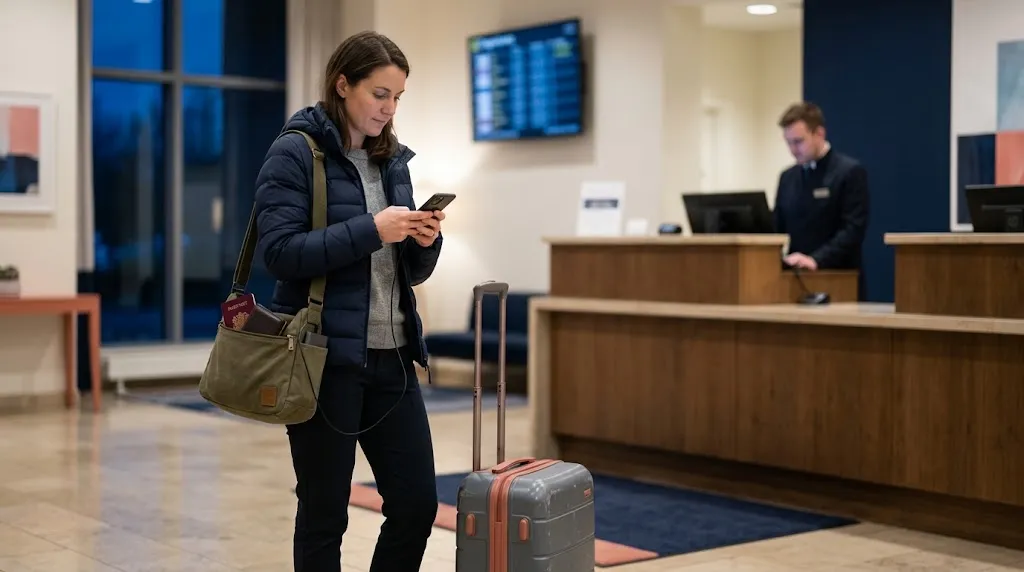
Start by deciding whether the problem is an inconvenience, an urgent problem, or an immediate emergency. That helps you choose the next action without treating every disruption as equally serious.
The table below is my planning framework, not an official emergency classification.
| Situation | Example | First Priority | Backup to Prepare |
|---|---|---|---|
| Disruption | Missed train, dead battery, closed attraction | Move somewhere calm and reassess | Offline information, spare charging, flexible time |
| Urgent problem | Lost wallet, unsafe accommodation, lost passport | Secure yourself and remaining resources | Backup funds, document copies, alternative accommodation |
| Immediate emergency | Serious injury, active threat, major disaster | Reach immediate local help or a safer location | Local emergency numbers, medical plan, trusted contact |
If your accommodation feels unsafe
You do not need to prove that something is wrong before changing rooms or leaving. Your first goal is to move to a staffed, public, or otherwise safer place where you can think clearly.
- Keep your phone, identification, money, and essential medication with you.
- Contact reception or the booking provider if appropriate.
- Use your backup accommodation plan if you decide to leave.
- Tell your trusted contact about the change.
- Contact local authorities if there is an immediate threat or crime.
If your wallet or cards disappear
Move somewhere safe before opening banking apps or making calls. Freeze or report affected cards using your bank’s official process.
- Switch to your separately stored payment method.
- Check whether identification was also lost.
- Review recent transactions.
- Report theft when required for local authorities or insurance.
- Ask your insurer or bank what documentation they need.
If you lose your passport abroad
Protect any identification and document copies you still have. Contact the relevant embassy or consulate for your nationality and follow its replacement-document process.
If the passport was stolen, you may also need a local police report depending on local and consular requirements.
If you feel followed, threatened, or harassed
Prioritize distance and a populated location over politeness. Move toward hotel reception, a staffed business, transport personnel, police, or another place where other people can assist.
- Do not go directly to an isolated accommodation if you believe someone is following you.
- Call the local emergency number when there is an immediate danger.
- Tell staff clearly that you need help.
- Contact your trusted person once you are somewhere safer.
- Preserve relevant messages or details if you later need to make a report.
If transport leaves you stranded
A missed connection becomes harder when you are also low on battery, money, or daylight. Solve those needs before chasing the cheapest replacement route.
- Move to a staffed station, airport area, hotel, café, or other suitable public place.
- Charge your phone if possible.
- Check official transport information.
- Tell your accommodation if your arrival time changes.
- Use your emergency budget when a safer alternative costs more.
If a major crisis affects your destination
Follow local authorities and official government instructions rather than relying on rumors in group chats or social media. Confirm information before changing location during a fast-moving situation.
- Check official emergency alerts.
- Contact your accommodation or tour provider when appropriate.
- Keep your phone charged.
- Update your trusted contact.
- Follow embassy or consular information relevant to your nationality.
- Keep transport, identification, medication, and essential supplies accessible.
Section Takeaway: When plans fail, reduce the problem to the next safe action. Get somewhere secure, protect communication and payment access, confirm reliable information, then solve the larger disruption.
Frequently Asked Questions
How detailed should a solo travel emergency plan be?
Keep the main plan to roughly one page or one easy-to-scan phone note. Include emergency contacts, accommodation, insurance, local emergency services, medical information, transport backups, and where your backup money and document copies are stored.
Who should be my emergency contact when traveling alone?
Choose someone dependable who regularly checks messages and can stay calm under pressure. Explain your itinerary, normal check-in routine, and exactly what you want them to do if they cannot reach you after an agreed period.
Do I need to share my live location while traveling solo?
No. Live location can be one useful tool, but it should not be your entire emergency system. A trusted person should still know your general itinerary, accommodation details, important travel days, and when you have agreed to check in.
How much emergency cash should a solo female traveler carry?
There is no universal amount because destinations and trip costs differ. Carry enough accessible backup money to handle realistic problems such as transport, food, phone access, or temporary accommodation, while keeping most of your emergency funds separate from physical cash.
What documents should I copy before a solo international trip?
Consider secure copies of your passport identification page, visa or travel authorization, insurance information, major reservations, and necessary medication information. A copy does not replace an original travel document, but it can make reporting a loss easier.
What should I do first if my phone is lost while traveling alone?
Move somewhere safe and use your offline backup information. Protect financial and personal accounts, use another device or trusted service to lock the phone when possible, and switch to your separately stored contacts, payment method, and accommodation details.
Should I tell people that I am traveling alone?
You do not owe strangers detailed information about your travel situation. Share useful details with trusted people and legitimate staff when necessary, but you can stay vague about your itinerary, room number, plans, or whether someone is expecting you elsewhere.
Final Takeaway: Keep Your Emergency Plan Simple
The best solo travel emergency plan is not the longest one. It is the plan you can understand at a glance when you are tired, stressed, or trying to make a quick decision.
Before each trip, I would check six things: one trusted contact, working communication, medical preparation, separated money, protected documents, and at least one practical exit option. Then I would customize the details for the destination.
- Save local emergency contacts.
- Share your basic itinerary.
- Keep important information offline.
- Separate your payment methods.
- Know where you could get medical care.
- Decide how you would leave an uncomfortable situation.
- Review official travel guidance shortly before departure.
Once those basics are ready, stop planning disasters and enjoy the trip. Preparation should give you more freedom to travel confidently, not make you spend the journey expecting something to go wrong.