How Can a Solo Female Traveler Secure Her Hotel Room Door?
Quick Answer
A solo female traveler can secure her hotel room door by checking that it closes properly, engaging the deadbolt and interior security latch, and verifying visitors before opening it. A portable door alarm may add another layer of protection if the hotel permits it and it does not interfere with emergency evacuation. The U.S. State Department’s lodging safety guidance also recommends checking all room locks and knowing your emergency exits.
Six Steps to Secure Your Hotel Door
- Check the door: Make sure it closes, latches, and cannot be pulled open without unlocking.
- Engage every lock: Use the built-in deadbolt and security latch whenever you’re inside.
- Consider an alarm: A portable door alarm can alert you to unexpected movement.
- Verify visitors: Contact reception before opening the door for unexpected staff or deliveries.
- Protect room access: Keep your room number and key card private.
- Preserve your exit: Never use a security device that traps you inside during an emergency.
One Important Rule
- If your hotel door does not lock correctly, request another room rather than relying on travel gadgets to compensate.
Wondering how a solo female traveler can secure her hotel room door without carrying complicated equipment? I focus on a simple routine that makes my sleeping space more secure while keeping emergency exits accessible.
Hotel door security is an important part of solo female travel safety. This guide explains which locks to check, whether portable devices help, and what to do when someone knocks unexpectedly.
In This Guide
- How Do You Check Whether Your Hotel Room Door Is Secure?
- What Is the Best Way to Lock a Hotel Room Door From Inside?
- Are Portable Door Locks and Doorstop Alarms Worth Using?
- How Can You Prevent Unwanted Hotel Room Entry?
- What Should You Do If Someone Tries to Open Your Hotel Door?
- Frequently Asked Questions About Hotel Door Security
How Do You Check Whether Your Hotel Room Door Is Secure?
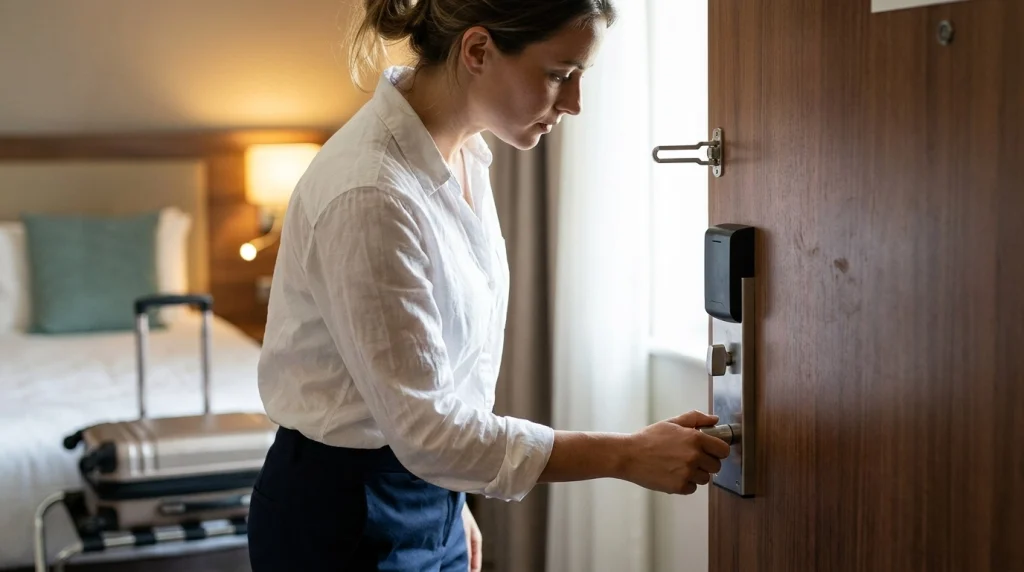
Start by checking the door immediately after entering your room. A working main lock matters more than any portable security accessory.
A hotel room door security check is a short inspection of the door, locking hardware, and nearby access points. Its purpose is to confirm that the room can be secured without blocking your escape.
Check the Door Before Unpacking
I recommend keeping your suitcase closed until you have inspected the entrance. Changing rooms is easier when your belongings are still together.
Use this straightforward checklist:
- Close the door and listen for the latch to engage.
- Gently pull the door to confirm it remains shut.
- Test the deadbolt and any interior security latch.
- Inspect the handle, strike plate, and frame for visible damage.
- Make sure the door closes without excessive force.
- Confirm that the door opens normally from the inside.
Some hotel doors have an automatic closer. Do not assume this means the latch engaged correctly.
If the door stays partly open or does not lock, contact reception immediately. A room change is preferable to spending the night worrying about faulty hardware.
Check Connecting Doors and Other Entrances
An adjoining-room door creates another possible access point. Check that it is securely locked from your side.
Also inspect the balcony door and any accessible windows. This matters particularly in ground-level rooms or rooms beside shared terraces.
For broader room inspection guidance, the State Department recommends checking locks, curtains, communication equipment, and emergency arrangements.
Look at the Emergency Exit Before Sleeping
A secure door is only useful if you can escape during an emergency. Find the nearest stairwell and identify another exit when available.
The U.S. Fire Administration’s hotel fire safety guidance recommends identifying two nearby exits and reviewing the evacuation plan.
Keep your key card, phone, and shoes somewhere easy to reach. Avoid placing luggage where it could obstruct your path.
Pro tip: Check the hotel’s posted evacuation instructions and local emergency number. Requirements can differ between countries and properties.
Section Takeaway: Inspect the door before getting comfortable. A properly functioning lock and a clear exit route form the foundation of hotel room security.
What Is the Best Way to Lock a Hotel Room Door From Inside?
The best starting point is to use the hotel’s working primary lock and interior secondary lock. These usually provide more dependable everyday protection than an improvised door barricade.
Use the Deadbolt and Security Latch
Many hotel rooms have an electronic key-card lock, an interior deadbolt, and a swing-bar latch. Their designs vary, so inspect the actual hardware.
When you enter your room:
- Close the door completely.
- Confirm the primary latch engages.
- Turn the deadbolt if one is provided.
- Engage the swing-bar latch or security chain.
- Check that nothing prevents a quick exit.
Use these locks whenever you’re inside, especially while sleeping or showering. However, remember that hotel staff may have emergency access procedures.
No ordinary hotel door should be treated as impossible to open from outside. Multiple layers simply reduce opportunities for unwanted entry.
Understand What Different Locks Actually Do
Each security feature solves a slightly different problem. This comparison helps you choose a sensible approach.
| Security Feature | Main Purpose | Important Limitation |
|---|---|---|
| Electronic key-card lock | Controls normal access from the hallway | Authorized or compromised keys may still permit entry |
| Interior deadbolt | Adds a mechanical locking layer | Emergency override arrangements differ |
| Swing-bar latch | Restricts door opening while occupied | Not a substitute for the main lock |
| Portable door alarm | Warns of possible door movement | Does not necessarily prevent entry |
| Doorstop wedge | Adds friction against some inward-opening doors | May fail on unsuitable floors or obstruct access |
| Portable travel lock | Adds an inside-only barrier on compatible doors | Fit, hotel rules, and emergency removal vary |
My preference: A hotel with a reliable built-in deadbolt and security latch comes first. Portable equipment is optional, not a replacement for proper maintenance.
Should You Push Furniture Against the Door?
I do not recommend making furniture barricades part of your normal bedtime routine. Heavy furniture can delay evacuation and make it harder for responders to enter.
A chair under the handle also provides uncertain protection. Its effectiveness depends on the handle, flooring, and direction in which the door opens.
Choose functioning locks and a property with responsive staff instead.
Are Portable Door Locks and Doorstop Alarms Worth Using?
Portable devices can be useful, but they are not essential for every solo traveler. Their value depends on your door, your ability to remove them quickly, and the hotel’s rules.
Portable Hotel Door Locks
A portable hotel door lock is a removable device designed to add an interior barrier without permanently modifying the door. Many models work only with certain inward-opening doors and strike plates.
Before considering one, check:
- Whether the hotel allows supplementary door-locking devices.
- Whether the design fits your particular door.
- Whether you can remove it immediately without tools.
- Whether it could delay emergency responders.
- Whether installation could damage the door or frame.
Never force an incompatible device into place. If it jams, the additional barrier may create a greater hazard than the problem it was meant to solve.
I prefer equipment that is simple to understand. Complicated installation is the last thing I want when arriving tired after a long journey.
Doorstop Alarms
A doorstop alarm usually resembles a wedge with a pressure-sensitive alarm. Some designs make noise when the door pushes against them.
This can offer an audible warning, but it is not a guaranteed physical barrier. Carpet, floor texture, door clearance, and opening direction can affect performance.
A reasonable checklist includes:
- Choose a product with clear manufacturer instructions.
- Check the batteries before departure.
- Confirm it suits the room’s flooring and door.
- Never place it where it creates a tripping hazard.
- Use it only if hotel policy and fire-safety requirements permit.
Test an alarm carefully without disturbing other guests. Do not assume that a loud alarm guarantees someone will intervene.
Which Option Makes More Sense for Beginners?
For a first solo trip, I would prioritize a dependable hotel over buying multiple security gadgets. Good reviews, staffed reception, reliable locks, and clear emergency exits matter more.
If you want extra reassurance, consider a simple alarm that does not impede the door’s operation. A portable blocking lock needs more careful evaluation.
Before spending money, read the manufacturer’s compatibility and safety instructions. Avoid products promoted with exaggerated claims about preventing every possible break-in.
Section Takeaway: Extra security equipment should support a safe room, not compensate for a defective one. An alert device may be more practical than a barrier that slows emergency evacuation.
How Can You Prevent Unwanted Hotel Room Entry?
Preventing unwanted entry involves more than locking hardware. Your room number, key card, visitor habits, and communication with staff also matter.
Keep Your Room Number Private
A room number is sensitive travel information. Avoid announcing it in the lobby or telling people you’ve just met.
At check-in, I prefer having the room number written down rather than spoken loudly. You can politely request the same from reception.
Other helpful habits include:
- Keep your key card separate from the packet showing your room number.
- Avoid displaying your room number in public photos.
- Do not post your precise hotel location in real time.
- Report a missing key card and ask reception about deactivating it.
- Meet unfamiliar visitors in staffed public areas.
These measures reduce unnecessary disclosure. They do not require being unfriendly or hiding that you’re enjoying your trip.
Verify Anyone Who Knocks Unexpectedly
You do not have to open your door because someone says they work for the hotel. Keep it locked until you can verify the visit.
If someone claims to be housekeeping, maintenance, security, or room service:
- Look through the peephole if it is safe to do so.
- Keep the door closed and engage the secondary lock.
- Call reception using a previously verified number.
- Ask whether they sent someone to your room.
- Arrange service later if the visit was unexpected.
Do not rely solely on a uniform or an identification badge. If the situation feels suspicious, ask reception to send a supervisor or security officer.
Harvard Global Support’s accommodation safety advice also recommends verifying unexpected maintenance visits and using available secondary locks.
Protect Your Privacy While Inside
Close your curtains before changing clothes, particularly in rooms facing nearby buildings. Check that the peephole cover works when one is provided.
Use the hotel’s Do Not Disturb option when appropriate. However, remember that hotels may have policies permitting welfare or maintenance checks.
A Do Not Disturb sign does not replace locking your door.
Choose Room Location With Escape Routes in Mind
There is no single safest floor for every hotel. Ground-level access, stairwell locations, building design, and evacuation options all affect your decision.
Before booking, consider asking:
- Is reception staffed overnight?
- Do guest floors have controlled access?
- Can I request a room without a connecting door?
- Are emergency stairwells clearly marked?
- What happens if my key card or room lock fails?
I also favor accommodation near practical transportation and well-used streets. The U.S. State Department travel advisories can help you review broader destination risks before booking.
Section Takeaway: Privacy and visitor verification are part of door security. Protect your room details, use hotel staff as a verification point, and choose accommodation carefully.
What Should You Do If Someone Tries to Open Your Hotel Door?
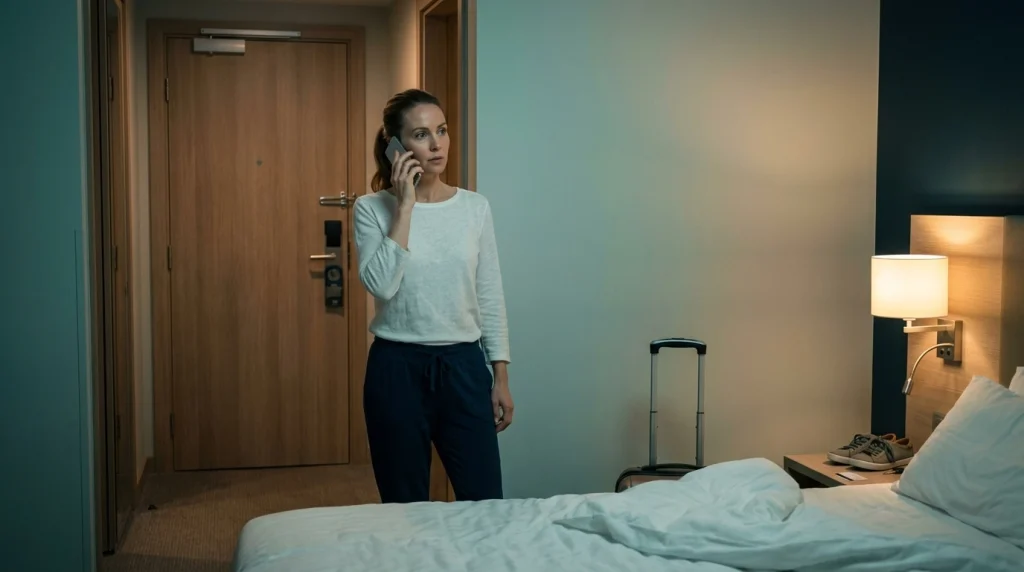
If someone unexpectedly attempts to enter, keep the door closed and seek help. Your response should depend on whether the situation is a mistake, a security concern, or an immediate threat.
If Someone Tries Your Door Handle
Not every unexpected handle movement means someone intends harm. A guest may have approached the wrong room, or a staff member may have made an error.
Still, treat unexpected access attempts seriously:
- Keep the locks engaged.
- Do not open the door to investigate.
- Contact reception or hotel security.
- Explain your room number and what happened.
- Request assistance if the person remains outside.
Avoid confronting the individual in the hallway. Let hotel staff investigate when that is safe and appropriate.
If Someone Claims There Is an Emergency
An unexpected claim about an urgent repair or room problem should normally be verified with reception. Use a known hotel number rather than a number provided by the person outside.
However, a genuine fire alarm or visible smoke requires following emergency procedures promptly. Never let a removable security device delay your escape.
If you see smoke, assess whether the route is safe and follow official fire instructions. Avoid elevators during a fire unless emergency personnel direct otherwise.
If You Believe Someone Is Trying to Break In
Contact hotel security and local emergency services if you believe an intruder presents an immediate danger. Give your hotel name, room number, and a brief description of the threat.
Move away from the door and follow emergency responders’ instructions. Leave through a safe route if doing so does not increase your risk.
If the hotel is unable or unwilling to address a serious security concern, request a room change or alternative accommodation.
Prepare an Overnight Emergency Plan
My suggested bedtime routine takes only a few minutes. It helps you avoid searching for important items in the dark.
- Charge your phone and keep it within reach.
- Save reception’s number and the local emergency number.
- Keep your room key in an easy-to-find place.
- Place shoes near your bed.
- Keep the route to the door unobstructed.
- Share your hotel details privately with someone you trust.
For international trips, eligible U.S. citizens can also review the State Department’s Smart Traveler Enrollment Program for destination updates and emergency communication information.
Pro tip: Review your destination government’s emergency instructions before departure. Emergency phone numbers and responder procedures are not the same everywhere.
Section Takeaway: When something unusual happens, verification and fast access to help matter most. Keep your door closed when appropriate, know how to contact assistance, and preserve a safe exit.
Frequently Asked Questions About Hotel Door Security
Can hotel staff open my door when the deadbolt is locked?
It depends on the hotel’s locking system and emergency access procedures. Some systems allow authorized overrides, while certain interior latches restrict ordinary access. Do not assume a deadbolt makes entry impossible. Ask reception about the property’s security arrangements if you’re concerned.
Should a woman traveling alone use a portable hotel door lock?
A portable lock can add a barrier on compatible doors, but it is not necessary for every traveler. Check hotel rules and the device’s instructions before use. Never install anything that could trap you inside or delay emergency responders.
Do hotel doorstop alarms work on carpet?
Performance depends on the alarm’s design, the carpet, and the space beneath the door. Some wedges may slide or fail to activate on certain surfaces. Check the manufacturer’s compatibility guidance and do not rely on the alarm as your only security measure.
Is it safe to sleep with the hotel room security latch engaged?
A working built-in security latch is generally intended for use while the room is occupied. Engage it according to the hotel’s instructions. Also confirm you can release it quickly from inside and keep your evacuation route clear.
What if my hotel room door does not lock properly?
Contact reception immediately and request repair or another room. Do not depend on luggage, furniture, or a portable accessory to make up for a defective primary lock. If the hotel cannot provide a secure room, consider changing accommodation.
Should I open my hotel door for unexpected housekeeping?
No. You can verify an unexpected visit while keeping the door closed. Call reception through a number you trust and ask whether housekeeping was sent. If you don’t need service, arrange another time through the front desk.
Is a door alarm better than a portable door lock?
They serve different purposes. A door alarm warns you about movement, while a portable lock attempts to restrict opening. For many travelers, an alarm may be simpler, provided its use is permitted and safe. Neither device replaces properly functioning hotel locks.
Final Takeaway: Secure Your Door Without Complicating Your Trip
Securing a hotel room door as a solo female traveler starts with choosing reliable accommodation and checking the door as soon as you arrive. Engage the available locks, protect your room number, and verify unexpected visitors.
Extra devices can offer reassurance, but emergency exit safety must always come first. The goal is a room where you can relax, not one that feels barricaded.
Before your next solo trip, save this hotel door security checklist and use it during your first few minutes after check-in. A simple, repeatable routine can help you feel more prepared and confident traveling alone.