What Should a Solo Female Traveler Pack in a Personal Item?
Quick Answer
A solo female traveler should pack her personal item with anything she cannot comfortably lose for 24 hours: identification, money, medication, phone, charging gear, travel documents, essential toiletries, one small clothing change, and basic comfort items. Keep security rules in mind, including the TSA carry-on liquids guidance when departing from a U.S. airport. The goal is not to fill every pocket but to create a compact backup system that stays with you throughout the journey.
Your personal-item priorities
- Identity: Keep your passport or required ID, boarding information, visas, and essential document copies accessible.
- Money: Carry your main payment method plus a backup card and a modest amount of usable cash.
- Health: Keep prescription medication and other genuinely necessary health supplies with you.
- Communication: Pack your phone, charging cable, adapter if needed, and an airline-compliant power bank.
- Backup comfort: Include enough hygiene, food, warmth, and clothing to manage a delay or missing checked bag.
One rule I use
- If losing an item would immediately affect my safety, health, identity, access to money, or ability to contact someone, I keep it with me.
When I pack for solo travel, I treat my personal item as more than an under-seat bag. It is my small emergency kit for the part of the trip where I have the least control.
Flights get delayed, overhead bags get gate-checked, and checked luggage sometimes arrives later than its owner. A well-packed personal item keeps those problems annoying instead of trip-changing.
In This Guide
- What counts as a personal item for solo travel?
- What documents and money should you keep in your personal item?
- What health and toiletry items should go in your personal item?
- What tech and safety items should a solo female traveler pack?
- What should you pack for comfort and delays?
- How should you organize a personal item without overpacking?
- Frequently asked questions
What Counts as a Personal Item for Solo Travel?
A personal item is the smaller bag you keep in the aircraft cabin, usually stored beneath the seat in front of you. Airlines set their own size and weight rules, so there is no single worldwide personal-item measurement.
Before packing, check your airline’s current baggage page. This matters even more on low-cost airlines, where baggage allowances may be tightly enforced.
Definition: A solo travel personal item is a compact cabin bag containing the documents, health supplies, electronics, valuables, and short-term essentials you want to keep physically close during your journey.
I prefer a backpack or securely closing travel bag over a completely open tote. It keeps my hands free while I handle my phone, passport, luggage, or transit ticket.
The personal item also becomes more important if your larger cabin bag is taken at the gate. The FAA notes that airline baggage policies can be stricter than general regulations, so it is smart to prepare for that possibility.
Think in terms of consequences, not categories
Instead of asking, “Will this fit?” I ask, “What happens if I cannot access this until tomorrow?” That question cuts out a surprising amount of unnecessary packing.
- High consequence: Passport, medication, phone, wallet, house keys, important travel documents.
- Medium consequence: Charger, toiletries, underwear, light layer, headphones, snacks.
- Low consequence: Multiple cosmetics, extra shoes, large styling tools, full-size skincare, bulky entertainment.
That hierarchy keeps the bag useful rather than merely full.
What Documents and Money Should You Keep in Your Personal Item?
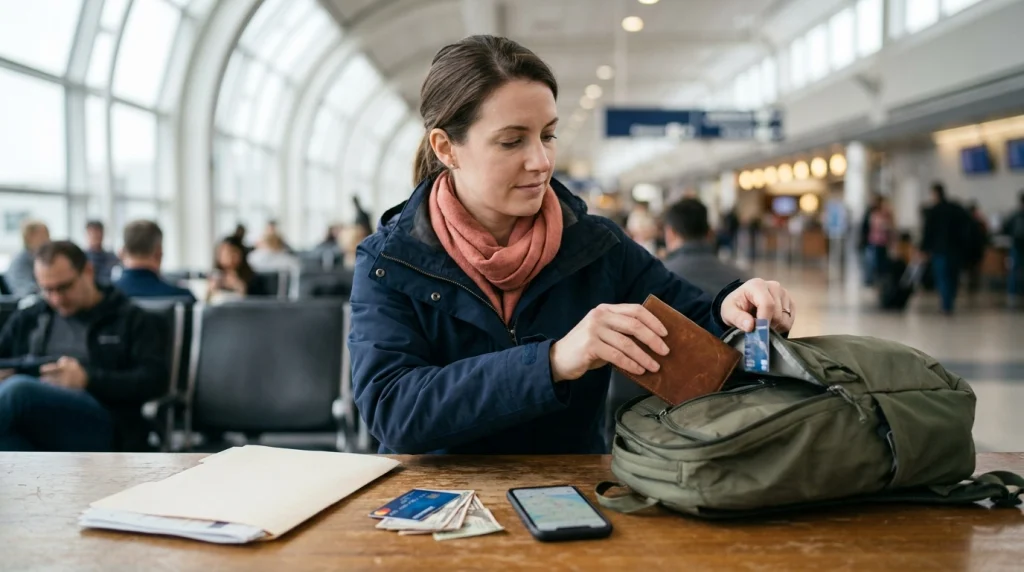
Keep your essential identification, travel documents, and accessible money with you rather than inside checked luggage. For a solo traveler, losing access to these items can affect every part of the trip at once.
The U.S. State Department also advises international travelers to organize required documents and keep copies in separate places.
Pack these travel documents first
- Passport or required identification: Keep it in a secure interior pocket that you can reach without unpacking the bag.
- Visa or entry documents: Carry any paper documents your destination requires.
- Boarding information: Keep it on your phone, but save an offline copy or screenshot too.
- Accommodation details: Save the address of your first night’s lodging offline.
- Travel insurance information: Store the policy number and emergency contact details digitally.
- Document copies: Keep copies separate from the originals and secure digital backups where possible.
- Emergency contacts: Write down at least one important number in case your phone becomes unavailable.
I also save my first accommodation address in a format I can show a driver without unlocking several apps. That tiny habit is especially useful after a long travel day.
For international trips, review the State Department’s international travel planning guidance before departure. Requirements and destination conditions can change.
Split your money rather than creating one failure point
Do not keep every card and every piece of cash in the same wallet. A lost wallet should not instantly remove every way you have to pay.
- Carry one primary payment card.
- Keep a backup card in a different secure location.
- Carry a modest amount of cash appropriate for arrival expenses.
- Keep emergency money discreet rather than in an obvious outer pocket.
Be careful about over-organizing, though. If retrieving your passport requires opening three pouches at a busy checkpoint, the system is working against you.
Section Takeaway: Keep identity, payment, arrival information, and backups accessible but separated enough that one mistake cannot take everything at once.
What Health and Toiletry Items Should Go in Your Personal Item?
Your personal item should contain medication you depend on and enough basic hygiene supplies to get through the journey and an unexpected delay. Never assume an essential prescription will be easy to replace after arrival.
CDC guidance recommends carrying needed medication in your cabin baggage and bringing enough for the trip, plus extra for potential delays.
Keep essential medicine with you
- Prescription medication: Carry the amount you need for your trip, following destination rules.
- Prescription information: Keep appropriate supporting information for important medication.
- Basic pain relief: Pack only medication that is suitable for you and legal at your destination.
- Allergy supplies: Keep any personally required treatment readily accessible.
- Period products: Carry enough for the travel day plus a small backup supply.
The CDC advises travelers to check whether their medicine is legal at their destination and to keep medicines properly labeled. Its traveling abroad with medicine guidance is a useful pre-trip reference.
Pro tip: Medication rules differ by country. Check official destination guidance or the relevant embassy before traveling with prescription or controlled medicines.
Build a tiny hygiene kit, not a bathroom cabinet
I pack for the next 12 to 24 hours rather than trying to carry my full routine. That keeps the essentials available without sacrificing half the bag.
- Travel-size toothbrush and toothpaste
- Small hand sanitizer
- Lip balm
- Tissues
- A few cleansing or face wipes
- Deodorant
- Period products if needed
- Small moisturizer
When departing from a U.S. airport, standard carry-on liquids, gels, creams, aerosols, and pastes are generally subject to the TSA 3-1-1 rule. Other countries may use their own security procedures.
Keep liquids together where you can retrieve them easily. A leak-resistant pouch also prevents one loose cap from turning your electronics pocket into a skincare experiment.
What Tech and Safety Items Should a Solo Female Traveler Pack?
The most useful travel technology helps you communicate, navigate, pay, and recover from disruptions. You usually need fewer gadgets than you think.
I prioritize anything that keeps my phone operational because one device may hold maps, tickets, hotel details, translation tools, transport apps, and emergency contacts.
My core travel-tech kit
- Phone: Download essential information before leaving reliable internet access.
- Charging cable: Keep one cable where you can reach it during a connection.
- Wall charger: Choose a compact charger suitable for your devices.
- Travel adapter: Bring one when your destination uses a different plug system.
- Power bank: Useful on long travel days, but check aviation battery restrictions.
- Headphones: Helpful for flights, calls, directions, and downtime.
Power banks deserve special attention. The FAA says spare lithium batteries and power banks must travel in carry-on baggage rather than checked baggage.
Review the FAA’s current lithium battery guidance before flying, especially if you use a high-capacity battery. If a cabin bag gets gate-checked, remove items the airline requires you to keep in the cabin.
What about personal safety items?
For solo travel, I favor prevention and communication over packing something that may be prohibited or illegal. Laws on defensive items differ sharply between countries and transport systems.
- Keep your phone charged.
- Save accommodation and transport details offline.
- Share your itinerary with a trusted contact when appropriate.
- Know how to contact local emergency services.
- Research destination-specific rules and cultural expectations.
- Avoid bringing restricted defensive products without checking local law and airline rules.
The State Department maintains specific guidance for women travelers, including advice on local laws, customs, health, and security considerations.
Pro tip: Check official government travel information for your destination before departure. Do not rely on social media alone for legal or safety guidance.
Section Takeaway: Your phone, power source, offline information, and a clear arrival plan usually contribute more to practical solo-travel safety than carrying extra gadgets.
What Should You Pack for Comfort and Delays?
Pack enough comfort items to make a long travel day manageable, but avoid turning your personal item into a second suitcase. Every comfort item should earn its space.
My test is simple: would I be glad to have this after a six-hour delay, or am I carrying it because there happened to be room?
Useful comfort items
- Reusable empty water bottle: Fill it after airport security where permitted.
- Simple snacks: Choose compact foods that travel well and comply with destination rules.
- Light layer: A cardigan, scarf, or packable layer helps with cold aircraft cabins.
- Eye mask: Useful without taking much space.
- Earplugs: Tiny, cheap, and helpful during flights or noisy connections.
- Underwear and socks: A fresh pair can make a delayed-luggage day much easier.
- Compact spare top: Worth considering for long-haul journeys.
If I have checked luggage, I usually keep one small clothing refresh in my personal item. I do not try to fit a complete replacement wardrobe underneath the seat.
What should stay out?
- Multiple pairs of shoes
- Full-size toiletries
- Large hair appliances
- Several books
- Duplicate electronics
- Bulky “just in case” clothing
- Items prohibited by aviation or destination rules
Solo travel often involves more bag handling than expected. You may need to manage stairs, public transport, security lines, narrow train aisles, or a walk between your station and hotel.
A lighter personal item protects your mobility. That matters when there is nobody else carrying your overflow bag.
How Should You Organize a Personal Item Without Overpacking?
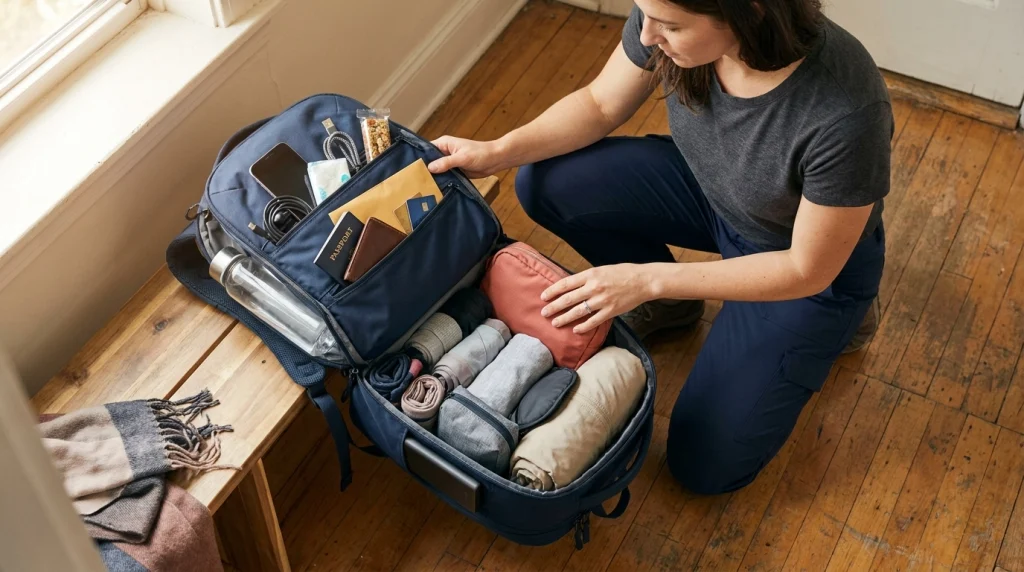
Organize your personal item by how quickly you may need each item. The best packing system lets you retrieve something without exposing every valuable you own.
I use three access zones: immediate, secure, and backup.
Zone 1: Immediate-access items
- Phone
- Boarding information
- Headphones
- Tissues
- Snack
- Water bottle
- Charging cable
Zone 2: Secure essentials
- Passport or ID
- Wallet
- Medication
- Backup payment method
- Important documents
Zone 3: Backup and comfort items
- Spare underwear and socks
- Compact top
- Toiletry pouch
- Eye mask
- Light layer when not being worn
Keep heavy items close to the back of a backpack when possible. Avoid letting a water bottle, camera, or dense power bank pull the bag away from your body.
| Item | Personal Item? | Priority | Why |
|---|---|---|---|
| Passport / ID | Yes | Essential | Required for identity and many travel processes. |
| Prescription medication | Yes | Essential | You may not be able to replace it quickly. |
| Phone and charger | Yes | Essential | Supports navigation, communication, bookings, and payments. |
| Power bank | Yes | High | FAA rules require spare lithium batteries and power banks to remain in carry-on baggage. |
| One clothing change | Usually | Medium | Useful during delays or temporarily missing luggage. |
| Full-size toiletries | Usually no | Low | Bulky and may conflict with security restrictions. |
| Extra shoes | Usually no | Low | They use too much valuable under-seat space. |
My five-minute final packing check
- Confirm the airline’s personal-item dimensions and weight rules.
- Remove anything that is merely a duplicate.
- Check liquids and restricted items.
- Confirm medication, passport or ID, wallet, phone, and charger are present.
- Lift the packed bag and ask whether you want to carry it through a station alone.
The last step catches overpacking quickly. If the bag already feels irritating at home, it will not improve after three hours of travel.
As of 2026, I would also recheck battery, baggage, and airport-security rules shortly before every flight. These requirements can change, and airlines or countries may apply rules differently.
Section Takeaway: Build your personal item around fast access, secure storage, and a 24-hour backup plan—not around using every inch of available space.
Frequently Asked Questions
Should a solo female traveler keep her passport in her personal item?
Yes, when a passport is required for your trip, keep it in your cabin bag or another secure place on your person rather than checked luggage. Use a zipped interior compartment and avoid repeatedly displaying it in crowded public areas.
Should medication go in a personal item or checked bag?
Essential medication should generally stay in your cabin baggage so it remains available if checked luggage is delayed or lost. Check destination rules before traveling and carry medication in appropriate labeled packaging with any supporting documentation you may need.
How many clothes should I pack in my personal item?
For most trips with separate luggage, one lightweight backup outfit is enough. I prioritize underwear, socks, and a compact top. The purpose is to survive a delay comfortably, not duplicate the clothes packed in your main bag.
Can I put a power bank in my personal item?
Yes, subject to applicable battery limits. In the United States, FAA rules require spare lithium batteries and power banks to remain in carry-on baggage rather than checked baggage. Check your airline if your power bank has an unusually high capacity.
What valuables should a solo traveler keep with her?
Keep your passport or ID, payment cards, phone, medication, keys, important travel documents, and small high-value electronics with you. Avoid placing items that would seriously disrupt your trip inside luggage that may be separated from you.
What is the biggest personal-item packing mistake?
The biggest mistake is filling the bag with low-priority items until important things become hard to reach. A personal item works best when documents, medication, communication tools, money, and basic overnight essentials remain organized and accessible.
Is a backpack better than a tote bag for solo female travel?
It depends on the trip, but I generally prefer a backpack or another bag that closes securely and leaves both hands free. A tote can work for simple journeys, yet open designs are less practical in crowded airports, stations, and city transport.
For me, the best solo-travel personal item is not the bag that holds the most. It is the bag that keeps the right things close when plans stop going perfectly.
Before leaving home, imagine arriving without your checked suitcase for one day. If you could still identify yourself, pay, communicate, take your medication, clean up, change a few clothes, and reach your accommodation, you packed the important things correctly.
Save this checklist before your next trip, then customize it around your destination, airline rules, health needs, weather, and travel style.