How Can a Solo Female Traveler Pack Light for a Long Trip?
Quick Answer
A solo female traveler can pack light for a long trip by packing for one week rather than the entire journey, choosing clothes that work together, planning regular laundry, limiting shoes, and carrying only essential toiletries, electronics, health items, and documents. Before packing medications or health supplies for international travel, check current guidance from the CDC Travelers’ Health resources.
Pack light for a long trip in six steps
- Pack one week: Build a seven-day clothing rotation and wash items during the trip.
- Choose a capsule: Use neutral, compatible pieces that create several outfits.
- Limit shoes: Wear your bulkiest pair and usually pack only one additional pair.
- Decant toiletries: Carry small amounts and replace ordinary products when needed.
- Protect essentials: Keep medication, identification, money, phone, and charging gear easy to reach.
- Leave empty space: A bag that closes easily is more useful than one packed to its limit.
Packing light for a long solo trip can feel harder than packing for a weekend. You start imagining every climate, dinner, laundry delay, and unexpected problem.
I approach it differently. I pack for the next seven days, then build simple systems that let those seven days repeat comfortably.
That matters even more when you’re traveling alone. You need to lift, carry, store, watch, and move your own luggage through every airport, station, staircase, hostel, and hotel.
In This Guide
- What Does Packing Light Mean for a Long Solo Trip?
- How Many Clothes Do You Need for a Long Trip?
- How Should You Choose and Organize Your Travel Bag?
- What Toiletries, Health, and Safety Items Should You Pack?
- Which Electronics and Documents Deserve Space?
- How Do You Pack for Different Climates and Cultures?
- Frequently Asked Questions
What Does Packing Light Mean for a Long Solo Trip?
Packing light means carrying enough to stay comfortable and prepared without packing for every possible situation. For a long trip, the key is building a repeatable clothing, laundry, and resupply system.
Definition: Light packing for long-term travel means choosing a compact group of reusable essentials that can support the trip through washing, layering, replacing consumables, and adapting along the way.
A month-long trip does not require four times as much clothing as a one-week trip. You still wear one outfit at a time.
The biggest difference is laundry. Once I plan where and how I can wash clothes, the temptation to pack three weeks of outfits drops quickly.
Why does light luggage matter more when you travel alone?
Solo travelers manage every physical part of the journey themselves. Nobody else is carrying the second suitcase while you check a train platform or find your accommodation.
- Transit is easier: You can handle stairs, buses, trains, ferries, and airport changes more independently.
- You attract less attention: One manageable bag is easier to control in crowded areas.
- Hotel changes feel simpler: Packing for a move takes minutes rather than an hour.
- You have fewer valuables to track: Every extra device, accessory, and bag creates another thing to protect.
- Changing plans becomes easier: Missing a train or switching accommodation is less stressful when your luggage remains manageable.
My favorite test is simple. I should be able to move my luggage up one normal flight of stairs without needing help.
If that sounds miserable before departure, the bag is probably too heavy.
Section Takeaway: Pack for mobility, not every imaginable problem. A long journey becomes easier when your luggage remains completely manageable by you.
How Many Clothes Do You Need for a Long Trip?
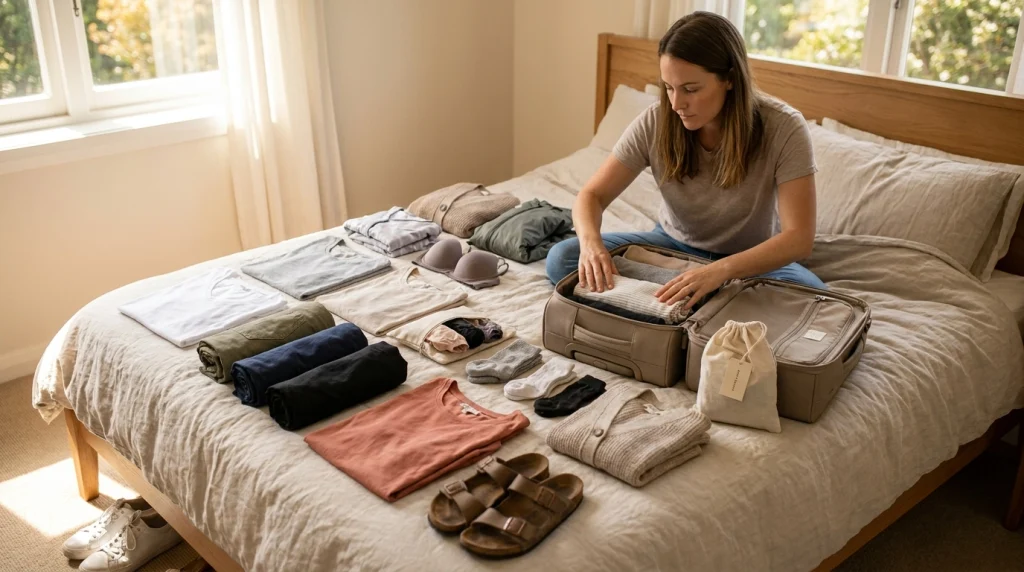
For most long trips, I would start with roughly five to seven days of everyday clothing. The exact mix depends on climate, activities, cultural expectations, and access to laundry.
The goal is not owning seven separate outfits. It’s creating many combinations from a small group of compatible pieces.
What does a practical seven-day capsule wardrobe look like?
| Category | Practical Starting Amount | Why |
|---|---|---|
| Tops | 5 | Enough variety while keeping laundry manageable |
| Bottoms | 3 | Choose pieces that work with every top |
| Dress or alternate outfit | 1–2 | Useful for warm days, dinners, or a change of style |
| Underwear | 7 | Supports a weekly washing cycle |
| Socks | 5–7 pairs | Adjust for sandals, boots, hiking, or climate |
| Bras | 2–3 | Rotate between washes |
| Sleepwear | 1 set | Keep it lightweight and quick drying |
| Warm layer | 1 | For evenings, flights, trains, and air-conditioning |
| Weather shell | 1 if needed | Choose according to season and destination |
| Shoes | 2 pairs total | One everyday pair plus one trip-specific pair |
Use a simple color system
I like to choose two or three main clothing colors and one accent color. Every top should work with at least two bottoms.
This removes those frustrating pieces that only match one specific outfit. Those are usually the first things I leave at home.
Plan laundry before adding clothes
For a long journey, I plan to wash clothing about once every five to seven days. That might mean a laundromat, accommodation laundry service, washing machine, or hand-washing a few small items.
- Pack a small amount of laundry detergent only if it makes sense for the route.
- Choose fabrics that can dry without special equipment.
- Avoid taking several pieces that require delicate care.
- Keep one clean outfit available while the rest dries.
- Use a lightweight bag for dirty clothing.
Repeat wear is normal. Other travelers are not keeping a record of how many times you wore the same black trousers.
Section Takeaway: Build a seven-day clothing cycle and solve laundry instead of packing for the full calendar length of your trip.
How Should You Choose and Organize Your Travel Bag?
Choose the smallest bag that comfortably holds your genuine essentials without forcing you to sit on it to close the zipper. Your airline’s own baggage page should always be the final authority for current cabin size and weight limits.
International baggage allowances are not universal. They can change by airline, fare, cabin, route, and aircraft.
Backpack or rolling suitcase?
Neither is automatically better for solo female travel. Your route matters more than the luggage style.
| Option | Best For | Main Trade-Off |
|---|---|---|
| Travel backpack | Frequent trains, stairs, uneven streets, and moving often | Weight stays on your body |
| Rolling carry-on | Airports, paved cities, hotels, and longer stays | Awkward on stairs and rough streets |
| Checked suitcase | Specialized gear, bulky cold-weather trips, or necessary equipment | More luggage to manage during transfers |
Do packing cubes help?
Packing cubes do not magically reduce the weight of your luggage. They help by creating boundaries.
I prefer three or four simple categories rather than a cube for every tiny item.
- Main clothing cube: Tops, bottoms, and dresses.
- Small clothing cube: Underwear, socks, bras, and sleepwear.
- Utility pouch: Chargers, adapters, and small accessories.
- Toiletry bag: Daily personal-care items.
I also avoid over-compressing everything. Compression can create extra room that tempts you to add more weight.
Leave a little breathing space. It makes packing much easier on travel days.
Section Takeaway: Your bag should support your route, and it should close easily. Organization matters, but keeping total weight manageable matters more.
What Toiletries, Health, and Safety Items Should You Pack?
For toiletries, pack the products you genuinely use and avoid preparing for every possible emergency. Ordinary shampoo, soap, toothpaste, and skincare can often be replaced during a long trip.
Medication is different. Essential prescription items deserve more careful planning.
Which toiletries are worth carrying?
- Toothbrush and toothpaste
- Small skincare routine you already use
- Deodorant
- Small shampoo and conditioner if needed
- Hairbrush or comb
- Menstrual products for the first part of the trip
- Small makeup kit if you use one regularly
- Sunscreen appropriate for your destination
Skip the giant backup bottles. Long-term travel does not mean carrying your bathroom cabinet across the world.
What belongs in your health kit?
The CDC recommends tailoring a travel health kit to your destination, trip length, planned activities, and individual needs. I treat prescriptions and difficult-to-replace health items differently from normal toiletries.
- Prescription medication you need
- A sensible amount for possible delays, when permitted
- Basic first-aid supplies suited to your trip
- Personal health items that may be difficult to replace
- Insurance information where applicable
- Destination-specific protection such as insect repellent when needed
Pro tip: Check current destination-specific health advice through the CDC or your destination’s official health authority before departure, especially for medication rules, vaccines, or disease risks.
Do solo women need extra safety gadgets?
You do not need a suitcase full of defensive gadgets to travel responsibly. Some self-defense items are restricted by airlines or illegal in certain destinations.
I prioritize boring but useful safety tools instead.
- Charged phone
- Portable power bank
- Offline accommodation address
- Backup payment method stored separately
- Copies of important documents
- Small luggage or hostel-locker lock where appropriate
- Emergency contact information
Women traveling internationally should also research local customs, laws, and destination-specific considerations through the U.S. State Department travel resources or their own government’s equivalent service.
Section Takeaway: Save space on replaceable toiletries, but do not casually reduce essential medications, health supplies, documents, or communication tools.
Which Electronics and Documents Deserve Space?
Electronics become heavy surprisingly fast. For most leisure trips, a phone can handle navigation, reservations, translation, communication, photography, entertainment, and basic planning.
Every additional device should have a clear purpose that justifies its charger, cable, adapter, and security burden.
Use the one-job test
Ask what each electronic item does that your existing devices cannot. If the answer is weak, leave it behind.
- Phone: Essential for most modern trips.
- Power bank: Useful on long transport days and navigation-heavy days.
- Universal or destination adapter: Choose only what your route requires.
- Laptop: Bring it when work or another genuine need requires it.
- Tablet or e-reader: Consider whether your phone already covers the same purpose.
- Camera: Worth the space when photography is an important part of your trip.
Keep documents light but redundant
Important travel information should not exist in only one place. I like a combination of physical essentials and secure digital backups.
- Passport or required identification
- Visas or entry documents when applicable
- Payment cards kept in separate locations
- Travel insurance information if purchased
- Essential reservations available offline
- Emergency contact information
- Secure digital copies of important documents
Do not carry piles of printed confirmations simply because they might become useful. Print only documents that genuinely need a physical copy or provide an important backup.
Keep flight-day essentials accessible
Your airport setup should not require opening your entire suitcase at a checkpoint. Place frequently accessed items where you can reach them quickly.
For U.S. departures, current screening information is available through the Transportation Security Administration travel guidance. Other countries may apply different screening procedures.
- Passport or identification
- Boarding pass
- Phone
- Wallet
- Liquids bag when required
- Electronics when removal may be required
- Medication you need during the journey
Section Takeaway: Every electronic device creates weight plus accessories. Carry the devices that solve important problems and make your essential documents accessible in more than one secure form.
How Do You Pack for Different Climates and Cultures?
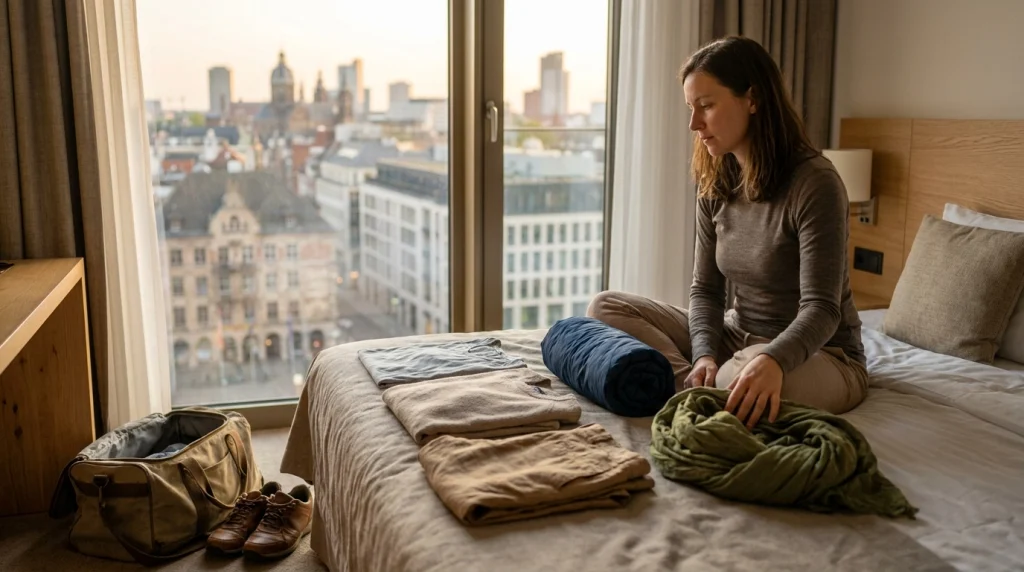
Pack for the hardest conditions on your actual itinerary, not every climate that could theoretically occur. Layers usually create more flexibility than carrying several bulky single-purpose outfits.
A long multi-destination trip requires more thought because weather and cultural expectations may change between stops.
How should you pack for mixed weather?
Build layers that work together. A lightweight base layer, normal shirt, warm mid-layer, and weather-resistant outer layer can cover far more situations than several heavy outfits.
- Hot destinations: Prioritize breathable fabrics and sun protection.
- Cool destinations: Add a warm layer without multiplying your entire wardrobe.
- Rainy destinations: Pack a compact shell or another solution suitable for the conditions.
- Cold destinations: Wear your bulkiest coat and footwear during major travel days when practical.
How should women account for local dress expectations?
Research the destination rather than assuming your normal wardrobe works everywhere. Religious sites, rural areas, formal spaces, or local social norms may call for more coverage.
A large lightweight scarf can sometimes help with modesty, sun, cold transport, or air-conditioning. It earns its place because it serves several purposes.
For destination inspiration and broader planning information, established travel resources such as Lonely Planet can be useful alongside official government guidance.
Do you need more luggage for a three-month trip than a three-week trip?
Not necessarily. After you have enough clothing to reach your next laundry day, adding more weeks does not automatically require more clothes.
You may need extra seasonal gear when the route changes climate. That is a route problem, not simply a trip-length problem.
Use the replace-versus-carry rule
Before packing a bulky “just in case” item, ask how hard it would be to replace at your destination. Common inexpensive items rarely deserve months of luggage space.
- Carry from home: Prescriptions, difficult-to-fit clothing, specialized equipment, and essential personal items.
- Consider buying later: Ordinary toiletries, inexpensive umbrellas, basic clothing, and consumables when readily available.
- Research first: Items affected by local availability, climate, cultural norms, or legal restrictions.
On a long trip, luggage space has value. Carrying something for eight weeks because you might need it once has a real mobility cost.
Section Takeaway: Pack for your confirmed route and use layering, laundry, and local resupply to handle changing conditions instead of carrying every possibility from home.
Frequently Asked Questions About Packing Light for a Long Solo Trip
Can a solo female traveler pack for a month in a carry-on?
Yes, many travelers can pack for a month using carry-on-sized luggage by packing roughly one week of clothes and doing laundry. Whether that works for you depends on climate, activities, medication, specialized equipment, airline limits, and your personal comfort.
How many pairs of shoes should I pack for a long trip?
Two pairs are enough for many trips: one comfortable everyday pair and one pair for a specific need such as hiking, nicer evenings, beaches, or different weather. Shoes consume space quickly, so every pair should have a clear purpose.
Should I use packing cubes or compression bags?
Packing cubes are useful for organization and make repeated packing easier. Compression bags can reduce bulk, but they do not reduce weight and may tempt you to overpack, so use them carefully.
How often should I do laundry on a long trip?
A five-to-seven-day laundry cycle works well for many light-packing travelers. Adjust it for climate, activity level, accommodation facilities, fabric drying time, and how often you change destinations.
What should a solo woman never remove just to save weight?
Do not sacrifice essential medication, required identification, important travel documents, necessary health supplies, communication tools, or appropriate weather protection merely to make your bag lighter. Reduce duplicates and replaceable items first.
Should I leave extra space in my suitcase?
Yes. Leaving some room makes repacking easier and gives you space for groceries, small purchases, warmer clothing, or items added later. A bag that is already completely full on departure becomes frustrating during a long trip.
Is it safer to travel with less luggage as a woman alone?
Lighter luggage does not guarantee safety, but manageable baggage can improve mobility and awareness. It can make stairs, transfers, transport changes, and accommodation moves easier because you can control your belongings without relying on strangers for physical help.
The simplest rule I use is this: pack for one week and build systems for everything after that.
A long trip does not require carrying your entire life. It requires enough clothing, reliable laundry, essential health and safety items, flexible layers, and a bag you can manage without help.
Lay everything out before departure, remove the pieces with no clear job, and test-carry the packed bag. If you can move confidently with it, you’re much closer to the freedom light packing is supposed to give you.