How Can a Solo Female Traveler Prepare for a Language Barrier?
Quick Answer
A solo female traveler can prepare for a language barrier by learning essential phrases, downloading offline translation tools, saving addresses in the local language, and planning how to ask for help without mobile data. Before leaving, I also recommend reviewing official communication guidance for international travelers and creating a backup plan for emergencies.
Prepare in six practical steps
- Learn essentials: Memorize words for hello, please, thank you, help, no, bathroom, hospital, and police.
- Download offline tools: Save translation languages and maps before leaving reliable Wi-Fi.
- Save local addresses: Keep your hotel, station, and important destinations written in the local language.
- Prepare screenshots: Save tickets, bookings, addresses, and important instructions where they work without internet access.
- Practice key requests: Know how to ask for directions, transportation, medical help, and your accommodation.
- Create backups: Carry a printed emergency card in case your phone is lost, dead, or unavailable.
Remember
- You don’t need fluency. You need enough preparation to solve ordinary problems and recognize when you need extra help.
If you’re wondering how can a solo female traveler prepare for a language barrier, start by preparing for situations rather than memorizing an entire phrasebook. Language barriers during solo travel feel most stressful when you’re tired, lost, dealing with transport, or trying to explain an urgent problem.
I’ve found that a simple communication system gives me more confidence than knowing dozens of random phrases. This guide covers translation tools, offline backups, essential phrases, safety communication, and ways to manage daily interactions when you don’t share a language.
In This Guide
- What Does a Language Barrier Mean for a Solo Female Traveler?
- How Should You Prepare Before the Trip?
- Which Translation and Offline Tools Should You Prepare?
- How Do You Communicate During Everyday Travel Situations?
- What Should You Do When a Language Barrier Becomes a Safety Problem?
- How Much of the Local Language Should You Learn?
- Frequently Asked Questions
What Does a Language Barrier Mean for a Solo Female Traveler?
A travel language barrier happens when you and another person don’t share enough language to communicate clearly. It can affect directions, transportation, accommodation, food orders, shopping, medical care, and emergencies.
Simple definition: A language barrier is a communication gap that makes understanding, explaining, asking, or confirming information harder.
For a woman traveling alone, the problem isn’t simply feeling embarrassed about pronunciation. The bigger issue is having nobody beside you to handle the conversation when something unexpected happens.
I think about language difficulty in levels. Ordering lunch with gestures is different from explaining that your train was canceled at 10:30 p.m.
- Low-pressure situations: ordering food, buying tickets, shopping, or asking when something opens.
- Moderate-pressure situations: finding a hotel, changing a reservation, explaining lost luggage, or understanding transport changes.
- High-pressure situations: medical problems, harassment, lost documents, police assistance, or being stranded after dark.
This distinction matters because you don’t need the same preparation for every conversation. A translation app may be perfect in a café but too slow during an urgent situation.
Language difficulty doesn’t automatically make a destination unsuitable
You can travel successfully in countries where you speak almost none of the local language. Tourist infrastructure, transport signs, accommodation support, and mobile connectivity can make communication much easier.
I’ve also found the reverse can happen. A destination may have plenty of English speakers, yet one rural bus station or small clinic can still leave you struggling to communicate.
That is why I prepare for the hardest realistic situation instead of assuming English will always be available.
How Should You Prepare Before the Trip?
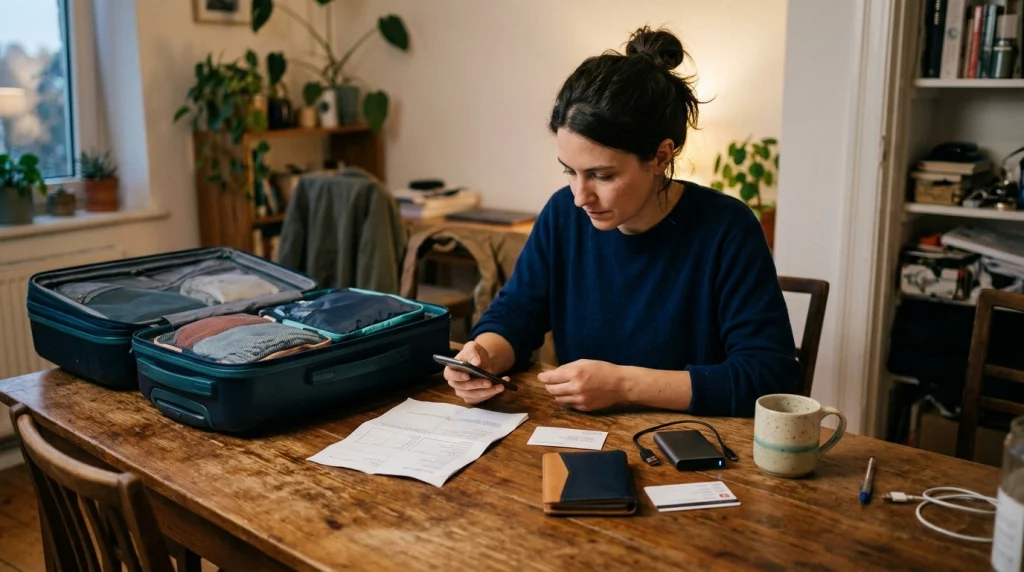
Prepare around the conversations you’re most likely to have. I focus first on arrival, accommodation, transportation, food, health, money, and emergency communication.
The goal isn’t perfection. It’s reducing the number of decisions you must make when you’re already tired or stressed.
Create a language-barrier travel note
I keep one phone note containing the information I might need to show another person. I also save the most important parts as screenshots.
- Your full accommodation name and address
- The address written in the local language or script
- Your accommodation phone number
- Airport, station, and transfer information
- Important reservation numbers
- Travel insurance contact details
- Your embassy or consulate details when relevant
- Local emergency numbers
- Medical allergies or essential health information
- A trusted person’s contact information
Don’t rely only on a booking app. Accounts log out, batteries die, and mobile data sometimes fails at exactly the wrong moment.
Prepare your first arrival carefully
A language barrier feels much harder after a long flight. For that reason, I make my first transfer simpler than the rest of the trip.
- Know the airport or station exit you need.
- Know whether you’ll use a train, bus, taxi, rideshare, or hotel transfer.
- Save the destination in the local script.
- Screenshot the route and booking details.
- Carry enough local payment options for the journey.
- Know what you’ll do if the planned transportation isn’t available.
On one trip, I arrived late with enough language ability to greet people and order food, but not enough to explain a complicated address. Showing the driver the written address solved the problem in seconds.
That taught me something important: sometimes the best phrase isn’t spoken at all.
Research cultural communication too
Words aren’t the only source of misunderstandings. Eye contact, gestures, personal space, touching, pointing, and tone can carry different meanings.
For women traveling alone, local expectations may also affect interactions with strangers or transportation providers. Review current guidance for women travelers alongside destination-specific laws and customs.
Pro tip: Check official destination guidance shortly before departure because local laws, safety conditions, and emergency procedures can change.
Section Takeaway: Prepare information you can show, not only words you can say. Your first arrival, accommodation address, emergency details, and backup transport plan deserve the most attention.
Which Translation and Offline Tools Should You Prepare?
A translation app is useful, but I never make one app my entire communication strategy. My preferred setup has online tools, offline tools, screenshots, and a small amount of printed information.
Download languages before departure
Google Translate supports downloadable language packs for many languages, allowing some translation features without internet access. Check whether your destination language can be downloaded through the official Google Translate offline language instructions.
Test the app before traveling. Learn where text, speech, conversation, and camera translation features appear.
Don’t wait until you’re standing in a station with weak data to learn the interface.
Download offline maps
Offline navigation can reduce the number of times you need to ask strangers for directions. Google provides instructions for downloading areas for offline use in Google Maps, although availability and offline features can vary.
I download the area around my accommodation, airport or station, and the neighborhoods I expect to explore. I also save major locations as named places.
Build several layers of backup
| Situation | Best First Tool | Backup |
|---|---|---|
| Phone has data | Live translation or maps | Saved screenshots |
| No mobile data | Offline translation and maps | Saved local-language addresses |
| Battery is low | Screenshots with low screen brightness | Printed information |
| Phone is lost or broken | Printed emergency card | Hotel, police, tourism office, or staffed business |
| Conversation is complex | Translation app with short sentences | Ask accommodation staff or another trusted person for help |
I also carry a compact power bank on long sightseeing days. Translation and navigation become less useful when your battery is at 3%.
Use camera translation carefully
Camera translation can help with menus, signs, instructions, and labels. I treat the result as a useful guide rather than a guaranteed perfect translation.
For medication, legal instructions, allergies, or anything safety-critical, I prefer confirmation from a qualified person.
Section Takeaway: Build a communication system that still works when mobile data disappears. Offline translation, offline maps, screenshots, written addresses, and printed backups cover different failure points.
How Do You Communicate During Everyday Travel Situations?
Simple language works better than complicated language. Speak slowly, use short sentences, and ask one question at a time.
Avoid slang, jokes, idioms, and long explanations. They’re harder for both people and translation software.
At your hotel or hostel
Accommodation staff can become one of your most useful language resources. Before leaving for the day, ask reception to confirm unfamiliar addresses or transportation instructions.
- Save the property’s address in the local language.
- Take a business card if one is available.
- Ask staff to write difficult destination names for you.
- Confirm how to return after public transport slows down.
If you’re staying in an apartment rental, prepare these details yourself because you may not have a staffed front desk.
On public transportation
I learn to recognize the written name of my destination even when I can’t pronounce it. Visual recognition can be more useful than perfect pronunciation.
- Screenshot your route.
- Save the final stop’s name.
- Know how many stops you expect.
- Check the destination displayed on the vehicle.
- Show the written location when asking for help.
If two people give conflicting directions, I verify again. I don’t follow someone simply because they sound confident.
At restaurants
Menus are one of the easiest places to use camera translation. Dietary restrictions require more preparation because misunderstandings can have consequences.
If you have a serious allergy, prepare a professionally translated allergy card when possible. Don’t depend on improvised gestures for a medical requirement.
At pharmacies or clinics
Medical communication deserves extra caution. Save the generic names of essential medications, known allergies, insurance information, and any important conditions before departure.
For destination-specific health information, check the CDC Travelers’ Health portal or the appropriate official health authority for your nationality and destination.
Pro tip: Translation technology can help start a medical conversation, but important diagnoses, dosage instructions, and allergy information should be confirmed by qualified medical staff.
When asking strangers for help
I prefer staffed places when I need more than a simple direction. Hotels, official transport desks, visitor centers, pharmacies, and established shops usually provide a clearer setting for communication.
You can still ask an ordinary passerby for help. Just keep your situational awareness while doing it.
What Should You Do When a Language Barrier Becomes a Safety Problem?
When communication affects your safety, stop worrying about sounding polite or grammatically correct. Your goal is to make the situation understandable and move toward a safer environment.
Learn words that create immediate meaning
I always prioritize a few urgent words over tourist vocabulary. Learn the local versions where practical.
- Help
- No
- Stop
- Police
- Hospital
- Doctor
- Taxi
- My hotel
- I am lost
- I need help
Also learn to recognize the written words or symbols for police, hospital, emergency exit, information, and transportation.
Move before translating when necessary
You don’t need to solve a language problem while remaining somewhere that feels unsafe. Move into a staffed, well-lit, public place first.
Then work on translation.
If someone is making you uncomfortable, you don’t need a beautifully translated explanation. A firm refusal, distance, and movement toward other people can communicate more effectively.
Carry an emergency communication card
A small paper card can help when your phone isn’t available. Keep the information limited to what someone would need to help you.
- Your name
- Your accommodation
- A trusted emergency contact
- Important medical information
- Your insurer’s emergency contact
- Embassy or consulate information when appropriate
Don’t put unnecessary financial information or sensitive account details on the card.
Know where to get human help
A translation app cannot judge context for you. When a situation becomes serious, seek people whose role makes them accountable.
- Police or official security staff
- Medical professionals
- Airport or station staff
- Hotel reception
- Tourist information staff
- Your embassy or consulate when appropriate
I also save emergency numbers before arrival. Don’t assume every country uses 911.
Pro tip: Verify the local emergency number and current official travel guidance for each destination before you leave home.
Section Takeaway: Safety comes before perfect translation. Move toward a safer setting, use simple urgent language, and involve accountable local professionals when a communication problem becomes serious.
How Much of the Local Language Should You Learn?
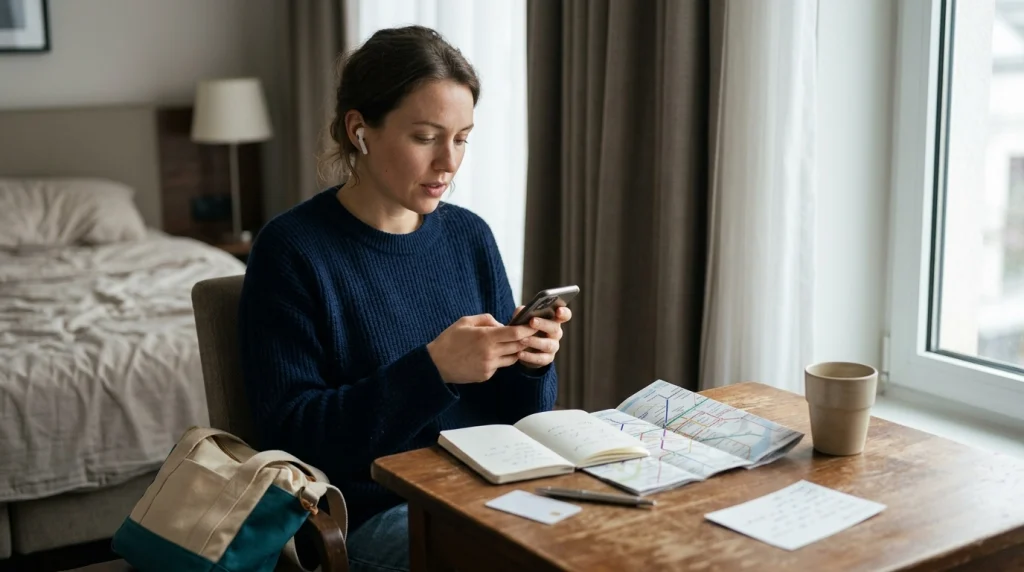
You don’t need conversational fluency for most short trips. I aim for a small vocabulary that helps me show respect, solve basic problems, and recognize important words.
Start with courtesy phrases
- Hello
- Goodbye
- Please
- Thank you
- Excuse me
- Sorry
- Yes
- No
Even basic courtesy can change the tone of an interaction. It also shows that you’re making some effort instead of expecting everyone else to adapt.
Add practical solo-travel phrases
- Where is the bathroom?
- Where is the station?
- How much does this cost?
- I have a reservation.
- Please take me to this address.
- Can you help me?
- I don’t understand.
- Can you write that down?
- Do you speak English?
- I need a doctor.
Choose phrases based on your itinerary. A hiking trip, city weekend, and road trip create different communication needs.
Practice pronunciation, not just spelling
Reading a phrase silently doesn’t mean someone will understand it when you say it. Listen to audio and repeat essential words aloud before departure.
I practice place names too. Knowing roughly how your neighborhood, hotel, station, and airport sound can make transportation conversations easier.
Learn numbers and basic signs
Numbers appear everywhere while traveling. They matter for prices, train platforms, departure times, addresses, room numbers, and tickets.
Recognizing basic written signs can also reduce dependence on your phone.
- Entrance
- Exit
- Open
- Closed
- Information
- Tickets
- Police
- Hospital
Don’t turn language study into another reason to delay your first solo trip. Prepare enough to function, then stay curious once you arrive.
Section Takeaway: Learn language that matches real travel tasks. Courtesy phrases, emergency words, transportation terms, numbers, and essential place names usually offer more value than memorizing long conversations.
Frequently Asked Questions About Language Barriers and Solo Female Travel
Can I travel alone if I don’t speak the local language?
Yes. Many solo travelers visit destinations without speaking the local language fluently. Preparation matters more than fluency. Download translation tools, save addresses in the local script, learn basic phrases, research transportation, and create offline backups before arriving.
Is Google Translate enough for solo travel?
It can be extremely useful, but I wouldn’t rely on one translation app alone. Mobile data, battery life, language availability, and translation accuracy can all create problems. Pair it with offline maps, screenshots, written addresses, essential phrases, and printed emergency information.
What phrases should a solo female traveler learn first?
Start with hello, please, thank you, excuse me, yes, no, help, stop, police, hospital, bathroom, and basic direction questions. Then add phrases for your hotel, transportation, food restrictions, and medical needs.
What should I do if my translation app doesn’t work?
Use saved screenshots, offline language packs, gestures, written addresses, or a printed phrase card. For complicated problems, move to a staffed location such as a hotel, station desk, pharmacy, visitor center, clinic, or police facility.
How can I communicate an address when I can’t pronounce it?
Save the full address in the destination’s local language or script and show it on your phone. I also keep a screenshot so it remains available offline. For important destinations, saving the map location gives you another way to confirm you’re going to the right place.
What if I need medical help but don’t speak the language?
Seek professional medical help rather than relying only on translation software. Show written information about allergies, medications, and important conditions. Contact your insurer if appropriate, and ask qualified medical staff to confirm important instructions before taking medication or agreeing to treatment.
Should a language barrier stop me from choosing a destination?
Not automatically. Consider the whole trip, including transportation, tourism infrastructure, safety, connectivity, accommodation support, and your comfort solving problems alone. A destination with limited shared language can still be manageable when your logistics and backup plans are strong.
Language barriers can make solo travel more challenging, but they don’t have to make it frightening. I feel most comfortable when I know I can communicate in several different ways instead of depending on one phrasebook, one app, or the hope that everyone speaks English.
Prepare your arrival, save essential information offline, learn a few useful words, and know where you’ll seek help if communication breaks down. Then leave room for the good part: discovering how much people can understand each other even when they don’t share the same language.