How Should a Solo Female Traveler Interact With Hotel Staff?
Quick Answer
A solo female traveler should interact with hotel staff politely, confidently, and professionally while protecting her personal information and maintaining clear boundaries. Share only the details needed for your stay, keep your room number private, verify unexpected requests, and report inappropriate behavior promptly. Good communication and sensible precautions can help you feel more comfortable throughout your trip.
Essential habits for safer hotel interactions
- Stay courteous: Greet employees respectfully and communicate your requests clearly.
- Protect privacy: Ask reception to write your room number instead of announcing it aloud.
- Set boundaries: Decline personal questions, unwanted conversations, or requests that make you uncomfortable.
- Verify identities: Call the front desk before opening your door to an unexpected person claiming to be an employee.
- Request practical help: Ask for secure room arrangements, reliable transport information, or assistance with a concern.
- Escalate concerns: Contact the duty manager, hotel security, or local emergency services when the situation warrants it.
One rule to remember
- You can be friendly without revealing your itinerary, room number, personal contact details, or whether someone is expecting you.
Knowing how a solo female traveler should interact with hotel staff can make checking in, requesting assistance, and handling unexpected situations much easier. I believe the best approach combines friendliness with awareness, so you can enjoy your trip without feeling pressured to share more than necessary.
This guide explains how to communicate with receptionists, housekeeping teams, concierges, drivers, and managers while protecting your privacy. You’ll also learn what to say when something feels uncomfortable and how to recognize the difference between ordinary hospitality and behavior that crosses a boundary.
In This Guide
- Why do hotel staff interactions matter when traveling alone?
- How should you communicate at check-in?
- How can you be friendly while maintaining boundaries?
- How should you handle hotel services and staff requests?
- What should you do if hotel staff make you uncomfortable?
- What should you say in common hotel situations?
- Frequently asked questions
Why Do Hotel Staff Interactions Matter When Traveling Alone?
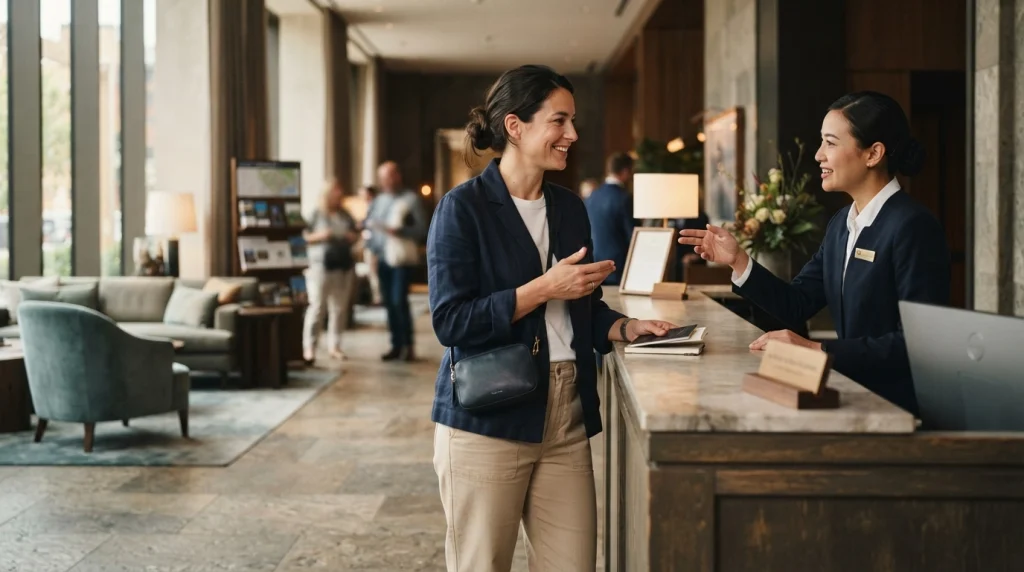
Hotel staff can help you navigate an unfamiliar place, solve booking problems, arrange transport, and respond to security concerns. Clear communication also helps you avoid misunderstandings without giving up your independence.
What does safe interaction with hotel staff mean?
Safe interaction means communicating respectfully while protecting your personal information, physical space, and decision-making freedom. You cooperate with legitimate hotel procedures without feeling obligated to answer intrusive questions or accept unwanted assistance.
For solo female travel, this balance matters because you may need to make quick decisions without a companion to consult. Your goal isn’t to distrust every employee; it’s to establish reasonable boundaries and know what to do when something feels wrong.
What can hotel staff reasonably ask you?
Reception staff commonly need your identification, reservation details, payment information, and contact details required by the property’s procedures or local law. Housekeeping may need to know whether you’d like your room cleaned, while a concierge may ask about your transport or sightseeing preferences.
You don’t need to volunteer unrelated personal details. You can keep answers focused on the service you need.
- Appropriate: Confirming your booking, checking your departure date, or asking whether you need a taxi.
- Optional: Discussing your sightseeing plans, hobbies, or reasons for traveling.
- Concerning: Repeatedly asking for your room number, demanding private contact details without a clear reason, or pressuring you to meet outside normal hotel services.
Context matters. A single friendly question isn’t necessarily a warning sign, but persistent questioning after you’ve declined deserves attention.
For broader preparation, review the U.S. Department of State travel information and the official guidance relevant to your destination. Advice can vary according to local laws, customs, and security conditions.
How Should You Communicate at Check-In?
At check-in, be polite, have your reservation information ready, and keep sensitive details out of other guests’ hearing. Ask the receptionist to write down your room number and avoid announcing it publicly.
Prepare your information before arriving
Having the essentials ready makes the check-in process smoother, especially after a long flight or a late arrival. Before reaching the desk, organize these items:
- Your booking confirmation and reservation reference.
- Accepted identification and payment method.
- The hotel’s address and contact number.
- Any important room requests, such as a working deadbolt or a room away from an exterior entrance.
Keep your phone, wallet, and luggage within reach while completing the formalities. If the lobby is crowded, avoid leaving your bag unattended while searching for documents.
Keep your room number confidential
Ask the receptionist to write your room number on the key sleeve rather than say it aloud. If the number is announced where other guests can hear it, calmly ask whether you can be assigned another room.
You can also request that staff never disclose your room number or confirm your presence to unexpected callers or visitors. This is a reasonable privacy request, although the exact procedures available vary by property.
Make practical room requests
You don’t need to explain your entire safety strategy to request a more suitable room. State what you need clearly and let the staff explain the available options.
- Ask whether the room has a functioning door lock, deadbolt, and window locks where applicable.
- Request a room away from an isolated exterior entrance if that would make you more comfortable.
- Ask whether reception is staffed overnight and how to contact security.
- Find out how to reach emergency exits and whether the property offers a verified taxi service.
Room location involves trade-offs. A higher floor may offer less direct street access, but the safest practical choice depends on the building, fire-evacuation arrangements, and your specific needs.
If your room cannot be secured, don’t accept reassurance as a substitute for a working lock. Ask for a room change or consider alternative accommodation.
Section takeaway: Keep check-in efficient and private. You can request reasonable security measures without disclosing why you prefer them.
How Can You Be Friendly While Maintaining Boundaries?
You can be warm, appreciative, and approachable without sharing personal information or accepting unwanted attention. A brief greeting, clear request, and polite thank-you are usually enough to maintain a good working relationship with hotel employees.
Use friendly but neutral conversation
Small talk can make hotel interactions pleasant, particularly when staff recommend restaurants or explain local transport. Keep conversations focused on practical travel information when you don’t know the person well.
For example, you might ask which entrance is open after dark or whether a restaurant is within walking distance. These questions help you learn about the area without revealing your complete itinerary.
If someone asks whether you’re traveling alone, answer according to your comfort level. You can simply say, “I’m here for a short trip,” or redirect the conversation toward your plans for the day.
Protect personal and digital information
Hotel staff rarely need access to your private social media accounts, personal messaging apps, or detailed schedule to provide ordinary services. Keep your phone and booking documents private, and avoid displaying sensitive information in public areas.
- Personal number: Use the hotel’s official contact channels rather than sharing your private number with individual employees.
- Social media: You don’t need to accept friend requests or disclose your accounts.
- Travel plans: Share only the details needed to arrange a service.
- Room access: Don’t hand your key to someone unless the hotel procedure clearly requires it and you understand why.
Never share your payment PIN, account password, or one-time security code with a hotel employee. If a payment request seems unusual, verify it through the hotel’s official reception or booking channel.
Say no without overexplaining
Some travelers worry that declining a request will seem rude. In practice, a short, calm response is often clearer than a long explanation that invites negotiation.
- “Thank you, but I’ll arrange my own transport.”
- “I’d prefer to keep my personal number private.”
- “I’m not available for a personal meeting, but I appreciate the recommendation.”
- “Please contact me through reception if you need anything related to my stay.”
You don’t have to smile through an uncomfortable interaction or apologize repeatedly for a reasonable boundary. If someone ignores your response, end the conversation and move toward a staffed public area.
Section takeaway: Courtesy is a communication style, not a promise of personal access. Your privacy and boundaries remain valid even when someone is being friendly.
How Should You Handle Hotel Services and Staff Requests?
Use official hotel channels for housekeeping, room service, transport, maintenance, and concierge assistance. Confirm unexpected visits or unusual requests before allowing anyone into your room or sharing sensitive information.
Housekeeping and maintenance visits
Housekeeping and maintenance employees may need to enter your room to perform legitimate duties, but you can ask for an explanation and a convenient time. If you didn’t request a visit, call reception to verify the employee’s identity and reason for coming.
When someone arrives at your door unexpectedly, follow this routine:
- Keep the door locked while you speak through it or use the peephole.
- Ask the person’s name, department, and reason for the visit.
- Contact reception using the number saved from your check-in information.
- Open the door only when you’re satisfied that the visit is legitimate and you feel comfortable.
- If the person pressures you or refuses to leave, keep the door closed and request assistance.
You can decline nonessential housekeeping or ask for a different appointment time. If maintenance is necessary to fix a serious problem, arrange the visit through reception and request an escort or another employee’s presence if that would help you feel safer.
Concierge recommendations and transport
A concierge can be useful when you need local directions, restaurant recommendations, or transport arrangements. Treat recommendations as helpful information rather than a guarantee that a driver, venue, or route is suitable for you.
Before accepting transport, clarify the pickup location, estimated fare, payment method, and whether the vehicle is booked through an official service. Verify the vehicle and driver details before entering, and share your journey details with a trusted contact when appropriate.
If an employee insists on a particular driver, demands an unexplained payment, or pressures you to change plans, pause and verify the arrangement independently. You can decline the offer and book through another legitimate service.
Understand the difference between helpful and intrusive service
| Situation | Reasonable response | When to be cautious |
|---|---|---|
| A receptionist offers local advice. | Thank them and ask practical follow-up questions. | They pressure you to visit a private location or share your personal contact details. |
| Housekeeping requests access. | Confirm the visit and agree on a suitable time. | The visit is unexpected, the identity cannot be verified, or the person refuses to leave. |
| A concierge arranges a taxi. | Confirm the booking, vehicle, and fare. | The details don’t match or the employee discourages independent verification. |
| A staff member asks about your plans. | Share relevant details if needed for a service. | They repeatedly seek your location or schedule for no clear reason. |
| An employee makes an inappropriate comment. | End the interaction and state your boundary if safe. | The behavior continues, becomes threatening, or affects your room security. |
The key distinction is not whether an employee is talkative or reserved. Look at whether the person respects your choices, follows normal procedures, and responds appropriately when you ask for privacy.
Section takeaway: Verify unexpected contact, use official service channels, and judge behavior by whether it respects your consent and security.
What Should You Do If Hotel Staff Make You Uncomfortable?
If a hotel employee makes you uncomfortable, take the behavior seriously without feeling you must resolve it alone. Move to a safer setting, communicate your concern clearly, and request help from a manager or another trusted source when needed.
Recognize behavior that deserves attention
A single awkward conversation doesn’t automatically mean you’re in danger. Repeated unwanted contact, unauthorized room access, threats, or deliberate disregard for your boundaries are more significant concerns.
Pay particular attention to these warning signs:
- An employee repeatedly asks to meet privately after you’ve declined.
- Someone claims to be staff but cannot be verified through reception.
- An employee attempts to enter your room without a legitimate reason or your permission.
- Someone requests your room key, personal phone, or sensitive account information without a valid explanation.
- A staff member follows you, makes unwanted sexual comments, or threatens you after you set a boundary.
- Management dismisses a serious security concern without offering a practical solution.
Consider the whole situation rather than judging it by one detail. If you feel threatened, you don’t need to wait for repeated incidents before seeking assistance.
How should you report inappropriate behavior?
When you can do so safely, describe the specific behavior and the action you need. Clear information helps management understand the problem and respond appropriately.
For example, you could say, “An employee came to my room without an appointment, and I couldn’t verify the visit. Please investigate and ensure nobody enters without my permission.”
If the employee is involved in the complaint, ask to speak with the duty manager or another senior person instead. Avoid confronting the individual alone if doing so might escalate the situation.
When you are in a safe place, make a record of the incident, including the time, location, what happened, and whom you contacted. Save relevant booking messages or complaint reference numbers.
When should you leave the hotel?
Consider changing rooms or properties when the hotel cannot resolve a serious security problem, an employee repeatedly violates your boundaries, or you no longer feel safe remaining there. You don’t need to stay simply because you’ve already paid.
If you face an immediate threat, prioritize reaching a safer public location and contacting local emergency services. Don’t delay seeking urgent help while negotiating a refund or waiting for a booking platform to respond.
For nonurgent complaints, contact hotel management and your booking provider, and ask about relocation or reimbursement options. Keep receipts and relevant correspondence in case you need to dispute a charge later.
Pro tip: Before traveling, save your destination’s official emergency number and review its current travel advice through the U.S. Department of State or your own government’s travel advisory service.
Section takeaway: Your immediate safety matters more than politeness, avoiding awkwardness, or recovering the cost of a room.
What Should You Say in Common Hotel Situations?
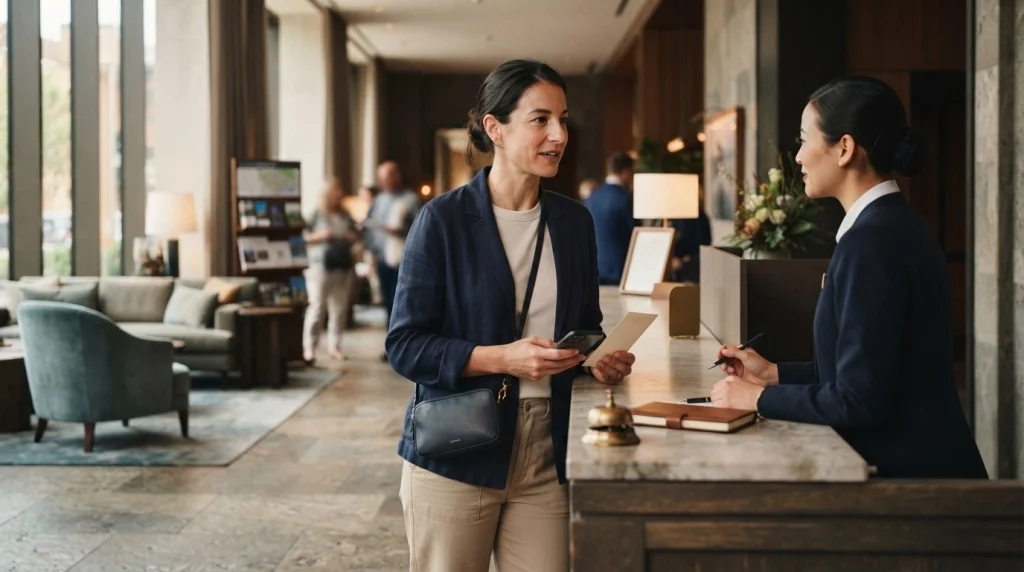
Short, prepared phrases can help you respond calmly when you’re tired, uncomfortable, or navigating a language barrier. Practice a few before departure so you don’t have to find the right words under pressure.
Useful phrases for everyday interactions
- At check-in: “Could you please write my room number on the key sleeve rather than saying it aloud?”
- When requesting privacy: “Please don’t disclose my room number or confirm my room details to visitors.”
- When declining a personal question: “I’d prefer to keep that private, thank you.”
- When arranging transport: “Could you confirm the driver’s name, vehicle details, and estimated fare?”
- When refusing an unexpected visit: “I wasn’t expecting anyone. I’ll call reception to confirm the appointment.”
- When requesting a room change: “The door lock isn’t working properly. I’d like to move to a room that can be secured.”
How can you communicate when there’s a language barrier?
Use short sentences, familiar words, and your phone’s translation tool when needed. Written requests can also help prevent confusion about room changes, transport arrangements, or maintenance visits.
For an important safety concern, ask for an employee who speaks a language you understand or contact someone who can translate accurately. Don’t rely on a vague gesture or an uncertain translation when confirming someone’s identity or a security procedure.
What if you’re worried about seeming rude?
Remember that a boundary can be respectful and firm at the same time. You can thank someone for their help while declining an invitation or asking them to follow the hotel’s normal procedures.
For example, “I appreciate your help, but I’d prefer to handle this through reception” keeps the conversation professional. If the person continues to pressure you, you can stop engaging and seek support elsewhere.
As of 2026, these basic habits remain useful across hotels, resorts, guesthouses, and hostels, although specific procedures differ by property and country. Adapt your approach to local customs without compromising essential privacy or safety needs.
Section takeaway: Prepare a few clear phrases before your trip. You can communicate confidently without being confrontational or disclosing personal details.
Frequently Asked Questions
Should a solo female traveler tell hotel staff she is traveling alone?
You don’t need to announce that you’re traveling alone unless the information is relevant to a service or necessary procedure. If someone asks, you can answer briefly or redirect the conversation. Focus on protecting your room details, personal information, and travel schedule.
Is it safe to be friendly with hotel staff when traveling alone?
Yes, friendly and professional communication is generally a sensible approach. Most routine interactions are about providing hospitality and assistance. Stay aware of your surroundings, avoid sharing unnecessary private information, and pay attention to whether employees respect your boundaries.
What should you do if a hotel employee asks for your phone number?
Ask why the number is needed and whether the hotel can contact you through its official communication system instead. Share your number when there’s a legitimate reason and you’re comfortable doing so. Never feel obligated to provide personal contact details for social reasons.
Should you let hotel staff enter your room?
Allow authorized staff to enter for legitimate services when appropriate, but verify unexpected visits through reception first. You can request a different time for nonurgent work. Keep the door secured until you’ve confirmed the person’s identity and understand the reason for the visit.
What if hotel management ignores a safety complaint?
Ask to speak with a senior manager or security supervisor and clearly explain what remains unresolved. If the problem affects your safety, move to a secure location and consider changing accommodation. Contact your booking platform or local emergency services when appropriate.
How can you avoid revealing your room number in public?
Ask reception to write the number down rather than announce it aloud. Keep your key sleeve out of public view, and avoid discussing room details where strangers can overhear. If your room number is disclosed to someone nearby, request a different room if you believe the disclosure creates a security concern.
Should you report unwanted attention from a hotel employee?
Yes, if the attention is unwanted, persistent, inappropriate, or threatening, you can report it to management. Explain what happened and what action you need. If the employee poses an immediate threat, prioritize reaching safety and contacting local emergency services before pursuing a formal complaint.
Final Takeaway: Be Courteous, Stay Private, and Trust Your Boundaries
Interacting with hotel staff should help you feel supported during your solo trip, not pressured into sharing personal details or accepting unwanted attention. Clear requests, professional communication, and sensible privacy habits can make unfamiliar hotel environments easier to navigate.
Before your next trip, save the hotel’s official contact number, prepare your check-in documents, and learn how to reach reception or security after hours. Keep your room number private and verify unexpected visits before opening your door.
Most importantly, remember that you can be friendly without sacrificing your comfort. If an interaction feels wrong, you can set a boundary, ask for help, or leave the situation.
Your trip belongs to you. Make decisions that support your confidence, independence, and peace of mind.