Should a Solo Female Traveler Carry a Backup Phone?
Quick Answer
Yes, a solo female traveler should consider carrying a backup phone when traveling internationally, taking a longer trip, arriving late, or depending heavily on apps for transportation, navigation, payments, and communication. It is not essential for every trip, but the U.S. State Department’s communication guidance specifically recommends having a backup communication method if your main phone is lost, stolen, damaged, or unusable.
A useful backup-phone setup
- Keep it separate: Store the second phone somewhere different from your everyday phone.
- Use an unlocked device: An unlocked phone gives you more options for local SIM cards and travel eSIMs.
- Prepare offline access: Save accommodation details, emergency contacts, maps, and essential travel information before departure.
- Protect your accounts: Do not make the spare phone an unlocked copy of your entire digital life.
- Plan for recovery: Know how you will access email, passwords, bookings, and two-factor authentication if your main phone disappears.
Most important
- A backup phone helps only if it is charged, protected, prepared, and stored separately from the device it is backing up.
I treat phone access as part of a solo travel safety plan, not simply a convenience. A phone may hold my hotel address, boarding pass, ride-hailing app, maps, translation tools, payment access, and the numbers I need when plans change.
That makes the question more important than whether carrying two phones feels excessive. The better question is whether losing one device could leave you unable to navigate, communicate, or reach your accommodation safely.
In This Guide
Should a Solo Female Traveler Carry a Backup Phone?
For many international or independent trips, yes. A backup phone gives you another way to communicate and access essential information if your primary device fails.
Definition: A backup travel phone is a second mobile device prepared to take over essential communication, navigation, booking, and account-access tasks when your main phone cannot be used.
A second phone matters more for a solo traveler because there may be no companion beside you with another working device. Losing access at the wrong moment can turn a small problem into a difficult one.
- Transportation: You may need a taxi or ride-hailing app after a delayed arrival.
- Navigation: Your hotel address or route may exist only on your phone.
- Communication: You may need to contact your accommodation, airline, insurer, or someone at home.
- Bookings: Confirmation numbers and tickets may be stored digitally.
- Safety: You may want to contact local authorities, your embassy, or another trusted source of help.
The State Department’s guidance for women traveling abroad also encourages planning ahead for unsafe situations and making sure someone you trust knows how to contact you.
A second phone does not prevent theft or guarantee safety. Its value is simpler: it preserves options when your normal communication system fails.
I would not consider it compulsory for a short domestic weekend where you know the area and have several easy ways to get help. The benefit rises as a trip becomes longer, more unfamiliar, or more dependent on digital services.
When Is a Backup Phone Worth Carrying?
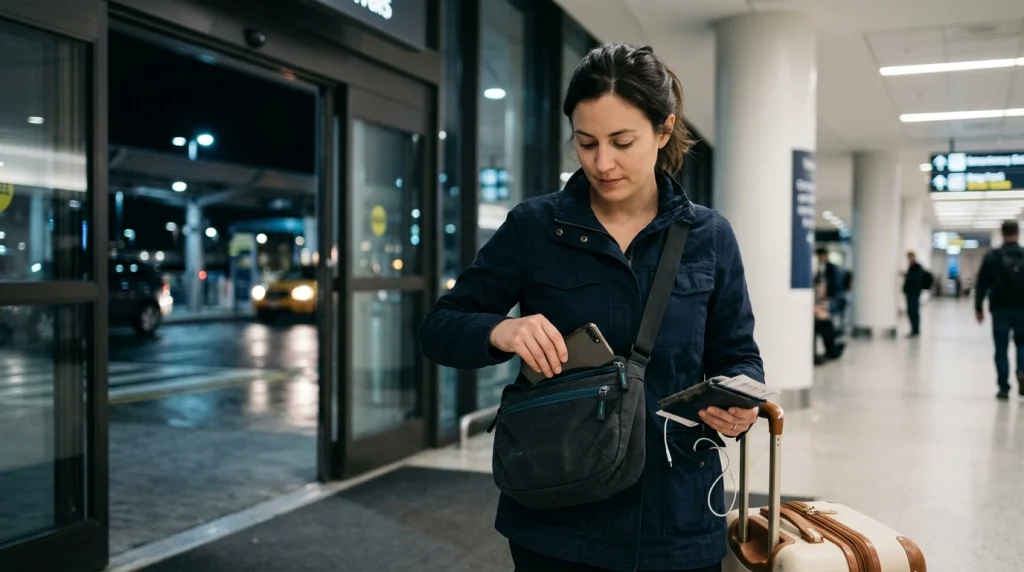
A second phone becomes most useful when losing your main phone would disrupt several parts of your trip at once. International solo travel is the clearest example.
Consider taking one when several of these apply
- You are traveling internationally.
- You will be away for a week or longer.
- You are visiting several cities or countries.
- You depend on ride-hailing apps for transportation.
- You expect late-night or early-morning transfers.
- You use your phone for boarding passes and reservations.
- You need translation apps to communicate.
- You depend on mobile banking or digital payments.
- You are traveling somewhere with unreliable mobile coverage.
- You would struggle to replace your phone quickly.
Airport arrivals are one situation where I want redundancy. Imagine landing after midnight and discovering that your primary phone will not connect to the local network.
A prepared spare could let you retrieve the hotel address, connect to airport Wi-Fi, or contact your accommodation. That is a practical advantage, not a guarantee against danger.
When a second phone may be unnecessary
You probably do not need two phones for every overnight trip. Good low-tech preparation can sometimes provide enough redundancy.
- A short trip in a familiar destination
- Reliable public transportation and staffed accommodation
- A printed hotel address and emergency-contact card
- Offline tickets and reservation information
- A charged power bank for battery problems
- Access to another device, such as a tablet with secure Wi-Fi access
The goal is not to carry more electronics. It is to avoid having one device become a single point of failure.
Backup Phone vs. Power Bank vs. Printed Backup: Which Is Better?
These tools solve different problems. A power bank fixes a dead battery, while a second phone can help when the original device is lost, stolen, damaged, or technically unusable.
| Backup option | Dead battery | Lost phone | No mobile data | Access digital bookings |
|---|---|---|---|---|
| Power bank | Yes | No | No | Only through main phone |
| Printed information | Not applicable | Partly | Yes | Only what you printed |
| Backup phone | Yes, if charged | Yes | Yes, with offline files | Yes, if prepared |
| Backup phone + printed card | Yes, if charged | Yes | Strongest option | Yes, if prepared |
I prefer layered backups rather than relying on one gadget. A modest second phone, a small power bank, and one printed card cover different failure points.
Offline navigation deserves special attention. Google explains how travelers can download Google Maps areas for offline use, although some features and regions have limitations.
Download the areas you need before departure. Do not wait until you lose cellular service.
How Should You Set Up a Backup Phone Before Traveling?
The best spare phone is boring. It should work when needed without becoming another complicated device to manage.
- Choose an unlocked phone. Carrier flexibility makes it easier to use a local SIM or supported eSIM.
- Install current software updates. Do this before leaving home on a trusted connection.
- Use a strong screen lock. A second phone should receive the same basic protection as your primary one.
- Install only essential apps. Think maps, airline, accommodation, transportation, translation, messaging, and your password manager.
- Download offline information. Save maps, reservations, addresses, and emergency information locally.
- Decide how it will connect. Test Wi-Fi, SIM, or eSIM compatibility before your trip.
- Test your recovery process. Confirm that you could access critical accounts without approving the login from your missing primary phone.
- Charge it before travel days. A spare phone with a flat battery is dead weight.
If you use an iPhone, Apple notes that an eSIM can be useful while traveling internationally, provided your device and carrier support it. An unlocked spare with compatible cellular bands gives you more flexibility.
Be careful with two-factor authentication
This is one of the easiest weaknesses to overlook. Your backup phone is less helpful if every important account sends its login approval to the missing phone.
Before traveling, review recovery options for your email, password manager, banking services, airline account, and other essential apps. Keep appropriate recovery codes somewhere secure and separate from both phones.
Do not save unprotected passwords or sensitive recovery information in a plain note. Convenience should not create a second security problem.
Where Should You Keep the Backup Phone?
Never store both phones in the same pocket, handbag, or easily removable pouch. One theft could otherwise eliminate both your primary and backup systems.
I would keep the spare powered off or in low-power mode inside a separate secured part of my luggage. During a transfer, I might move it to another concealed and controlled location that stays with me.
Use separation, not secrecy
The practical idea is simple: one incident should not take both devices. Do not leave the spare unattended in an unlocked room or obvious outer luggage pocket.
- Main phone in your normal secure carry location
- Backup phone somewhere separate
- Power bank in another accessible compartment
- Printed emergency card separate from your wallet when practical
Enable your phone manufacturer’s device-finding features before the trip. Apple, for example, explains how Find My can help locate or lock a missing device.
Also consider what information the spare contains. You may not need years of photos, personal messages, work files, or every financial app copied onto it.
A minimal travel setup reduces exposure if the second phone is lost. Essential access matters more than creating an exact clone of your primary device.
Pro tip: Technology risks, local laws, emergency procedures, and communication conditions vary by destination. Check current government travel advice for your destination before departure.
What Should You Save on a Backup Travel Phone?
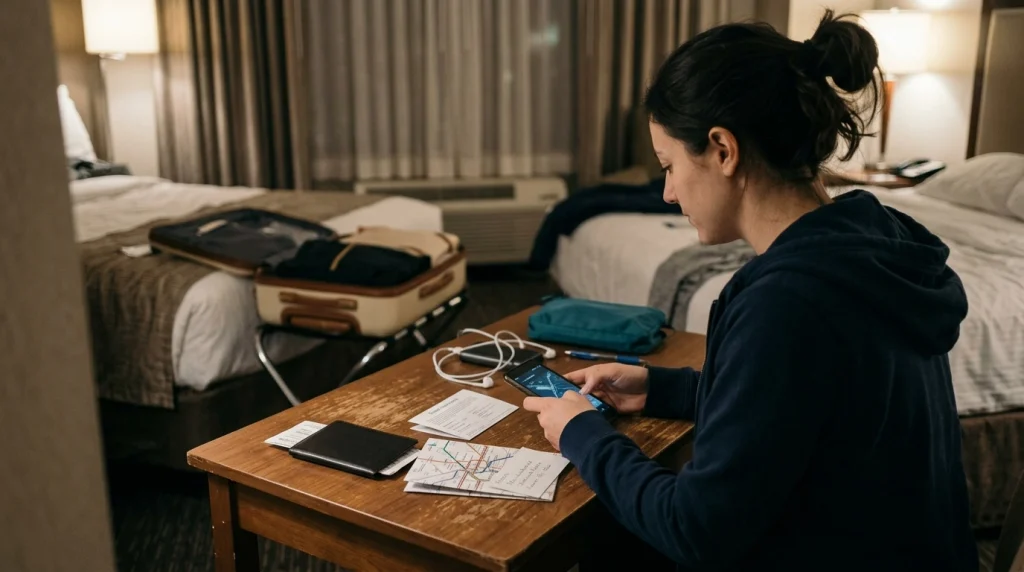
Prepare the phone around the tasks you would need to complete during the first few hours after losing your main device. Keep the list short and functional.
Save these essentials offline where appropriate
- Accommodation name and full address
- Accommodation telephone number
- Flight numbers and booking references
- Travel insurance details
- Emergency contact numbers
- Local emergency-service information
- Embassy or consulate contact information when relevant
- Offline destination maps
- Airport-to-hotel transportation instructions
- Important train or bus information
- Basic translated phrases if language is a concern
Install only apps you genuinely need
- Maps
- Airline or rail app
- Accommodation app
- Ride-hailing or taxi app used at your destination
- Messaging app
- Translation app
- Password manager
- Travel insurance app, if useful
Be selective with banking apps. Depending on your accounts, secure web access or one necessary financial app may be enough.
I also recommend knowing at least one important phone number without depending on a contact list. Technology is useful, but basic redundancy remains valuable.
As of 2026, carrying a second phone is easier than it once was because unlocked devices, Wi-Fi communication, eSIM options, offline maps, and cloud-based reservations provide several ways to restore basic travel functions. The important part is configuring those tools before something goes wrong.
Frequently Asked Questions
Do I really need two phones for solo travel?
No. A backup phone is optional, not a universal requirement. It becomes more worthwhile on international, long, complex, or app-dependent trips where losing one device would disrupt transportation, navigation, bookings, payments, and communication at the same time.
Can I just bring a power bank instead?
A power bank solves a battery problem, but it cannot replace a phone that is lost, stolen, damaged, or malfunctioning. For many trips, carrying both a power bank and low-tech backup information offers stronger coverage than either one alone.
Does my backup phone need its own SIM card?
Not necessarily. A spare phone can still access saved offline information and trusted Wi-Fi. However, independent cellular service can make it more useful, so check whether an appropriate physical SIM, local SIM, or eSIM will work with your device and destination.
Should I keep both phones turned on?
You usually do not need to. Keeping the backup powered off or in a battery-saving state can preserve its charge. Turn it on periodically during longer trips to check its battery, updates, connectivity, and essential apps.
Should my backup phone contain all my banking apps?
Usually not. Install only what you would genuinely need and can protect securely. A spare phone should provide essential access without becoming a second device containing every sensitive account and personal file you own.
What if I cannot afford a second smartphone?
Use layered low-cost backups. Carry printed accommodation and emergency details, download offline maps, bring a reliable power bank, save important documents securely, and make sure a trusted person has your itinerary and knows how to reach you.
What should I do if my main phone is stolen while traveling alone?
Move somewhere safe first. Use your backup method to contact anyone necessary, secure or lock the missing device through the manufacturer’s tools, contact your carrier when appropriate, and report theft to local authorities or your insurer if required.
My takeaway: A backup phone is worth carrying when your trip depends heavily on one device. The smartest setup is not the most expensive one; it is the one that still lets you communicate, navigate, and reach help after your primary phone disappears.
Before your next solo trip, run one simple test: imagine your phone vanished five minutes after landing. If you could still find your accommodation, contact someone you trust, retrieve essential booking information, and arrange transportation, your backup plan is doing its job.