How Can a Solo Female Traveler Prepare for Airport Security?
Quick Answer
A solo female traveler can prepare for airport security by checking the rules for every airport on her route, organizing liquids and electronics before leaving home, keeping identification accessible, and packing valuables so they stay together during screening. I also recommend reviewing current airport security guidance shortly before departure because screening procedures can change.
Prepare in six simple steps
- Check local rules: Review the departure airport, transfer airport, airline, and return-airport requirements.
- Organize liquids: Keep restricted liquids together and easy to remove if your airport requires separate screening.
- Verify identification: Make sure your passport or accepted identification is valid for the checkpoint and destination.
- Pack for screening: Keep electronics, medication, documents, and unusual items easy to reach.
- Secure valuables: Put your phone, wallet, passport, and jewelry inside a zipped bag rather than loose in a tray.
- Know your options: If screening makes you uncomfortable, calmly ask an officer about privacy or available screening procedures.
Airport security can feel more stressful when you are traveling alone because nobody else is watching your bag, holding your passport, or remembering which tray contains your phone.
I prepare for the checkpoint as its own stage of the trip. A few decisions at home can make the airport feel far more manageable.
Airport-security preparation means organizing your documents, luggage, clothing, liquids, electronics, medication, and timing so you can complete required screening without unnecessary confusion or delays.
In This Guide
- What should I check before leaving for the airport?
- How should I pack my carry-on for faster security?
- What should I wear and keep accessible?
- What happens during screening, and what can I ask for?
- How do airport security rules change by country?
- What should I do if something goes wrong?
- Frequently asked questions
What Should I Check Before Leaving for the Airport?
Check the rules for your actual route, not just the country where you live. Airport security procedures can differ between departure, connection, and return airports.
As of 2026, I treat security rules as trip-specific information. I recheck them before packing and again shortly before departure.
Verify your identification first
Your passport or identification is the one item you cannot casually replace at the checkpoint. Check the expiration date, name, and destination requirements before leaving home.
- Domestic travel: Confirm which forms of identification your security authority and airline accept.
- International travel: Keep your passport accessible and check destination entry requirements separately.
- Name details: Compare the name on your booking with the identification you plan to use.
- Digital documents: Save useful copies securely, but do not assume a photograph replaces an original document when the original is required.
For travel through U.S. checkpoints, adults aged 18 and older must present acceptable identification. Since May 7, 2025, a non-REAL ID-compliant state license or identification card is no longer accepted as standard checkpoint identification unless you use another accepted document.
You can review the current TSA acceptable identification list before departure.
Check your airport’s security information
I look up the departure airport itself because new scanners can change what passengers must remove from their bags. Transfer airports matter too.
- Liquid and gel limits
- Laptop and tablet procedures
- Medication requirements
- Special screening procedures
- Prohibited items
- Airport assistance services
- Recommended arrival times
Use the airport or airline’s recommended arrival window instead of assuming one timing rule works everywhere.
Section Takeaway: Check identification, airport rules, transfer requirements, and restricted items before you start packing. Security preparation begins at home.
How Should I Pack My Carry-On for Faster Security?
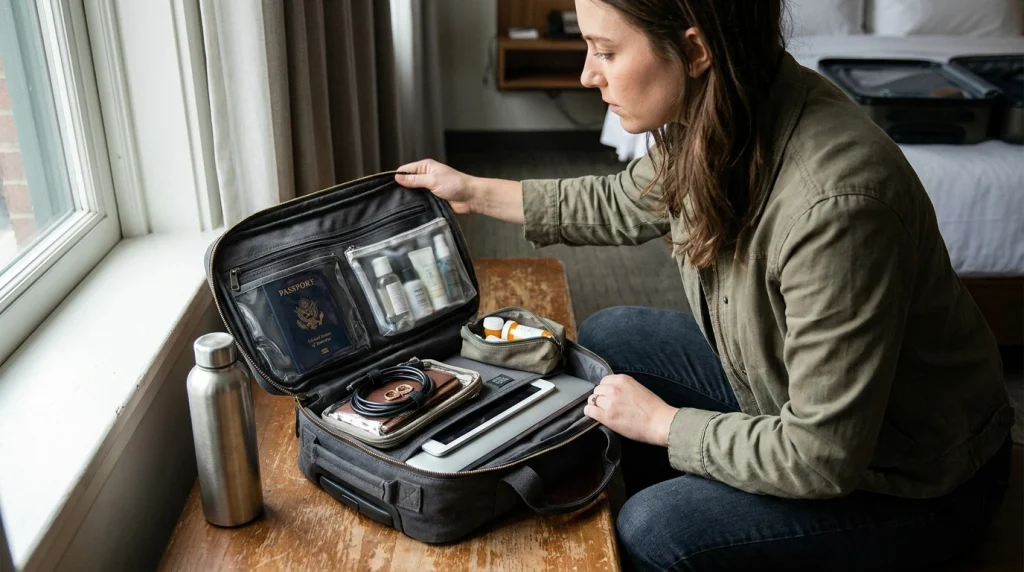
Pack your carry-on so security officers can see and access items without dismantling your entire bag. An organized bag also helps you notice quickly if something is missing.
My goal is simple: nothing important should be buried, loose, or scattered across several trays.
Create a security-ready packing system
I use one accessible area of my carry-on for anything I may need before boarding. This keeps me from opening every compartment while standing in the queue.
- Document pocket: Passport or identification and boarding information.
- Liquid section: Toiletries and cosmetics that fall under airport liquid restrictions.
- Electronics section: Laptop, tablet, e-reader, chargers, and power accessories.
- Medication section: Prescription medicine and supporting documents when required.
- Valuable-items pouch: Wallet, watch, small jewelry, keys, and other loose valuables.
Before packing an unfamiliar item, I check whether it belongs in carry-on baggage, checked baggage, or neither. The TSA maintains a searchable What Can I Bring database for U.S. departures.
Know the U.S. 3-1-1 liquids rule
For standard U.S. carry-on screening, liquids, gels, aerosols, creams, and pastes generally follow the 3-1-1 system. Containers are limited to 3.4 ounces, or 100 milliliters, and must fit into one quart-sized clear bag per passenger.
Medically necessary liquids and certain other categories can have different procedures. Declare them when required instead of trying to hide them among ordinary toiletries.
| Security issue | U.S. example | UK example | Best preparation |
|---|---|---|---|
| Ordinary liquids | Usually 3.4 oz/100 ml or less per container under the 3-1-1 rule | 100 ml remains the limit at most airports, while some airports allow larger containers | Check the specific departure and transfer airports |
| Identification | Adults 18+ need an accepted form of checkpoint ID | Document checks depend on journey and airport stage | Keep passport or accepted ID readily accessible |
| Liquid medicine | Medically necessary liquids can receive special screening | Essential liquid medicine over 100 ml can be permitted with supporting proof when required | Carry documentation and declare the medicine when necessary |
Keep the bag visually simple
A tightly packed bag filled with overlapping electronics, food, cables, dense powders, and miscellaneous objects can require extra inspection.
- Wrap charging cables neatly.
- Keep large electronics easy to reach.
- Avoid stuffing small metal items into random pockets.
- Use a small pouch for coins and keys.
- Keep an empty water bottle accessible for refilling after security.
Section Takeaway: Organize your bag around what security may need to inspect. The easier items are to identify and reach, the easier the checkpoint usually feels.
What Should I Wear and Keep Accessible at Airport Security?
Wear something comfortable that you can adjust without turning the checkpoint into a repacking session. You do not need a special airport-security outfit.
I prioritize simple layers, secure pockets, and shoes that do not take several minutes to remove or put back on.
Choose practical clothing
- Simple shoes: Pick footwear that is easy to remove if the checkpoint requires it.
- Light layers: Keep coats and bulky outerwear easy to take off.
- Minimal loose jewelry: Put valuable pieces in a secure pouch if you prefer not to wear them through screening.
- Zipped pockets: Useful before the checkpoint, but empty them when officers instruct you to do so.
- Comfortable clothing: Wear something you can move in easily if additional screening becomes necessary.
Do not scatter valuables across trays
This is one of my biggest solo-travel habits. Before my bag enters the scanner, I place my phone, wallet, watch, and other small valuables inside a zipped compartment.
Loose valuables are easier to forget when several trays come out in a different order.
- Keep your passport in the same secure place each time.
- Put loose jewelry into one pouch.
- Zip your wallet into your carry-on.
- Do not leave a phone sitting alone in a tray if it can safely go inside your bag.
- Count your trays before walking away from the collection area.
A quick five-second check after screening can save a miserable return trip to the checkpoint.
What Happens During Screening, and What Can I Ask For?
Security screening can involve document checks, X-ray screening of belongings, metal detectors, imaging technology, hand inspection, or additional screening. The exact process depends on the airport and circumstances.
Your best strategy is to listen carefully and ask calm, direct questions when you do not understand an instruction.
Move through the checkpoint in a deliberate order
- Have your boarding information and identification ready when required.
- Read signs before reaching the tray area because procedures can vary by lane.
- Remove only the items that airport staff or signs tell you to remove.
- Place small valuables inside your carry-on rather than leaving them loose.
- Watch your belongings move toward the scanner before moving through passenger screening.
- Collect every item and step away from the belt before reorganizing yourself.
I avoid repacking directly beside the conveyor unless something must be secured immediately. Moving to a nearby bench gives other passengers space and gives me time to check my belongings properly.
Can you request privacy during security screening?
In some jurisdictions, including U.S. TSA screening, passengers can request more private screening procedures in certain circumstances. Procedures differ internationally, so ask the officer what options are available where you are traveling.
If you feel uncomfortable, do not guess what you are allowed to request. Calmly say that you would like the procedure explained before it continues.
- Ask what additional screening involves.
- Request a supervisor if you need clarification.
- Ask whether private screening is available.
- Explain medical devices, mobility needs, or sensitive conditions before screening when relevant.
- Follow lawful instructions while clearly communicating your concern.
For international solo trips, I also review broader official guidance for women travelers, especially when the destination has unfamiliar laws or customs.
Pro tip: Before an international trip, verify security, identification, medication, and destination-entry information through official government, airport, and airline sources rather than relying only on social media posts.
Section Takeaway: You do not need to rush silently through a procedure you do not understand. Listen, ask concise questions, and know that screening rules and privacy options vary by country.
How Do Airport Security Rules Change by Country and Airport?
There is no single worldwide airport-security routine. Even airports in the same country can use different equipment and temporarily apply different procedures.
This matters on solo international trips because you may pass through security more than once.
Check every airport on a connecting itinerary
Your first airport may allow an item that creates a problem during a connection. Transfer screening can also affect liquids purchased after the first checkpoint.
- Departure airport
- International transfer airport
- Domestic connection airport
- Return departure airport
- Any airport where you must reclaim and recheck baggage
The UK is a useful example of why airport-specific research matters. Current government guidance says liquid rules can depend on the airport, with 100 ml limits still used at most airports while some locations permit larger containers.
Check the official UK hand-luggage restrictions if your trip passes through a UK airport.
Do not assume newer scanners mean no restrictions
A modern scanner may change whether liquids or electronics must leave your bag. It does not mean every security restriction has disappeared.
- Follow the signs in your actual lane.
- Listen to officers instead of copying the passenger ahead.
- Keep liquids organized even if you expect newer screening technology.
- Do not transfer one airport’s rules to another airport.
I think of airport security like local transportation. The basic purpose is familiar, but the practical details change from place to place.
What Should I Do If Something Goes Wrong at Airport Security?
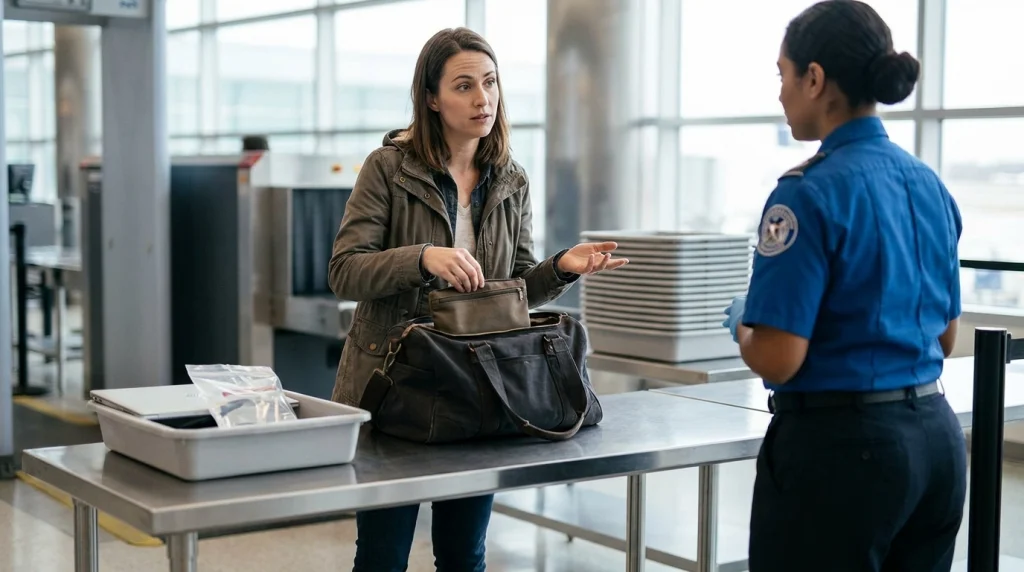
Stay calm and solve one problem at a time. Most stressful checkpoint situations become harder when you start opening every bag, searching every pocket, and worrying about your flight simultaneously.
If an item is questioned
- Ask which item needs inspection.
- Let the officer explain why it cannot pass.
- Ask what lawful options are available.
- Do not argue based on a rule you remember from another airport.
- Accept that the screening authority has the final decision at that checkpoint.
If the item matters, ask whether you can return to the public side to repack, check it, give it to someone, or use another permitted option. What is possible depends on the airport and your available time.
If you cannot find your passport, phone, or wallet
Stop moving and retrace the checkpoint in order. Check your zipped pouch, pockets, tray collection area, and the place where you reorganized your bag.
- Move out of the main passenger flow.
- Check the same compartments you normally use.
- Tell security staff quickly if you believe the item remained at the checkpoint.
- Contact airport lost property if security confirms the item is not there.
- Inform the airline immediately if missing identification may affect boarding.
If additional screening makes you anxious
Ask the officer to explain the next step. Clear information is usually more useful than trying to predict what the procedure means.
I also remind myself that additional screening does not automatically mean I did anything wrong.
- Breathe and listen before answering.
- Keep your responses simple and accurate.
- Tell staff about relevant medical needs.
- Ask for available privacy options when appropriate.
- Request a supervisor if you need a procedure clarified.
Section Takeaway: When something goes wrong, slow the situation down mentally. Identify the exact problem, ask what your options are, and keep track of your documents and belongings.
Frequently Asked Questions About Airport Security for Solo Female Travelers
How early should a solo female traveler arrive for airport security?
Follow the arrival guidance from your airline and departure airport because recommended times vary by airport, route, baggage, and travel period. Give yourself extra margin if you have unfamiliar documents, medical items, special assistance needs, or a complicated international connection.
Should I put my passport in the security tray?
Follow instructions at the checkpoint, but avoid leaving your passport loose when it can be secured safely inside your carry-on. I keep identification in one dedicated location so I know exactly where it is before and after screening.
Can I carry makeup through airport security?
Usually, yes, but liquid, gel, cream, spray, and paste cosmetics may fall under liquid restrictions. Mascara, liquid foundation, creams, perfume, and similar products should be checked against the rules of your departure and transfer airports.
Can I bring prescription medication through security?
Medication is commonly permitted, but rules for liquid medicines, needles, controlled drugs, and supporting documentation vary. Keep essential medicine accessible, carry prescription information when appropriate, and verify both security rules and the destination country’s medication-entry laws.
What if I am asked to have additional screening?
Listen to the officer’s explanation and ask what the procedure involves if you are unsure. If you have a medical concern, privacy concern, or sensitive situation, communicate it clearly and ask what accommodations or private-screening options are available.
Is airport security harder when traveling alone?
The screening rules are not harder simply because you are alone. The practical challenge is that you must manage your bags, documents, trays, electronics, and valuables yourself, which makes organization especially useful for a first-time solo traveler.
What is the best airport-security habit for a first solo trip?
Give every important item a permanent place before leaving home. When your passport, phone, wallet, liquids, medication, and electronics each have a predictable location, you spend less time searching and have fewer chances to leave something behind.
The simplest way to make airport security easier is to prepare before you join the queue.
Check the rules for your real itinerary, pack so important items stay organized, and give yourself enough time to follow instructions without rushing. Once you have used the same system on a few solo trips, the checkpoint becomes another familiar travel routine instead of the stressful part of the airport.