What Documents Should a Solo Female Traveler Prepare Before an International Trip?
Quick Answer
A solo female traveler should prepare her passport, required visa or electronic travel authorization, transportation and accommodation confirmations, travel insurance details, health documents, emergency contacts, and backup copies before an international trip. Requirements vary by destination, so check an official international travel checklist and your destination’s entry rules before departure.
Prepare these documents first
- Passport: Check its expiration date, condition, empty pages, and destination-specific validity rules.
- Entry permission: Obtain any required visa, eVisa, electronic authorization, or arrival documentation.
- Travel confirmations: Save your flights, accommodation, transfers, and onward or return travel details.
- Health documents: Carry insurance information, prescriptions, medication letters, and vaccination certificates when required.
- Emergency information: Keep emergency contacts, embassy or consulate details, and your basic itinerary accessible offline.
- Backup copies: Keep paper and secure digital copies separate from your original passport and other critical documents.
One important rule
- Never assume a document that worked for a previous country will satisfy the rules for your next destination or transit airport.
Preparing documents for a solo international trip is about more than getting through immigration. Your paperwork also becomes part of your safety net when nobody else is carrying a duplicate passport copy, hotel address, insurance policy, or emergency number for you.
My preferred system is simple: carry the essential originals, separate the backups, and make key information available offline. That keeps a small problem from becoming a trip-changing one.
In This Guide
- Which passport and entry documents do you need?
- Which booking and itinerary documents should you save?
- Which health, vaccination, and medication documents matter?
- Which safety documents are especially useful when traveling alone?
- How should you store original documents and backup copies?
- What should you check during the final week before departure?
- Frequently asked questions
Which Passport and Entry Documents Do You Need?

Your passport and destination-specific entry permission are the documents most likely to determine whether your international trip can begin. Check them before paying for non-refundable bookings.
International travel documents are the identity, entry, health, booking, financial, and emergency records you may need to cross borders and manage your trip abroad.
Start with your passport
Check the passport expiration date months before departure. Some destinations require remaining validity beyond your planned departure date, so never rely on the date alone without checking the country’s current rule.
- Name: Your flight booking should match the name used on your passport.
- Validity: Check the destination’s required remaining validity period.
- Condition: Replace a badly damaged passport before traveling.
- Blank pages: Check whether your destination requires space for entry or visa stamps.
- Copies: Make copies of the passport’s identification page.
If your passport expires soon, renew it early. Processing delays can turn a simple renewal into an expensive last-minute problem.
Check visas and electronic travel authorizations
A passport does not automatically give you permission to enter every country. Depending on your nationality and destination, you may need a visa, eVisa, electronic authorization, visa on arrival, or another form of entry permission.
Check the official immigration, embassy, or consulate information for your destination. Look separately at transit rules if your flight connects through another country.
- Visa approval: Save the confirmation electronically and print it when appropriate.
- Electronic authorization: Keep the approval number or confirmation accessible offline.
- Transit requirements: Check every country where you may pass through immigration.
- Entry forms: Complete required digital arrival forms within the permitted time window.
Do you need proof of onward travel?
Some destinations or airlines may ask for evidence that you intend to leave. A return ticket or confirmed onward journey can serve this purpose when required.
Keep your itinerary available without mobile data. Border control is not the place to discover that your confirmation lives inside an app you cannot open.
Section Takeaway: Your passport, entry authorization, and destination-specific immigration requirements should be checked first. Confirm the rules for both your destination and any transit countries.
Which Booking and Itinerary Documents Should You Save?
You do not need to print every email related to your trip. You do need enough information to continue traveling if your phone loses data, power, or access to an app.
Keep your first accommodation easy to prove
Save the full name, address, phone number, booking reference, and dates for your first accommodation. Immigration officers may ask where you are staying.
This information also matters after arrival. If a taxi driver cannot understand your pronunciation or your phone stops loading maps, a written address can solve the problem quickly.
- Hotel, hostel, guesthouse, or rental name
- Full street address
- Telephone number
- Booking confirmation number
- Check-in and check-out dates
- Late-arrival instructions when applicable
Save transportation confirmations
Keep copies of your international flights plus any important trains, buses, ferries, or airport transfers. You do not need a paper folder full of every local ticket.
Prioritize reservations that would be difficult or expensive to replace. That usually includes your arrival transfer and transportation between overnight destinations.
Create a simple master itinerary
A master itinerary is not a minute-by-minute schedule. It is one compact page showing where you expect to sleep and how you plan to move between major stops.
| Document | Carry Original? | Paper Backup? | Offline Digital Copy? |
|---|---|---|---|
| Passport | Yes | Yes, identification page | Yes |
| Visa or entry authorization | As required | Recommended | Yes |
| Flight itinerary | No | Useful | Yes |
| Accommodation confirmation | No | First stay recommended | Yes |
| Travel insurance | No | Policy/emergency number | Yes |
| Prescription or doctor’s letter | When relevant | Yes | Yes |
| Vaccination certificate | When required | Copy recommended | Useful backup |
Share the basic itinerary with one trusted person at home. They need enough information to help during an emergency, not a live report of every café you visit.
Section Takeaway: Save the bookings that prove where you are staying and how you are entering or leaving the country. Keep the critical details available even when your phone has no internet connection.
Which Health, Vaccination, and Medication Documents Matter?
Health paperwork is destination-specific. For 2026 travel, check current requirements instead of relying on rules from an older trip or social media post.
Pro tip: Review official destination health guidance through the CDC Travelers’ Health guidance or the appropriate health authority for your nationality and destination.
Travel insurance details
Keep your insurer’s name, policy number, emergency assistance number, and instructions for making a claim. Confirm whether your policy covers medical treatment and emergency evacuation abroad.
Do not assume your normal health plan works internationally. Verify the coverage before departure and save the answer with your trip records.
Vaccination certificates
Most travelers will not need to show a general vaccination booklet at every border. However, specific countries or itineraries can require official proof of particular vaccinations.
One important example is the International Certificate of Vaccination or Prophylaxis, often called the yellow card. CDC explains that it is the internationally recognized document used for required yellow-fever vaccination evidence.
Check the International Certificate of Vaccination or Prophylaxis guidance if your itinerary involves a country with yellow-fever entry requirements.
Transit can matter too. A layover in a country with yellow-fever risk may affect the paperwork required later in your route.
Prescription medication paperwork
Medication that is ordinary at home may be restricted somewhere else. Check the destination’s rules before carrying prescription medicines across the border.
- Original packaging: Keep medication labeled when possible.
- Prescription copy: Carry a copy for medicines you may need to explain or replace.
- Doctor’s letter: Ask for one when your condition or medication could require explanation.
- Generic name: Include the generic medication name, not only a brand name.
- Special permits: Check whether controlled or restricted medicines need advance authorization.
The U.S. State Department’s medicine and health guidance for international travel also recommends checking destination rules before departure.
If you have an allergy, chronic condition, or other important medical issue, consider carrying a compact health summary. Include information that would help a clinician understand your needs quickly.
Section Takeaway: Health documentation depends on your destination and personal needs. Check insurance, medication legality, vaccination rules, and any required certificates before packing medicines.
Which Safety Documents Are Especially Useful When Traveling Alone?
Women do not generally need a separate legal document simply because they are traveling solo. What changes is the value of having your own backup information ready when no companion can provide it.
Prepare an emergency contact card
Keep at least one emergency contact somewhere beyond your phone’s contact list. A small paper card is useful if your device is lost, damaged, or locked.
- Your primary emergency contact
- A second trusted contact
- Your travel insurance assistance number
- Your accommodation’s phone number
- Local emergency numbers
- Your embassy or consulate contact details when relevant
Do not put unnecessary sensitive personal information on the card. Include what someone would need to help you, not your complete identity history.
Give one trusted person useful information
Share enough information for someone at home to understand your route. Your passport identification-page copy, basic itinerary, accommodation details, insurance information, and emergency contacts are usually more useful than constant location updates.
I prefer a clear check-in plan over nonstop messaging. It protects independence while giving someone a defined point to notice if something is wrong.
Save embassy or consulate information
Your country’s embassy or consulate may assist with problems such as a lost passport or a serious crisis. Save its address and emergency contact information before the trip rather than searching for it under stress.
Prepare driving documents when needed
If you will drive abroad, check whether the destination accepts your home license. Some countries require an International Driving Permit together with your valid license.
Review official driving and transportation guidance and destination rules before renting a vehicle.
- Valid driving license
- International Driving Permit when required
- Rental confirmation
- Vehicle insurance information
- Roadside assistance contact
Section Takeaway: Solo-travel safety paperwork is mainly about redundancy. Make sure you can identify yourself, contact help, prove your bookings, and continue your trip without relying on another traveler.
How Should You Store Original Documents and Backup Copies?
The safest system is not to keep every version of every document in one place. A stolen bag should not take your passport, all copies, insurance details, emergency numbers, and payment backups at once.
Use three layers
- Original layer: Carry original documents that you legally need during travel.
- Separate physical layer: Keep selected photocopies away from the originals.
- Secure digital layer: Store protected copies you can reach from another device if needed.
This approach gives you options after loss or theft. The U.S. State Department also advises travelers to make multiple copies of important travel documents and keep copies separately.
What should you photocopy?
- Passport identification page
- Visa or entry authorization when relevant
- Travel insurance policy details
- Important prescriptions or medical letters
- Required vaccination certificate
- First accommodation confirmation
- Major transportation bookings
You usually do not need paper copies of routine restaurant reservations or every attraction ticket. Focus on information that affects your identity, border entry, health, accommodation, and ability to leave.
Keep digital copies available offline
A cloud copy is useful only when you can reach it. Save selected files securely on your device as well, especially when traveling somewhere with unreliable data coverage.
Use a strong device passcode and secure accounts with appropriate authentication. Avoid placing unprotected passport scans in public folders or openly accessible photo albums.
Leave a backup at home
Give a trusted person copies of your most important documents and itinerary. This creates another recovery path if both your originals and personal backups disappear.
The goal is not to create a giant document archive. It is to make replacement, identification, communication, and emergency support easier.
Section Takeaway: Never store your originals and every backup together. Separate physical copies, secure digital copies, and a trusted-at-home set provide stronger protection.
What Should You Check During the Final Week Before Departure?
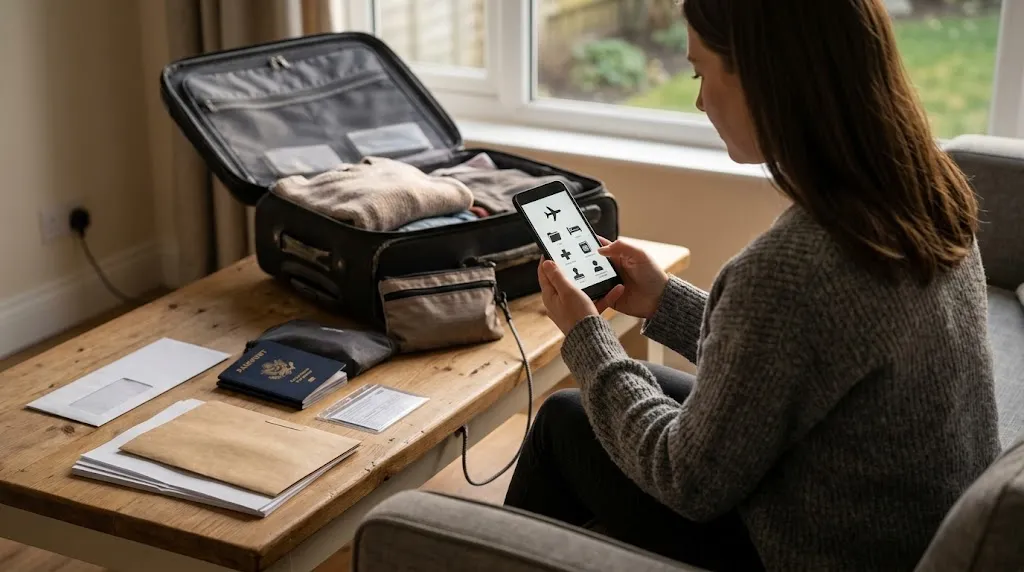
Your final document review should confirm that nothing has changed since you booked. Entry requirements, health rules, transportation schedules, and local conditions can change.
Use this final international travel document checklist
- Passport: Confirm validity, condition, and destination requirements.
- Visa: Confirm approval and permitted entry dates.
- Transit: Recheck requirements for connection countries.
- Flights: Confirm departure times, terminals, and passenger-name details.
- Accommodation: Save the first property’s full address and phone number.
- Onward travel: Keep proof available when your destination may request it.
- Insurance: Save the policy number and emergency assistance contact.
- Medication: Check local rules and pack prescriptions or letters when needed.
- Vaccinations: Carry required certificates for your itinerary.
- Emergency contacts: Store them digitally and on paper.
- Copies: Separate your passport copy from your original.
- Offline access: Open important files once before leaving to ensure they actually work offline.
Do one airplane-mode test
Put your phone into airplane mode at home. Then try opening your hotel address, first transfer, insurance details, passport copy, visa confirmation, and emergency contacts.
If something does not open, fix it now. This five-minute test can reveal surprising gaps in your preparation.
Check the documents you may need during arrival
Do not bury everything at the bottom of a checked suitcase. Keep documents needed at immigration, customs, transport counters, and hotel check-in accessible.
My preferred arrival setup is a small document pouch plus secure offline copies. It reduces the amount of searching I need to do when I am tired after a long flight.
Section Takeaway: The final week is for verification, not major research. Recheck entry rules, confirm your records open offline, and move arrival documents somewhere easy to reach.
Frequently Asked Questions About Solo Female Travel Documents
Should I carry a photocopy of my passport while traveling?
Yes, a photocopy of your passport identification page can be a useful backup. Keep it separate from the original, and also consider storing a secure digital copy and leaving another copy with someone you trust.
Do solo female travelers need any special documents?
Usually, women do not need a separate document simply because they are traveling alone. Requirements depend more on nationality, destination, visa status, health rules, trip purpose, driving plans, medication, and local entry regulations.
Should I print my hotel booking confirmation?
A printed copy is not always required, but having the first accommodation address and confirmation offline is useful. Border officials may ask where you are staying, and a paper copy still works when your phone does not.
Do I need to carry travel insurance documents?
Keep at least your insurer’s name, policy number, emergency assistance contact, and relevant coverage details. You may not need the entire policy on paper, but you should know how to access it during an emergency.
Should I bring vaccination records on an international trip?
Bring any vaccination certificate your destination or itinerary requires. Certain travelers may need an International Certificate of Vaccination or Prophylaxis, especially when yellow-fever entry requirements apply.
What documents should I carry for prescription medication?
Carry medicine in appropriate original packaging when possible and bring copies of relevant prescriptions. A doctor’s letter can also help explain your condition and medications, especially when traveling with controlled or restricted medicines.
What happens if I lose my passport while traveling alone?
Report the loss according to local requirements and contact your country’s nearest embassy or consulate for replacement guidance. A separate passport copy, identification records, and accessible emergency contacts can make the process easier.
Final takeaway: Good document preparation is not about carrying a thick folder everywhere. Prepare the documents your route requires, create sensible backups, keep essential information offline, and verify the rules again shortly before departure.
Once those basics are organized, you can spend less time worrying about paperwork and more time preparing for the trip itself.