How Can a Solo Female Traveler Find Destinations With Good Medical Access?
Quick Answer
A solo female traveler can find destinations with good medical access by checking hospital quality, emergency transport, travel-health risks, insurance acceptance, language access, and the distance from her accommodation to appropriate care. Before booking, I recommend comparing destinations with official health information and the CDC’s guidance for getting health care during travel.
My quick medical-access checklist
- Hospital access: Confirm that a suitable hospital or emergency department is reachable from where you’ll stay.
- Emergency transport: Check the local emergency number and whether reliable ambulance services operate in your destination.
- Health risks: Review destination-specific disease notices, vaccines, and other health guidance before booking.
- Insurance coverage: Verify overseas medical coverage and consider emergency evacuation protection when appropriate.
- Language access: Find out whether your chosen hospital offers English-speaking staff or interpretation services.
- Medication access: Research prescription rules and bring enough essential medication for your trip plus reasonable backup.
One rule I use
- Don’t judge medical access at country level alone. Check the exact city, neighborhood, hospital, transport route, and travel insurance arrangements you would depend on.
When women ask me how can a solo female traveler find destinations with good medical access, I suggest treating healthcare as part of destination research rather than an afterthought.
Solo female travel safety isn’t only about crime, transportation, or accommodation. Knowing where you could get competent medical care can make a trip easier to plan and less stressful if something unexpected happens.
I use a simple approach: research the destination first, then the city, then the neighborhood, and finally the medical facilities I could realistically reach. This guide explains that process step by step.
In This Guide
- What Does Good Medical Access Mean for a Solo Traveler?
- How Can I Research Medical Access Before Booking?
- How Should I Compare Destinations for Medical Access?
- How Do I Check Medical Care Near My Accommodation?
- Do I Need Travel Medical and Evacuation Insurance?
- What Medical Emergency Plan Should a Woman Traveling Alone Have?
- Frequently Asked Questions
What Does Good Medical Access Mean for a Solo Traveler?
Good medical access means being able to identify, reach, communicate with, and pay for appropriate healthcare when you need it. A country having excellent hospitals somewhere within its borders isn’t enough.
Your actual experience depends heavily on where you stay. A traveler in a capital city may have completely different options from someone several hours away on an island or mountain route.
For solo travel, I look at six separate factors:
- Appropriate facilities: Hospitals or clinics that can handle the type of emergency you may realistically face.
- Travel time: How long reaching suitable care could take from your accommodation.
- Emergency response: Whether ambulances or other emergency transportation are available and dependable.
- Communication: Whether you can communicate with clinicians or arrange interpretation.
- Payment: Whether you may need to pay upfront and seek insurance reimbursement later.
- Escalation options: Whether medical evacuation is possible if local treatment isn’t adequate.
This matters even more when traveling alone. If you’re injured or ill, you may not have a companion beside you to research hospitals, explain your medical history, or deal with insurance calls.
That doesn’t mean choosing only major global cities. It means understanding the trade-off you’re making when you choose somewhere more remote.
Medical access for solo travel is therefore a planning measure, not a guarantee of treatment quality. I want to know my realistic options before I need them.
Pro tip: Health conditions and healthcare availability can change. Check official destination health information shortly before departure instead of relying only on blogs or old forum posts.
How Can I Research Medical Access Before Booking?

Start with official destination health guidance, then verify hospitals and emergency arrangements at city level. I prefer doing this before I buy a non-refundable flight.
1. Check destination-specific health information
I start with the CDC Travel Health Notices and destination health pages. These can flag outbreaks, infectious-disease concerns, infrastructure disruptions, and precautions travelers should consider.
Don’t treat a health notice as a complete medical-access rating. Use it as one piece of the destination decision.
2. Read official travel advice
Government travel advisories often include a health section covering local facilities, ambulance services, medication rules, insurance, and emergency contacts.
If you’re not American, your own government’s foreign affairs department may provide similar destination guidance. I still find U.S. State Department pages useful as an additional research source.
3. Search for hospitals before hotels
Search the city you’re considering together with terms such as “hospital,” “emergency department,” “24-hour clinic,” and “international hospital.”
Then confirm important details through the facility’s official website or direct contact. Don’t depend entirely on a map listing.
I check:
- 24-hour emergency availability
- address and phone number
- specialties offered
- language or interpretation information
- whether international patients are handled
- payment and insurance information, when published
4. Check the actual journey to care
A hospital that’s 10 kilometers away may be easy to reach in one city and difficult in another. Traffic, ferries, mountain roads, nighttime transport, and weather can change the picture.
I usually check the route from the neighborhood where I’m considering accommodation rather than from the city’s geographic center.
5. Search your embassy or consulate resources
Embassies and consulates may maintain lists of physicians or medical facilities. The U.S. State Department also explains that consular staff can help U.S. citizens locate doctors or hospitals during a serious problem.
That assistance shouldn’t replace preparation. Save the relevant contact information before your trip.
Section Takeaway: Research in layers: official health guidance → city-level facilities → neighborhood access → emergency transport → payment arrangements.
How Should I Compare Destinations for Medical Access?
Compare destinations using the same checklist instead of relying on vague descriptions like “good healthcare.” That makes your decision more consistent.
I use the following planning framework. The time ranges are personal decision thresholds, not official medical standards.
| Factor | Lower-Concern Profile | Needs More Research | Questions I Ask |
|---|---|---|---|
| Hospital access | Suitable hospital reachable in roughly 30 minutes | Care may require 60+ minutes or inter-city transport | Where would I go for a serious illness or injury? |
| Emergency transport | Clear emergency number and documented ambulance service | Unclear response system or reliance on private transport | Who would transport me at 2 a.m.? |
| Language | Hospital confirms English or interpretation support | No information available | Could I explain allergies and symptoms clearly? |
| Insurance | Coverage confirmed before departure | Coverage unclear or large upfront payment possible | Who pays first, and what documents would I need? |
| Evacuation | Clear insurer assistance process | Remote destination with no evacuation plan | What happens if local care isn’t enough? |
For example, imagine choosing between a central neighborhood in a large city and an isolated beach area several hours away. Both could be appealing solo destinations, but they present different medical-access trade-offs.
I might still choose the remote option. I would simply prepare differently, including stronger evacuation coverage and a clearer transport plan.
Your own threshold should also reflect your itinerary. Hiking, diving, skiing, scooter riding, and remote tours can change the type of medical access you need.
Section Takeaway: Don’t ask which country has the “best healthcare.” Ask what care you could realistically reach from your exact itinerary.
How Do I Check Medical Care Near My Accommodation?
Research medical access from the exact neighborhood where you plan to sleep. This is one of the most useful checks a solo traveler can make.
Once I’ve shortlisted a hotel or hostel, I identify at least one suitable medical facility nearby. For longer trips, I may save two.
Look beyond the nearest clinic
A small clinic may be perfect for a minor problem but unsuitable for surgery, serious trauma, or advanced imaging. Distance alone doesn’t tell you enough.
Look at the facility’s services before saving it as your emergency option.
Check access at night
Your daytime transport plan may not work at 1 a.m. Public transport could stop, building entrances may close, and a quiet area may have fewer taxis.
I check whether ride-hailing, licensed taxis, hotel transport, or another realistic option operates after dark.
Ask your accommodation specific questions
A hotel saying “medical help is nearby” tells me little. Specific questions produce better information.
- Which hospital do you normally recommend to international guests?
- How would a guest reach it during the night?
- Can reception call an ambulance?
- Is reception staffed 24 hours?
- Can staff help communicate with medical services?
A hostel or hotel isn’t a medical authority. Still, these answers help you understand the practical support available if you’re traveling alone.
Pro tip: Save the hospital name, address, phone number, local emergency number, insurer assistance number, and accommodation address offline on your phone.
Do I Need Travel Medical and Evacuation Insurance?
Medical coverage deserves serious attention because ordinary domestic insurance may not fully cover treatment abroad. Coverage differs by policy, destination, activity, and nationality.
The U.S. State Department recommends reviewing overseas medical coverage and considering travel medical insurance. Its travel insurance guidance also distinguishes travel health coverage from medical evacuation coverage.
Travel medical insurance and evacuation insurance aren’t identical
Travel medical insurance generally relates to eligible treatment costs while abroad. Medical evacuation coverage concerns transportation when appropriate care isn’t available locally, subject to the policy’s terms.
Read the actual policy wording. Marketing summaries can leave out important exclusions.
Before buying a policy, I would check:
- emergency medical benefit limit
- medical evacuation benefit
- deductible or excess
- pre-existing-condition rules
- excluded activities
- motorcycle or scooter conditions
- pregnancy-related restrictions
- requirements for insurer pre-authorization
- whether hospitals are paid directly or you pay first
Remote travel changes the calculation
A broken ankle in a major city and the same injury on a remote island can create completely different logistics. The second scenario may involve boats, aircraft, or long road transfers.
CDC guidance specifically encourages travelers to consider additional insurance covering healthcare and emergency evacuation, particularly when visiting remote areas.
I also keep an emergency payment method separate from my everyday wallet. Even an insured traveler may face deposits or upfront costs before reimbursement.
Section Takeaway: Insurance doesn’t create medical infrastructure, but it can make accessing or transferring to appropriate care financially more manageable.
What Medical Emergency Plan Should a Woman Traveling Alone Have?
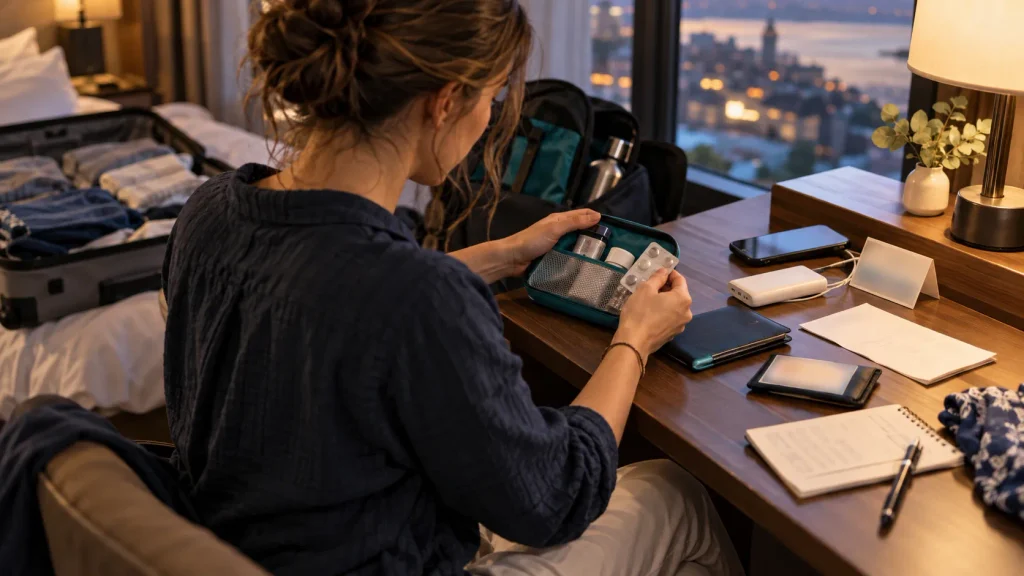
A solo traveler should carry enough information for another person to help her even if she’s stressed, sick, or unable to explain everything clearly. Keep the plan short enough to use quickly.
Create an emergency health note
CDC recommends keeping important medical information available. I would store a phone copy and a paper backup.
Include:
- full name
- date of birth
- emergency contact
- important medical conditions
- serious allergies
- current medications
- blood type, if known accurately
- travel insurance company and assistance number
- policy number
- passport information stored securely
Carry medication carefully
Bring essential prescription medication in appropriate packaging and check destination rules before departure. Some countries regulate medicines that may be ordinary prescriptions elsewhere.
CDC also advises taking enough medication for the trip and extra for possible delays.
Have a communication backup
I like having the accommodation’s address saved both in English and, when useful, in the local language. The same approach can help with allergies or important medical information.
A translation app can help with basic communication. It isn’t a substitute for a qualified interpreter during complex medical decisions.
Tell one trusted person your plan
Share your itinerary, accommodation details, insurer information, and a simple check-in routine with someone you trust.
If you’re a U.S. citizen, the State Department’s international travel checklist also explains emergency preparation and enrollment options such as STEP.
Know when your destination requires extra planning
I spend more time on medical planning when my itinerary includes factors that could make care harder to reach.
- remote islands
- multi-day treks
- rural road trips
- high-altitude areas
- adventure sports
- long boat journeys
- areas affected by severe weather or infrastructure disruption
That doesn’t automatically make these places inappropriate for solo travel. It means the medical-access plan deserves as much attention as accommodation and transportation.
Pro tip: Before leaving, review current official information through the CDC, your government’s travel advisory service, and the destination’s own health authorities. Guidance can change after you’ve booked.
Section Takeaway: The best emergency plan is one you can use under pressure: saved contacts, medical information, insurance details, offline addresses, and someone at home who knows your itinerary.
Frequently Asked Questions
How can I tell whether a destination has good hospitals?
Start with government travel guidance and official hospital websites rather than social media recommendations alone. Check emergency services, hospital specialties, location, international-patient information, communication options, and how long reaching appropriate care would take from your accommodation.
Should I avoid rural destinations when traveling alone?
Not necessarily. Rural travel may require more preparation because specialist care, ambulance services, or evacuation can take longer. Research the nearest appropriate facility, transport options, communication coverage, insurance conditions, and your backup plan before booking.
How close should my hotel be to a hospital?
There is no universal distance that makes a hotel safe. I prefer thinking in realistic travel time rather than kilometers and considering traffic, nighttime transport, terrain, and the type of medical facility available.
Can my embassy help if I become seriously ill abroad?
Consular assistance varies by nationality. For U.S. citizens, the State Department says embassies and consulates can help identify local doctors or hospitals and contact family with permission, but travelers remain responsible for medical expenses.
Is travel insurance enough if healthcare is limited locally?
No. Insurance can help with eligible costs and, depending on your policy, medical evacuation. It cannot turn a remote clinic into a full-service hospital, which is why destination research and evacuation planning should work together.
What should I check if I take prescription medication?
Check whether your medication is legal at the destination and whether documentation is required. Carry enough medication for your planned trip plus a reasonable delay buffer, and keep important prescriptions and medical details accessible.
When should I research travel health information?
Start before booking if health access could affect your destination choice. CDC advises travelers to arrange destination-specific health preparation before departure, and official guidance should be checked again shortly before the trip because conditions can change.
Finding a solo destination with good medical access isn’t about eliminating every possible risk. It’s about knowing what would happen if you needed help.
Before I consider my destination research complete, I want five answers: where I would go, how I would get there, how I would communicate, how I would pay, and what happens if local care isn’t enough.
Answer those questions before departure, and medical access becomes a practical part of your solo trip plan instead of something you have to figure out during an emergency.