
What Should a Solo Female Traveler Check When Entering a Hotel Room?
Quick Answer
When entering a hotel room alone, check that nobody is inside, every entrance locks securely, the windows and connecting doors are secure, and the room has working safety equipment. Locate the nearest emergency exit, test the room phone, and make sure your curtains provide privacy. If anything feels wrong, leave the room and contact reception rather than investigating alone. These steps follow the practical recommendations in the U.S. Department of State’s hotel and lodging safety guidance.
Your first five-minute room safety checklist
- Scan the room: Check the bathroom, closet, space behind curtains, and accessible areas under the bed.
- Test the locks: Secure the main door and check windows, balcony doors, and connecting doors.
- Protect your privacy: Close the curtains and keep your room number and key details private.
- Check emergency equipment: Find the fire exit route, smoke alarm, and any carbon monoxide detector provided.
- Test communication: Confirm your phone works, keep your mobile charged, and save the hotel’s contact number.
- Trust your instincts: Report broken locks, suspicious items, or unexpected access points and request another room if necessary.
One important rule
- If you suspect someone is inside or discover signs of forced entry, don’t enter or continue searching. Move to a staffed public area and contact hotel security or local emergency services.
Knowing what to check when entering a hotel room can make solo travel feel more manageable, especially after a long flight or a late-night arrival. I recommend making a quick room inspection part of every check-in routine, whether you’re staying in a city hotel, a guesthouse, or a private hostel room.
This guide explains how to check your room systematically, identify warning signs, protect your privacy, and decide when to request a room change. The aim isn’t to make you suspicious of every hotel, but to help you settle in with greater confidence.
In This Guide
- 1. What should you check first when entering a hotel room?
- 2. How do you check hotel room doors, windows, and locks?
- 3. How can you protect your privacy and spot unusual signs?
- 4. What fire and emergency features should you check?
- 5. When should you request a different hotel room?
- 6. What is the five-minute hotel room safety checklist?
- 7. Frequently asked questions
1. What should you check first when entering a hotel room?
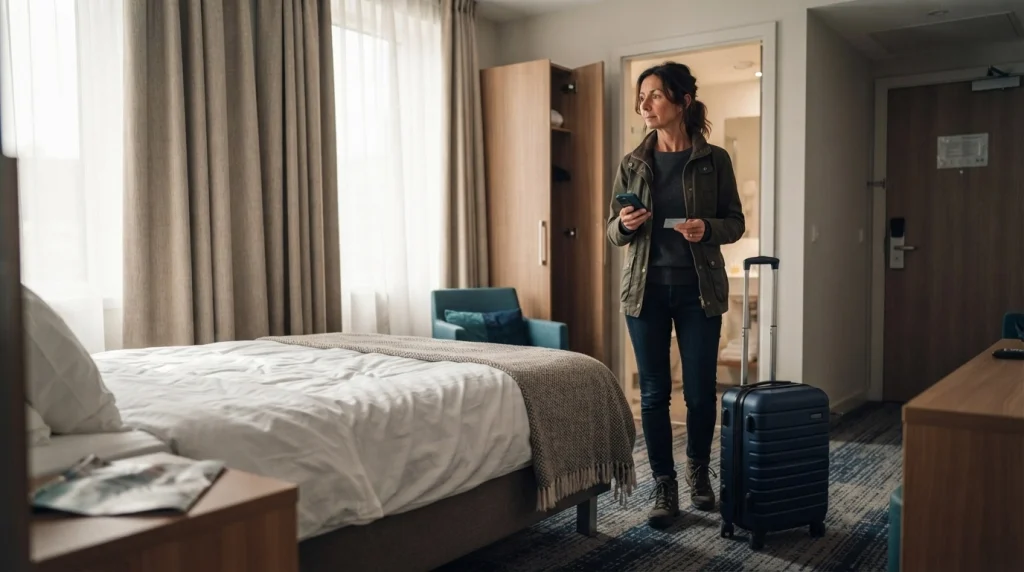
Start with your immediate surroundings, the room’s accessible spaces, and the main exit. A quick visual inspection helps you notice problems before you unpack, shower, or relax.
Scan the room before settling in
Solo female travel means taking a trip without a travel companion, so you make your own decisions about accommodation, personal security, and emergency plans. A simple arrival routine can help you manage those responsibilities without turning every hotel stay into a stressful exercise.
Keep your phone and room key with you while checking the space. If possible, leave your luggage near the entrance until you’ve confirmed that the room looks normal and secure.
Check these areas in a consistent order:
- Bathroom: Look behind the shower curtain and check the accessible corners.
- Closets and storage spaces: Open the closet and inspect any accessible wardrobe or storage area.
- Behind curtains: Check the space between the curtains and windows.
- Under the bed: Look underneath if the space is accessible and you can do so without putting yourself at risk.
- Entry and connecting doors: Check for damage, unusual gaps, or signs that a door has been tampered with.
You don’t need to dismantle furniture or inspect every fixture. If you have a genuine reason to believe someone is hiding inside, step away and ask hotel security for assistance instead.
Notice anything that seems out of place
Pay attention to broken furniture, damaged locks, unexpected open doors, exposed wiring, or belongings that don’t appear to belong to you. An unusual object isn’t automatically evidence of danger, but unexplained signs deserve a closer look from hotel staff.
For example, a connecting door that won’t close properly is a practical security concern, even if the rest of the room appears clean. Ask reception to resolve the problem before you settle in.
Check that the room matches your booking
Confirm the room type, number of beds, and any essential features you requested. If you booked a private room, make sure it isn’t a shared room or a room with an unexpected adjoining arrangement.
Also check that the entrance is the one you expect. A room with a direct exterior entrance or an easily accessible balcony may require different precautions from a room reached through a controlled hotel corridor.
Section takeaway: Inspect the room before unpacking, and never put yourself at risk to complete a checklist.
2. How do you check hotel room doors, windows, and locks?
Your room should allow you to secure every accessible entrance from inside. Check each lock yourself rather than assuming the door is secure because it looks modern or the hotel has good reviews.
Test the main door and secondary locks
Close the main door firmly and test its locking mechanism. Look for a working deadbolt, security latch, or another secondary locking device where available.
Check that the door closes fully without forcing it and that the handle, frame, and lock show no obvious damage. If the door doesn’t latch securely, ask for a repair or another room immediately.
Use this simple door checklist:
- Close the door and confirm it latches properly.
- Test the deadbolt or secondary lock from inside.
- Check the peephole, if provided, for a clear view of the hallway.
- Confirm that the door frame and surrounding area show no obvious damage.
- Keep the key card accessible and use the available locks whenever you’re inside.
A portable door wedge can provide an extra layer of resistance against a door being pushed inward, provided it’s compatible with the door and doesn’t obstruct emergency evacuation. It shouldn’t replace working hotel locks or a room change when the entrance is defective.
Check windows, balconies, and connecting doors
Windows and balcony doors deserve the same attention as the main entrance, particularly on lower floors or in rooms with exterior access. Openings that can be reached from adjoining balconies, rooftops, fire escapes, or nearby structures may create additional risks.
Check the following features:
- Window locks: Confirm they engage properly and the window closes securely.
- Balcony access: Check that balcony doors lock and consider whether neighboring balconies provide access.
- Connecting doors: Ensure any adjoining-room door locks securely from your side.
- Ground-level access: Check whether an outside walkway or entrance makes the room unusually accessible.
If a lock is broken, don’t assume that keeping the curtains closed will compensate for it. Request another room with secure access.
Which room features matter most?
No single hotel feature guarantees safety, and the right choice depends on the building layout and destination. Use this comparison to prioritize what you need before accepting a room.
| Feature | What to check | Priority |
|---|---|---|
| Main door | Closes fully and locks securely | Essential |
| Secondary lock | Engages properly from inside | Strongly preferred |
| Windows and balcony | Accessible openings close and lock | Essential where accessible |
| Connecting door | Locks securely from your room | Essential if present |
| Peephole | Provides a usable view outside | Useful security feature |
| Portable door wedge | Fits the door and doesn’t block evacuation | Optional backup |
Section takeaway: Working locks and secure access are non-negotiable. Extra gadgets cannot make up for a defective door or window.
3. How can you protect your privacy and spot unusual signs?
Once you’ve checked the physical security of your room, protect your privacy and make sure your belongings remain under your control. You don’t need expensive equipment; a few careful habits make a practical difference.
Close the curtains and check sightlines
Close the curtains or blinds fully, especially after dark when interior lighting can make the room visible from outside. Stand near the window briefly to see whether gaps leave your bed or changing area exposed.
If the curtains don’t close properly, ask reception for a solution or a different room. This matters particularly in buildings facing other hotel rooms, nearby apartments, or busy streets.
Look for unusual electronics without jumping to conclusions
Check for unfamiliar devices, unexplained wiring, or objects placed in unusual positions, particularly if they appear directed toward private areas. However, ordinary hotel equipment can look unfamiliar, and an unusual device alone doesn’t establish that surveillance is taking place.
If something concerns you, don’t dismantle it or tamper with hotel equipment. Photograph the item if safe, leave the room if necessary, and ask management or security to inspect it.
Focus on concrete warning signs rather than viral hotel-room inspection tricks. There is no simple visual test that can reliably identify every hidden camera or guarantee complete privacy.
Keep your room number and personal details private
Protecting your privacy starts before you reach the room. Ask reception to write your room number down rather than announce it within earshot of other guests.
Once inside, use these habits:
- Keep your key card and any room-number sleeve out of public view.
- Don’t share your room number with people you’ve just met.
- Avoid posting live social media updates that reveal your exact accommodation.
- Verify unexpected calls or requests for payment directly with reception.
- Meet new acquaintances in the lobby or another public space instead of inviting them into your room.
These precautions are especially useful when you’re traveling alone and don’t have a companion to help verify unexpected situations.
Check the room safe and protect valuables
If the room includes a safe, test its basic locking operation before storing important items. Read the instructions and confirm that you can open it again without assistance.
Don’t assume every hotel safe provides the same level of protection. Keep essential medication, a payment card, and access to emergency contacts available rather than putting every critical item in one place.
For passports or other valuables that you don’t need throughout the day, ask about the hotel’s central safe if the in-room option appears unreliable. Check the hotel’s storage policy and request a receipt when appropriate.
Section takeaway: Protect your privacy through sensible checks and careful habits, not fear or unsupported assumptions about ordinary objects.
4. What fire and emergency features should you check?
A secure room also needs to support a safe exit during a fire, power failure, or other emergency. Before unpacking, learn how to get from your room to a suitable exit and how to contact hotel staff.
Find the nearest emergency exit
Read the evacuation plan posted on the back of the door or elsewhere in the room. Identify the nearest usable stairwell and a backup route rather than relying only on the elevator.
Notice how far you must walk and whether the corridor is clear. If the layout is confusing, ask reception to explain the emergency route.
Make a quick mental note of:
- The nearest emergency stairwell.
- A second route in case the closest exit becomes inaccessible.
- The location of fire alarms and extinguishers along the route.
- The hotel’s designated assembly point, if one is identified.
Don’t assume you can escape through a window. Upper-floor windows may not offer a safe exit, and climbing down balconies can be dangerous.
Check smoke alarms and carbon monoxide precautions
Look for a smoke alarm or other fire detection equipment. Check for a carbon monoxide detector where applicable, particularly in accommodation that uses fuel-burning appliances or has an attached garage.
Carbon monoxide is an odorless, colorless gas that can cause serious poisoning. You cannot reliably detect it by smell or appearance, so ask hotel staff about detector provision if you’re unsure.
If an alarm sounds, you experience unexplained dizziness or confusion, or you suspect a gas-related hazard, leave the affected area and contact emergency services. Don’t stay inside to investigate the source.
Test communication and essential facilities
A working way to contact help matters when you don’t have a companion nearby. Check that your mobile phone has a usable signal or Wi-Fi calling access, and find out how to reach reception from the room.
If the room has a landline, test it or ask staff to confirm its operation. Save the hotel’s direct number in your phone, and identify the local emergency number before you need it.
Also check that you can locate your key card, flashlight, and essential medication quickly. Keep your phone charged and within reach when you sleep.
Pro tip: For country-specific travel risks and emergency preparation, consult the official U.S. Department of State travel information or your own government’s travel advisory service. Local emergency numbers and available services vary by destination.
Section takeaway: Learn your exit route before you need it, and confirm you can contact help without relying on a single device.
5. When should you request a different hotel room?
Request a room change whenever an important security feature doesn’t work, the room has an unresolved access problem, or you feel unsafe for a specific reason. You don’t have to prove that a threat exists before asking hotel management to address a reasonable concern.
Warning signs that deserve immediate attention
Some issues require a straightforward repair, while others call for leaving the room and contacting security. The appropriate response depends on the seriousness of the problem.
| What you notice | What to do |
|---|---|
| Main lock won’t secure | Don’t settle in; request another room. |
| Window or connecting door won’t lock | Request a repair or a different room. |
| Signs of forced entry or an unexplained open entrance | Don’t enter or investigate; move somewhere secure and contact security. |
| Unexplained object or device | Ask management or security to inspect it. |
| Blocked exit or serious fire-safety concern | Notify staff immediately and seek suitable alternative accommodation if unresolved. |
| Someone attempts unauthorized entry | Keep the door secured, contact security, and call local emergency services if threatened. |
How should you ask for a room change?
Be clear and specific about the problem. You can ask for another room without describing yourself as anxious or apologizing for your concern.
For example, say:
“The door doesn’t lock securely from inside, and I don’t feel comfortable staying in this room. Could you arrange another room with working locks and secure windows?”
If you suspect unauthorized entry, don’t return to the room alone just to collect your belongings. Ask hotel security to accompany you if retrieving essential items is safe.
What if hotel staff dismiss your concern?
If the hotel can’t resolve a serious security problem, move to a staffed public area and contact the booking platform or property management. If you face an immediate threat, prioritize reaching a secure location and contacting local emergency services.
Keep records of the problem, including photographs of visible damage when safe to take them, relevant messages, and the names of staff you contacted. These details may help if you need a refund, alternative accommodation, or a formal complaint.
When booking a replacement room, consider the location and access arrangements rather than choosing solely by price. A more expensive room isn’t automatically safer, but a property with secure entry, responsive staff, and functioning locks is a more sensible choice.
Section takeaway: A room change is a reasonable response to defective locks, unsafe access, or unresolved security concerns. You don’t need to stay somewhere that leaves you feeling exposed.
6. What is the five-minute hotel room safety checklist?
A repeatable checklist helps you remember the essentials even when you’re tired, arriving late, or managing several bags. Use this version whenever you check into a hotel, guesthouse, or private hostel room.
Minute 1: Check the immediate space
- Scan the bathroom, closet, curtains, and accessible spaces.
- Look for signs of forced entry or anything clearly out of place.
- Leave immediately if you suspect someone is inside.
Minute 2: Secure every entrance
- Close and lock the main door.
- Test the deadbolt or secondary locking device.
- Check accessible windows, balcony doors, and connecting doors.
Minute 3: Protect your privacy
- Close curtains and blinds.
- Keep the room key and number private.
- Check that no obvious privacy or access problem needs staff attention.
Minute 4: Prepare for an emergency
- Read the posted evacuation plan.
- Identify the nearest stairwell and an alternative exit.
- Locate fire-safety equipment and check available alarms.
Minute 5: Confirm you can get help
- Find the hotel’s contact number and reception procedure.
- Confirm your phone is charged and can connect.
- Report defects and request a room change before unpacking.
Five minutes is a useful target, not a deadline. Take longer when the layout is unfamiliar or an essential feature needs checking.
What should you do after the inspection?
Once everything checks out, place your belongings where you can reach them and keep essential items accessible. Lock the door whenever you’re inside, including when sleeping or showering.
When leaving, secure windows and doors, keep valuables out of sight, and carry your key card separately from any sleeve displaying your room number. If someone knocks unexpectedly, use the peephole or speak through the locked door, then call reception to verify any claimed staff visit.
These small habits support a practical solo-travel safety routine without requiring you to stay on high alert throughout your trip.
Section takeaway: Build the checklist into your arrival routine so you can finish the essential checks before relaxing.
7. Frequently asked questions
Should a solo female traveler inspect a hotel room before unpacking?
Yes. Inspect the room before unpacking so you can identify broken locks, unsecured windows, unexpected access points, or suspicious circumstances early. Check the bathroom, closet, accessible spaces, and main entrance first, then confirm that the room’s essential safety features work.
Is it safer to stay on a higher hotel floor?
A higher floor may reduce access from the street, but it doesn’t guarantee safety. Consider the building’s security, balcony access, window locks, emergency stairs, and evacuation arrangements. Choose a room with secure entrances and a clear emergency plan rather than relying on floor number alone.
Should I use a portable hotel door lock?
A portable door lock or wedge can provide an additional layer of security when compatible with the door. However, it cannot replace a working primary lock or compensate for a defective entrance. Never use a device that prevents emergency evacuation or violates the accommodation’s safety requirements.
What should I do if my hotel room door doesn’t lock?
Don’t settle into a room whose main door won’t secure properly. Contact reception from a safe location and request a repair or another room. If you suspect someone has entered without permission or the room may be occupied, don’t investigate alone; contact hotel security or local emergency services when necessary.
How can I tell if a hotel room has a hidden camera?
No simple visual inspection can guarantee that a room is free from hidden cameras. Look for clearly unusual devices or unexplained wiring, especially around private areas, but don’t assume ordinary electronics are surveillance equipment. If you have a specific concern, leave the room if necessary and ask hotel management or security to investigate.
Should I tell someone which hotel I’m staying in?
Sharing your accommodation details with a trusted person can support your safety while traveling alone. Consider sending them your hotel name, check-in details, and itinerary, while avoiding public posts that reveal your room number or exact location in real time. Agree on a simple check-in routine if that helps you feel more secure.
What should I do if I feel unsafe after checking into a hotel?
Take your concern seriously, especially if you notice a specific security problem or someone is attempting unauthorized access. Move to a staffed public area, contact hotel management or security, and request alternative accommodation when appropriate. If you face an immediate threat, contact local emergency services.
Make room safety part of every solo trip
Knowing what to check when entering a hotel room helps you start each stay with a clearer sense of control. You don’t need to inspect every detail obsessively; focus on secure locks, privacy, emergency exits, and reliable communication.
Before your next trip, save the five-minute checklist on your phone so you can use it even when you’re tired or arriving somewhere unfamiliar. Pair it with careful accommodation research, a sensible arrival plan, and a trusted contact who knows your itinerary.
The goal of solo female travel safety isn’t to eliminate every possible risk. It’s to recognize important warning signs, make informed decisions, and give yourself the freedom to enjoy the journey with greater confidence.
