How Can a Woman Secure a Hotel Room Door While Traveling Alone?
Quick Answer
A woman traveling alone can secure her hotel room door by engaging every working interior lock, checking that the door closes firmly, and verifying unexpected visitors before opening it. A portable door wedge or compatible travel security device may add protection, but it should never interfere with emergency evacuation. For additional guidance, consult the U.S. Department of State’s lodging safety advice.
Essential hotel door security steps
- Test the main lock: Close the door and confirm that the latch and deadbolt work correctly.
- Use secondary locks: Engage the built-in security chain, swing bar, or privacy latch when available.
- Add suitable protection: Consider a portable door wedge or alarm that fits the door and does not block your escape.
- Verify visitors: Keep the door closed while confirming unexpected staff visits with reception.
- Protect your room details: Keep your key card, room number, and access information private.
- Know your exit: Locate the emergency stairs and understand how to leave quickly if necessary.
Before you settle in
- If the primary lock fails, contact reception and request a repair or a different room.
- Never rely on furniture or a portable device to compensate for a defective hotel lock.
Knowing how to secure a hotel room door while traveling alone can make an unfamiliar room feel more comfortable and manageable. I recommend building a simple door-checking routine into every solo trip, whether you’re staying in a city hotel, a guesthouse, or a private room at a hostel.
This guide explains how to use hotel locks, choose portable security devices, handle unexpected knocks, and respond when a door doesn’t feel secure. The aim is practical protection without compromising your ability to leave quickly during an emergency.
In This Guide
- How should you check hotel door locks when you arrive?
- Which portable devices can help secure a hotel door?
- Which hotel door security option should you choose?
- What should you do if someone knocks unexpectedly?
- How can you keep your room secure while sleeping?
- What should you do if your hotel room door feels unsafe?
- Frequently asked questions
How Should You Check Hotel Door Locks When You Arrive?
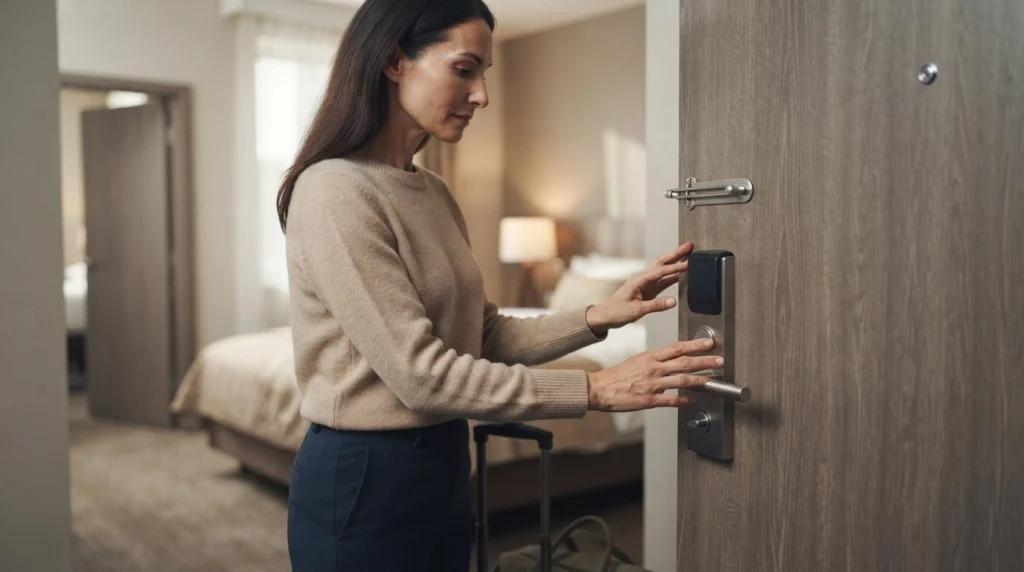
The first step is to check the door itself before unpacking or settling into the room. A portable security accessory is useful only when the primary door and lock function properly.
Test the main lock and secondary latch
Close the door completely and test each lock from inside. Check that the door latches without force and that the deadbolt or other built-in security mechanism engages correctly.
Look for these features:
- Main lock: The key card or key should operate the lock normally.
- Deadbolt: If fitted, it should extend fully and retract without sticking.
- Security latch: A swing bar or chain should engage securely according to its design.
- Peephole: If provided, check that you can see who is outside before opening the door.
- Door frame: Look for visible damage, loose hardware, or gaps suggesting the door may not close properly.
Do not assume a door is secure just because it clicks shut. Test the locks individually and gently check that the closed door remains latched.
Check connecting doors and nearby access points
Some hotel rooms have connecting doors, balconies, patios, or accessible windows. Check these features too, particularly if the room is on a low floor or near a shared outdoor walkway.
- Lock any connecting door from your side.
- Close and secure accessible windows and balcony doors.
- Check that curtains close fully if nearby rooms or buildings overlook your windows.
- Report any lock that sticks, moves loosely, or fails to secure its opening.
If a connecting door doesn’t lock, don’t assume the neighboring room is empty or that the hotel has secured it for you. Ask reception to inspect the problem or provide another room.
Know how to contact reception
Save the hotel’s verified phone number in your mobile phone and learn how to reach reception from the room telephone, if available. This gives you a direct way to request help without opening the door.
Also locate the nearest emergency stairwell and read the posted evacuation instructions. Door security should never prevent you from leaving during a fire or another emergency.
Section takeaway: Check every relevant lock immediately after arrival. If the main door, deadbolt, or another important access point cannot be secured, ask for a repair or room change before settling in.
Which Portable Devices Can Help Secure a Hotel Door?
A portable door wedge, travel door lock, or door alarm can provide an extra layer of protection in some hotel rooms. The best choice depends on the door design, the hotel’s rules, and whether the device allows a fast emergency exit.
Rubber door wedges
A rubber door wedge sits between the floor and the bottom of a closed inward-opening door. When positioned correctly on a suitable surface, it can make the door harder to push open from outside.
Wedges are compact and generally simple to use. However, their effectiveness varies with floor friction, door clearance, door-opening direction, and the force applied.
Before relying on one, check that it works with the door and floor. Don’t use it if it creates a tripping hazard or could delay your escape.
Portable travel door locks
A portable travel lock attaches to compatible door hardware to help restrict opening from inside. Designs vary, so a device that fits one type of door may not work with another.
Before packing one, check:
- Whether it supports the door’s lock and strike-plate design.
- Whether the door opens inward or outward.
- Whether the manufacturer lists your door type as compatible.
- Whether you can release the device quickly from inside.
- Whether the accommodation permits its use.
Never force a device onto a door that wasn’t designed to accommodate it. A badly fitted lock can damage the door or give you a false sense of security.
Portable door alarms
A portable door alarm can sound when a door moves or when its sensor detects a trigger condition. Depending on the design, it may alert you to unexpected activity rather than physically preventing entry.
That distinction matters. An alarm is a warning tool, not a substitute for a working lock, and it may not summon hotel security automatically.
Check the battery before your trip and learn how to silence the alarm quickly. Avoid any setup that blocks the door or delays evacuation.
Use accessories as backup, not a repair
Portable devices cannot make every defective door safe. If a hotel door doesn’t latch or its primary lock fails, report the problem and request a secure alternative.
For a broader overview of room checks, the Australian government’s solo-traveller safety guidance recommends using available locks and considering a door wedge while inside your accommodation.
Section takeaway: Choose portable protection that fits your room and allows quick exit. A compatible accessory may add reassurance, but the hotel’s primary lock must still work properly.
Which Hotel Door Security Option Should You Choose?
The right door security option depends on the problem you’re trying to solve. Built-in locks should always come first, while portable devices can offer extra protection when they’re compatible with the room.
Use this comparison to decide what belongs in your solo travel safety kit.
| Option | Main purpose | Limitations | Best use |
|---|---|---|---|
| Built-in deadbolt | Secures the closed door from inside | May be faulty or absent on some doors | Your first line of protection |
| Swing bar or chain latch | Adds a secondary interior barrier | Hardware can be loose or damaged | Extra security while inside |
| Rubber door wedge | Helps resist inward door movement | Depends on floor, clearance, and door design | Compatible inward-opening doors |
| Portable travel lock | Restricts opening on compatible doors | Not compatible with every lock or frame | Rooms with a matching door design |
| Portable door alarm | Alerts you to certain door movements | Usually doesn’t physically stop entry | An additional warning layer |
| Reception or hotel security | Can investigate, repair, or change rooms | Response and staffing vary by property | Faulty locks or suspicious activity |
For most travelers, a sensible approach is to use the built-in locks correctly and pack one compatible accessory if it suits their needs. Carrying several gadgets is less useful than knowing how to operate your door and contact help.
What should you look for when choosing a portable device?
Prioritize practical features rather than marketing claims about being impossible to break into. No portable device can guarantee that a room is secure.
- Compatibility: Confirm the device works with the doors you commonly encounter.
- Ease of use: You should be able to install and remove it without tools or complicated steps.
- Emergency release: You must be able to leave quickly from inside.
- Portability: A compact, lightweight design is easier to carry consistently.
- Clear instructions: Understand the correct setup before you need it.
When booking accommodation, also check whether the property has staffed reception, controlled access to guest floors, and a reliable way to contact security. These features support your door routine without replacing it.
Section takeaway: Start with working hotel locks and add only a compatible backup device. The most practical setup is one you can use correctly without sacrificing a safe exit.
What Should You Do If Someone Knocks Unexpectedly?
You don’t have to open your hotel room door simply because someone claims to be an employee or says they have a delivery. Keep the door secured until you’ve independently verified the visit.
Verify the person’s identity without opening the door
An unexpected knock might be harmless, but a uniform or confident explanation doesn’t prove that someone has permission to enter. Use a cautious, repeatable process instead of making a quick judgment.
- Keep the door closed and engage the available interior locks.
- Use the peephole, if available, without unlocking the door.
- Call reception using the hotel’s verified number or room telephone.
- Ask whether staff were sent to your room and why.
- If the visit cannot be confirmed, tell reception and ask staff to investigate.
If the visitor is legitimate, you can arrange a suitable time for the service or meet staff in the lobby when practical. You don’t need to explain that you’re traveling alone.
What if someone tries the handle or keeps knocking?
Stay behind the locked door and contact reception or hotel security. Explain what happened, where you are, and whether the person is still outside.
Don’t open the door to investigate or confront someone in the hallway. If the person threatens you, tries to force entry, or you believe danger is immediate, contact local emergency services.
If reception cannot address the concern, ask for a security escort, a room change, or help moving to a staffed public area. Choose the option that gives you the safest practical route.
Keep your room number private
Room security begins before you reach the door. During check-in, you can ask staff to write down your room number instead of announcing it where other guests might hear.
Keep your key card separate from any sleeve displaying the room number. Don’t share the room number with people you have just met, and avoid posting identifying details about your accommodation publicly while you’re staying there.
Section takeaway: Verify unexpected visitors through a trusted hotel contact. If someone behaves suspiciously, keep the door locked and let hotel staff or emergency responders handle the situation.
How Can You Keep Your Room Secure While Sleeping?
Before going to sleep, lock the door, check any secondary latch, and keep your phone and room key within easy reach. A consistent nighttime routine is easier to follow than a complicated system of extra barriers.
Build a simple bedtime safety routine
- Close the door firmly and engage the main lock.
- Use the built-in secondary lock, following its instructions.
- Check that accessible windows, balcony doors, and connecting doors are secured.
- Keep your charged phone nearby and make sure you can contact help.
- Place your room key somewhere easy to find in the dark.
- Keep your route to the exit clear of bags, shoes, and portable equipment.
A portable wedge or compatible travel lock may provide additional reassurance while you’re in the room. However, don’t use an arrangement that prevents you from opening the door quickly during an evacuation.
Balance privacy with emergency access
Close the curtains and use the hotel’s privacy sign if you don’t want routine housekeeping visits. Still, a sign doesn’t replace the lock, and hotel policies may allow staff to enter for legitimate emergencies.
Learn how the hotel’s evacuation system works before going to bed. The U.S. Department of State’s lodging safety checklist recommends checking room safety features and identifying emergency exits when you arrive.
If a device sounds an alarm, know how to deactivate it without fumbling. Keep the exit unobstructed, and don’t depend on a window as your only escape route unless emergency guidance specifically identifies it as usable.
Section takeaway: Lock the door, keep essentials accessible, and protect your privacy. A good nighttime setup adds reassurance while preserving a clear, usable exit.
What Should You Do If Your Hotel Room Door Feels Unsafe?
If your hotel door won’t lock properly, request another room or a prompt repair before staying there. Don’t let embarrassment or concern about inconveniencing staff stop you from raising a reasonable safety issue.
Know when to request a room change
Contact reception if you notice any of these problems:
- The main lock or deadbolt won’t engage.
- The door doesn’t latch securely or appears damaged.
- A connecting door cannot be locked from your side.
- Someone appears to have accessed your room without explanation.
- Staff cannot explain or resolve a security concern that you reported.
Explain the specific issue and ask for a room with functioning locks. If the hotel cannot offer a satisfactory solution, consider moving to alternative accommodation.
What if you return and find the door open?
If you return and find your room door open, damaged, or apparently tampered with, don’t enter to investigate. Move to a staffed public area if you can do so safely, then contact hotel security or local police as appropriate.
Tell staff what you observed and ask them to investigate before you return to the room. If you suspect a crime, avoid disturbing potential evidence.
Choose accommodation with security in mind
Door security starts during the booking process. Reviews, property descriptions, and direct questions to the hotel can help you assess whether a place meets your needs.
Before booking, consider asking:
- Is reception staffed overnight, or is there an emergency contact?
- Do guest floors have controlled access?
- Can I request a room without a connecting door?
- What happens if a room’s lock fails?
- Are emergency exits clearly marked and accessible?
For additional planning, consult your government’s current travel advice and the relevant destination’s official guidance. Safety arrangements vary between properties, so avoid assuming that every hotel follows the same procedures.
Section takeaway: You can request a different room whenever a serious security problem remains unresolved. Your safety matters more than keeping an inconvenient booking.
Frequently Asked Questions
Can a woman secure a hotel room door without a deadbolt?
Yes, but the available alternatives depend on the door’s design and the accommodation’s rules. Use any functioning built-in lock, ask reception about additional security, and request another room if the primary lock doesn’t secure the door properly.
Is a rubber door wedge enough to secure a hotel room?
No. A rubber wedge may help resist an inward-opening door, but its effectiveness depends on the floor, door clearance, and other conditions. Treat it as an additional precaution rather than a replacement for working hotel locks.
Should I use a portable travel lock in every hotel?
Not necessarily. Portable locks work only with compatible door designs and may be prohibited by some properties. Check compatibility before traveling, follow the manufacturer’s instructions, and ensure the device doesn’t prevent a quick emergency exit.
Should I open the door if someone says they work at the hotel?
No, you don’t need to open it immediately. Keep the door locked and contact reception using a trusted phone number to verify the person’s identity and reason for visiting. If the visit cannot be confirmed, ask hotel staff to investigate.
Can I use a door alarm while sleeping?
A portable door alarm may provide an extra warning if someone opens or moves the door. Check its instructions, battery, and compatibility before use. Remember that an alarm may not prevent entry or automatically alert hotel security.
What should I do if my hotel door won’t lock?
Contact reception immediately and request a repair or another room. Don’t rely on furniture or portable equipment to compensate for a defective primary lock. If the hotel cannot provide suitable accommodation, consider moving somewhere safer.
Is it safe to add extra locks that make the door harder to open?
Extra locks can provide reassurance when used correctly, but they must allow you to exit quickly during an emergency. Avoid improvised barriers that could trap you inside, obstruct evacuation, or interfere with fire safety requirements.
Final Takeaway: Make Hotel Door Security Part of Every Solo Trip
Securing a hotel room door while traveling alone doesn’t require a suitcase full of gadgets. Start by checking the main lock, using available secondary locks, protecting your room details, and verifying unexpected visitors before opening the door.
A compatible travel wedge or alarm may provide extra reassurance, but neither replaces a working lock or a clear emergency exit. If the room doesn’t feel secure, contact reception and ask for a practical solution.
Before your next trip, save this checklist and use it whenever you check in. A few careful checks can help you settle in with greater confidence and focus on enjoying your journey.