How Can a Woman Research Whether a Destination Is Safe for Solo Travel?
Quick Answer
A woman can research whether a destination is safe for solo travel by combining official government advice, women-specific safety information, neighborhood research, transportation details, recent traveler experiences, and a realistic backup plan. Start with current official guidance for women travelers, then investigate the exact areas, transportation methods, and situations your trip will involve rather than judging an entire country as simply “safe” or “unsafe.”
Research these six things first
- Official advisories: Check current warnings, local laws, demonstrations, crime concerns, and regional restrictions.
- Women-specific risks: Research harassment, dress expectations, gender norms, and how women are treated in public spaces.
- Neighborhoods: Compare where visitors stay, how the area feels after dark, and whether transportation is nearby.
- Transportation: Learn which taxis, ride services, trains, buses, and airport transfers are considered reputable.
- Recent experiences: Read current reports from women who traveled alone, while separating personal anecdotes from verified facts.
- Backup options: Know how you would change hotels, leave an area, get medical help, or contact emergency services.
One important rule
- Recheck official advice shortly before departure because security, health, transportation, and political conditions can change after you book.
If you’re wondering how can a woman research whether a destination is safe for solo travel, don’t search only for “Is this country safe?” That question is too broad to tell you what your own trip will feel like.
I research solo female travel safety in layers. I look at the country first, then the city, neighborhood, accommodation, transportation, arrival time, and specific activities I expect to do alone.
In This Guide
- What Does “Safe” Mean for a Woman Traveling Alone?
- Which Official Sources Should You Check First?
- How Do You Research Women-Specific Safety Risks?
- How Do You Research Neighborhood and Transportation Safety?
- Can You Trust Blogs, Forums, and Traveler Reviews?
- How Do You Turn Your Research Into a Go-or-Reconsider Decision?
- Frequently Asked Questions
What Does “Safe” Mean for a Woman Traveling Alone?
A destination being “safe” does not mean nothing bad can happen there. For solo travel, I define safety as having enough reliable information and practical options to manage the risks I am reasonably likely to face.
A place can also have different risk levels depending on your neighborhood, arrival time, transportation, activities, and personal circumstances.
Definition: Solo female travel safety is the process of identifying destination-specific risks, understanding how those risks could affect a woman traveling alone, and preparing realistic ways to avoid, reduce, or respond to them.
Stop looking for a single safety score
I don’t base a trip on one crime ranking or travel-safety score. National averages can hide huge differences between cities and neighborhoods.
They also rarely explain the situations a solo woman cares about most.
- Can I arrive at the airport after dark and get a reputable ride?
- Will I feel comfortable walking from dinner to my hotel?
- Are women commonly harassed on certain transport routes?
- Are there cultural expectations around clothing or behavior?
- Can I easily change plans if I become uncomfortable?
- Will my phone work reliably enough for maps and communication?
- Do I know the local emergency number?
Research the trip you will actually take
A seven-day city break and a month-long backpacking trip can create completely different risks in the same country. Your research should match your itinerary.
I break my trip into situations rather than trying to answer one giant safety question.
| Travel situation | What I research | What I want to know |
|---|---|---|
| Airport arrival | Official taxis, ride apps, public transport, transfer desks | How I reach my hotel without improvising while tired |
| Accommodation | Neighborhood, reception hours, secure access, recent reviews | Whether I can comfortably enter and leave alone |
| Evenings | Transport frequency, lighting, busy areas, closing times | How I get back without depending on strangers |
| Day trips | Return transport, phone coverage, tour operators, terrain | Whether I can manage the outing independently |
| Nightlife | Transport home, drink safety, venue area, local norms | How I maintain control of my transport and decisions |
Section Takeaway: Research specific situations, not a destination’s reputation. The useful question is whether your planned version of the trip gives you manageable risks and workable backup options.
Which Official Sources Should You Check First?
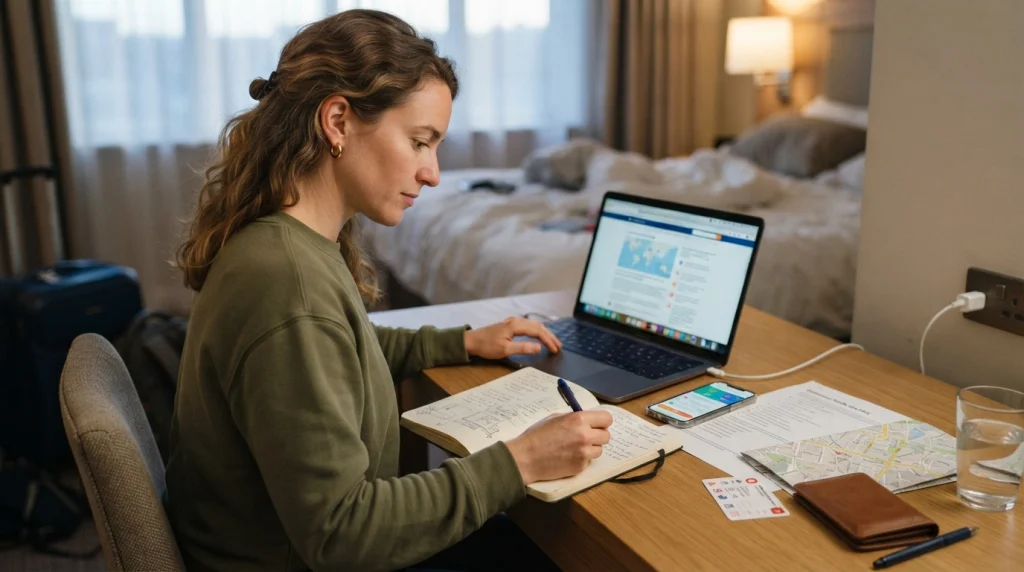
Start with official sources before blogs or social media. Government travel guidance gives you a baseline for current security conditions, local laws, transportation concerns, demonstrations, entry rules, and emergency information.
As of 2026, I also recheck these sources near departure because conditions can change after booking.
1. Government travel advisories
For international trips, I check the U.S. State Department travel advisories even when I’m also consulting another country’s guidance. I pay more attention to the explanation than to the headline level alone.
Look for warnings tied to particular regions or situations.
- Crime
- Civil unrest
- Political demonstrations
- Terrorism
- Kidnapping
- Natural disasters
- Local laws
- Transportation conditions
A warning for one border region does not automatically describe the capital city. The reverse is also true.
2. Compare advice from another government
I like checking a second official source because governments may organize or explain risks differently. The UK government’s foreign travel advice includes destination pages and separate guidance for women and independent travelers.
If two governments highlight the same issue, I investigate it more closely. If their wording differs, I read the underlying regional and situational details instead of trying to decide which headline sounds more reassuring.
3. Check destination-specific health information
Safety research should include health. The CDC Travelers’ Health destination pages provide destination-specific health information, while Travel Health Notices highlight certain current outbreaks and health events.
That matters more for some trips than others. A remote hiking itinerary can require different preparation than a short urban trip.
4. Record emergency information before you travel
Find the local emergency number and your embassy or consulate information before departure. Don’t rely on searching for everything after something has already gone wrong.
U.S. travelers can also consider the Smart Traveler Enrollment Program, or STEP. It provides embassy and consulate updates for registered destinations.
Pro tip: Travel advisories, health notices, entry rules, protests, strikes, and local emergencies can change quickly. Check official destination guidance when planning and again shortly before departure.
Section Takeaway: Use official government and health sources to establish the factual baseline. Then use traveler reports to understand what those conditions may feel like in everyday life.
How Do You Research Women-Specific Safety Risks?
General crime information isn’t enough for solo female travel. Women may encounter issues that broad destination guides barely mention.
I specifically search for women’s experiences with public transportation, harassment, nightlife, accommodation, cultural expectations, and unwanted attention.
Research cultural norms without stereotyping
Local customs can influence clothing, public behavior, alcohol, dating, photography, and interactions between women and men. Learn the norm without assuming every local person behaves the same way.
I want practical answers to questions like these:
- Are shoulders or knees normally covered in religious sites?
- Do women commonly use public transport alone after dark?
- Are some train cars or waiting areas designated for women?
- Are there laws affecting unmarried couples or public affection?
- Does nightlife finish after public transportation stops?
- Is street harassment frequently mentioned by recent female travelers?
Search for patterns, not dramatic stories
A frightening story can be important, but one story cannot tell you the probability of the same thing happening to you. I look for repeated themes across many recent sources.
For example, twenty unrelated women mentioning aggressive taxi touts at the same airport deserves attention. One vague comment from eight years ago carries much less weight.
Pay attention to when and where problems happen
Context often changes the usefulness of a safety report. “I was harassed in the city” tells me far less than a report naming the neighborhood, time of day, transportation method, and situation.
I sort reports into patterns.
- Location: Is one neighborhood repeatedly mentioned?
- Time: Are problems concentrated late at night?
- Transport: Do complaints involve unofficial taxis or a particular station?
- Setting: Are nightlife areas different from daytime tourist districts?
- Behavior: Are scams aimed specifically at newly arrived visitors?
Know your own circumstances
Women’s experiences can also vary with age, race, nationality, disability, religion, sexual orientation, appearance, language ability, and other factors. Someone else’s trip report may not predict yours perfectly.
The goal is not finding a traveler exactly like you. It’s gathering enough relevant experiences to understand possible situations before you encounter them.
Pro tip: For gender-specific legal and safety information, compare traveler experiences with official destination guidance. Laws and cultural expectations should never be inferred from social media alone.
Section Takeaway: Women-specific research should focus on recurring situations and practical context. Look for patterns around harassment, transport, nightlife, local norms, and the exact areas you plan to visit.
How Do You Research Neighborhood and Transportation Safety?
Your neighborhood and transportation choices can matter more to your daily experience than a country’s general safety reputation. I spend a surprising amount of research time on the few kilometers around my accommodation.
This is especially important when I expect to walk alone.
Research your accommodation area block by block
Start with two or three neighborhoods commonly used by visitors. Compare access to transportation, restaurants, pharmacies, grocery stores, main streets, and places that stay active into the evening.
Then inspect the immediate area around specific accommodations.
- How far is the nearest reliable transit stop?
- Will you walk through quiet industrial streets?
- Are restaurants nearby?
- Does the hotel have staffed reception?
- Can a taxi or ride service stop directly outside?
- Are recent guests describing the location positively?
- Do reviewers repeatedly mention uncomfortable nighttime walks?
A cheap room can become a poor value if I need expensive taxis every evening because I don’t feel comfortable with the location.
Plan the airport transfer before booking the flight
Arrival is one situation I rarely leave to improvisation. After a long flight, I’m tired, carrying luggage, and unfamiliar with the city.
I research the full route from arrival terminal to accommodation.
- Identify official airport transportation.
- Check when public transit stops running.
- Find the normal method for obtaining a licensed taxi.
- Check whether a reputable ride-hailing service operates there.
- Save the hotel address offline.
- Keep enough backup payment for another transport option.
The U.S. State Department’s guidance for women travelers recommends researching reputable transportation and considering prearranged airport transport.
Research nighttime transportation separately
A metro system that is easy at 2 p.m. may feel completely different near midnight. Check service hours, station entrances, taxi availability, and the route from the final stop to your accommodation.
I also ask myself whether I can leave an evening activity early without depending on the group I arrived with.
Check whether your phone will support your safety plan
Maps, translation, ride services, hotel messages, banking, and transportation apps often depend on mobile data. Research SIM cards, eSIM availability, roaming, offline maps, and charging options before arrival.
A phone isn’t a complete safety system. Still, losing navigation and communication at the same time can turn an ordinary problem into a stressful one.
Section Takeaway: Research the smallest useful geographic area: your arrival terminal, transport route, neighborhood, hotel entrance, and evening return options. Those details often matter more than national rankings.
Can You Trust Blogs, Forums, and Traveler Reviews?
Traveler experiences are useful when you treat them as observations rather than official facts. They can reveal practical details that government advisories rarely cover.
The key is comparing multiple recent accounts.
Use reviews for questions they can answer well
Accommodation reviews can help you understand things such as street noise, reception quality, entrance security, surrounding businesses, and what the walk from a station feels like.
Female travelers may also mention details that a hotel description leaves out.
- Whether they returned alone after dinner
- Whether staff handled unwanted visitors appropriately
- Whether dorm doors or lockers worked
- Whether the neighborhood became deserted at night
- Whether transportation was easy to access
Filter by recency
I give more weight to recent reviews because neighborhoods, transportation systems, businesses, political conditions, and scams can change. A detailed 2026 report is normally more useful for a 2026 trip than a report from 2017.
Older posts can still help with culture and general logistics. They shouldn’t override current official guidance.
Separate discomfort from danger
Some reviews use “unsafe” to describe unfamiliarity, poverty, noise, crowds, graffiti, or cultural differences. Those things can feel uncomfortable without necessarily indicating a specific threat.
Look for concrete descriptions instead.
| Weak information | More useful information |
|---|---|
| “The neighborhood felt sketchy.” | “The final three blocks from the station were empty after 11 p.m.” |
| “The taxis are dangerous.” | “Airport staff directed passengers to a licensed taxi counter, while touts approached outside.” |
| “Men bothered me constantly.” | “I received repeated comments while walking alone near the nightlife district after dark.” |
| “I never felt unsafe.” | “I used the metro by day and booked rides back to my hotel after 10 p.m.” |
Don’t let algorithms become your risk assessment
Social platforms tend to reward dramatic content. One person may describe a destination as terrifying while another presents it as completely carefree.
I use both as leads for further research, not final answers.
Section Takeaway: Traveler reports are strongest when they are recent, specific, and repeated across independent sources. Use them to understand everyday experience, but use official sources for laws, emergencies, health, and current security conditions.
How Do You Turn Your Research Into a Go-or-Reconsider Decision?
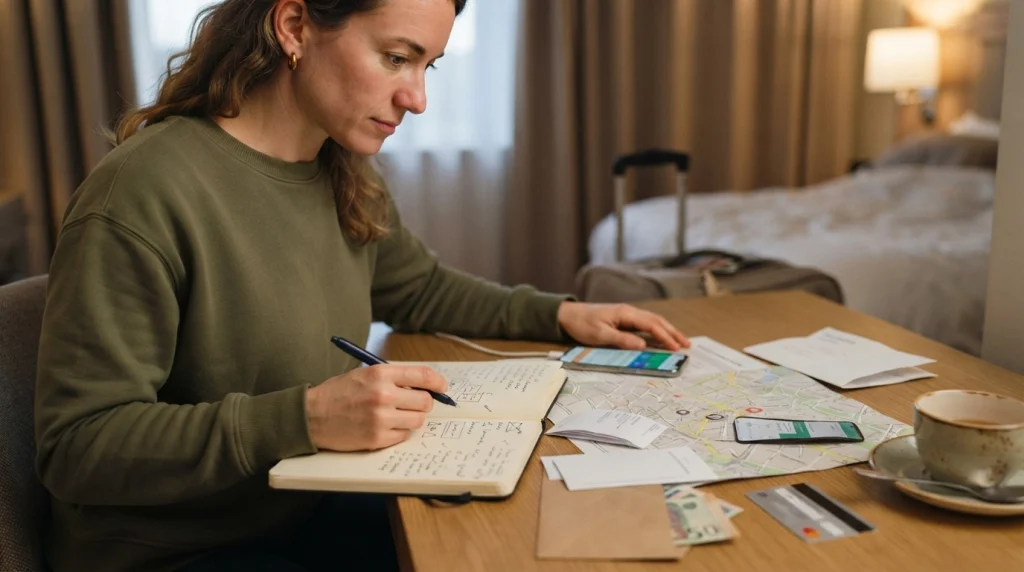
After researching, turn your notes into specific questions you can answer. I want to know whether the trip works for me, not whether somebody on the internet would personally take it.
I use five categories.
1. Current conditions
Check whether official sources identify serious risks affecting your actual itinerary. Pay attention to regional restrictions and recent changes.
2. Transportation
Ask whether you have reliable transportation when you are most vulnerable to confusion: arrival, departure, late evenings, and remote day trips.
3. Accommodation
Choose somewhere that supports your independence. Location, secure access, reception, and easy transportation can be worth paying more for.
4. Communication and money
You should have a way to navigate, communicate, and pay without relying on one device or one card. I normally separate my backup payment method from my everyday wallet.
5. Exit options
This is the question people often skip. If your accommodation, neighborhood, driver, tour, or situation feels wrong, what can you do next?
Write down realistic alternatives.
- A second accommodation option
- Another transportation method
- Emergency money
- A trusted contact at home
- Local emergency services
- Embassy or consulate details when relevant
- Travel insurance contact information
Use a simple research worksheet
| Question | What to record |
|---|---|
| What do current official advisories say? | Main risks, restricted regions, date checked |
| What issues do women repeatedly report? | Harassment, transportation, scams, nightlife, cultural norms |
| Where will I stay? | Neighborhood, transit access, reception, nighttime return |
| How will I arrive? | Primary transfer, cost estimate, backup transport |
| How will I stay connected? | SIM/eSIM, offline maps, charger, trusted contact |
| What will I do if plans fail? | Backup hotel, money, transportation, emergency contacts |
I once thought extensive destination research meant trying to predict every possible problem. It doesn’t.
The useful part is identifying the few situations where I could lose options, then fixing those before I leave. A preplanned airport ride or better-located hotel can reduce more stress than reading another hundred generic safety comments.
Pro tip: Do a final official-source check within the days before departure. Health notices, demonstrations, transport disruptions, severe weather, and security conditions may change after your original research.
Section Takeaway: Your research is complete when you understand the main risks relevant to your itinerary and know what you will do if an important part of the plan fails. The goal is informed flexibility, not certainty.
Frequently Asked Questions
How far in advance should a woman research solo travel safety?
Start researching before making major non-refundable bookings, especially for international trips. Check neighborhoods, transportation, laws, health requirements, and official advisories early, then review current official information again shortly before departure because conditions can change.
What is the best source for checking whether a country is safe?
No single source gives a complete answer. Start with official government travel advisories and destination health guidance, then add local transportation information and recent female traveler experiences to understand how risks may affect your specific itinerary.
Are travel advisories enough for solo female travelers?
No. Advisories provide an important factual baseline, but they may not describe everyday experiences in your hotel neighborhood or the practical reality of returning alone after dinner. Add women-specific research, transportation planning, accommodation reviews, and recent local information.
Should I cancel a trip if I find negative stories online?
One negative story should usually prompt more research rather than an automatic decision. Look for repeated patterns, verify current conditions through official sources, identify where and when incidents occurred, and decide whether your itinerary exposes you to the same circumstances.
How can I tell whether a neighborhood is suitable for a woman traveling alone?
Check recent accommodation reviews, public transportation access, evening activity, street layout, hotel reception hours, and the route you would walk after dark. Look for specific observations from recent travelers rather than relying only on labels such as “safe area.”
Should women research local dress codes before traveling alone?
Yes. Clothing expectations can be connected to religious customs, local law, or ordinary cultural norms. Check official destination guidance and reputable local information so you understand when modest clothing or specific dress is expected without relying on stereotypes.
How do I avoid becoming anxious from too much safety research?
Research actions instead of endlessly reading frightening stories. Once you know your arrival plan, neighborhood, transportation, important laws, emergency contacts, communication options, and backup arrangements, stop consuming repetitive content unless conditions change.
Research enough to give yourself options, then go experience the destination.
No destination comes with a promise that nothing will go wrong. The useful goal is understanding what risks are relevant to you and making sure one uncomfortable moment doesn’t leave you without choices.
Before booking, research the country, city, neighborhood, transportation, accommodation, and women-specific concerns separately. Before departure, check official sources again and save the information you would need if plans changed.
That approach has made my solo trips feel far more manageable. I arrive knowing where I’m going, how I’m getting there, and what I’ll do if the first plan stops working.