How Can a Solo Female Traveler Research Local Safety Before Booking a Trip?
Quick Answer
Before booking a solo trip, research safety from several angles instead of relying on a single “safe or unsafe” rating. Check current government advisories, neighborhood-level information, transportation options, recent traveler experiences, local laws, accommodation reviews, and emergency resources. I always start with the official destination travel advisory, then verify what those risks mean for the exact areas I plan to visit.
What to check before booking
- Official advisories: Check current warnings, local laws, civil unrest, crime concerns, and areas travelers should avoid.
- Neighborhood safety: Research the specific district around your hotel, not just the destination as a whole.
- Transport after dark: Find out whether licensed taxis, rideshare apps, trains, or airport transfers are practical at your arrival time.
- Recent reviews: Read newer accommodation and traveler reports for recurring problems involving harassment, scams, theft, or unsafe streets.
- Local norms: Learn about dress expectations, alcohol rules, photography restrictions, and behavior that may attract unwanted attention.
- Backup plans: Save emergency contacts and identify alternative accommodation and transportation before paying for non-refundable bookings.
My booking rule
- I don’t book because someone online says a city is “totally safe.” I book when I understand the specific risks and have a realistic plan for handling them.
Solo female travel safety research is less about finding a perfect destination and more about reducing unknowns before you pay. The question I want answered isn’t simply, “Is this country safe?”
I want to know where I’ll sleep, how I’ll arrive, what happens after dark, which scams keep appearing, and what I’ll do if my original plan fails.
This guide shows you how to research those details before booking. It works for a first solo trip as well as a new destination you’ve never visited before.
In This Guide
- What Does Local Safety Research Mean for a Solo Female Traveler?
- Which Official Safety Sources Should You Check First?
- How Do You Research Whether a Neighborhood Is Safe?
- How Should You Research Transportation Safety?
- How Much Should You Trust Traveler Reviews and Social Media?
- What Should You Check Before You Actually Book?
- Frequently Asked Questions
What Does Local Safety Research Mean for a Solo Female Traveler?
Local safety research means examining the risks connected to your exact itinerary rather than judging an entire country by one reputation. A destination can feel straightforward in one neighborhood and difficult in another.
Solo female travel safety research is the process of checking official warnings, location-specific conditions, transportation, accommodation, cultural norms, health issues, and emergency options before committing to a trip.
Separate destination risk from itinerary risk
A country’s overall safety situation is only your starting point. Your actual exposure depends heavily on where you stay and how you move around.
- Arrival time: Landing at 2:00 p.m. can create a different situation from arriving alone at midnight.
- Accommodation location: A cheap hotel far from the center may require long late-night journeys.
- Activities: Hiking alone, nightlife, road trips, and remote excursions introduce different risks.
- Trip length: A two-day city break and a three-week multi-city itinerary need different backup plans.
- Communication: Limited mobile coverage or language barriers can make small problems harder to solve.
This is why I don’t use a simple “safe destination” list as my final decision tool. Lists can help me discover options, but they rarely reflect my exact arrival, hotel, route, or activities.
Look for patterns, not frightening individual stories
Almost every major destination has alarming stories online. One bad experience doesn’t automatically tell you how common that problem is.
Instead, look for the same concern appearing across several independent sources. Repeated mentions of one taxi scam, isolated streets, harassment pattern, or transport problem deserve more attention.
- Is the concern mentioned by official sources?
- Does it appear repeatedly in recent traveler reports?
- Does it affect your planned neighborhood?
- Does it occur mainly at certain times?
- Can you reduce the risk by changing your itinerary?
Section Takeaway: Good safety research narrows broad destination warnings into practical questions about your own accommodation, transport, timing, and activities.
Which Official Safety Sources Should You Check First?
Start with government and public-health sources because they provide structured information you can verify. Then add local and traveler perspectives for context.
As of 2026, I would still recheck these sources shortly before departure. Political events, demonstrations, entry rules, disease outbreaks, and transportation disruptions can change after you book.
Check a government travel advisory
Open the advisory for your destination and read more than the headline level. Look for specific regions, border areas, demonstrations, crime concerns, terrorism warnings, local laws, and transport restrictions.
The U.S. Department of State also maintains guidance specifically for women travelers, including considerations around public transportation, accommodation, local customs, harassment, and personal safety.
A high-level warning doesn’t always apply equally across the whole country. Conversely, a generally low-risk country can still have areas where extra planning makes sense.
Check health risks before paying for the trip
Safety isn’t limited to crime. Health requirements can affect whether your itinerary is practical, especially for remote travel.
Review the CDC’s pre-travel health guidance and destination-specific information before departure. Check vaccines, medicines, outbreaks, food and water risks, and access to medical care.
Pro tip: Always verify destination safety and health guidance directly with official government and public-health sources shortly before booking and again before departure.
Compare several source types
| Source | Best for | Main limitation |
|---|---|---|
| Government advisory | Major security risks, laws, restricted areas | May not explain everyday neighborhood experience |
| Public-health authority | Vaccines, outbreaks, health preparation | Doesn’t answer most street-safety questions |
| Local tourism authority | Local transport and visitor information | Usually written to encourage tourism |
| Recent hotel reviews | Street atmosphere and accommodation issues | Individual experiences are subjective |
| Solo traveler communities | Female-specific practical experiences | Advice can be outdated or anecdotal |
No single source answers every safety question. I trust the overall picture more when several independent sources point in the same direction.
Section Takeaway: Use official advisories for verified risks, then add recent local and traveler information to understand what those risks may mean day to day.
How Do You Research Whether a Neighborhood Is Safe?
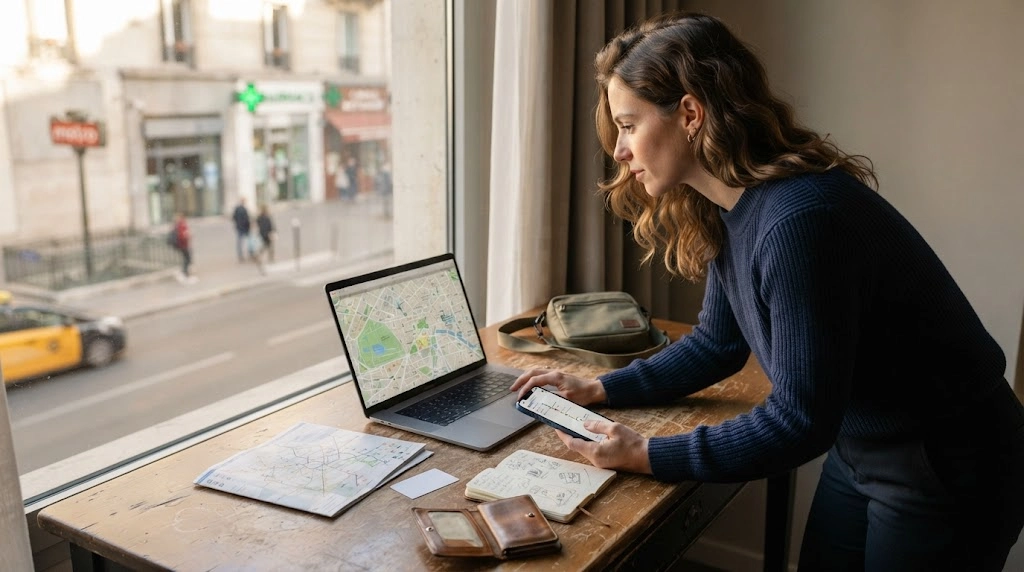
Research the exact area around your accommodation before booking it. Searching only “Is Barcelona safe?” or “Is Bangkok safe?” is too broad to guide a hotel decision.
Inspect the area around the property
Start with a map and examine the surrounding streets. Check how far the property is from transport, busy roads, restaurants, pharmacies, and places you expect to visit.
- How far is the nearest useful train or metro station?
- Will you walk through quiet industrial streets?
- Are restaurants or convenience stores nearby?
- Does the route look practical with luggage?
- Can a taxi stop directly outside the property?
I also compare the hotel’s distance from attractions with the route I’d take after dinner. A property can be “only 20 minutes away” while still creating an awkward walk late at night.
Read reviews using safety-specific search terms
Don’t read only the highest-rated reviews. Search recent reviews for words connected to the experience you’re trying to understand.
- safe
- solo
- woman or female
- night
- walk
- station
- taxi
- harassment
- street
- noise
A single complaint doesn’t automatically change my decision. Five recent reviews describing the same problem get my attention.
Check whether the neighborhood works for your travel style
“Safe” and “comfortable for me” aren’t always identical. A lively nightlife district may have plenty of people around while still being exhausting for someone who dislikes late-night crowds.
A quiet residential district may feel peaceful by day but inconvenient if public transportation stops early. Match the neighborhood to how you plan to use it.
If you’re new to solo travel, paying slightly more for a central and well-connected area can simplify the trip. Reduced transport friction often matters more to me than getting the cheapest room.
Section Takeaway: Judge the few blocks around your accommodation, not the destination’s overall reputation. Your walking routes and transport options matter every day.
How Should You Research Transportation Safety?
Transportation deserves its own safety check because many solo trips go wrong during transfers rather than sightseeing. Research airport arrival, everyday transit, and late-night options separately.
Plan your first journey before boarding the flight
Your airport-to-hotel route is one of the few transfers you can completely research in advance. Write down your preferred option and one backup.
- Check arrival time. Confirm whether public transport still operates when your flight lands.
- Identify licensed options. Research official airport taxis, trains, buses, or established app-based transport.
- Estimate the journey. Know the rough duration so an unexpected route change is easier to notice.
- Save your hotel details. Keep the address offline in case mobile data fails.
- Create a backup. Know what you’ll do if your flight is delayed by two hours.
That last step matters. A perfect 9:00 p.m. train plan isn’t useful when a delay pushes arrival past the final departure.
Research transport after dark
Don’t assume daytime transportation works the same way at night. Train frequency, station entrances, crowd levels, and taxi availability may change.
- When does the metro or train stop running?
- Are rideshare services commonly used?
- Can your hotel arrange a licensed taxi?
- Are unofficial taxis common at stations?
- Can you share your ride details with someone?
- Do you need cash for transport?
Government guidance for women travelers recommends researching taxi and rideshare companies and using reputable or licensed transportation. App-based rides can also provide a digital record of the vehicle and trip.
Pro tip: Transportation rules and services change. Verify airport transfers and late-night public transport with the airport, transit authority, or accommodation before departure.
How Much Should You Trust Traveler Reviews and Social Media?
Traveler reviews are useful for detecting recurring practical problems, but they shouldn’t replace official safety information. Treat them as observations rather than verified statistics.
Prioritize recent, specific reports
A detailed report from two months ago is normally more useful than a vague post from five years ago. Conditions around hotels, stations, scams, and transport can change.
Look for posts that explain where, when, and what happened. “I hated this city” tells you little about the risk you’re trying to evaluate.
- Useful: “The metro entrance beside my hotel closed at 11 p.m., so I used a taxi after dinner.”
- Less useful: “This whole city felt sketchy.”
Look for female-specific context without assuming every experience will match yours
Solo female travel groups can surface concerns that general destination guides barely mention. These may include unwanted attention, dress expectations, nightlife experiences, hostel layouts, or taxi interactions.
Still, two women can experience the same destination differently. Age, language, appearance, neighborhood, travel style, and timing all shape experiences.
Use established travel resources for background research
Travel publishers such as Lonely Planet can help you understand neighborhoods, transport systems, cultural norms, and common itinerary patterns. I use this information as background rather than treating it as a real-time safety alert.
A simple rule helps me avoid overreacting: official sources identify major risks, while recent traveler reports help me understand everyday friction.
Section Takeaway: Use social media and reviews to identify patterns and questions. Verify important safety decisions through more authoritative sources whenever possible.
What Should You Check Before You Actually Book?
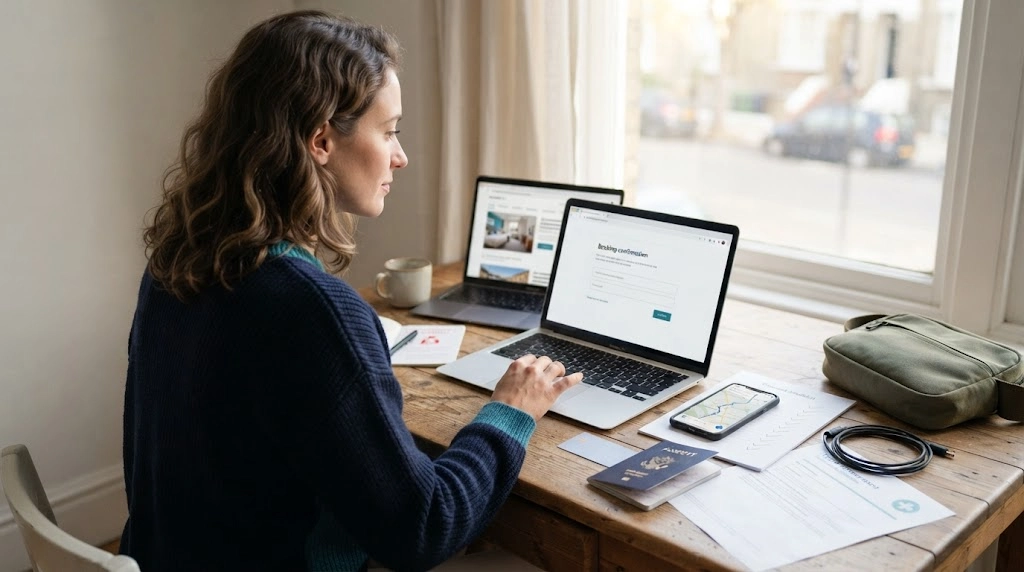
Before entering your card details, run one final safety check across your accommodation, arrival, health preparation, local rules, and backup options.
My pre-booking safety checklist
- Travel advisory checked: I understand the current advisory and any regional warnings.
- Neighborhood checked: I’ve researched the blocks around my accommodation.
- Recent reviews checked: I’ve searched for recurring comments about solo women, night walking, transport, and scams.
- Arrival route planned: I know how I’ll reach the accommodation at my scheduled arrival time.
- Backup transport found: I have another option if the original transfer fails.
- Health guidance checked: I’ve reviewed destination-specific vaccine, medicine, and health recommendations.
- Local laws checked: I understand important rules involving clothing, alcohol, medication, photography, or public behavior.
- Phone access planned: I know how I’ll get mobile data or Wi-Fi after arrival.
- Emergency help identified: I’ve saved local emergency numbers and relevant embassy or consular information.
- Booking terms checked: I know whether I can cancel or change accommodation if circumstances change.
Red flags that make me research further
A warning isn’t always a reason to cancel. It is a reason to understand the situation before committing money.
- Several recent reports describe the same harassment or scam.
- My hotel requires a long isolated walk after dark.
- Late-night transport information is unclear.
- Official guidance identifies the exact region on my itinerary.
- The cheapest flight arrives when normal transportation has stopped.
- Recent political demonstrations affect areas I plan to visit.
- I can’t identify a practical backup accommodation or transfer.
If a concern has an easy solution, I change the plan. I might choose another neighborhood, book an earlier flight, arrange an airport transfer, or shorten a remote section.
If I can’t explain how I’ll reduce an important risk, I keep researching before paying. That simple rule prevents price and excitement from making the decision for me.
Pro tip: Recheck official guidance close to departure even after you’ve booked. Safety conditions, demonstrations, health notices, and transportation disruptions can change.
Section Takeaway: A good booking decision doesn’t require zero risk. It requires understanding the relevant risks, reducing the ones you can control, and having a backup plan.
Frequently Asked Questions
How can I tell if a destination is safe for solo female travelers?
Check official travel advisories, neighborhood information, transport options, local laws, accommodation reviews, and recent reports from women travelers. Avoid relying on a single safety ranking because conditions can differ significantly between neighborhoods and travel styles.
Are government travel advisories enough for planning a solo trip?
No. Government advisories are useful for major risks and local laws, but they may not explain everyday details around your hotel. Combine them with official local information, transport research, recent accommodation reviews, and current traveler experiences.
How far in advance should I research destination safety?
Start before booking so safety information can influence your flight, neighborhood, and accommodation choices. Check again shortly before departure because advisories, demonstrations, transport schedules, entry requirements, and public-health conditions can change.
Should I trust Reddit, Facebook groups, or TikTok for solo travel safety advice?
Use them to discover practical questions and recurring experiences, not as your only safety source. Prioritize recent and detailed posts, look for repeated patterns, and verify important claims with official or authoritative sources.
What should a solo female traveler research about a hotel?
Check recent reviews, reception hours, neighborhood location, transport access, night walking routes, room security, luggage storage, and late-arrival procedures. Search reviews specifically for comments from solo travelers and women when available.
Is staying in the cheapest neighborhood a bad idea when traveling alone?
Not automatically. Compare the savings with extra transport costs, late-night travel, long walks, and limited nearby services. A slightly more expensive central property can sometimes reduce daily transportation and make your itinerary simpler.
What is the most important safety step before a first solo trip?
Know exactly how you’ll reach your accommodation after arriving. Research the route, identify reputable transportation, save the address offline, and have a backup option if your flight or train arrives later than expected.
Research the Trip You Will Actually Take
Don’t try to prove that a destination is completely safe. No honest research process can promise that.
Instead, research the trip you’ll actually take: your neighborhood, arrival time, transport, accommodation, activities, local norms, health needs, and backup plans.
- Start with official sources.
- Narrow your research to your specific itinerary.
- Look for repeated patterns in recent reviews.
- Plan both arrival and late-night transportation.
- Know your emergency and backup options.
- Recheck important information before departure.
That process gives you something far more useful than a generic safety score. It gives you enough context to make your own informed booking decision with fewer surprises.