How Can a Woman Research Emergency Services Before Visiting a Destination?
Quick Answer
Before visiting a destination, a woman should research the local police, ambulance, fire, hospital, embassy or consulate, and emergency communication options. Verify numbers through official government sources, save them offline, identify nearby medical facilities, and check your travel insurance before departure. For international trips, start with the U.S. State Department travel information or your own government’s equivalent.
Research These Before You Leave
- Emergency numbers: Confirm the correct numbers for police, ambulance, and fire services.
- Nearby hospitals: Save at least one suitable medical facility near your accommodation.
- Embassy help: Record contact details for your embassy or consulate when traveling internationally.
- Insurance assistance: Save your insurer’s emergency and medical-assistance numbers.
- Offline access: Store important numbers and addresses somewhere that does not depend on mobile data.
- Local limitations: Research whether emergency response, English support, or medical care varies outside major cities.
One Extra Step
- Recheck essential details shortly before departure because emergency guidance and local conditions can change.
When I research a new destination alone, I don’t stop after checking whether the neighborhood looks safe. I want to know exactly who I would contact if I became sick, lost my passport, felt threatened, or needed help getting somewhere safe.
That preparation takes less time than most travelers expect. It also makes unfamiliar destinations feel much easier to manage.
As of 2026, I treat emergency-service research as a normal part of solo female travel safety. The goal isn’t to expect trouble; it’s to remove guesswork if something goes wrong.
In This Guide
- What Emergency Services Should You Research Before a Trip?
- Where Can You Find Reliable Local Emergency Numbers?
- How Should You Research Hospitals and Medical Care?
- When Can an Embassy or Consulate Help?
- How Should You Save Emergency Information?
- What Should Be on Your Pre-Trip Emergency Checklist?
- Frequently Asked Questions
What Emergency Services Should You Research Before a Trip?

You should research the services that would help with the most likely urgent situations: police, ambulance, fire response, medical care, consular assistance, and travel-insurance support.
I divide this research into six simple categories.
- Police: For crime, threats, theft, stalking, harassment, or immediate personal danger.
- Ambulance: For serious illness, injury, or another medical emergency requiring rapid care.
- Fire and rescue: For fires, building emergencies, crashes, or rescue situations.
- Hospitals and clinics: For medical problems that need treatment but may not require emergency transport.
- Embassy or consulate: For certain passport problems, arrests, serious crises, or assistance locating appropriate local resources.
- Travel insurer: For help coordinating covered medical treatment, payment procedures, or evacuation benefits when included in your policy.
An emergency-service plan is simply a short list of verified contacts, locations, and backup options you can reach quickly during a problem.
It doesn’t need to become a giant travel document. Mine usually fits on one phone note plus an offline copy.
Research problems that matter specifically when you’re alone
Traveling alone changes one practical detail: there may be nobody beside you to make calls or search for help while you’re dealing with a problem.
That makes preparation more useful.
- Know how you would contact police if you felt followed or threatened.
- Know which hospital you would use if you became ill at night.
- Know how to contact your accommodation’s front desk or security team.
- Know who could help if your passport disappeared.
- Know how your insurer wants you to handle emergency treatment.
- Know how you would communicate if your normal mobile connection failed.
Pro tip: Verify destination-specific safety information through an official government travel advisory shortly before departure. Conditions and emergency procedures can change.
Section Takeaway: Research the contacts that would solve real problems, not every imaginable disaster. Police, medical care, consular support, insurance, and communication backups cover most situations worth preparing for.
Where Can You Find Reliable Local Emergency Numbers?
Use official government or emergency-service sources whenever possible. Don’t rely on an old blog post, social media graphic, or an unverified search-result snippet for a number you may need urgently.
Emergency numbers are not universal.
Check more than one trusted source
I normally verify an important number against two reliable sources before saving it.
- The destination’s official government website
- The national or municipal police website
- The official ambulance, health ministry, or fire-service website
- Your government’s destination travel advisory
- Your embassy or consulate’s official website
- Your hotel or accommodation, especially for local procedures
The U.S. Department of State publishes destination-specific information for U.S. travelers and explains how Americans can seek emergency assistance abroad.
If you’re not American, use your own foreign ministry’s travel-advice service first. Your embassy’s role and emergency contact process may differ.
Don’t assume one number reaches every service
Some countries use a single emergency number. Others maintain separate numbers for police, ambulance, or fire services.
Local coverage can also differ between cities and rural areas.
| What to Research | Best Source | What to Save |
|---|---|---|
| Police | Government or police website | Emergency number and non-emergency option |
| Ambulance | Health ministry or emergency service | Number and any access instructions |
| Hospital | Hospital’s official website | Name, address, phone, and route |
| Embassy | Foreign ministry or embassy website | Main and after-hours contacts |
| Insurance | Your policy or insurer app | Assistance number and policy number |
Section Takeaway: Treat emergency numbers like flight times—verify them rather than assuming. Save the source along with the number so you know where the information came from.
How Should You Research Hospitals and Medical Care?
Choose at least one medical facility near where you’ll stay and understand what your insurance expects you to do if you need treatment.
I do this before departure rather than searching while sick.
Identify the right type of facility
A nearby clinic can be useful for minor problems. A larger hospital may be more appropriate for serious injuries, complex treatment, or emergencies.
Check these details:
- Distance from your accommodation
- Opening hours
- Emergency department availability
- Languages offered, if listed
- Payment expectations
- Whether your insurer recommends specific facilities
- How you would reach the facility at night
The CDC Travelers’ Health section is also useful for destination-specific health preparation before international travel.
Understand your insurance before you need it
Medical coverage abroad varies widely between policies. Read your own policy instead of assuming ordinary domestic coverage applies.
- Save your policy number.
- Save the 24-hour assistance number.
- Check whether preauthorization may be required.
- Review emergency medical coverage.
- Review medical evacuation coverage if included.
- Know whether you may need to pay first and claim reimbursement later.
I also keep essential medical information in an easy-to-find place. That may include medication names, allergies, and an emergency contact.
Pro tip: For health risks, vaccines, or destination-specific medical guidance, check official health authorities such as the CDC or your country’s equivalent rather than relying only on travel forums.
When Can an Embassy or Consulate Help?
Your embassy or consulate can be an important backup during a serious problem abroad, but it does not replace local police, ambulance, or medical services.
Local emergency services usually remain the first contact for immediate danger.
Save consular details before departure
Find your nearest embassy or consulate and record its contact information.
- Main telephone number
- After-hours emergency number, if provided
- Address
- Official website
- Instructions for emergencies
For U.S. citizens, the State Department says travelers needing emergency assistance abroad can contact the nearest U.S. embassy or consulate. It also publishes central emergency contact options for situations where travelers cannot reach the local post.
The State Department also operates the Smart Traveler Enrollment Program, commonly called STEP. U.S. citizens can use it to receive security information and help embassies contact them during certain emergencies.
Know what consular help cannot replace
An embassy isn’t a private security service or medical provider. Its exact abilities depend on your nationality, location, local law, and the situation.
That is why I save both local emergency contacts and consular contacts rather than treating them as interchangeable.
Section Takeaway: Local emergency services handle immediate local emergencies. Your embassy or consulate is a separate backup resource for eligible consular assistance and serious problems abroad.
How Should You Save Emergency Information?
Store emergency information in at least two places. One should work without internet access.
A phone-only plan is fragile if your battery dies, your device is lost, or mobile data stops working.
Create a small offline emergency card
I keep the list short enough to scan in seconds.
- Local emergency number or numbers
- Nearest suitable hospital
- Accommodation name, address, and telephone number
- Embassy or consulate contact
- Travel-insurance assistance number
- Policy number
- One trusted personal contact
I save one digital version and keep another copy away from my main phone. A printed card in a wallet or luggage pocket can work well.
Save locations, not just telephone numbers
Knowing a hospital’s name isn’t enough if you’re stressed and cannot find it.
- Save the hospital in your map app.
- Download the surrounding map for offline use when possible.
- Save your accommodation’s full written address.
- Keep addresses in the local language when useful.
- Take a screenshot of important directions.
I also share my broad itinerary and accommodation information with one trusted person. That person doesn’t need constant updates, but they should know where I’m supposed to be.
What Should Be on Your Pre-Trip Emergency Checklist?
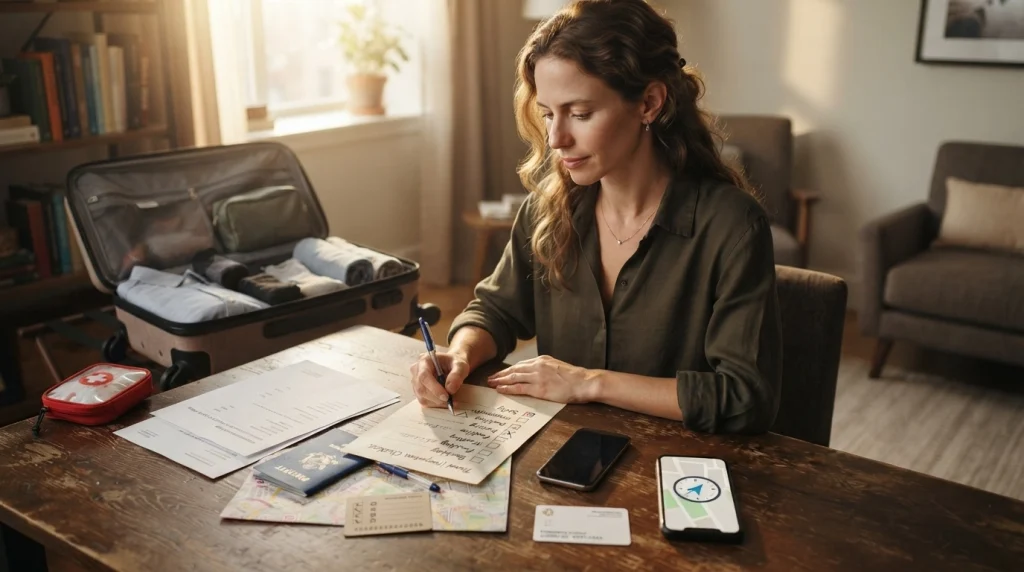
Your checklist should answer one practical question: if something happened tonight, could you find the right help without starting your research from zero?
If the answer is yes, you’ve probably done enough.
- Check the current travel advisory. Review official destination information shortly before the trip.
- Verify local emergency numbers. Save police, ambulance, and fire information as appropriate.
- Find a hospital. Identify at least one suitable facility near your accommodation.
- Check insurance. Save your policy and assistance details.
- Find your embassy or consulate. Record normal and emergency contacts.
- Save your accommodation. Keep its address and telephone number offline.
- Download maps. Make key locations accessible without mobile data.
- Create a backup copy. Keep emergency details somewhere besides your main phone.
- Share basic plans. Give a trusted person enough information to know where you’re staying.
- Recheck before departure. Confirm that important information hasn’t changed.
I usually do this final review about one or two days before an international trip. It takes only a few minutes once the main research is finished.
The biggest benefit is mental space. I can spend the trip exploring instead of wondering what I would do if I needed help.
Section Takeaway: Good emergency preparation is short, verified, and accessible offline. You don’t need a complicated crisis manual—you need the right information when seconds and clear thinking matter.
Frequently Asked Questions
Should a solo female traveler save the local police number before traveling?
Yes. Save the verified local police or general emergency number before departure. If the destination uses separate emergency numbers, record the relevant police, ambulance, and fire contacts rather than assuming one universal number works everywhere.
How can I verify an emergency number for another country?
Start with the destination government’s official website, your government’s travel advisory, or official police and emergency-service pages. When a number is important, confirm it with a second reliable source and avoid depending on an old travel blog or social media post.
Should I research hospitals even if I have travel insurance?
Yes. Insurance and medical facilities solve different problems. Your policy may help with eligible costs or coordination, but you should still know where an appropriate hospital is and how you would reach it from your accommodation.
Can my embassy send police or an ambulance for me?
Embassies and consulates provide consular assistance, but they don’t replace local emergency services. If you’re in immediate danger or need urgent medical help, local police or emergency medical services are generally the appropriate first contact.
What emergency information should I keep offline?
Keep local emergency numbers, your accommodation address, a nearby hospital, insurance assistance details, embassy information, and one trusted personal contact offline. A screenshot, saved note, downloaded map, or printed card can provide useful backup access.
How often should I update my emergency research?
Check the information when planning the trip and verify critical details again shortly before departure. Recheck during a longer trip if local conditions, transportation, accommodation, health guidance, or official travel advice changes.
Is emergency planning necessary for destinations considered safe?
Yes. Emergency research isn’t only about crime. Travelers can experience illness, injury, lost documents, transport problems, severe weather, or communication failures in destinations with otherwise low perceived risk.
Prepare for Emergencies Without Letting Them Define Your Trip
Researching emergency services is one of those travel tasks I hope I never need to use. I still do it before every unfamiliar international destination.
Knowing the local emergency numbers, nearest appropriate hospital, insurance contact, and consular backup removes several decisions from a stressful moment.
- Verify rather than assume.
- Use official sources.
- Keep the list short.
- Store a copy offline.
- Recheck important details before leaving.
Once that’s done, put the list away and enjoy your trip. Preparation should give you more freedom to travel confidently, not make you spend the journey expecting something to go wrong.