How Can a Woman Research Dress Expectations Before Solo Travel?
Quick Answer
A woman can research dress expectations before solo travel by checking official travel guidance, local laws, tourism information, recent photos, accommodation advice, and comments from women who live in or recently visited the destination. Start with the U.S. State Department guidance for women travelers, then compare official information with current local examples before packing.
Research dress expectations in this order
- Check local laws: Find out whether clothing rules are legal requirements or simply social expectations.
- Read official advice: Look for destination-specific sections covering women travelers, religion, customs, and public behavior.
- Study local photos: Notice what women wear in ordinary streets, public transport, markets, and restaurants.
- Separate situations: Beachwear, sightseeing clothes, religious-site clothing, and evening outfits may follow different expectations.
- Confirm recent information: Use current sources because rules, social expectations, and enforcement can change.
- Pack flexible layers: A light overshirt, scarf, or longer layer can solve many unexpected dress-code problems.
One rule I use
- I never rely on one influencer’s outfit photo as proof of what is appropriate across an entire destination.
If you’re wondering how can a woman research dress expectations before solo travel, start earlier than the night before packing. Clothing can affect comfort, cultural respect, access to religious sites, and how confidently you move through unfamiliar surroundings.
I treat dress research like transportation research. I want enough information to make sensible choices without spending my entire trip worrying about whether my clothes are “right.”
In This Guide
- What Do Dress Expectations Mean for a Woman Traveling Alone?
- Where Should a Woman Research Local Dress Expectations?
- How Can You Tell Whether Dress Advice Is Reliable?
- What Should You Pack When Dress Expectations Are Unclear?
- How Should You Adapt Your Clothing After Arrival?
- Frequently Asked Questions
- What Is the Simplest Dress-Research Strategy?
What Do Dress Expectations Mean for a Woman Traveling Alone?
Dress expectations are the legal, religious, cultural, and social standards that influence what people commonly wear in a destination. They are not always the same thing as a formal dress code.
Definition: Travel dress expectations are the local rules and social norms that shape what clothing is considered acceptable, respectful, practical, or appropriate in a particular setting.
That distinction matters. A sleeveless top might be legal on a city street but inappropriate inside a religious building.
A swimsuit may be ordinary at a resort beach yet inappropriate several streets inland. Evening clothing may also differ from what locals usually wear during daytime errands.
Separate legal rules from cultural preferences
Your first job is to learn whether a clothing expectation has legal consequences. Government travel guidance often includes a section covering local laws and customs.
The U.S. State Department notes that destinations can have different expectations concerning women’s clothing and appearance. Its guidance recommends checking destination-specific local laws and customs before traveling.
- Legal requirement: A rule backed by local law or regulation.
- Religious-site requirement: Clothing required to enter a mosque, temple, church, shrine, or other sacred space.
- Strong cultural norm: Clothing may be legal but attract unwanted attention or cause offence.
- Personal style norm: Locals commonly dress one way, but visitors have broad flexibility.
- Activity requirement: An attraction, restaurant, club, trek, or tour may impose its own clothing rules.
Research the setting, not only the country
Country-wide advice can be too broad. Expectations may change between major cities, rural communities, resorts, religious areas, beaches, and nightlife districts.
I therefore research what I plan to do each day. My clothing question becomes more specific than, “What do women wear in this country?”
- What do women commonly wear while sightseeing?
- Are shoulders or knees normally covered in religious buildings?
- What is typical on public transport?
- Does a beach town have different expectations away from the beach?
- Are upscale restaurants noticeably more formal?
- Does the destination become more conservative during religious periods or festivals?
Section Takeaway: Research clothing by situation as well as destination. Something appropriate at a beach, resort, or nightclub may not work at a religious site or in a conservative residential neighborhood.
Where Should a Woman Research Local Dress Expectations?

Use several source types instead of trusting one blog, social video, or packing list. I begin with official information and then use local visual evidence to understand what the written advice looks like in everyday life.
1. Start with official government travel guidance
Government travel pages are useful for separating laws and significant cultural concerns from casual style advice. Check the section titled “Local Laws and Customs,” “Women Travelers,” or something similar.
The U.S. State Department’s laws abroad guidance reminds travelers that local laws apply even when they differ from laws at home. That makes official sources especially important when clothing rules could have legal consequences.
You can also compare destination guidance from the UK government’s foreign travel advice. Look at the local laws and cultural differences section for the specific country you’re researching.
2. Check the destination’s tourism authority
Official tourism boards often explain etiquette in a softer, more practical way. Search the destination’s official tourism site for terms such as “etiquette,” “local customs,” “what to wear,” “religious sites,” and “visitor information.”
Be careful with search results. Confirm that you are using the actual national, regional, or city tourism authority rather than a commercial website with a similar name.
3. Look at recent everyday photos
Photos can show details that written dress advice misses. I focus on ordinary locations rather than resort advertising or highly styled travel photography.
- Busy shopping streets
- Metro and railway stations
- Local cafés
- Markets
- Public parks
- Museums
- University districts
- Religious neighborhoods
Look for patterns across many people. One woman’s outfit tells you almost nothing about what is typical.
4. Ask accommodation staff specific questions
Hotel and hostel staff can be useful because they answer visitor questions every day. Avoid asking only, “Can I wear shorts?”
Specific questions get better answers:
- “Would knee-length shorts look unusual around this neighborhood?”
- “Do I need covered shoulders at the places I’m visiting tomorrow?”
- “Is this restaurant casual or should I bring something smarter?”
- “Would you recommend carrying a scarf for the religious sites?”
- “Do clothing expectations change outside the tourist center?”
5. Use recent traveler experiences as supporting evidence
Forums, travel communities, and social platforms can reveal current everyday experiences. I use them after official sources, not instead of official sources.
Always check when the information was posted. A detailed answer from 2018 may be less useful than a current official page or several recent firsthand reports.
| Source | Best For | Main Limitation |
|---|---|---|
| Government travel advice | Laws, significant customs, official cautions | May not describe everyday fashion in detail |
| Official tourism authority | Visitor etiquette and attraction rules | May simplify differences within a destination |
| Recent street photos | Seeing common clothing in real settings | A photo cannot explain laws or context |
| Accommodation staff | Neighborhood-specific questions | Advice reflects one person’s experience |
| Recent traveler communities | Practical experiences and current observations | Opinions can conflict or lack context |
Pro tip: Recheck official destination advice shortly before departure. Laws, security conditions, religious events, and local guidance can change after you originally book the trip.
Section Takeaway: Use official sources to establish the rules, then use recent local evidence to understand everyday practice. The combination is much more useful than either source alone.
How Can You Tell Whether Dress Advice Is Reliable?
Reliable dress advice tells you where, when, and why a clothing expectation applies. Be skeptical of sweeping statements such as “women must always cover up” or “tourists can wear anything.”
Use the three-source check
Before changing my entire packing list, I try to confirm an important dress expectation through three different signals. This takes only a few minutes once you know what to search.
- Official source: Check government or tourism guidance for laws and formal expectations.
- Current visual source: Look at recent photos or videos showing ordinary public areas.
- Local or recent practical source: Check recent visitor reports or ask your accommodation.
If all three point in the same direction, packing becomes simple. If they conflict, I choose the more flexible and conservative clothing option until I can confirm locally.
Watch for vague language
Words such as “modest” can mean different things in different places. Try to translate vague advice into specific clothing choices.
- Do shoulders need covering?
- Are upper arms usually covered?
- Should skirts or shorts reach the knee?
- Are leggings normal without a long top?
- Is cleavage uncommon?
- Is a head covering required anywhere?
- Are sandals acceptable?
Check whether advice applies to locals, tourists, or religious sites
A common research mistake is taking a rule for one location and applying it everywhere. Religious buildings often have stricter clothing requirements than surrounding streets.
Tourist resorts may work in the opposite direction. Clothing that looks ordinary inside the resort may stand out immediately in a nearby residential area.
Check the publication date
As of 2026, I strongly prefer current official guidance and recent local examples. Social expectations can evolve, while temporary events can also make dress more sensitive for a limited period.
Season matters too. Clothing patterns during intense summer heat can look different from winter, even when the underlying cultural expectation stays the same.
Section Takeaway: Reliable advice is specific about location, context, and timing. Cross-check important claims instead of treating one viral post as a destination-wide rule.
What Should You Pack When Dress Expectations Are Unclear?
When you’re uncertain, pack clothes that can become more or less covered without requiring a complete outfit change. Flexible layers are more useful than filling your bag with clothing you would never normally wear.
Build a simple adaptable outfit system
- Light overshirt: Covers shoulders and arms without adding much weight.
- Large lightweight scarf: Useful when extra coverage is appropriate, where permitted.
- Loose trousers: Comfortable for transport and useful in more conservative settings.
- Midi or maxi skirt: Provides another warm-weather option when shorts feel unsuitable.
- Higher-neckline top: Easy to combine with trousers or skirts.
- Comfortable walking shoes: Useful regardless of cultural dress expectations.
I also choose fabrics based on weather. Covering more skin in a hot climate feels far easier in breathable clothing than in heavy denim or thick synthetic fabric.
Plan outfits by activity
| Situation | Research Before Packing | Flexible Option |
|---|---|---|
| Everyday sightseeing | Common street clothing and weather | Breathable top with trousers or longer skirt |
| Religious sites | Shoulder, knee, head, and footwear rules | Long layer plus appropriate covering if required |
| Beach or pool | Swimwear rules inside and outside beach areas | Swimwear with an easy cover-up |
| Restaurants | Venue formality and footwear expectations | One simple outfit that can look smarter with accessories |
| Rural day trip | Whether norms differ outside tourist centers | More coverage with lightweight layers |
Don’t pack from fear
Researching local culture should help you make informed choices, not make you frightened of getting dressed. Many destinations give visitors considerable flexibility.
The goal is to understand the context before arriving. Once you know the stricter situations, you can pack for those without redesigning your entire wardrobe.
Pro tip: For destination-specific rules, check the latest official travel advice again before departure rather than relying on a packing article saved months earlier.
How Should You Adapt Your Clothing After Arrival?
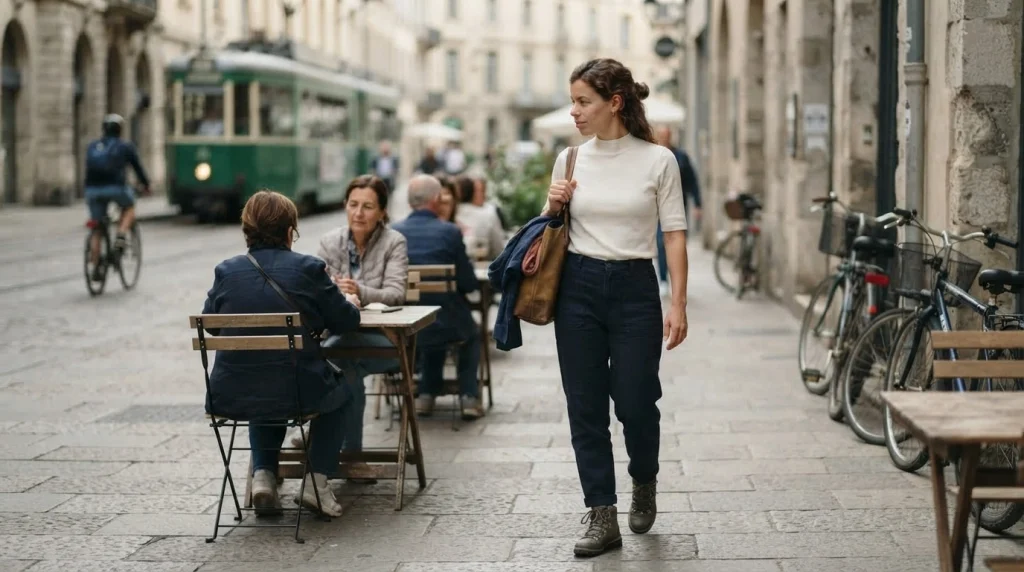
Once you arrive, compare your research with what you observe around you. Pay attention to women of a similar age in ordinary situations rather than copying tourists at major attractions.
Observe before changing everything
I usually learn more during my first walk to a café or supermarket than from an hour of scrolling staged travel photos. Everyday clothing gives useful context quickly.
Look at several settings before drawing conclusions:
- Public transport
- Shopping streets
- Residential areas
- Cafés and casual restaurants
- Business districts
- Tourist attractions
Ask when a specific situation is unclear
If you’re visiting a religious building or community with unfamiliar customs, ask someone responsible for that place. Entrance staff, guides, hotel staff, or tour operators can usually explain what visitors should wear.
Keep a flexible layer in your day bag when appropriate. That allows you to adapt without returning to your accommodation halfway through the day.
Comfort still matters
Respecting local expectations does not mean wearing something that makes walking, heat management, or movement difficult. Aim for clothing that fits both the local context and the practical demands of your trip.
My favorite travel outfits are rarely dramatic. They’re the ones I can walk in for hours, use on public transport, and adjust with one extra layer.
Section Takeaway: Your research gives you a starting point, but observation gives you local context. Stay flexible rather than trying to create a perfect wardrobe before departure.
Frequently Asked Questions
How far in advance should I research dress expectations?
Start while planning your trip so you know whether you need any specific clothing. Recheck official information during the final week before departure, especially when religious events, legal rules, or changing local conditions could affect visitors.
Can I use Instagram or TikTok to research what women wear?
Yes, but use social media as visual supporting evidence rather than your only source. Resort content, influencers, and tourists may dress differently from local women, so compare several recent posts with official destination guidance.
Do female tourists need to dress exactly like local women?
Usually, no. The useful goal is understanding legal requirements, religious-site rules, and strong cultural expectations rather than trying to imitate local fashion perfectly.
Should I dress more conservatively because I’m traveling alone?
Solo travel does not automatically create a separate dress code. Research the actual destination and situation, then choose clothing that helps you feel comfortable, respectful, and able to move confidently through the places you plan to visit.
How do I know what “modest dress” means in a specific country?
Look for concrete explanations instead of relying on the word “modest.” Check whether guidance mentions shoulders, knees, cleavage, tight clothing, head coverings, swimwear, or specific rules for religious sites.
What if different websites give conflicting dress advice?
Give more weight to current government guidance and official local sources for legal requirements. For everyday customs, compare recent photos, accommodation advice, tourism information, and several recent traveler experiences before deciding.
Should I buy special clothes before every solo trip?
Usually not. A few adaptable pieces such as loose trousers, a lightweight overshirt, a longer skirt, and a scarf can often cover different situations without creating an entirely separate travel wardrobe.
What Is the Simplest Dress-Research Strategy?
Start with official local-law and women-traveler guidance, then check tourism information and recent everyday photos. Finally, confirm any unclear situations with your accommodation or another reliable local source.
Research the places you’ll actually visit rather than trying to find one universal outfit for an entire country. A religious site, beach, rural town, restaurant, and nightlife district can each have different expectations.
- First: Identify legal requirements.
- Second: Learn major cultural and religious expectations.
- Third: Look at recent everyday clothing.
- Fourth: Pack flexible layers.
- Fifth: Observe and adjust after arrival.
Good dress research should make solo travel easier, not more intimidating. Give yourself enough information to arrive prepared, then leave room to learn from the destination once you’re there.
Before your next trip, spend 20 minutes checking the official rules and the places on your itinerary. That small bit of research can remove a surprising amount of uncertainty from packing and your first day alone.