How Can a Woman Know If She Is Ready to Travel Alone?
Quick Answer
A woman is usually ready to travel alone when she can make everyday decisions independently, manage basic trip logistics, protect her boundaries, and solve small problems without immediately needing someone else. You do not need to feel fearless. You need enough preparation and self-trust to act when something changes, while using reliable resources such as the U.S. State Department guidance for women travelers when researching your destination.
Signs You May Be Ready
- You make decisions: You can choose transport, accommodation, meals, and daily plans without needing constant reassurance.
- You solve problems: A delayed train or wrong turn feels inconvenient rather than impossible.
- You set boundaries: You can say no, leave uncomfortable situations, and put safety before politeness.
- You plan basics: You know where you will sleep, how you will arrive, and how much money you can spend.
- You tolerate solitude: Eating alone or spending several hours by yourself does not ruin the experience.
- You have backup plans: You know who to contact and what you would do if your original plan failed.
Still Unsure?
- Try a solo day trip or one-night stay close to home before committing to a longer journey.
If you are asking, “How can a woman know if she is ready to travel alone?” you are probably balancing excitement with a long list of doubts. That is normal for a first solo trip.
I do not measure solo travel readiness by whether someone feels nervous. I look at how she handles decisions, uncertainty, money, safety, loneliness, and changing plans.
In This Guide
- What Does Being Ready to Travel Alone Actually Mean?
- Can You Handle the Practical Side of a Solo Trip?
- Are You Emotionally Ready to Travel Alone?
- Are Your Safety and Decision-Making Skills Ready?
- How Can You Test Whether You Are Ready?
- What Signs Mean You Should Wait or Change the Trip?
- Frequently Asked Questions
What Does Being Ready to Travel Alone Actually Mean?
Being ready for solo travel means having enough independence, planning ability, and judgment to manage a trip without depending on a companion. It does not mean eliminating fear.
Some nervousness can remain even after years of travel. The important question is whether nervousness stops you from thinking clearly.
Definition: Solo female travel is independent travel in which a woman is responsible for her own itinerary, transport, accommodation, budget, daily decisions, and personal safety rather than relying on a travel companion.
Readiness is not the same as confidence
You might feel confident because you are excited. That does not automatically mean you are prepared.
You might also feel anxious while being completely capable. I pay more attention to behavior than emotion.
- Confidence says: “I think I can do this.”
- Readiness says: “I know what I will do if something goes wrong.”
- Preparation says: “I have already reduced the problems I can reasonably predict.”
A useful readiness test is to imagine your flight being delayed, your phone battery reaching 5%, or your hotel booking being wrong. Would you freeze, or would you begin looking for alternatives?
You do not have to become fearless first
Fear can be useful when it makes you check transportation, accommodation, local customs, or your arrival route. It becomes less useful when it convinces you that uncertainty itself means you are unprepared.
I prefer a simple standard: you should be able to feel nervous and still make sensible decisions.
Section Takeaway: Solo travel readiness is not a feeling of perfect confidence. It is the ability to act thoughtfully even when you feel uncertain.
Can You Handle the Practical Side of a Solo Trip?

You are much closer to being ready when you can organize the basic mechanics of a trip without someone managing them for you. These skills are learnable.
Before booking, see whether you can independently complete the following tasks.
- Compare several accommodation options and evaluate their locations.
- Plan transportation between the airport or station and your accommodation.
- Create a simple solo trip itinerary without scheduling every hour.
- Estimate food, transportation, accommodation, activity, and emergency costs.
- Use offline maps or save important locations before leaving Wi-Fi.
- Keep copies of essential travel documents in separate places.
- Research entry rules, local laws, cultural expectations, and common travel problems.
- Identify an emergency contact and arrange check-ins with someone at home.
Can you manage your own money?
Money independence matters because there may be nobody beside you to solve a payment problem. You should understand your daily spending limit and emergency reserve.
I like to separate normal spending money from backup money. Losing one wallet should not leave me without access to funds.
- Daily budget: Covers planned meals, transport, activities, and small purchases.
- Emergency buffer: Covers an unexpected room, replacement transport, or another urgent expense.
- Backup payment: Keep another usable card or payment option separate from your main wallet.
Can you plan your first and last mile?
The first hour after arrival deserves more attention than many travelers give it. You may be tired, carrying luggage, and unfamiliar with the area.
Know how you are getting from your arrival point to your accommodation before leaving home. The UK government’s solo and independent travel guidance also emphasizes destination research, transport planning, accommodation preparation, and leaving itinerary details with someone at home.
Pro tip: Check current official travel advice for your destination shortly before departure because transport disruptions, entry rules, and local conditions can change.
Section Takeaway: If you can independently manage accommodation, transport, money, documents, communication, and a backup plan, you already have many of the practical skills solo travel requires.
Are You Emotionally Ready to Travel Alone?
Emotional readiness means being comfortable enough with your own company that solitude does not automatically feel like failure. You do not need to enjoy being alone every minute.
Solo trips contain quiet periods. There may be nobody beside you at breakfast, on a train, or during an evening walk through a busy area.
How comfortable are you doing ordinary things alone?
Before taking a major trip, test yourself at home. Small experiments reveal more than imagining your future confidence.
- Eat lunch alone in a restaurant.
- Spend two hours exploring an unfamiliar neighborhood.
- Visit a museum or attraction without a companion.
- Take public transportation somewhere new by yourself.
- Attend an event alone and decide when you want to leave.
- Spend most of a day without relying on constant messages from friends.
If those activities feel unusual but manageable, that is encouraging. Feeling awkward is not the same as being unable to cope.
Can you manage travel anxiety without letting it control the trip?
Useful travel anxiety tips focus on turning vague worries into specific problems. A specific concern usually has a possible response.
- “What if I get lost?” Download offline maps and save your accommodation.
- “What if I feel lonely?” Choose social accommodation, tours, classes, or hostel events.
- “What if my family worries?” Agree on a check-in schedule before departure.
- “What if I panic?” Build a lighter itinerary and give yourself permission to return to your accommodation.
Female-friendly hostels and organized activities can help first-time travelers add social contact without giving up independence. You can also explore travel communities such as Women Who Travel when looking for perspectives from other women travelers.
Can you enjoy your own version of the trip?
One benefit of solo travel is not having to negotiate every choice. You can leave a museum early, spend an hour in a café, or change tomorrow’s plans.
I think readiness grows when that freedom sounds interesting rather than frightening. You begin seeing being alone as flexibility, not isolation.
Section Takeaway: Emotional readiness does not require loving solitude. You should simply be able to spend meaningful time alone while managing occasional discomfort or loneliness.
Are Your Safety and Decision-Making Skills Ready?
Solo female travel safety depends partly on preparation and partly on decisions made during the trip. No checklist can remove every risk.
Your goal is to keep useful options available when circumstances change.
Can you say no without feeling guilty?
Strong boundaries matter when traveling alone. You may need to reject an invitation, decline help, change seats, cancel a ride, or leave somewhere unexpectedly.
You do not owe strangers information about where you are staying or whether you are alone. You also do not need a complicated explanation when something feels wrong.
- Leave if a situation makes you uncomfortable.
- Verify transportation before getting inside.
- Protect your room number and accommodation details.
- Avoid advertising your full itinerary to strangers.
- Keep enough phone battery or backup power for navigation and communication.
- Know how to contact local emergency services.
Do you research risk without becoming obsessed with it?
Good safety research looks at the specific destination instead of treating every city or country as equally risky. Check neighborhoods, transport norms, local laws, cultural expectations, and current official information.
Before an international trip, review the current U.S. State Department travel advisories or your own government’s equivalent.
Health preparation matters too. The CDC Travelers’ Health resource provides destination-related health information that can be checked before international travel.
Pro tip: Use official government or public-health sources for current safety and health requirements rather than relying only on social media posts or old forum discussions.
Can you change your plan quickly?
This is one of my strongest signs of readiness. Independent travel requires flexibility.
If an area feels uncomfortable, a hostel does not match expectations, or transport stops running, you should be willing to change the plan. The original itinerary is never more important than your wellbeing.
Section Takeaway: A prepared solo traveler knows how to verify information, protect personal details, set boundaries, and abandon a plan when conditions change.
How Can You Test Whether You Are Ready?
You do not need to make your first independent trip a two-week international adventure. Build solo travel confidence in stages.
I prefer progressive practice because it lets you discover weaknesses while the consequences remain small.
| Practice Level | Suggested Length | What It Tests | Good Next Step |
|---|---|---|---|
| Solo local outing | 4–8 hours | Navigation, eating alone, independent decisions | Plan your own day in a nearby area |
| One-night trip | 24–36 hours | Accommodation, packing, evening comfort, transport | Stay in a familiar or nearby city |
| Short solo trip | 2–4 days | Budgeting, itinerary pacing, loneliness, problem solving | Choose an easy-to-navigate destination |
| International solo trip | 4+ days | Entry rules, language differences, unfamiliar transport, cultural navigation | Choose complexity that matches your previous experience |
Try the 24-hour readiness test
Choose a nearby destination and plan one full day without delegating decisions. Treat it like a real trip.
- Choose your destination yourself.
- Set a realistic spending limit.
- Plan transportation in both directions.
- Navigate without asking a friend to guide you.
- Eat at least one meal alone.
- Handle one activity without company.
- Return home using your own plan.
- Write down what felt easy and what caused stress.
If the day was imperfect but manageable, that is useful evidence. You do not need everything to go smoothly.
The better question is whether you could recover when something did not go as expected.
Review the experience instead of scoring yourself
Solo travel readiness is not a scientific pass-or-fail test. Look for patterns.
- What decisions made you uncomfortable?
- Did you enjoy having control of your schedule?
- Did solitude feel peaceful, awkward, or overwhelming?
- Could you navigate without constant reassurance?
- What would make the next trip easier?
Section Takeaway: Practice close to home first if you are unsure. Small solo experiences give you better evidence of readiness than waiting for fear to disappear.
What Signs Mean You Should Wait or Change the Trip?
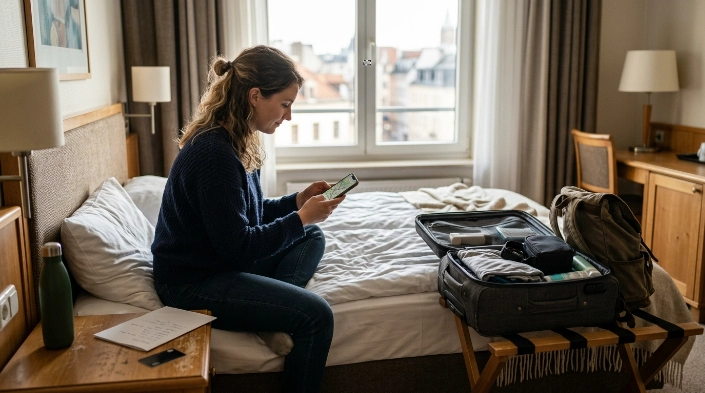
Sometimes the right answer is not “do not travel alone.” It is “choose a simpler version of the trip.”
Changing the destination, length, accommodation, or schedule can turn an overwhelming plan into a manageable one.
Consider slowing down if several of these are true
- You have never handled basic travel bookings yourself.
- You cannot access emergency money independently.
- You feel unable to say no to strangers or leave uncomfortable situations.
- You depend on another person for nearly every unfamiliar decision.
- You are booking the trip mainly because you feel pressured to prove something.
- The destination requires skills or experience you do not yet have.
- Your anxiety prevents you from sleeping, eating, planning, or thinking clearly.
- You do not have a realistic way to communicate with someone if plans change.
None of these automatically means solo travel is permanently unsuitable. They identify skills or conditions worth addressing first.
Make the trip easier instead of abandoning the idea
A first solo trip does not need to be dramatic. Reducing complexity is often the smartest choice.
- Stay two or three nights instead of ten.
- Choose one city instead of moving between several places.
- Arrive during daylight where practical.
- Book the first night’s accommodation before departure.
- Choose somewhere with straightforward public transportation.
- Join a walking tour or social activity during the first day.
- Give yourself free time instead of building an exhausting schedule.
My favorite first-trip itineraries leave room to change your mind. A flexible solo trip itinerary is easier to manage than a schedule where one delay ruins the entire day.
As of 2026, I still recommend checking official information close to departure rather than assuming advice from an older trip remains current.
Section Takeaway: If your current plan feels too difficult, reduce the difficulty rather than treating the whole idea of solo travel as a failure.
Frequently Asked Questions
Is it normal to be scared before traveling alone for the first time?
Yes. Nervousness does not automatically mean you are unprepared. Focus on whether you can make decisions despite the nerves, research your destination, create backup plans, manage your money, and ask for help when needed.
What age should a woman start traveling alone?
There is no single ideal age for every traveler. Legal requirements, maturity, financial independence, travel experience, destination difficulty, and personal judgment matter more than a universal number. Younger travelers should also verify accommodation and transportation age restrictions before booking.
Should my first solo trip be international?
It does not have to be. A nearby city or short domestic trip can teach the same basic skills with less complexity. Once navigation, accommodation, budgeting, and being alone feel manageable, international travel may feel much easier.
How do I know whether I will feel lonely traveling alone?
Test shorter periods of intentional solitude first. Take yourself to lunch, spend a day exploring alone, or book a one-night stay nearby. If you enjoy some independence but still want company, choose social accommodation, tours, classes, or group activities.
What is the most important solo female travel safety skill?
Good judgment is more useful than memorizing dozens of rules. Research before leaving, protect personal information, verify transport, keep communication available, notice changes around you, and be willing to leave whenever a situation makes you uncomfortable.
What if my family thinks I am not ready?
Listen to specific concerns rather than reacting to general fear. Show them your accommodation, transportation plan, emergency contacts, budget, and check-in schedule. Their worry does not make the decision for you, but useful concerns can reveal gaps worth fixing.
Can I travel alone if I am naturally anxious?
Many anxious people travel independently. What matters is whether your anxiety remains manageable enough for planning, sleeping, eating, navigating, and making decisions. Starting with a short, familiar trip can help you learn how you respond without creating unnecessary pressure.
You are ready to travel alone when you can replace “I hope nothing goes wrong” with “If something changes, I know what I can do next.”
You do not need perfect confidence, unlimited money, or years of travel experience. You need practical preparation, boundaries, enough independence, and a willingness to adapt.
If you are still unsure, make your first step smaller. Plan a solo afternoon, then an overnight stay, then a short trip.
Confidence often arrives after you start practicing independence, not before.