
How Can a Woman Use Public Transportation When She Does Not Speak the Language?
Quick Answer
A woman can use public transportation safely in a country where she does not speak the local language by planning her route, downloading offline maps and translations, saving destination names in the local script, and confirming stops visually. Choose reputable transport services, travel during daylight when practical, and keep a backup plan in case your phone or route fails. Language barriers are manageable when you prepare before boarding.
Essential steps for a smoother journey
- Plan your route: Save your departure station, transfer points, destination, and return journey before leaving.
- Prepare translation tools: Download the local language for offline translation and learn how to translate signs using your camera.
- Save key addresses: Keep your hotel address in the local script and as a screenshot.
- Use visual clues: Follow station names, route colors, platform numbers, and electronic displays.
- Ask for simple help: Show staff your destination on your phone rather than relying on spoken directions.
- Protect your safety: Keep your belongings close, stay in well-lit public areas, and choose a trusted alternative if a journey feels unsafe.
Before you leave
- Check current local transport advice, operating hours, ticket rules, and emergency numbers.
- Carry a little local currency and a written backup of your destination and essential contact details.
Traveling alone is challenging enough without worrying about an unfamiliar language. Yet a language barrier does not have to stop you from taking a train, finding a bus, or exploring a new city independently.
When planning solo trips, I focus on practical preparation rather than perfect language skills. This guide explains how to navigate public transportation, communicate with locals, handle mistakes, and make safer decisions as a woman traveling alone in 2026.
In This Guide
- How should you prepare before using public transportation?
- Which public transportation options are easiest without the language?
- How can you navigate stations, tickets, and transfers?
- How can you communicate when you do not speak the local language?
- How can you stay safe as a solo female traveler?
- What should you do if you miss a stop or get lost?
- Frequently asked questions
How should you prepare before using public transportation?

The easiest way to manage a language barrier is to solve as many questions as possible before you reach the station. You do not need to memorize an entire language or understand every announcement.
Download maps and translation tools
Install a navigation app and a translation app before departure. Download the destination area’s map and the local language pack when offline features are available.
This matters when you enter an underground station with weak reception, run out of mobile data, or discover that the station’s Wi-Fi requires a local phone number.
- Offline maps: Save your hotel, the nearest major station, and the places you plan to visit.
- Offline translation: Download the language and test typed translations before you leave your accommodation.
- Camera translation: Practice translating signs, ticket machines, and printed instructions.
- Route planning: Check official transit websites or apps for current routes, service changes, and ticket rules.
Offline tools have limits. Live traffic, updated departure times, and some translation features may still require an internet connection.
Save the information you may need to show someone
Prepare a small collection of screenshots that you can open without searching through your messages. Include your accommodation address, the station nearest your destination, and the route you intend to take.
Save the destination in both its local spelling and any familiar transliteration. Some map apps display different spellings, especially when a language uses a writing system you cannot read.
- Your hotel’s full name and address in the local language.
- The destination station and its line or route number.
- Your ticket confirmation, reservation number, or QR code, where applicable.
- The local emergency number and your accommodation’s telephone number.
- A trusted contact’s details and a written backup of your planned route.
Learn a few useful words
You can travel without speaking the language fluently, but a few phrases make basic interactions easier. Practice saying them aloud and save written versions on your phone.
| Purpose | Phrase to learn | When to use it |
|---|---|---|
| Ask for help | Can you help me? | When you need assistance from staff. |
| Confirm a stop | Is this my stop? | Before getting off a bus or train. |
| Find a location | Where is this station? | When showing a station name or map. |
| Ask about payment | How much is the ticket? | At a ticket counter or bus terminal. |
| Get urgent help | Please help me. I am lost. | When you need someone to direct you to assistance. |
Use a translation app to learn the correct local phrases rather than assuming these English sentences translate word for word. You can also ask your accommodation’s staff to write down the most useful expressions.
Section Takeaway: Prepare your digital maps, saved addresses, translated phrases, and backup contact details before leaving. A few minutes of planning can remove many avoidable travel problems.
Which public transportation options are easiest without the language?
For many travelers, clearly marked metro systems and major train networks are easier to navigate than informal buses or complicated local transport routes. The best choice depends on the destination, available signs, service reliability, and your personal safety needs.
Compare your transport options
Use this comparison to choose a practical starting point. These are general navigation considerations, not a guarantee that one transport type is safer everywhere.
| Transport | Language difficulty | Best preparation |
|---|---|---|
| Metro or subway | Often low to moderate | Save line colors, station names, and transfer points. |
| Mainline train | Low to high, depending on the station | Confirm the train number, platform, carriage, and destination. |
| City bus | Moderate to high | Track stops on a map and check where to pay. |
| Airport shuttle | Often low to moderate | Confirm the official pickup point, fare, and drop-off location. |
| Licensed taxi or tracked ride-hailing service | Often low with a saved address | Verify the driver, vehicle, booking, and destination before boarding. |
Start with a simple route
If you’re new to a destination, make your first trip a short journey between two recognizable places. A direct route from your accommodation to a major station or popular attraction lets you practice reading signs without juggling several transfers.
For example, plan a hypothetical 20-minute metro ride with one departure station and one arrival station. Save the route map, identify the direction of travel, and note the stop immediately before your destination.
Once that trip feels manageable, try a route with one transfer. You can build confidence gradually instead of forcing yourself to master an unfamiliar transit network on your first afternoon.
Know when public transportation is not the right choice
Cheap transport is not automatically the best option. If the route involves an isolated stop, a late-night arrival, poor service information, or a long walk through an unfamiliar area, compare alternatives before setting out.
Check official local guidance and recent destination-specific travel advice. The U.S. Department of State’s transportation safety guidance explains why transport risks and recommended precautions vary by location.
A reputable, prearranged transfer or licensed taxi may be more appropriate for a late airport arrival. Verify the service and price in advance, and avoid accepting unsolicited rides from strangers.
Section Takeaway: Choose the route you can understand and manage, not simply the cheapest one. Start with clear signage and fewer transfers, then adjust your plans to local safety advice.
How can you navigate stations, tickets, and transfers?
You can navigate an unfamiliar transit system without understanding every announcement if you know your route’s visual markers. Focus on station names, platform numbers, line colors, train directions, and the stop where you need to exit.
Follow the route one step at a time
Before entering a station, break your journey into small actions. Write down the sequence so you can check it without needing to ask for spoken directions.
- Find the correct entrance: Match the station name and entrance signs to your saved map.
- Buy the correct ticket: Check the destination, fare zone, travel direction, and whether you need a single or return ticket.
- Identify the platform: Follow the line color, route number, and direction shown on the station map.
- Confirm the train or bus: Compare its destination display with your saved route before boarding.
- Track your progress: Watch station displays or follow your location on an offline map where possible.
- Exit carefully: Check the station name and choose the correct exit for your destination.
Do not rely on color alone. Some transit systems use similar colors, and colors can appear differently on small screens or printed signs.
How do you buy a ticket without speaking?
Ticket machines are often manageable when you can select a language you understand. Look for a language menu, use camera translation for unfamiliar instructions, and confirm the final fare before paying.
If the machine is confusing, approach an official ticket counter or staffed information desk. Show the station name on your phone and use a short translated question about the fare or ticket type.
- Check whether you must tap a card before entering and again when exiting.
- Find out whether the ticket is valid for a particular journey, time period, or fare zone.
- Keep your ticket or digital confirmation accessible until the journey ends.
- Check whether you must validate a paper ticket before boarding.
- Use official ticket machines, authorized sales counters, or trusted transport apps.
These rules differ between cities, even within the same country. Never assume that buying a ticket automatically activates it.
What if announcements are only in the local language?
Use the written displays and your saved stop sequence as your main reference. Audio announcements can help, but they should not be your only way to recognize your stop.
Count the stops from your departure point and compare them with the route map. If the display changes unexpectedly, check an official transit app or ask a staff member to confirm your direction.
For a longer train journey, set a discreet reminder shortly before your expected arrival. Treat it as a backup, because delays and route changes can make a reminder inaccurate.
Section Takeaway: Follow written signs, confirm the direction of travel, and keep your ticket accessible. A simple written route is easier to manage than trying to interpret every announcement.
How can you communicate when you do not speak the local language?
You can communicate many basic travel needs through translated text, photographs, maps, and simple gestures. Clear visual information often works better than trying to explain a complicated route in a language neither person understands well.
Use your phone as a communication aid
A translation app can help you ask questions, understand responses, and read transport instructions. Practice with it before traveling so you know where to find offline translations and camera features.
For the best results, keep messages short and specific. Translate one question at a time instead of entering a long paragraph containing several different requests.
These examples show how to communicate common transport needs:
- Finding a station: Show a map pin and ask whether you are heading in the right direction.
- Confirming a stop: Display your destination station and ask whether the vehicle stops there.
- Buying a ticket: Show the station name and ask for the correct ticket.
- Finding a platform: Display your train number and departure time.
- Getting assistance: Show a translated message explaining that you are lost and need help reaching a staffed area.
Keep your phone secure while translating in public. Step to one side in a safe, well-lit area rather than standing distracted near a platform edge or busy road.
Choose whom to ask for help
When you need directions, start with an official employee, ticket clerk, station information desk, or uniformed transport worker. They are more likely to know the current route and ticket rules than a random passerby.
If no staff member is available, choose a visible public place and ask someone who appears comfortable helping. A family, shop employee, or group near an information counter may be a practical option, depending on the setting.
Show your destination rather than handing over your unlocked phone. Keep hold of your belongings and maintain enough space to leave if the interaction makes you uncomfortable.
Use photos and written messages
Prepare a few short messages in the local language before leaving your accommodation. You can store them in your notes app or print them on a small card.
- “Please show me where to buy a ticket.”
- “Does this train go to [station name]?”
- “I need help finding this address.”
- “Where is the official taxi stand?”
- “Please contact the station staff.”
Fill in the station or address before translating each message. A complete destination name is less ambiguous than pointing to a vague place on a large map.
Gestures can help, but use them carefully. A gesture that seems friendly in your home country may have a different meaning elsewhere, so neutral pointing and showing written information are usually better choices.
Prepare for weak internet access
Do not assume that you will have mobile data throughout every journey. Underground platforms, remote stations, international roaming limits, and SIM registration requirements can all affect connectivity.
The U.S. Department of State’s communication-abroad guidance recommends preparing connectivity options, saving important contacts, and downloading translation tools before travel.
Before departure, make sure your phone has enough battery for navigation. Carry a power bank when practical, and keep a written copy of essential details in a separate place.
Section Takeaway: Use short translated messages, destination screenshots, and official staff when possible. You do not need fluent speech to ask a clear question or understand a simple answer.
How can you stay safe as a solo female traveler?
Language barriers can make it harder to recognize an unexpected route change or ask for help, so safety planning matters. Choose transport based on local conditions, the time of day, the route, and how easily you can get assistance.
Research the destination before boarding
Public transportation is not equally safe in every city or country. Check current official travel advice and local transport rules instead of assuming that a familiar-looking bus or train operates like the system at home.
Review the destination-specific guidance from your government and, where useful, local transport authorities. The Australian government’s public transportation safety advice covers route planning, choosing seats, protecting belongings, and finding assistance.
Look for information about late-night services, common theft risks, official taxis, ticket requirements, and areas where transport may be disrupted. Ask your accommodation about reputable options for the particular route you intend to take.
Use practical precautions on buses and trains
Being prepared does not mean assuming everyone is dangerous. It means keeping control of your route, your belongings, and your options if a situation changes.
- Choose visible areas: Wait near other passengers or official staff in well-lit, populated parts of the station.
- Keep valuables secure: Place your phone, passport, and wallet where you can protect them from opportunistic theft.
- Stay aware: Keep headphones low or put them away when you need to hear announcements or notice changes around you.
- Protect your route information: Share your itinerary with someone you trust when appropriate, especially for unfamiliar or longer journeys.
- Keep your bags close: Avoid leaving luggage unattended or placing essential items beyond your reach.
- Choose a suitable seat: When practical, sit in a well-lit area near the driver, staff, or other passengers.
These precautions support awareness, but they cannot guarantee personal safety. Adapt them to the vehicle, local customs, and advice from reliable local sources.
Plan your arrival and return journey
Before leaving, check when the last train or bus runs and whether your destination has a safe, practical onward route. A station may be busy during the day but isolated after the final commuter services depart.
Save your accommodation address in the local language and confirm how you will return before setting out. If your planned service stops running, use a verified alternative rather than accepting an unsolicited ride.
When using a licensed taxi or ride-hailing service, verify the vehicle and driver against the booking details. Share the trip with a trusted contact if the service supports it, and confirm the destination before departure.
Recognize when to change your plan
If someone makes you uncomfortable, you do not have to stay seated or continue the interaction. Move toward staff or a populated area, change seats when appropriate, and seek help if the behavior continues.
If a route becomes unsafe or you lose confidence in the situation, stop and reassess from a secure public location. A verified taxi, official transfer, or assistance from transport staff may be more suitable for the remaining journey.
Section Takeaway: Combine route preparation with awareness of local risks. Your safety matters more than saving a small fare or completing a journey exactly as planned.
What should you do if you miss a stop or get lost?
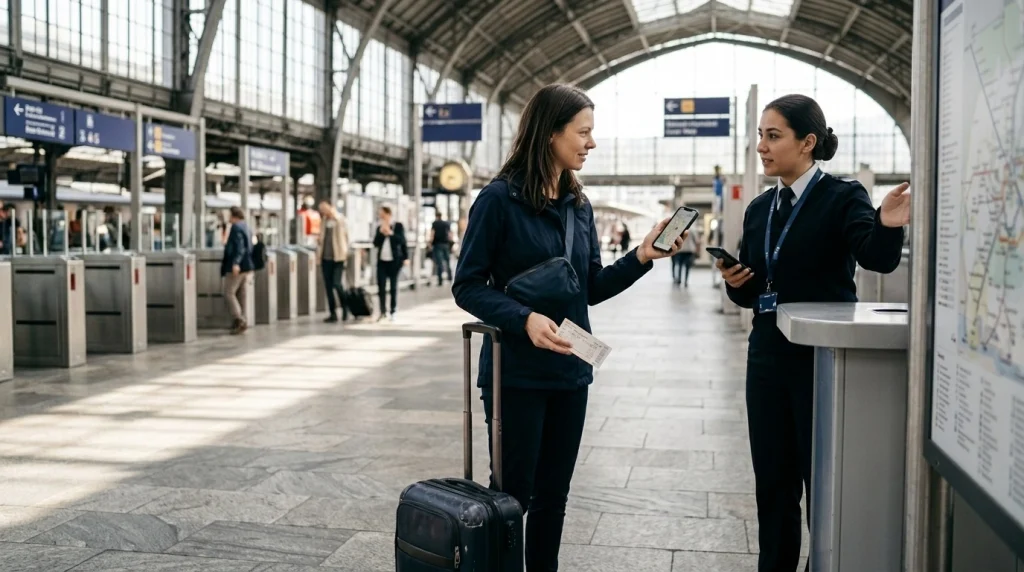
Missing a stop or taking the wrong train is usually a navigation problem, not a travel disaster. The safest response is to pause, identify your current location, and choose a verified route rather than rushing into an unfamiliar area.
If you get on the wrong bus or train
Stay calm and check your route map. If the vehicle is moving, avoid jumping off at an unfamiliar location simply because you think you have made a mistake.
- Identify the current station or stop using the onboard display or your map.
- Check whether the vehicle is moving toward or away from your destination.
- Get off at a suitable, populated stop when it is safe to do so.
- Find an official information desk or use your saved route to plan the next leg.
- Check whether your original ticket remains valid for the corrected journey.
If the vehicle’s direction is unclear, show your destination to an official employee. Avoid boarding another vehicle until you have confirmed where it goes.
If your phone loses battery or internet access
Use the information you saved before leaving. Screenshots, written directions, printed tickets, and a small card with your accommodation address can help you continue without a working connection.
If your battery is nearly empty, stop using unnecessary apps and preserve power for essential navigation or emergency communication. Seek assistance from an official staffed location if you can no longer confirm your route.
If you feel unsafe or need urgent help
Move toward an official station office, transport employee, security desk, or other appropriate public place. Use a prepared translation message to explain what happened and ask for assistance.
Know the local emergency number before traveling. If you face immediate danger, contact local emergency services or ask nearby staff to call them, where safe and practical.
Keep your passport and emergency contact information accessible without displaying your documents or personal details unnecessarily. If your phone is lost or stolen, use your backup contact list and seek help through official channels.
Build a backup plan for every important journey
Before taking an unfamiliar route, identify one reasonable alternative. It might be another train connection, a later official bus, or a reputable taxi service that you have researched in advance.
Allow extra time for transfers and ticket purchases, especially on your first few trips. A 15- to 30-minute buffer may be useful for a simple urban journey, although busy stations and long-distance connections may require more.
Section Takeaway: Stop, confirm your location, and ask for help before making another move. A backup route and offline information can turn an inconvenient mistake into a manageable delay.
Frequently asked questions
Can I travel alone if I do not speak the local language?
Yes, you can travel alone without speaking the local language fluently. Prepare your routes, save addresses in the local script, download offline maps and translation tools, and learn a few useful phrases. Research local safety conditions and choose transport that suits your experience and destination.
Which app should I use for public transportation abroad?
The best app depends on the destination. Use the local transport authority’s official app when available, alongside a navigation app and an offline translation tool. Download maps and language packs before departure, and verify that your chosen apps cover your route and operating hours.
How can I buy a bus or train ticket without speaking the language?
Use an official ticket machine, authorized counter, or trusted transport app. Look for a language selector and translate unfamiliar instructions using your phone’s camera. Confirm the destination, fare, and ticket validity before paying, and check whether you must validate the ticket before boarding.
What should I do if I cannot understand a transport announcement?
Check the station displays, onboard screens, and saved route map. Track your stops and compare the current location with your planned journey. If a disruption changes your route, ask official staff for help using a translated message rather than guessing where to go next.
Is public transportation safe for women traveling alone?
Safety depends on the destination, transport operator, time of day, and local conditions. Research official travel advice, use reputable services, protect your belongings, and stay aware of your surroundings. If a route or situation feels unsafe, choose a verified alternative instead of continuing under pressure.
How can I ask for directions when nobody speaks English?
Show your destination on a map or display its name in the local language. Use a translation app to ask one short question at a time. When possible, approach transport employees or an official information desk, and confirm important directions before following them.
Should I avoid public transportation if I feel anxious about the language barrier?
Not necessarily. Begin with a short daytime journey on a clearly marked route, then build confidence gradually. If the destination has significant transport safety concerns or you cannot verify the route, consider a reputable alternative. You can travel independently without forcing yourself into situations that feel unsafe.
Make language barriers manageable on your next solo trip
You do not need to speak every local language to navigate a new city. A reliable route, saved destination details, offline translation tools, and a little preparation can help you travel more independently.
Start small, confirm your directions, and leave room for unexpected changes. Most importantly, remember that choosing a safer or simpler transport option is a sensible travel decision, not a failure of independence.
Before your next journey, spend 10 minutes preparing your route, downloading essential information, and checking the latest local travel advice. That small habit can make an unfamiliar transport system feel much easier to approach.
Pro tip: Before departure, consult your government’s current destination travel advisory and the local transport authority for route changes, safety warnings, and emergency contact details.
