How Should a Woman Prepare Cash and Cards for a Solo Trip?
Quick Answer
A woman preparing cash and cards for a solo trip should avoid relying on one wallet, one card, or one bank account. I prefer a main payment card, a separately stored backup card, enough local cash for essential spending, and an emergency reserve that remains accessible if my wallet disappears. Before an international trip, I also review official emergency financial guidance for travelers.
Prepare Your Travel Money in Six Steps
- Take two cards: Use one normally and keep the second somewhere separate.
- Carry useful cash: Keep enough local currency for transport, food, tips, and short card outages.
- Split your money: Never put every card and all your cash in one purse or backpack pocket.
- Check card fees: Review foreign transaction fees, ATM fees, withdrawal limits, and international-use settings.
- Protect account access: Save issuer contact details and make sure you can still sign in if your phone is lost.
- Keep emergency access: Reserve enough money to change transportation or accommodation without using your daily budget.
Preparing travel money is less about deciding whether cash or cards are better. It is about making sure one lost wallet, declined transaction, or broken phone cannot leave you unable to pay.
When I plan a solo trip, I build redundancy into my money setup before departure. That small amount of preparation makes unfamiliar airports, late arrivals, and unexpected changes much easier to handle.
In This Guide
- What Is the Best Cash and Card Combination for a Solo Woman?
- How Much Cash Should a Woman Carry on a Solo Trip?
- Which Cards Should You Take When Traveling Alone?
- How Should You Split and Store Cash and Cards?
- How Can You Avoid Card Fees and Payment Problems Abroad?
- What Should You Do If Cash or Cards Are Lost or Stolen?
- Frequently Asked Questions
What Is the Best Cash and Card Combination for a Solo Woman?
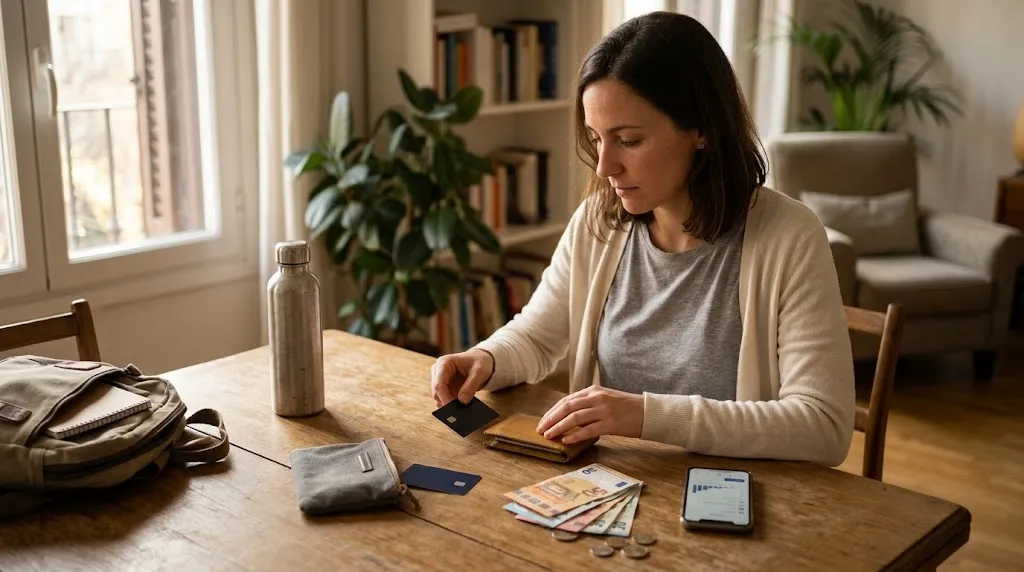
The safest setup is usually a mix of payment methods rather than a wallet full of cash or a single bank card. I want at least two independent ways to pay before I leave home.
That gives me options. If a card gets declined, I can use cash or the backup card without turning a small inconvenience into an emergency.
Travel money preparation means arranging your cash, cards, account access, and emergency funds so that losing one payment method does not remove your ability to pay for essential expenses.
Use a four-layer payment setup
I find this structure simple enough for a first solo trip and flexible enough for longer international travel.
- Main card: The credit or debit card used for normal daily purchases.
- Backup card: A second card kept separately from the main wallet.
- Local cash: Money for small businesses, transport, tips, markets, or temporary card problems.
- Emergency reserve: Money available for unexpected accommodation, transportation, health, or payment disruptions.
The emergency reserve does not need to sit in your handbag. In fact, I prefer most of it to remain electronically accessible.
Your exact setup depends on the destination. A card-friendly capital city may require little cash, while rural areas or local markets may rely on it more heavily.
| Payment Method | Best Role | Where to Keep It | Main Risk |
|---|---|---|---|
| Main card | Hotels, restaurants, transport, larger purchases | Daily wallet | Loss, theft, decline, fraud block |
| Backup card | Replacement payment access | Separate secure location | Useless if stored with main card |
| Local cash | Small purchases and short disruptions | Small daily amount plus separate reserve | Difficult to replace after theft |
| Emergency funds | Unexpected hotel, ride, ticket, or essential expense | Separate account or payment method | Unavailable if all access depends on one phone |
Section Takeaway: Build your travel money around redundancy. One lost card should be an inconvenience, not the end of your access to money.
How Much Cash Should a Woman Carry on a Solo Trip?
Carry enough cash to solve short-term payment problems, but not so much that losing it becomes a major financial loss. I usually think in days of essential spending rather than one universal dollar amount.
For a card-friendly city, one day of basic expenses can be a useful starting point. Cash-heavy or remote destinations may require more.
Calculate cash from essential expenses
Before leaving, estimate what you might need if cards stopped working until the next day.
- Transport back to your accommodation
- One day of simple meals and water
- Small tips or local fees
- A transit ticket or taxi
- Basic toiletries or medicine
- A small buffer for unexpected cash-only expenses
Suppose your essential daily costs are about $70 equivalent. Carrying roughly $80 to $120 equivalent in usable local currency could cover a temporary card problem without putting hundreds of dollars in your wallet.
That is an example, not a fixed rule. Prices and card acceptance vary sharply between destinations.
Do not carry the entire trip budget in cash
Large amounts of cash create a single point of failure. Once cash is lost or stolen, recovery is usually much harder than blocking a card.
I prefer withdrawing or exchanging manageable amounts during the trip when practical. Before doing that, I check whether repeated ATM withdrawals would create excessive fees.
Get useful denominations
Small notes can be more practical than one large bill. They help with taxis, markets, tips, cafés, and purchases where a merchant may not have much change.
I also avoid displaying a thick stack of notes while paying. I take out what I need and put the wallet away.
Keep emergency cash separate
Your daily cash and backup cash should not live in the same compartment. Otherwise, one stolen wallet removes both.
A modest second cash reserve can stay in a separate secure location. The goal is not to invent a clever hiding place; it is simply to avoid keeping everything together.
Section Takeaway: Carry enough cash for short-term essentials, then protect yourself by keeping most of your travel funds somewhere else.
Which Cards Should You Take When Traveling Alone?
I recommend taking at least two usable payment cards when practical. They should ideally give you more than one route to your money.
Two cards are especially useful during solo travel because there is no travel companion beside you with another wallet.
Choose a practical main card
Your main card should work internationally and match the way you expect to spend. Check its fees before assuming it is travel-friendly.
- Foreign transaction fee
- International ATM fee
- Daily withdrawal limit
- Card network acceptance
- International-use restrictions
- Fraud notification settings
- Emergency replacement options
If you use a credit card, know the available credit and repayment terms. Travel is a poor time to discover that a card has an unexpectedly low available limit.
Make the backup genuinely independent
A second card is most useful when losing the first does not automatically disable the second. Where possible, I prefer a backup connected to a different account or issuer.
That creates better separation. A bank-wide security hold or compromised account is less likely to remove both payment methods at once.
Credit card or debit card?
Both can have a role. A credit card may be convenient for hotels, transportation, and purchases, while a debit card can provide ATM access to your own money.
The FTC notes that protections and reporting rules differ between credit and debit cards. It advises reporting a missing card or unauthorized transaction quickly.
You can review the FTC’s guidance for lost or stolen credit, ATM, and debit cards before departure.
Do not depend completely on a digital wallet
Phone payments are useful, but I treat them as another layer rather than my entire payment system. Your phone can run out of battery, lose service, break, or disappear.
Carry a physical payment option unless you know your destination and itinerary allow you to function without one.
Section Takeaway: Two payment cards are better than one, but they provide the most protection when they are stored separately and do not depend on the same point of failure.
How Should You Split and Store Cash and Cards?
Keep your normal spending money easy to reach and your backup money separate. The best system is simple enough that you can maintain it throughout the trip.
I use a three-layer approach: daily wallet, separate backup, and larger account-level reserve.
Layer 1: Your daily wallet
This contains only what you reasonably expect to use while you are out.
- Main payment card
- One day’s practical cash
- Transit card if needed
- Only the identification you need to carry
A smaller daily wallet limits the impact of pickpocketing or accidental loss.
Layer 2: Your separate backup
Keep a second card and modest cash reserve away from the daily wallet. Do not place both cards inside the same purse just because they sit in different pockets.
If appropriate secure storage is available at your accommodation, you may decide to leave the backup there while sightseeing.
Layer 3: Your account-level emergency reserve
This money exists to solve larger problems. It might cover a new hotel, urgent transportation, replacement ticket, or several unexpected days of basic expenses.
It should remain separate from your sightseeing and shopping budget. Otherwise, normal overspending can quietly consume your safety cushion.
Think about your phone as part of your money system
Banking now often depends on text codes, authentication apps, email access, or mobile banking. Losing the phone can therefore affect several financial tools at once.
Before leaving, prepare a recovery plan.
- Know your important passwords or use secure password management.
- Make sure account recovery information is current.
- Save card issuer contact numbers somewhere other than the physical card.
- Keep secure copies of essential travel information.
- Know how you would contact your bank without your normal phone.
Do not store photos showing full card numbers, security codes, and passwords together in an unsecured photo gallery.
Section Takeaway: Separate daily money, backup payment access, and emergency funds so that no single lost item removes all three.
How Can You Avoid Card Fees and Payment Problems Abroad?
Check the cost and settings of your cards before departure. Small international fees can become expensive when they occur on every purchase or ATM withdrawal.
I review the account terms rather than relying on what I remember from a previous trip.
Check foreign transaction fees
Some cards charge a fee when you make foreign purchases. Others do not.
Confirm the current terms directly with your issuer, especially if the card has changed since your last trip.
Understand ATM fees
An overseas cash withdrawal can involve more than one fee. The CFPB notes that both your own financial institution and the ATM owner may charge for using another institution’s ATM.
Review your bank’s ATM policy before departure and read the ATM screen before confirming a withdrawal. You can check the CFPB’s ATM fee guidance for the general rule.
Be careful with dynamic currency conversion
At some foreign shops or ATMs, you may be offered the option to pay in your home currency instead of the local currency. This is called dynamic currency conversion, or DCC.
Visa explains that DCC can include an exchange rate plus extra fees or markup. The screen should show the conversion details and give you a choice.
I normally review the offered rate and cost rather than accepting home-currency conversion automatically. Visa provides a clear explanation of dynamic currency conversion.
Turn on useful account alerts
Transaction alerts can help you notice a purchase you did not make. I prefer alerts for purchases, withdrawals, and suspicious account activity when my bank supports them.
Make sure those alerts will still reach you abroad. A notification system tied only to a home SIM may become less useful if that number is unavailable.
Check whether your issuer needs travel information
Bank practices vary. Some issuers no longer require travel notices, while others provide settings or support specifically for international use.
Check your issuer’s current instructions rather than assuming a notification is required.
Section Takeaway: Know your card’s international fees, ATM rules, security alerts, and currency-conversion choices before you start spending abroad.
What Should You Do If Cash or Cards Are Lost or Stolen?
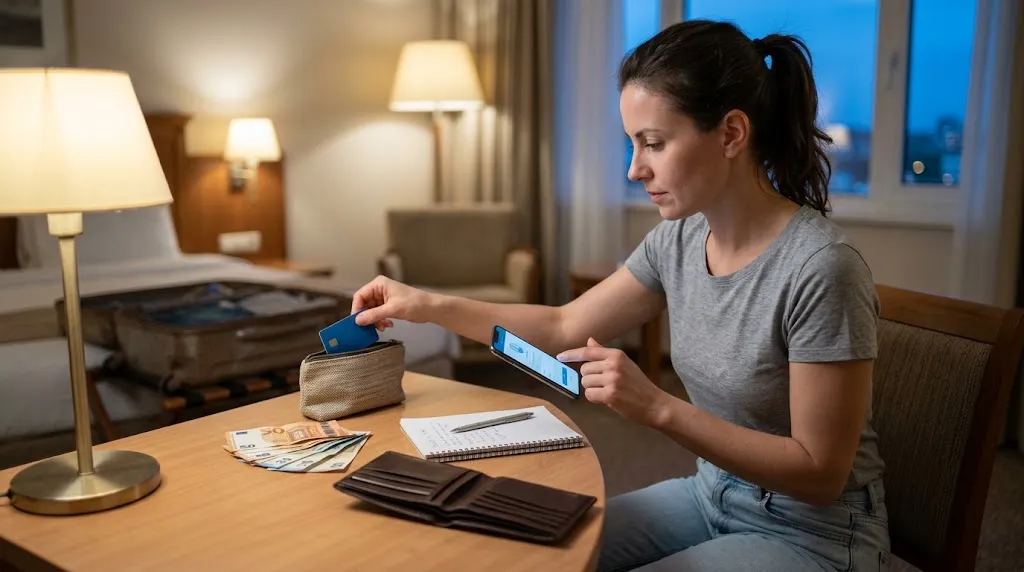
Act quickly on a lost card. Cash may be difficult to recover, but a card can usually be blocked before more transactions occur.
This is the moment when a separately stored backup card becomes worth the small effort it took to prepare.
If your card is missing
- Lock or block the card: Use your issuer’s app or official contact method immediately.
- Review recent transactions: Look for charges or withdrawals you do not recognize.
- Report unauthorized activity: Follow your bank or card issuer’s instructions without delay.
- Switch to your backup: Use your separately stored card or emergency cash.
- Ask about replacement: Some issuers can arrange emergency or expedited replacement services.
- Document what happened: Keep relevant transaction details and reports for insurance or disputes.
The U.S. State Department advises travelers to report lost or stolen credit cards to the card company immediately. It also notes that some issuers may help with replacement cards or urgent payment needs.
If your cash is stolen
First protect your personal safety rather than chasing a thief or confronting someone. Then assess what else disappeared with the money.
If identification or cards were also stolen, contact the appropriate issuer and local authorities when a report is needed.
If your entire wallet disappears
This is why I avoid carrying every financial resource together. Start with the payment method stored elsewhere, then block the missing cards.
If you are a U.S. citizen facing serious financial difficulty abroad, the State Department provides information on consular financial assistance and ways family or friends may help transfer funds.
Watch for scams after a loss
A stressful situation makes urgent-sounding requests easier to believe. Be cautious if someone claims you must immediately transfer money, reveal banking details, or pay an unofficial fee.
The State Department maintains international travel scam guidance with examples of tactics travelers may encounter.
Pro tip: Before an international trip, save the official travel-advisory and emergency-assistance pages for your destination. Rules, local conditions, and emergency contacts can change.
Section Takeaway: Block a missing card quickly, switch to your separate backup, and protect your safety before worrying about replacing cash.
Frequently Asked Questions
Should a woman carry cash when traveling alone?
Yes. Even in card-friendly destinations, a modest amount of cash can help with small businesses, transit, tips, taxis, or temporary card problems. The amount should reflect local prices and payment habits rather than a universal rule.
Is it better to travel with cash or a credit card?
Neither should be your only payment method. A card is practical for many larger purchases, while cash works when electronic payments fail or are not accepted. Using both creates more flexibility and reduces dependence on a single system.
How many cards should a solo female traveler take?
Two usable cards are a sensible minimum when practical. Keep the backup separate from the main wallet. If possible, cards linked to different accounts or issuers provide more redundancy than two cards that depend on the same compromised account.
Where should I keep my backup credit or debit card?
Keep it somewhere separate from your everyday wallet and purse compartment. Depending on your accommodation and itinerary, that might mean appropriate secure storage in your room or another discreet location that does not travel beside your main card.
Should I withdraw all my travel cash before leaving home?
Usually, you do not need to carry your entire trip budget as cash. Research your destination’s ATM availability, exchange options, card acceptance, and fees first. Then choose a mix that limits both withdrawal costs and the risk of carrying excessive cash.
What if my bank card is declined while I am traveling alone?
Try your backup payment method rather than repeatedly attempting the same card. Check your banking app or contact the issuer using an official channel. Keep enough separate cash to pay for immediate transport, food, or other essentials while resolving the problem.
How much emergency money should I have for a solo trip?
Base the amount on realistic problems you may need to solve, such as an extra hotel night, urgent transport, food, or a temporary card failure. Keep emergency funds separate from the normal trip budget and avoid carrying the entire reserve as physical cash.
The simplest rule for 2026 is to give yourself more than one way to pay. A main card, separate backup card, practical cash reserve, and accessible emergency fund can turn a lost wallet or declined transaction into a manageable problem.
Before your next solo trip, spend ten minutes checking your card fees, ATM limits, account recovery options, and backup storage. That preparation is small, but the freedom it gives you on the road can be significant.