How Can a Woman Prepare Her Bank Cards Before International Travel?
Quick Answer
Before international travel, check that your debit and credit cards work overseas, review fees and limits, and confirm whether your issuer wants a travel notice. I also recommend enabling transaction alerts, memorizing your PIN, carrying a backup card separately, and saving emergency contact details before departure. The Visa travel guidance is a useful starting point for checking common card-preparation steps.
Your pre-trip card checklist
- 1. Confirm overseas use: Check whether each card can be used in your destinations.
- 2. Review fees: Check foreign transaction, ATM, and cash-advance charges.
- 3. Check your PIN: Know the PIN for any card you may use at an ATM.
- 4. Turn on alerts: Enable purchase, withdrawal, decline, and fraud notifications where available.
- 5. Carry a backup: Keep a second usable card somewhere separate from your main wallet.
- 6. Save emergency contacts: Store your issuers’ international phone numbers somewhere secure.
One safety habit I never skip
- Never keep every card, all your cash, and your passport together in one bag.
If you’re wondering how a woman can prepare her bank cards before international travel, the goal is simple: make sure you can still access money when something goes wrong.
For a solo female traveler, that backup matters even more. A declined card, swallowed debit card, or stolen wallet is easier to handle when you’ve planned for it before leaving home.
In This Guide
- What should you do to prepare your bank cards before traveling abroad?
- Should you tell your bank you’re traveling internationally?
- Which bank cards should you take on an international trip?
- How can you avoid card fees and bad currency conversions?
- How should you secure your cards and banking apps abroad?
- What should you do if a card is lost, stolen, or declined?
- Frequently asked questions
What Should You Do to Prepare Your Bank Cards Before Traveling Abroad?
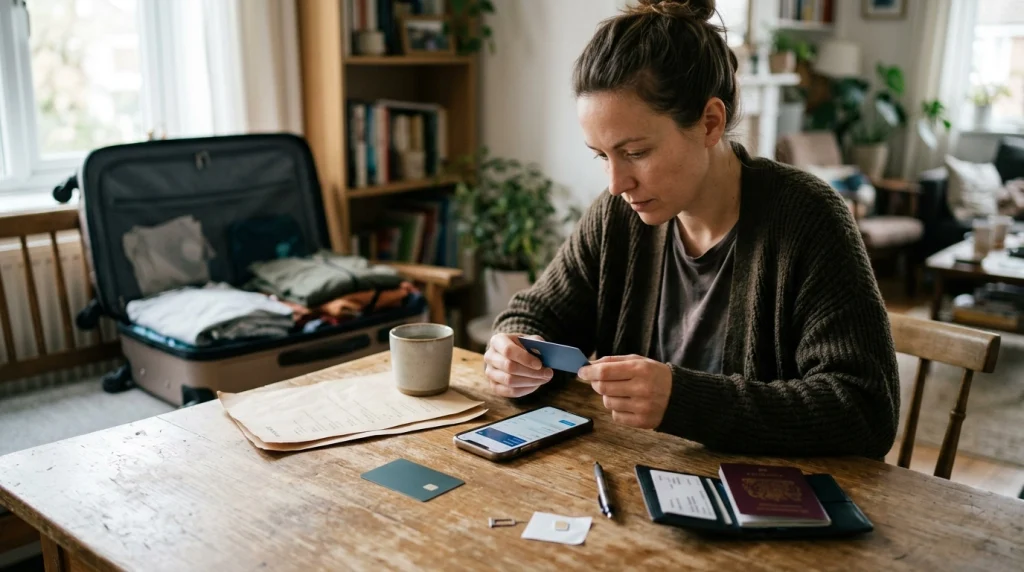
Start by checking every card you expect to use. Don’t assume a card that works perfectly at home will behave the same way overseas.
Bank-card travel preparation means making sure your cards, accounts, authentication methods, fees, limits, and emergency backups are ready for international use before departure.
Think beyond the plastic card. You also need access to your banking app, authentication messages, emergency numbers, and a second way to pay.
Check each card about a week before departure
I prefer doing my final card check several days before flying. That leaves time to solve a forgotten PIN, expired card, blocked international setting, or outdated phone number.
- Expiration date: Make sure the card remains valid for your entire trip.
- Available balance or credit: Leave enough room for hotels, transportation, deposits, and emergencies.
- International use: Confirm the card can make purchases and withdrawals overseas.
- ATM withdrawal limit: Know your daily limit before you need emergency cash.
- Purchase limits: Check whether daily spending limits could affect large hotel or transportation charges.
- PIN: Memorize it instead of storing it beside the card.
- Contact information: Make sure your bank has your current mobile number and email.
Test your banking access before leaving
Open each banking app and make sure you can sign in. Check whether your password manager, biometric login, or authentication method will still work away from home.
If your bank sends security codes by SMS, think about how you’ll receive them abroad. Losing access to your home number can turn a five-minute banking task into a stressful problem.
- Check whether international roaming is needed for authentication texts.
- Update old phone numbers before departure.
- Know your banking passwords without keeping them in plain text.
- Install official banking apps before leaving home.
- Update the apps while you’re on a trusted network.
Section Takeaway: Prepare access, not just cards. Your PIN, account login, alerts, limits, and authentication method are part of your travel money system.
Should You Tell Your Bank You’re Traveling Internationally?
Check with each card issuer before departure. Some issuers still accept or recommend travel notices, while others rely more heavily on automated fraud detection.
Don’t assume one bank’s policy applies to every card. Use your bank’s official app, website, or customer-service number to check.
What information might your bank need?
- Your departure and return dates
- The countries you plan to visit
- Any major transit countries
- The specific cards you plan to use
Mastercard advises travelers to tell their bank when traveling cross-border because an issuer may otherwise treat an unfamiliar overseas transaction cautiously. You can review its cardholder travel guidance before departure.
Why can cards still be declined after a travel notice?
A travel notice isn’t a guarantee that every purchase will be approved. Fraud systems also consider transaction patterns, merchant behavior, account status, available funds, and other risk signals.
This is why I never build a solo trip around one card. One working backup can turn a payment problem into a minor inconvenience.
- Keep your bank’s app installed.
- Enable decline alerts if available.
- Know how to unlock or unfreeze your card.
- Carry a second payment method.
Pro tip: Bank procedures change. Verify your specific issuer’s current international-use and travel-notice policy before every trip rather than relying on advice from an older journey.
Which Bank Cards Should You Take on an International Trip?
For most solo trips, I prefer a primary payment card, a debit card for cash access, and one backup card. The exact combination depends on your accounts and destination.
The important part is redundancy. Two cards stored in the same stolen wallet aren’t a meaningful backup.
| Card type | Best use | Check before travel | Where I keep it |
|---|---|---|---|
| Primary credit card | Hotels, restaurants, transport, larger purchases | Foreign transaction fee, available credit, international acceptance | Secure everyday wallet |
| Debit or ATM card | Local-currency withdrawals | ATM fee, withdrawal limit, international access | Secure wallet when needed |
| Backup card | Emergency use if another card fails or disappears | Activation, expiration date, PIN if applicable | Separate secure location |
Why I separate my cards
On solo trips, I keep my main spending card accessible and my backup somewhere separate and secure. I don’t want one lost bag to remove every way I have to pay.
I also avoid carrying my entire financial life during an ordinary sightseeing day. A card I don’t expect to use can stay secured at my accommodation when that is the safer option.
Should your backup card be from another bank?
If possible, using a different issuer can add another layer of redundancy. A bank-specific account problem is less likely to affect both cards at once.
A different payment network can also be useful where acceptance varies. That isn’t mandatory, but it gives you another option.
- Primary card for everyday purchases
- Debit card for planned ATM withdrawals
- Backup card stored separately
- A modest amount of emergency cash
Section Takeaway: Your best travel wallet isn’t the one with the most cards. It’s the one that gives you at least two independent ways to access money.
How Can You Avoid Card Fees and Bad Currency Conversions?
Before leaving, read the fee schedule for every card you plan to use. International payment costs can come from several different places.
- Foreign transaction fee: A fee your issuer may charge for qualifying foreign transactions.
- ATM fee from your bank: Your bank may charge for using an outside ATM.
- ATM operator fee: The company owning the machine may charge separately.
- Cash-advance fee: Credit-card ATM withdrawals may be treated differently from debit withdrawals.
- Currency conversion markup: A merchant or ATM may offer its own conversion rate.
The Consumer Financial Protection Bureau notes that both your financial institution and an ATM owner can charge fees in some situations. Check your own account terms and the ATM screen before confirming a withdrawal through its ATM fee guidance.
Should you pay in local currency?
When a foreign card terminal asks whether you’d like to pay in your home currency or the local currency, I normally choose the local currency. This lets my card network and issuer handle the conversion instead of accepting the merchant’s offered conversion.
The merchant’s conversion option is often called dynamic currency conversion, or DCC. Always read the screen carefully before approving the transaction.
Simple rule: If you’re in Japan and the terminal asks whether you want to pay in yen or your home currency, compare the options carefully and generally select the local currency rather than automatically accepting the conversion offered by the merchant.
Don’t use a credit card at an ATM without checking the terms
A credit-card cash withdrawal may be treated as a cash advance. That can involve different fees and interest rules from an ordinary purchase.
I reserve credit-card cash withdrawals for emergencies unless I’ve confirmed the terms beforehand. For planned cash, I use a debit or ATM card suited to withdrawals.
Section Takeaway: Check the fee schedule before you travel, not while standing at an unfamiliar ATM. Know what your bank charges and what the machine itself may charge.
How Should You Secure Your Cards and Banking Apps Abroad?
Physical card security is only half the job in 2026. Your phone may also contain banking apps, saved cards, email access, and authentication codes.
I treat my phone and wallet as two separate pieces of financial infrastructure. Losing both at once would be far harder to recover from.
Turn on transaction alerts
Enable alerts for purchases, withdrawals, unusual activity, and declined transactions where your issuer offers them. Fast alerts help you notice activity that isn’t yours.
- International purchase alerts
- ATM withdrawal alerts
- Online purchase alerts
- Transaction amount alerts
- Card-decline alerts
Know how to freeze your card
Open your banking app before travel and find the card-control screen. Learn where the freeze, lock, or report-lost function is located.
You don’t want your first attempt to find that button to happen while stressed in a crowded train station.
Protect your PIN and card details
- Cover the keypad while entering your PIN.
- Don’t write your PIN on the card.
- Don’t keep your PIN in an obvious phone note.
- Avoid sending complete card details through messages or email.
- Don’t photograph the front and back of every card and leave the images unprotected in your photo gallery.
- Keep emergency phone numbers separate from the physical cards.
A habit I like is storing issuer names, emergency contact numbers, and the last four digits of each card in a secure place. I don’t need to carry a plain-text copy of every sensitive card detail.
Keep your backup physically separate
My main card usually stays with me during the day. My backup stays in another secure location whenever practical.
This matters for solo female travel safety because financial independence is part of your emergency planning. You should be able to pay for safe transport or accommodation even after losing a wallet.
Section Takeaway: Protect your money in layers. Separate your cards, secure your phone, enable alerts, and know how to freeze an account quickly.
What Should You Do If a Card Is Lost, Stolen, or Declined?
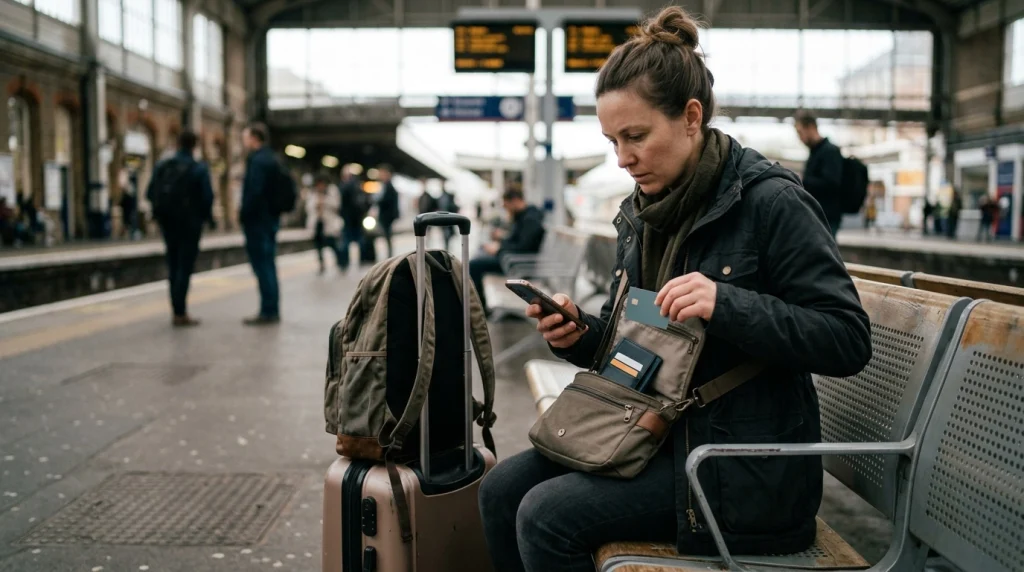
If a card disappears, act quickly. Don’t wait until you see several suspicious transactions before contacting the issuer.
If your card is lost or stolen
- Freeze or lock the card: Use your official banking app if that feature is available.
- Contact the issuer: Report the card lost or stolen as soon as possible.
- Review recent transactions: Look for anything you don’t recognize.
- Ask about replacement options: Find out whether an emergency replacement or other assistance is available.
- Switch to your backup: Use the separate card or emergency cash you prepared before departure.
The U.S. Federal Trade Commission recommends reporting a lost or stolen credit, ATM, or debit card promptly. Its lost and stolen card guidance explains why quick reporting matters.
If your card is unexpectedly declined
Try not to keep repeating the same transaction. Check your banking app first for a fraud alert, lock, insufficient balance, or declined-transaction notification.
- Confirm the card isn’t frozen.
- Check your available balance or credit.
- Look for a fraud-verification request.
- Try your backup card if appropriate.
- Contact the issuer through an official number if the problem continues.
If an ATM keeps your card
Don’t leave without noting the ATM location, bank name, and machine identification details if visible. Contact the ATM operator and your card issuer using verified contact information.
If recovering the card becomes uncertain, consider freezing it immediately. Your backup payment method now becomes important.
If you lose access to all your money
Contact your bank or card issuer first and ask about emergency replacement or emergency-cash options. Your embassy or consulate may also provide guidance in a serious financial emergency.
For U.S. citizens, the State Department publishes information about emergency financial assistance abroad, including steps to take after lost or stolen cards.
Pro tip: Before departure, save the emergency contact information for your bank and your country’s embassy or consulate. Use official sources rather than numbers supplied by strangers or unverified search results during a crisis.
Section Takeaway: Speed matters after a lost card. Freeze it, contact the issuer, check transactions, and move to the backup payment method you prepared before the trip.
Frequently Asked Questions
How many bank cards should a woman take when traveling internationally?
Two independent payment cards are a sensible minimum for many trips, although your needs may differ. I prefer a primary card plus a backup stored separately, with a debit or ATM card available when I expect to withdraw local cash.
Should I notify my bank before every international trip?
Check your issuer’s current policy before departure. Some banks still support travel notices, while others use automated fraud-detection systems and may not require one, so don’t rely on what another bank or an older trip required.
Is it better to travel with a debit card or credit card?
They serve different purposes. I typically use a suitable credit card for many purchases and a debit card for planned ATM withdrawals, while checking each card’s fees, protections, limits, and international-use rules first.
Should I keep my debit card and credit card together?
I don’t recommend keeping every payment method in one place. If one wallet or bag disappears, separating your backup card gives you another way to pay for transportation, accommodation, food, or other urgent needs.
Should I choose my home currency when a foreign ATM asks?
Don’t automatically accept your home currency. Read the conversion offer carefully because the ATM or merchant may be providing its own exchange rate, and compare that option with having your card network or issuer perform the conversion.
What information should I save before traveling?
Save your issuer’s verified emergency number, the card’s last four digits, and instructions for freezing or reporting the card. Also make sure you can access your banking account and authentication method while outside your home country.
What is the most important bank-card safety tip for a solo female traveler?
Don’t let one incident eliminate every way you can access money. Keep a backup payment method separate from your primary wallet so a lost bag, stolen card, account block, or ATM problem doesn’t leave you financially stranded.
My final pre-flight check: I confirm overseas use, fees, PINs, limits, alerts, app access, emergency contacts, and my separate backup card. Once those are handled, I can focus on the trip instead of wondering whether my money will work when I land.
Preparing your bank cards isn’t complicated, but it deserves the same attention as your passport and travel insurance. Give yourself two reliable ways to access money, know what each card costs to use, and have a recovery plan before you board the plane.