How Can a Woman Practice Solo Travel Before a Longer Trip?
Quick Answer
A woman can practice solo travel before a longer trip by gradually increasing how much she does alone. Start with local outings, then take a day trip, spend one night away, and finally try a two- or three-night practice trip. Along the way, rehearse navigation, eating alone, transport, budgeting, check-ins, and personal safety while reviewing official guidance for women travelers.
A simple solo-travel practice plan
- Practice locally: Spend several hours alone in an unfamiliar part of your own city.
- Take a day trip: Navigate transportation, meals, activities, and your return journey without help.
- Stay overnight: Book accommodation, check in alone, and handle an evening independently.
- Try two nights: Practice managing energy, money, downtime, packing, and changing plans.
- Review what felt difficult: Fix those weak points before committing to your longer journey.
Remember
- Your practice trip does not need to feel perfect. Its purpose is to discover what you still need to learn.
Practicing solo travel before a longer trip is one of the easiest ways to replace uncertainty with useful experience. You don’t need to begin by flying across the world alone.
I prefer to think of these smaller outings as dress rehearsals. Each one lets you test a few solo female travel skills without making a large commitment.
In This Guide
What Does Practicing Solo Travel Actually Mean?
Practicing solo travel means deliberately doing parts of a future trip alone before attempting the complete journey. You are rehearsing independence, not trying to recreate every detail.
Solo female travel means traveling without a companion while independently managing transportation, accommodation, meals, activities, money, safety decisions, and your daily schedule.
Your practice outings help you learn how those responsibilities feel when nobody else is immediately making decisions with you.
That distinction matters. Reading about solo travel can prepare you intellectually, but navigating an unfamiliar station alone teaches you something different.
Why small practice trips work
A shorter outing reduces the number of unknowns you face at once. Home can still be close while you practice behaving like an independent traveler.
- Navigation: Can you find a destination without relying on another person?
- Decision-making: Can you change plans calmly when something closes or gets delayed?
- Social comfort: Are you comfortable eating, sightseeing, or sitting alone?
- Safety awareness: Do you notice your surroundings without becoming constantly afraid?
- Energy management: Can you recognize when you need rest rather than another activity?
The objective isn’t proving that you are fearless. It is learning how you respond when a trip becomes inconvenient, quiet, tiring, or unfamiliar.
That information becomes useful when you design your longer solo trip.
How Can a Woman Practice Solo Travel Close to Home?
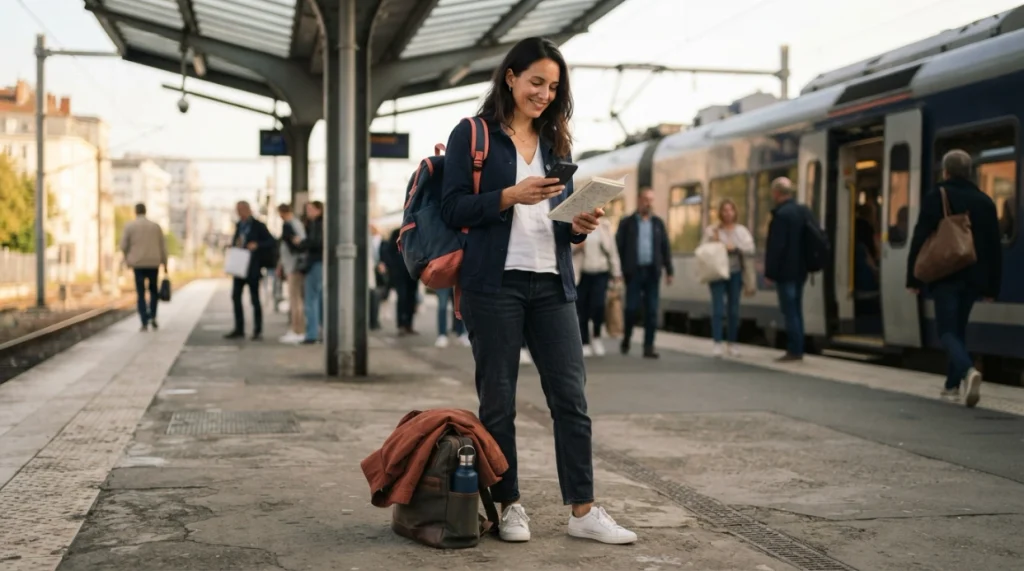
Start close to home and increase the difficulty gradually. A four-stage progression works better than jumping directly into a long international journey.
Think of each stage as a small experiment. Move forward when the current stage starts feeling manageable rather than intimidating.
| Practice stage | Suggested length | What to practice |
|---|---|---|
| Local solo outing | 3–6 hours | Navigation, eating alone, making decisions |
| Solo day trip | 8–12 hours | Transport, timing, budgeting, changing plans |
| One-night trip | 24–36 hours | Accommodation, evening routine, packing, check-in |
| Mini solo trip | 2–3 nights | Full trip rhythm, downtime, fatigue, spending, flexibility |
Stage 1: Spend half a day alone somewhere unfamiliar
Choose a neighborhood, museum district, park, or nearby town that you don’t know well. Travel there independently and stay for several hours.
Give yourself a few simple responsibilities.
- Find your route without calling someone for directions.
- Eat one meal alone.
- Choose an activity without asking another person’s opinion.
- Keep track of your spending.
- Return home using your own transport plan.
Notice which part creates discomfort. For some women, navigation feels easy while sitting alone in a restaurant feels surprisingly strange.
Stage 2: Take a complete day trip
Your next test should include an outbound journey and a fixed return time. A destination one or two hours from home often works well.
Create a loose solo trip itinerary rather than scheduling every minute.
- One main attraction or activity
- One meal away from home
- One unplanned hour
- A clear route back
- A backup transport option
The unplanned hour matters. Longer trips contain empty time, and many first-time solo travelers underestimate how unfamiliar that can feel.
Stage 3: Book one night away
An overnight stay changes the experience because you must manage accommodation and an evening routine. Those are important parts of longer solo travel.
Pick somewhere logistically easy. Your first rehearsal doesn’t need difficult connections or an isolated location.
Section Takeaway: Build independence in layers. A nearby overnight trip can reveal more useful information than months of worrying about a future journey.
Which Solo Travel Skills Should You Rehearse?
Practice the skills that will affect your everyday experience on the longer trip. Navigation, transportation, money, communication, and safety deserve more attention than sightseeing.
Practice navigating without depending on one app
Use your normal mapping app, but learn what you would do if your phone lost service or power. Save important addresses and transport details before leaving.
- Know the accommodation address.
- Save an offline map when practical.
- Carry a charging cable or power bank.
- Identify a backup route.
- Know where the main station or transport hub is.
A good rehearsal is intentionally finding your way back from an unfamiliar attraction without following someone else’s lead.
Practice eating and spending time alone
Eating alone often worries beginners more than the practical parts of travel. Practice at a café first, then try a proper restaurant.
Don’t hide behind your phone for the entire meal. Let yourself experience what being alone in public feels like.
- Order confidently.
- Ask staff a question if needed.
- Keep valuables controlled.
- Enjoy the meal without rushing.
Also practice quieter moments. Sit in a park, read at a café, or spend an evening in your accommodation without treating empty time as a problem.
Practice handling money independently
Create a small budget for each rehearsal. Track transport, food, accommodation, and activities exactly as you would during a longer journey.
Carry more than one payment option when appropriate. Keep backup money separately rather than storing everything together.
Practice your safety routine
A useful solo female travel safety routine should be simple enough to repeat every day. It shouldn’t require constantly feeling suspicious.
- Share your basic itinerary with someone you trust.
- Know how you will reach your accommodation before arriving.
- Avoid revealing your room number or exact accommodation details to strangers.
- Know how you would leave an uncomfortable situation.
- Check local emergency information before international trips.
- Research reputable transportation options in advance.
The U.S. State Department specifically advises women travelers to research transportation and local customs, plan for unsafe situations, and ensure a trusted person knows their plans. Its international travel checklist is also useful when preparing for a longer overseas trip.
Pro tip: Safety conditions, laws, transportation risks, and entry requirements can change. Check your destination’s official government information shortly before departure rather than relying only on older travel articles.
Section Takeaway: Rehearse ordinary travel tasks until they feel familiar. Confidence usually grows from repeated problem-solving, not from eliminating every possible risk.
How Can You Build Confidence and Manage Travel Anxiety?
Build solo travel confidence by making challenges slightly harder over time. You don’t need to wait until every anxious feeling disappears.
A useful goal is becoming comfortable acting despite mild uncertainty.
Create one manageable challenge per outing
Don’t test five new things simultaneously. Choose one skill that currently makes you nervous.
- Eat dinner alone.
- Use unfamiliar public transport.
- Attend a walking tour alone.
- Ask a stranger or staff member for directions.
- Spend an evening without calling home for reassurance.
Once that challenge becomes ordinary, add another. This gives you evidence that you can handle unfamiliar situations.
Practice being social without depending on company
Solo travel does not mean avoiding other people. It means you control when and how you interact.
Try low-pressure environments where conversation can happen naturally.
- Group walking tours
- Cooking or craft classes
- Hostel social events
- Small-group excursions
- Meetup-style community events
A hostel is accommodation that commonly offers shared rooms, private rooms, and communal spaces. You don’t need to stay in a dormitory to use social accommodation as part of a future trip.
Learn your personal loneliness pattern
A short practice trip can show you when loneliness appears. Some travelers feel it during dinner, while others notice it late at night.
Prepare a simple response instead of treating loneliness as proof that solo travel isn’t for you.
- Journal for ten minutes.
- Message someone at home.
- Join a planned group activity.
- Visit a lively café or public place.
- Rest if tiredness is making emotions stronger.
I like to separate discomfort from danger. Feeling awkward during a solo dinner is a skill-building moment, while feeling unsafe requires action.
That distinction helps you respond appropriately instead of treating every uncomfortable feeling as the same problem.
How Can You Test Your Longer-Trip Systems and Know You’re Ready?
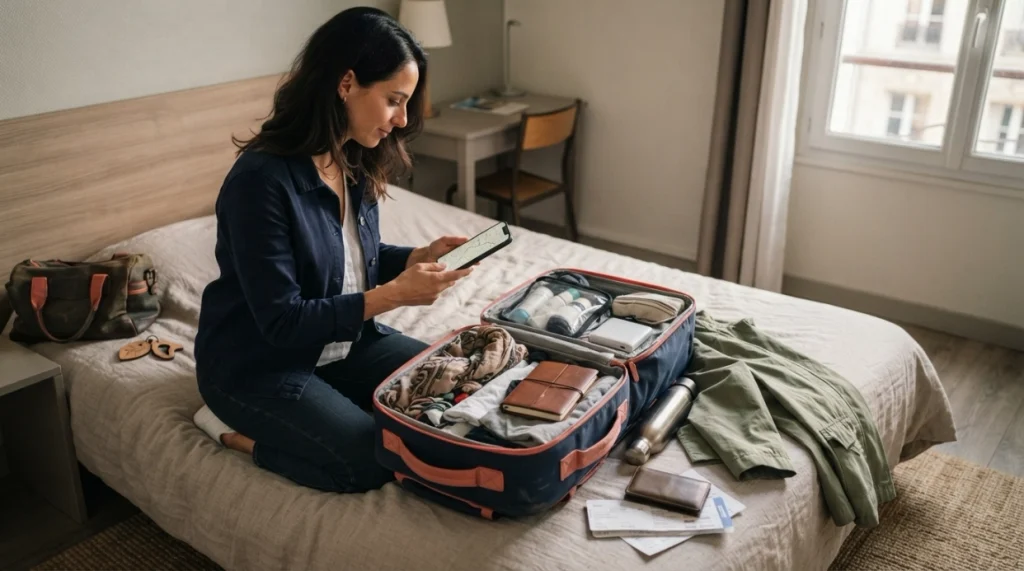
Use your final practice trip as a miniature version of the longer journey. Two or three nights is enough to test most daily systems.
Pack, budget, communicate, navigate, and schedule yourself as though the longer trip had already started.
Test your accommodation routine
Choose accommodation yourself and research the location before booking. Practice arriving, checking in, finding your room, and learning the surrounding area.
After checking in, identify several useful places nearby.
- A food option
- A transport stop
- A pharmacy or convenience store
- A well-lit route back
- A staffed place where you could ask for help
Test your packing system
Pack approximately the same way you expect to pack for the longer trip. Resist bringing extra items simply because your rehearsal is close to home.
After returning, divide your belongings into three groups.
- Used: Items you genuinely needed.
- Unused but essential: Medication, documents, or emergency items.
- Unused and unnecessary: Things you probably shouldn’t carry on the longer trip.
This is one of the easiest ways to reduce overpacking before departure.
Test what happens when plans change
You don’t need to manufacture an emergency. Instead, practice making an ordinary backup decision.
If an attraction closes, choose something else. If rain starts, redesign the afternoon without calling someone else to solve it.
Use a readiness checklist after your practice trip
You don’t need a perfect score. Look for evidence that you can manage the normal responsibilities of traveling alone.
- I can navigate an unfamiliar area independently.
- I can eat and spend several hours alone comfortably.
- I can manage accommodation check-in and an evening alone.
- I can use transport without relying on a companion.
- I know how to contact someone if plans change.
- I can manage my daily travel budget.
- I have backup payment and phone-power options.
- I can change an itinerary without panicking.
- I know how to leave a situation that feels unsafe.
- I understand which parts of solo travel still make me nervous.
If several items still feel difficult, practice those specific situations again. There is no advantage in rushing.
Prepare the international layer separately
An international journey adds passports, entry rules, health considerations, laws, cultural expectations, and communications planning. Your local practice trip cannot reproduce all of those factors.
If you are a U.S. citizen traveling internationally, the State Department’s Smart Traveler Enrollment Program can connect your trip information with the nearest U.S. embassy or consulate.
Health requirements also vary by destination. Review the CDC Travelers’ Health resources when relevant to your destination and circumstances.
Pro tip: Check official destination advisories, health guidance, local laws, and entry requirements again shortly before departure. Current information matters more than an old checklist.
Section Takeaway: You are ready for a longer solo trip when ordinary travel problems feel solvable. Readiness means having systems and backup plans, not knowing exactly what will happen.
Frequently Asked Questions
How long should a solo travel practice trip be?
Start with a few hours alone, progress to a day trip, and then try one or two nights away. A two- or three-night rehearsal can test accommodation, navigation, downtime, budgeting, packing, transport, and safety routines without requiring a long commitment.
Should my first practice trip be far from home?
No. Staying reasonably close to home often makes the first rehearsal easier because you can focus on independent travel skills rather than complicated logistics. Increase distance once navigating, eating alone, and managing accommodation begin to feel comfortable.
What if I feel lonely during my first solo overnight trip?
Loneliness during a practice trip doesn’t automatically mean longer solo travel will be unsuitable. Notice when it happens, then experiment with group activities, cafés, journaling, planned calls home, or quiet downtime so you learn which strategies work for you.
Is eating alone important to practice before solo travel?
Yes, because meals happen every day during most trips. Start with coffee or lunch, then try dinner alone. Practicing beforehand can make restaurant decisions feel routine instead of becoming an unnecessary source of anxiety during your longer journey.
How can I practice solo female travel safety at home?
Practice sharing plans with a trusted contact, researching transportation, protecting accommodation information, keeping backup payment separately, and knowing your route home. These habits can become automatic before you need them in a less familiar destination.
What should I do if my practice trip goes badly?
Treat the experience as information rather than failure. Write down exactly what caused trouble, such as poor planning, loneliness, heavy luggage, confusing transportation, or an uncomfortable accommodation, then design another shorter practice trip around that specific weakness.
How do I know whether I’m ready to travel internationally alone?
You should be able to manage normal travel tasks independently and respond calmly when plans change. International readiness also requires current research on entry rules, health guidance, laws, transportation, cultural expectations, accommodation, communications, and destination-specific safety conditions.
Your longer trip doesn’t need to be your first solo experiment. Give yourself a local outing, a day trip, and at least one overnight rehearsal first.
Each small trip gives you something more useful than abstract confidence: evidence that you can make decisions, solve ordinary problems, and take care of yourself while traveling alone.