
What Should a Woman Do If She Gets Lost While Driving Alone?
Quick Answer
If a woman gets lost while driving alone, she should stay calm, stop navigating while the car is moving, and find a safe, legal place to park before checking her route. She can use GPS, contact a trusted person, or ask staff at a reputable public business for directions. If she feels threatened, she should stay in a secure location and contact local emergency services when necessary.
What to do first
- Stay composed: Slow down safely and avoid sudden turns, speeding, or risky lane changes.
- Park safely: Choose a well-lit, populated location or a designated stopping area rather than an isolated roadside.
- Check navigation: Re-enter your destination, confirm your location, and review the next few turns before moving again.
- Tell someone: Share your location and explain where you are heading if you need assistance.
- Trust your instincts: If someone is following or threatening you, head toward a staffed public place or police facility when safe, and call for help.
Before driving again
- Confirm the destination, road conditions, fuel level, and whether the proposed route is safe.
- If you cannot establish a safe route, stay somewhere secure and arrange reliable assistance instead of continuing blindly.
Getting lost while driving alone can feel unsettling, especially when you’re unfamiliar with the area or traveling after dark. The safest response is to pause, regain your bearings, and make your next decision from a secure location.
As Emma Collins, I approach solo travel planning with one priority: making sure you have a practical backup plan when the journey stops going as expected. This guide explains how to handle navigation problems, choose a safe place to stop, get reliable directions, and recognize when you need outside help.
In This Guide
- What should you do first when you realize you’re lost?
- Where is the safest place to stop when driving alone?
- How can you find your route again safely?
- Who should you contact if you cannot find your way?
- What should you do if you feel unsafe or stranded?
- How can you prepare for getting lost on a solo drive?
- Frequently asked questions
What Should You Do First When You Realize You’re Lost?
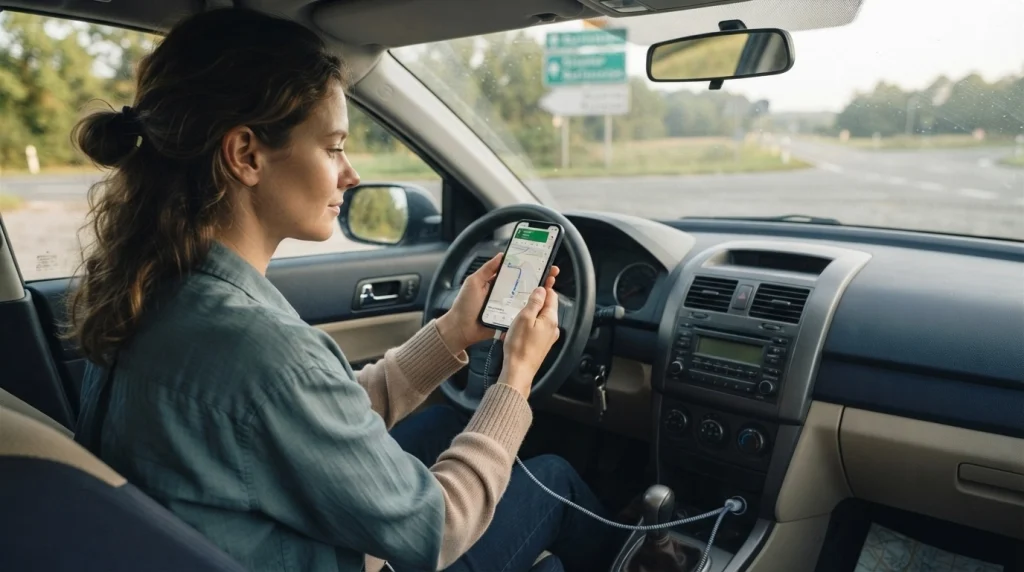
If you realize you’re lost while driving alone, prioritize road safety before trying to solve the navigation problem. You do not need to find the correct road immediately; you need to avoid making the situation more dangerous.
1. Stay calm and keep driving safely
Missing a turn is inconvenient, not an emergency by itself. Take a breath, keep your attention on traffic, and follow the road until you can stop legally and safely.
Do not swerve across lanes, reverse on a busy road, or make a sudden turn because your GPS announces a missed exit. A few extra minutes on the road are preferable to a collision.
2. Stop interacting with your phone
Never type a new address, zoom in on a map, or read messages while the vehicle is moving. The National Highway Traffic Safety Administration’s distracted-driving guidance recommends parking safely before using your phone for tasks that take your attention away from driving.
If you have a passenger, ask them to manage navigation. When traveling alone, wait until you’ve parked before making adjustments.
3. Work out what kind of problem you’re facing
Not every wrong turn requires the same response. Identify whether you have a simple navigation mistake, a technical problem, or a potential safety concern.
- Wrong turn: Your navigation still works, and you need to recalculate the route.
- Lost signal: Your phone cannot load maps or establish a connection.
- Road closure: Your planned route is blocked or unsafe to use.
- Vehicle trouble: Your car has a mechanical issue, a flat tire, or insufficient fuel.
- Personal safety concern: You suspect someone is following you or feel threatened by your surroundings.
Knowing which problem you have helps you choose the right response instead of making several rushed decisions at once.
Section takeaway: Stop making navigation decisions under pressure. Get to a safe stopping point, identify the problem, and then choose your next step.
Where Is the Safest Place to Stop When Driving Alone?
The safest place to stop is a legal, accessible location where you can assess your route without exposing yourself to unnecessary traffic or personal risk. Look for a suitable public place rather than pulling over wherever the road happens to allow it.
Choose a stopping place that fits the situation
- Busy fuel station: Often useful for checking directions, buying fuel, or asking an employee for help.
- Staffed shopping center: Can provide lighting, people nearby, and access to customer service during opening hours.
- Official rest area: A practical option on highways where stopping on the shoulder would be dangerous.
- Hotel or established business: May offer a safer place to regroup, use a phone, or arrange transportation.
- Police station or designated emergency facility: Appropriate when you face a credible threat or need urgent assistance.
These options are not equally suitable in every location. Check opening hours, access restrictions, lighting, and the surrounding area before choosing where to stop.
Places to avoid when possible
A quiet shoulder, an unlit parking area, or an isolated side road may leave you with fewer options if something goes wrong. Avoid stopping in a travel lane or on a narrow shoulder unless an emergency makes it unavoidable.
If your car breaks down on a highway, follow local roadside-emergency guidance. Turn on hazard lights when appropriate, remain aware of passing traffic, and contact roadside assistance or emergency services as needed.
Do not assume that leaving the vehicle is always safer. On a busy motorway, staying inside with your seat belt on may be the safer choice, depending on the vehicle’s position and local emergency guidance.
Should you stop at a stranger’s house?
Usually, a staffed public business is a better first option than approaching an unfamiliar private residence. You can request directions from employees without having to enter someone’s home or disclose unnecessary personal information.
If a stranger offers help, you can politely decline a ride or an invitation to follow them somewhere. You can ask them to explain the route while you remain in a public, secure location.
Section takeaway: Choose a legal, visible stopping place with reliable access to help. Your surroundings matter as much as your ability to get back on the right road.
How Can You Find Your Route Again Safely?
You can usually recover your route by checking your current location, confirming your destination, and choosing a sensible route from where you are now. Use reliable navigation tools, but do not follow an app blindly when road conditions or personal safety suggest another option.
Use GPS navigation correctly
Once parked, open your preferred navigation app and check whether it has identified your actual location. If the map shows you in the wrong place, wait briefly for the location to update or compare it with nearby road signs.
Before restarting the car, confirm these details:
- Destination: Check the exact address, hotel name, or entrance you need.
- Current location: Identify the road, nearest intersection, town, or recognizable landmark.
- Next maneuver: Review the next few turns instead of focusing only on the final arrival time.
- Road conditions: Look for closures, toll roads, restricted roads, and routes that may be unsuitable for your vehicle.
- Arrival time: Consider whether the suggested route will take you onto unfamiliar roads after dark.
If the app suggests a route through an isolated area, an unpaved road, or a location you do not feel comfortable entering, look for a suitable alternative. The shortest route is not always the most practical one.
What if your phone has no signal?
A weak mobile signal does not always mean you have lost every navigation option. Depending on your device, settings, and map app, you may still be able to view your position on previously downloaded maps.
Try these options after parking safely:
- Open an offline map you downloaded before the trip.
- Check saved directions, screenshots, or written notes from your travel plan.
- Look for road signs showing towns, route numbers, and distances.
- Use a vehicle navigation system if available and functioning.
- Ask staff at a reputable business to help identify your location or contact assistance.
If none of these options works, do not drive randomly hoping to find a familiar road. Stay somewhere appropriate and seek reliable local assistance.
Use landmarks and road signs as backup tools
Road signs can help you confirm whether you are heading toward the right town, highway, or district. A major intersection, bridge, railway station, or public building may also help you identify your position.
When asking for directions, request one clear destination or a simple route back to a main road. Complicated verbal instructions can be difficult to remember, especially when you are already stressed.
GPS versus asking someone for directions
Both methods can help you recover your route, but they serve different purposes. Use this comparison to decide what makes sense in your situation.
| Option | Best used when | Main limitation |
|---|---|---|
| GPS navigation | You have a working device and a usable map | Signal, map accuracy, or road restrictions may cause problems |
| Offline maps | Mobile data is unavailable but maps were downloaded | Live traffic and some route features may be unavailable |
| Road signs | You need to identify a highway, town, or junction | Signs may be missing, unclear, or unfamiliar |
| Staff at a public business | You need local directions or help contacting someone | Staff may not know the route or speak your language |
| Roadside assistance | Your vehicle is disabled or cannot continue safely | Response time and service coverage vary by location |
For solo travel, I recommend having at least two navigation options available before setting off. For example, use live GPS navigation alongside an offline map and a saved copy of your accommodation address.
Pro tip: Before an international road trip, review the destination’s official driving guidance at the U.S. Department of State’s driving and transportation safety page. Check local road rules, driving conditions, and emergency arrangements for your specific destination.
Section takeaway: Rebuild your route from a confirmed location, not from guesswork. If navigation remains unreliable, seek assistance before continuing.
Who Should You Contact If You Cannot Find Your Way?
If you cannot work out your location or route, contact someone who can help you make a safe, informed decision. The right person depends on whether you need directions, vehicle assistance, local information, or emergency protection.
Contact someone you trust
A friend, family member, or trusted travel contact can help you think clearly when you feel overwhelmed. Once parked, share your live location if your phone supports it, along with your intended destination and an approximate arrival time.
If your location-sharing feature is unavailable, send a screenshot of your map or describe nearby signs and landmarks. Tell your contact when you expect to check in again.
Keep your messages practical. You do not need to post your precise location publicly or tell strangers that you are traveling alone.
Ask staff at a reputable public business
If your phone cannot establish your location, ask an employee at a staffed fuel station, hotel, or other established business for assistance. They may be able to identify the nearest main road or help you contact a taxi company, roadside service, or local authority.
Ask for directions to a recognizable public destination rather than accepting an unfamiliar detour. If you feel uncomfortable, thank the person and seek help elsewhere.
Contact roadside assistance if your car is the problem
If your vehicle has a flat tire, engine trouble, or another mechanical issue, use your rental company’s assistance number, motor club, insurer, or local roadside service. Tell the dispatcher your location, vehicle description, problem, and whether you are in a dangerous position.
For a rental car, follow the rental company’s breakdown instructions and insurance terms. Avoid agreeing to costly repairs from an unsolicited tow operator before confirming that the service is legitimate, unless an immediate emergency requires urgent action.
When should you call emergency services?
Call the local emergency number if you face an immediate threat, a serious collision, a medical emergency, or another situation requiring urgent assistance. You do not have to wait until you have exhausted every navigation option.
Emergency numbers differ between countries. Before an international trip, save the correct number and learn whether operators can communicate in a language you understand.
If you are unsure whether the situation qualifies as an emergency, explain what is happening to the local emergency operator or an appropriate authority and follow their instructions.
Section takeaway: Contact a trusted person for reassurance, roadside assistance for vehicle problems, and emergency services for immediate danger. Be specific about your location and needs.
What Should You Do If You Feel Unsafe or Stranded?
If getting lost turns into a personal safety concern, stop treating the situation as a simple navigation problem. Your priority is reaching a safer environment and getting appropriate help, even if that means abandoning your original itinerary.
What if you think someone is following you?
If another vehicle appears to be following you and you feel threatened, avoid driving to your accommodation or another private location where the person could learn where you are staying. Do not pull over in an isolated place to confront the driver.
Instead, consider these steps:
- Stay in control: Keep your doors locked and windows closed while driving, where appropriate.
- Head toward help: If you can drive safely, head to a staffed public location or police facility rather than an isolated road.
- Contact assistance: Call local emergency services if you believe you are in immediate danger.
- Share your location: Tell a trusted person what is happening when you can do so safely.
- Avoid confrontation: Do not stop to question the other driver or try to prove that you are being followed.
One unusual turn or a vehicle appearing twice does not prove someone is following you. Focus on observable behavior, your surroundings, and the safest practical next step.
What if you are lost after dark?
Nighttime navigation can be more difficult because landmarks are harder to recognize and some businesses close. If you are unfamiliar with the area, prioritize well-maintained roads and established public destinations over shortcuts through isolated neighborhoods.
If you cannot confidently identify a safe route, stop at a suitable staffed location and reassess. You may decide to book a nearby hotel, arrange a licensed taxi, or postpone the drive until daylight.
Do not continue driving simply because you feel embarrassed about being lost. A change of plan is sensible when visibility, fatigue, or uncertainty makes driving less safe.
What if you run out of fuel or your car breaks down?
A vehicle problem can turn a navigation mistake into a roadside emergency. Your response should depend on the road, traffic, weather, and condition of the vehicle.
- Move out of traffic if you can do so safely.
- Activate hazard lights when appropriate.
- Contact roadside assistance or emergency services if your position creates immediate danger.
- Avoid accepting unsolicited help that makes you uncomfortable.
- Follow local guidance about remaining inside the vehicle or moving to a safer place.
On a busy highway, do not attempt repairs beside moving traffic. If your vehicle is in a dangerous position, explain that clearly when requesting help.
What if you are in an unfamiliar country?
Driving abroad adds another layer of uncertainty because road signs, driving conventions, and emergency procedures may differ from those at home. Some destinations also have roads that become difficult to navigate after dark or during severe weather.
Before continuing, check official information about local driving requirements and road conditions. The U.S. Department of State’s international travel guidance provides a starting point for travelers visiting other countries.
If you need help from an embassy or consulate, remember that its role and available services differ from those of local emergency responders. For an immediate threat or road accident, contact the appropriate local emergency service first when possible.
Pro tip: Save your destination’s official emergency number, your rental company’s assistance contact, and your accommodation details before departure. Verify that these details apply to the country where you are driving.
Section takeaway: Feeling unsafe is a valid reason to change your plans. Choose safety over reaching your original destination on time.
How Can You Prepare for Getting Lost on a Solo Drive?

The best time to prepare for a navigation problem is before you start the engine. A small amount of planning can reduce stress and help you make better decisions if your GPS fails or your route changes unexpectedly.
Build a simple navigation backup plan
Before leaving, make sure you can identify your destination and request help even if your preferred navigation app stops working.
- Download offline maps: Save the areas you expect to visit while you have reliable internet access.
- Save important addresses: Keep your accommodation, rental-car office, and planned stops in your phone.
- Carry a charging cable: A working phone is less useful when its battery is empty.
- Bring a power bank: Keep a backup power source charged and accessible.
- Record emergency contacts: Save local emergency numbers and roadside assistance details.
- Keep a paper backup: Write down essential addresses and directions in case your phone becomes unusable.
These preparations do not eliminate every problem, but they give you alternatives when one tool fails.
Plan your route around safety, not just speed
When choosing a route, consider the type of roads, expected driving time, weather, daylight, and availability of fuel or rest stops. A slightly longer route on familiar main roads may be more manageable than an unfamiliar shortcut.
For a long solo drive, identify one or two reasonable stopping points before departure. This gives you places to reassess your route without searching for somewhere suitable under pressure.
Tell someone about your plans
Sharing a basic itinerary helps a trusted person recognize when your journey may not be going as expected. You do not need to report every turn, but agree on a check-in time for longer drives.
Include these details in your plan:
- Your departure location and intended destination.
- Your estimated arrival time.
- The main route or planned stopping points.
- Your accommodation details, when relevant.
- A simple plan for contacting each other if you are delayed.
If you change your route substantially, update your contact when you can safely do so. Never send updates while driving.
Prepare for driving in unfamiliar places
For international trips, review local driving laws, road signs, license requirements, insurance coverage, and any rules about using a phone or navigation device. You should also know whether your rental agreement restricts certain roads or areas.
Research the journey in advance rather than relying entirely on the navigation app. Official road authorities, destination travel guidance, and reputable rental companies can help you understand local conditions.
As of October 2026, these precautions remain practical for solo road trips in both familiar and unfamiliar destinations. However, road closures, local laws, and emergency arrangements can change, so verify current details before departure.
Section takeaway: Prepare offline navigation, backup contacts, and planned stopping points before leaving. A backup plan makes an unexpected detour easier to manage.
Frequently Asked Questions
Should I keep driving if I get lost while driving alone?
Continue only if you can drive safely and are heading toward a suitable place to stop. Avoid sudden turns or using your phone while moving. Once you reach a legal, safe stopping point, check your location and establish a reliable route before continuing.
Is it safe to ask strangers for directions when traveling alone?
You can ask for directions, but a staffed public business is often a more comfortable option than approaching an unfamiliar person in an isolated area. Keep your interaction public, avoid unnecessary personal details, and decline rides or invitations that make you uncomfortable.
What should I do if my GPS stops working in an unfamiliar area?
Park safely and check whether your offline maps, saved directions, or vehicle navigation system can help. Use road signs to identify your location, and ask staff at a reputable public business for assistance if necessary. Avoid driving randomly when you cannot establish a safe route.
Should I call the police if I get lost while driving alone?
Getting lost by itself usually does not require a police call. Contact local emergency services if you face an immediate threat, a dangerous breakdown, a serious accident, or another urgent safety problem. For ordinary directions, contact a trusted person or seek help at a suitable public business.
What should I do if I get lost while driving alone at night?
Find a legal, well-lit stopping place with reliable access to help, such as a staffed fuel station or suitable public facility. Recheck your route and avoid isolated shortcuts. If you cannot establish a safe journey, consider arranging reliable transportation or staying somewhere secure until daylight.
How can I let someone know where I am if I have no mobile signal?
Use any available offline navigation to identify a nearby road, town, or recognizable landmark. If you can safely reach a staffed business, ask for help contacting your trusted person. If you face immediate danger, seek the nearest appropriate emergency assistance rather than relying on location-sharing technology.
How can I feel more confident driving alone in a new destination?
Practice your route planning before departure, download offline maps, learn local driving rules, and identify safe stopping places. Start with shorter drives when possible and allow extra time for unfamiliar roads. Confidence comes from preparation and knowing how to respond when plans change.
Final Takeaway: Put Your Safety Before Your Schedule
Getting lost while driving alone does not mean you have failed as a traveler. It means you have encountered an unexpected problem that needs a calm, practical response.
Remember these priorities:
- Stay focused on driving until you can stop safely.
- Use a legal, suitable stopping place to check your location.
- Confirm your route before setting off again.
- Contact a trusted person or appropriate local assistance when needed.
- Change your plans if the route, weather, or surroundings feel unsafe.
Solo travel becomes more manageable when you prepare for the unexpected. Keep your navigation backups ready, share your plans with someone you trust, and give yourself permission to pause when you need to.
You do not have to solve every problem immediately. The safest next step is the one that helps you regain control without putting yourself at unnecessary risk.
Pro tip: Review current destination-specific driving advice and local emergency information before your next solo road trip. Official guidance is more reliable than assuming the rules and road conditions will match those at home.
