Which Local Phrases Should a Woman Learn Before Traveling Alone?
Quick Answer
Before traveling alone, a woman should learn local phrases for greetings, directions, transportation, prices, food needs, accommodation, medical help, boundaries, and emergencies. You do not need conversational fluency, but you should be able to ask for help, understand a simple answer, and communicate when your phone fails; review official communication guidance for international travel while preparing.
Learn these first
- Basic courtesy: Hello, please, thank you, excuse me, yes, and no.
- Directions: Where is this place, station, hotel, restroom, or exit?
- Transport: How much is the fare, and does this go to my destination?
- Food and health: I am allergic to this, I need water, and I need a doctor.
- Firm boundaries: No, please stop, leave me alone, and do not touch me.
- Emergency help: I need help, call the police, and where is the nearest hospital?
One important rule
- Verify translations and pronunciation with a reliable native or destination-specific source before departure. A phrase is only useful if locals can understand what you mean.
If you are wondering which local phrases should a woman learn before traveling alone, focus on phrases that help you move, pay, eat, communicate, and leave uncomfortable situations. Learning local language for solo travel is less about sounding fluent and more about staying capable when you need something quickly.
I use a simple test when building a travel phrase list: could this sentence help me solve a real problem without depending on my phone? If yes, it earns a place on my list.
In This Guide
- Why Do Local Phrases Matter When You Travel Alone?
- What Local Phrases Should a Solo Woman Learn First?
- Which Safety and Emergency Phrases Matter Most?
- What Phrases Help With Transport, Food, and Hotels?
- How Should You Learn and Save Local Phrases?
- Frequently Asked Questions
- What Should You Remember Before You Leave?
Why Do Local Phrases Matter When You Travel Alone?
Local phrases give a solo traveler another way to solve small problems independently. They also reduce your dependence on mobile data, translation apps, and finding someone who speaks your language.
A solo-travel survival phrase is a short expression learned before a trip because it helps you complete an essential task, communicate a need, set a boundary, or request assistance in the destination’s local language.
You do not need hundreds. Twenty carefully chosen phrases can be more useful than memorizing long vocabulary lists without context.
The goal is functional communication. You want enough language to create options when plans change.
Local language can make everyday travel easier
Small interactions happen constantly when you travel alone. You may need to confirm a platform, ask about a fare, find a restroom, or explain where you are staying.
- At a station: “Does this train go to ___?”
- In a taxi: “How much will it cost?”
- At a café: “I would like this, please.”
- On the street: “Where is ___?”
- At your hotel: “I have a reservation.”
These are simple sentences. Yet they cover situations you might face several times a day.
Language can also support safer decisions
A woman traveling alone may sometimes need language that is more direct than ordinary tourist vocabulary. Knowing how to say “no,” “stop,” or “I need help” can matter more than knowing the names of ten local dishes.
The U.S. State Department advises women travelers to research local customs, laws, transport, and destination-specific risks before departure. You can review its guidance for women travelers while deciding which phrases deserve priority.
- Know the local emergency number.
- Know how to ask for police or medical help.
- Learn one unmistakable phrase for telling someone to stop.
- Know how to ask where the nearest safe public place is.
- Save your accommodation name and address offline.
Language does not remove travel risk. It gives you one more practical tool when you need to act.
Section Takeaway: Learn phrases based on situations, not vocabulary categories. Prioritize words that help you navigate, communicate needs, protect boundaries, and find assistance.
What Local Phrases Should a Solo Woman Learn First?

Start with a small phrase set that covers courtesy, navigation, money, communication, and basic needs. These phrases offer the highest everyday value for most destinations.
Translate the sentences into the main language used where you are going. Then confirm both meaning and pronunciation before your trip.
| Phrase category | Examples to translate | Priority |
|---|---|---|
| Courtesy | Hello, please, thank you, excuse me | High |
| Understanding | I don’t understand, please speak slowly | High |
| Directions | Where is ___? Is it near? Which way? | High |
| Transport | Does this go to ___? Stop here, please | High |
| Money | How much? Can I pay by card? | Medium |
| Food | I would like this, without ___, I am allergic to ___ | High when medically relevant |
| Boundaries | No, stop, leave me alone, do not touch me | Essential |
| Emergency | Help, police, hospital, doctor | Essential |
Start with six courtesy phrases
Courtesy words make ordinary interactions smoother. They also help you begin a conversation before pointing to a map or showing someone an address.
- Hello.
- Please.
- Thank you.
- Excuse me.
- Yes.
- No.
Learn the culturally appropriate version, not just a literal translation. Some languages change wording based on formality, age, or gender.
Learn phrases for when communication breaks down
You will not understand every reply. Prepare for that before you start asking questions.
- I don’t understand.
- Please speak slowly.
- Can you repeat that?
- Can you show me?
- Can you write it down?
- Do you speak English?
“Can you show me?” is especially useful. A person can point to a platform, menu item, building, or street even when you share almost no vocabulary.
Know numbers that affect your trip
You do not have to memorize every number. Learn enough to recognize common prices, times, platforms, and quantities.
- One through ten.
- Your room number.
- Your train or bus number.
- Common money amounts.
- The words for today and tomorrow.
- The local way of saying morning, afternoon, and evening.
I would prioritize recognition over perfect pronunciation here. Understanding that someone said platform eight can be more useful than reciting numbers flawlessly.
Which Safety and Emergency Phrases Matter Most?
The most important safety phrases are short, unmistakable, and easy to say under stress. Learn them before fun vocabulary such as shopping expressions or sightseeing terms.
Your exact list should reflect your destination. Local laws, emergency systems, and cultural expectations vary.
Memorize direct boundary phrases
Polite language works for ordinary situations. An uncomfortable situation may require something shorter and firmer.
- No.
- Stop.
- Leave me alone.
- Do not touch me.
- Move away from me.
- I am leaving.
- I am not going with you.
Do not make these phrases complicated. You want language you can remember even when you feel startled or stressed.
Learn how to attract assistance
Know at least one general request for help and one phrase for each major emergency service. Confirm your destination’s emergency number separately.
- Help me, please.
- I need help.
- Call the police.
- Call an ambulance.
- I need a doctor.
- Where is the police station?
- Where is the hospital?
- This is an emergency.
A useful solo-travel phrase should be understood quickly. Avoid long explanations when one direct sentence will work.
Prepare one medical information card
If you have allergies, a chronic condition, or an important medication, save the relevant wording in the local language. Keep it available offline as well as on paper.
- I am allergic to ___.
- I take this medicine.
- I have ___.
- I need a doctor.
- I need a pharmacy.
- Where is the nearest hospital?
The CDC recommends planning in advance for medical care abroad and suggests having important medical information available in the destination’s local language when possible. Review its health-care-during-travel guidance before departure.
Pro tip: Verify emergency numbers, medical options, local laws, and current safety information through official government or destination sources before every international trip.
Section Takeaway: Your emergency language list should be short enough to memorize. “No,” “stop,” “help,” “police,” “doctor,” and “hospital” belong near the top.
What Phrases Help With Transport, Food, and Hotels?
Transport, meals, and accommodation create many of the conversations a solo traveler has each day. Learning a few repeatable sentence patterns can cover dozens of situations.
Transportation phrases
Transport phrases should help you confirm three things: destination, price, and stopping point. These reduce the need to explain complicated routes.
- Where is the train station?
- Where is the bus stop?
- Does this go to ___?
- Which platform do I need?
- What time does it leave?
- How much is the fare?
- Please take me to this address.
- Please stop here.
- Is this the correct stop?
Save your hotel’s address in the local writing system whenever possible. Showing an accurate written address can solve a communication problem faster than repeating a place name.
Food and restaurant phrases
Most travelers can order by pointing. Dietary restrictions and allergies need more precise language.
- A table for one, please.
- I would like this.
- Without ___, please.
- Does this contain ___?
- I am allergic to ___.
- Is this vegetarian?
- Water, please.
- The bill, please.
If an ingredient could cause a serious medical reaction, do not depend on improvised translation. Prepare a verified allergy card before traveling.
Hotel and accommodation phrases
Your accommodation phrase list should help you check in, fix a room problem, and communicate with reception. Keep your booking confirmation available offline too.
- I have a reservation.
- My name is ___.
- What time is check-out?
- Where is my room?
- The key does not work.
- The door does not lock.
- I need another room.
- Please call a taxi for me.
- Can you write the address for me?
- Where is the nearest pharmacy?
One phrase deserves special attention: “The door does not lock.” If something affects your room security, you want to communicate it clearly without constructing a sentence on the spot.
Shopping and payment phrases
You only need a few money-related phrases for most trips. Combine them with numbers and gestures when necessary.
- How much is this?
- Is that the total price?
- Can I pay by card?
- Cash only?
- Do you have change?
- I don’t want this, thank you.
That last sentence is useful in markets and high-pressure sales situations. A short, practiced refusal is easier than inventing an excuse.
How Should You Learn and Save Local Phrases?
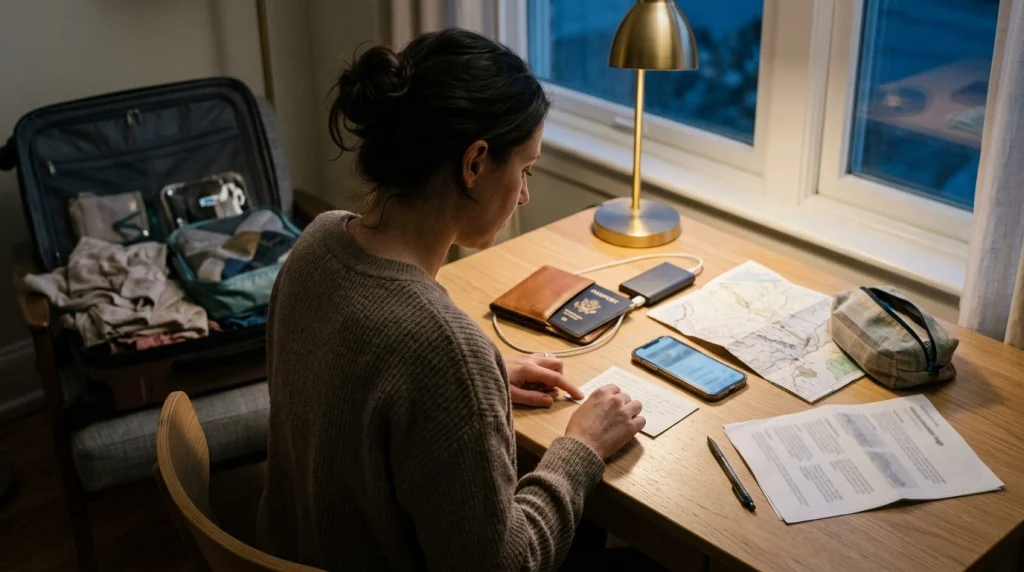
Do not spend your preparation time trying to become fluent. Build a small travel language system you can use when you are tired, offline, or under pressure.
Step 1: Build a personal list of 20 to 30 phrases
Start with the situations you are most likely to face. Then add phrases based on your health, itinerary, accommodation, and transportation plans.
- Choose six basic courtesy phrases.
- Add five directions and transportation phrases.
- Add three payment phrases.
- Add any necessary food or allergy wording.
- Add four firm safety phrases.
- Add emergency and medical requests.
A beach resort, hiking trip, large city, and rural homestay will not require identical language. Customize the list.
Step 2: Verify meaning instead of trusting one automatic translation
Automatic translation is convenient, but context matters. A literal translation can sound unusually formal, childish, vague, or completely different from how locals speak.
- Check a reputable phrasebook.
- Compare more than one translation source.
- Ask a native speaker when possible.
- Confirm formal and informal versions.
- Listen to recorded pronunciation.
- Check whether gender affects the wording.
This matters most for medical details, allergies, emergencies, and firm boundary phrases. Those are not good places for guessing.
Step 3: Practice hearing the answer
Travelers often practice asking a question but forget that someone will answer it. Train yourself to recognize likely responses.
If you learn “Which platform?” also learn the numbers. If you learn “How much?” practice recognizing common prices.
- Listen to several native-speaker recordings.
- Repeat each important phrase aloud.
- Practice at normal speaking speed.
- Learn common directional words such as left, right, straight, near, and far.
- Learn yes, no, open, closed, today, and tomorrow.
Step 4: Keep an offline phrase card
Your phone may lose signal, run out of battery, or become unavailable. Keep a second version of your essential information.
- Save screenshots of important translations.
- Download offline language data when your translation app supports it.
- Write essential phrases on a small card.
- Save your accommodation address in the local script.
- Write down the local emergency number.
- Keep critical medical wording easy to reach.
The State Department also recommends backup communication planning when traveling abroad. Your phone should be useful, but it should not be your only plan.
Step 5: Practice phrases as complete scenarios
I prefer practicing short travel situations instead of isolated words. It is closer to how you will use the language.
- Taxi: “Please take me to this address. How much?”
- Station: “Does this train go to ___? Which platform?”
- Restaurant: “I am allergic to ___. Does this contain ___?”
- Hotel: “The door does not lock. I need another room.”
- Boundary: “No. Stop. Leave me alone.”
- Emergency: “I need help. Call the police.”
Practicing this way builds recall. Your brain connects the phrase to a situation instead of treating it like a vocabulary test.
As of 2026, translation technology makes international communication easier than ever. Still, learning a small set of local phrases remains useful because batteries, networks, apps, and stressful situations do not always cooperate.
Before departure, also review destination-specific health information and emergency planning guidance from the CDC Travelers’ Health resources.
Section Takeaway: Memorize a small core list, verify critical translations, practice likely replies, and keep an offline copy. Your language plan should still work when your phone does not.
Frequently Asked Questions
How many local phrases should I learn before traveling alone?
Aim for about 20 to 30 high-value phrases instead of trying to learn hundreds of words. Cover greetings, directions, transportation, payments, food needs, boundaries, medical help, and emergencies first, then add destination-specific expressions.
What is the most important phrase for a solo female traveler?
There is no single phrase for every situation, but “help,” “no,” “stop,” and “I need a doctor” deserve high priority. You should also know how to request police or emergency assistance in the local language.
Do I need to speak the local language to travel alone safely?
No. Many women travel independently without speaking the destination’s language fluently, but a basic phrase set improves communication and reduces dependence on technology. Research how widely your own language is understood before you go.
Should I learn polite phrases or emergency phrases first?
Learn both, but memorize emergency and boundary language before optional tourist vocabulary. Courtesy phrases support daily interactions, while phrases such as “stop,” “help,” and “hospital” may matter when time and clarity are more important.
Is a translation app enough for solo travel?
A translation app is useful, but it should not be your only communication method. Keep key phrases, medical information, your accommodation address, and emergency details available offline in case your phone loses power, service, or access.
Should I learn phrases in the local alphabet or script?
If the destination uses a different writing system, keep important addresses and phrases in both that script and one you can read. Showing the local version can help drivers, hotel staff, pharmacists, and other people understand you more quickly.
What phrases should I learn if I have a food allergy?
Learn “I am allergic to ___,” “Does this contain ___?” and wording that explains the seriousness of your allergy. Have the translation professionally or reliably verified, and carry it in writing rather than relying only on memory.
What Should You Remember Before You Leave?
You do not need to speak perfectly to travel independently. You need a practical set of phrases that helps you ask, understand, refuse, navigate, and get help.
Start with the words you would need on a difficult day, not just an easy sightseeing day. That usually means prioritizing transport, directions, health needs, clear boundaries, and emergency assistance.
- Learn 20 to 30 useful phrases.
- Memorize the shortest safety phrases.
- Verify medical and allergy translations carefully.
- Practice hearing numbers and directions.
- Save important wording offline.
- Carry your accommodation address in the local script.
- Check the destination’s emergency number before arrival.
Then learn a few friendly extras. A genuine hello, please, and thank you can make everyday interactions warmer while giving you more confidence each time you speak.
Your goal is not perfect grammar. It is being able to handle the next small problem yourself and keep moving.