What Should a Woman Do If Hotel Staff Enter Her Room Unexpectedly?
Quick Answer
If hotel staff enter your room unexpectedly, prioritize your immediate safety, keep a clear path to the exit, and tell the person to stop or leave if you feel uncomfortable. Once you are safe, contact the front desk or hotel security, document what happened, and request a room change or a different accommodation if necessary. If someone threatens you, refuses to leave, or attempts to assault you, seek emergency assistance immediately.
What to do first
- Protect yourself: Move toward a safer position and keep an unobstructed route to the door.
- Set a boundary: Clearly say, “I wasn’t expecting anyone. Please leave now.”
- Verify the reason: Contact reception independently to confirm who entered and why.
- Report the incident: Ask the manager on duty to investigate and record your complaint.
- Preserve details: Note the time, person’s description, what they said, and any witnesses.
- Escalate if necessary: Contact local emergency services if you face an immediate threat.
Remember
- You do not have to confront an employee or prove their intentions before seeking help.
- A legitimate maintenance or housekeeping task does not mean you must accept unsafe or unexplained entry.
An unexpected hotel room entry can be unsettling, especially when you’re traveling alone and have chosen your accommodation to feel secure. Knowing what should a woman do if hotel staff enter her room unexpectedly can help you respond calmly without putting yourself at greater risk.
As a solo female traveler, I consider room privacy an essential part of accommodation safety, not a minor customer-service issue. This guide explains how to respond in the moment, report inappropriate entry, protect your privacy, and decide whether it’s safe to remain at the property.
In This Guide
- What should you do immediately when hotel staff enter unexpectedly?
- Why might hotel staff enter a guest’s room without warning?
- How should you report an unexpected hotel room entry?
- Should you stay at the hotel or move somewhere else?
- How can you protect your room privacy for the rest of your stay?
- What mistakes should solo female travelers avoid?
- Frequently asked questions
What should you do immediately when hotel staff enter unexpectedly?
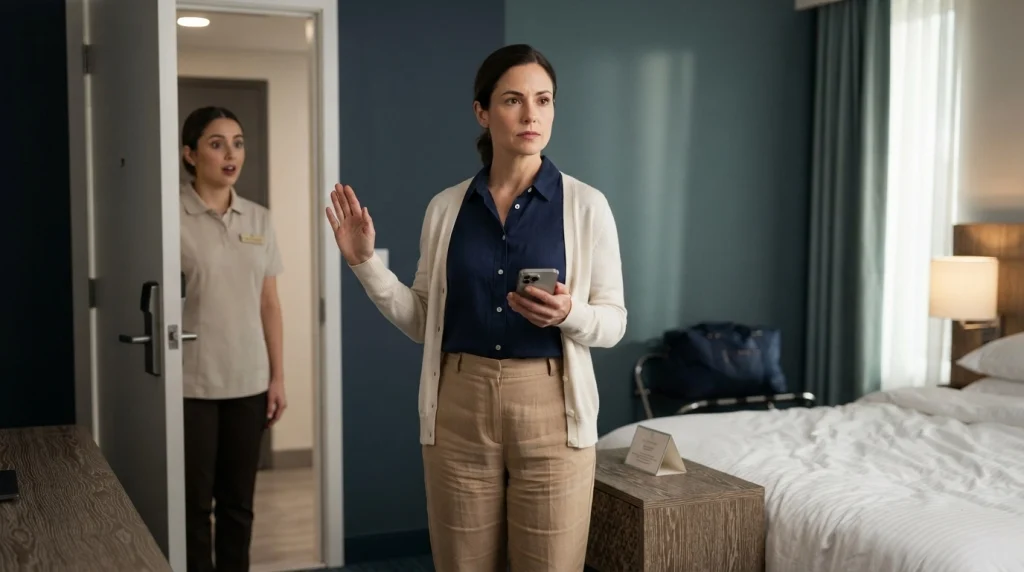
If hotel staff enter your room without warning, focus first on personal safety rather than figuring out whether a hotel rule has been broken. You can question the entry and report it after you have control of the situation.
1. Assess the situation before reacting
Take a quick look at who entered, whether they are alone, and whether you have a safe route out. You do not need to approach the person, grab their identification, or move closer to investigate.
If you are changing clothes, showering, sleeping, or otherwise vulnerable, prioritize covering yourself and creating distance. Keep your phone accessible if you can do so safely.
2. Tell the person to stop or leave
Use a firm, simple statement rather than a long explanation. You can say, “Please leave my room now. I did not authorize this visit.”
If the employee says they need to complete a task, ask them to explain it from the doorway or after they have stepped back into the hallway. You do not have to argue about hotel procedures while feeling threatened.
- Keep your voice clear and assertive.
- Avoid physical confrontation unless necessary to protect yourself from immediate harm.
- Do not let the person block your route to the door or pressure you into moving somewhere isolated.
- If the person refuses to leave or behaves threateningly, move to safety and call hotel security or local emergency services.
3. Contact reception through a trusted channel
Once you can do so safely, call the front desk using the verified number in your hotel information or the number displayed on the official hotel website. Explain that someone entered your room unexpectedly and ask reception to confirm the person’s identity and purpose.
Do not rely solely on the explanation given by the person who entered. Independent verification helps distinguish an ordinary service mistake from an incident that requires further action.
4. Write down what happened
As soon as you’re safe, record the approximate time, how the person entered, what they said, whether they left when asked, and who you contacted. Save relevant messages, call records, and complaint reference numbers.
You do not need to photograph or record someone if doing so could put you at risk. Your immediate safety matters more than collecting evidence.
Safety first
If you suspect an attempted assault, forced entry, theft, or another crime, leave the immediate danger if possible and contact local authorities. Do not wait for a hotel manager to approve your decision to seek help.
Section takeaway: Get safe, set a clear boundary if it is safe to do so, verify the incident independently, and document the details afterward.
Why might hotel staff enter a guest’s room without warning?
Unexpected entry can happen for several reasons, ranging from a housekeeping mistake to a serious security concern. The reason matters, but it does not remove your right to raise concerns about privacy and personal safety.
Common explanations for unexpected entry
- Housekeeping errors: An employee may misunderstand room status, overlook a privacy sign, or enter the wrong room.
- Maintenance work: Staff may believe they need to inspect an appliance, plumbing fixture, air conditioner, or other equipment.
- Miscommunication: A room-status error or an incorrect handover between shifts may make an occupied room appear available for service.
- Welfare concerns: Staff may enter under an emergency procedure if they reasonably believe a guest needs urgent assistance.
- Security or safety checks: A reported leak, alarm, or other hazard may require prompt access, depending on the circumstances.
- Inappropriate conduct: Entry may be unauthorized, unexplained, repeated, or accompanied by behavior that makes you feel unsafe.
These possibilities are not equally serious, and you cannot determine someone’s intentions from the entry alone. Ask the hotel to explain what happened, identify the employee, and clarify whether the visit was authorized under its procedures.
Does hotel staff have the right to enter your room?
There is no single worldwide rule that governs every hotel room entry. The applicable law, accommodation agreement, local emergency rules, and circumstances all matter.
Hotels may have legitimate reasons to access rooms for emergencies, maintenance, housekeeping, or other permitted purposes. However, an employee’s job does not automatically give them unlimited permission to enter whenever they choose.
In 2026, the safest approach is to distinguish between an explanation for entry and a justification for how it happened. Ask whether the hotel had a valid reason, whether notice was required or reasonably possible, and what steps management will take to prevent a repeat.
For general accommodation safety, the U.S. Department of State’s lodging safety guidance recommends checking room security and contacting the front desk about suspicious activity.
When should an unexpected entry concern you more?
Some circumstances call for a stronger response than an ordinary housekeeping mistake. Take the incident particularly seriously if:
- The person enters while you are undressed or in bed and does not promptly withdraw.
- The employee refuses to identify themselves or explain their purpose.
- They ignore a clear request to leave, make sexual comments, threaten you, or attempt unwanted contact.
- The same person returns repeatedly without an agreed appointment or credible explanation.
- You discover missing belongings, signs of tampering, or evidence that someone accessed the room without authorization.
One warning sign does not prove criminal intent, but you do not need proof before reporting a reasonable safety concern. Ask for a manager or security officer, and contact local authorities if the circumstances suggest a crime or immediate danger.
Section takeaway: A service mistake and a threatening intrusion require different responses, but both can be reported. Do not let an employee’s job title discourage you from protecting your privacy.
How should you report an unexpected hotel room entry?
Report the incident to hotel management as soon as you are safe. A clear, factual complaint creates a record and gives the hotel an opportunity to explain the entry and address any security failure.
Speak to the manager on duty
Contact the front desk and request the manager on duty or the security supervisor. If you feel uncomfortable speaking at the reception counter, ask to communicate by telephone or in another public area where you feel secure.
Describe what happened without guessing about the employee’s motives. Include the time, the person’s description, what they said, and whether you had requested housekeeping or maintenance.
Use a direct complaint script
You can adapt this message for an in-person conversation, telephone call, or email.
Sample message to hotel management
“A member of your staff entered my room unexpectedly at approximately [time] on [date]. I had not arranged a visit, and the entry made me concerned about my privacy and safety. Please identify the employee, explain why the entry occurred, record my complaint, and confirm what steps you will take to prevent another incident.”
“I would also like to discuss a room change and any additional security measures available. Please provide a written response or complaint reference.”
Ask for specific corrective action
Rather than accepting a general apology as the entire resolution, ask management to address the practical problem. Depending on what happened, reasonable requests may include:
- A written explanation of the entry and the reason access was permitted.
- Confirmation that the incident has been recorded and referred to the appropriate supervisor.
- A room change, preferably to a different floor or area if that would improve your sense of security.
- Instructions that housekeeping or maintenance must contact you before a non-urgent visit.
- A review of access records or available security footage, where appropriate and legally permitted.
- Assistance arranging alternative accommodation if you no longer feel safe staying there.
Ask the hotel to preserve relevant records promptly if you suspect misconduct. Access logs and surveillance footage may be subject to retention limits and privacy rules, so avoid assuming that every recording exists or can be shared with you.
Escalate if management dismisses your concern
If the hotel refuses to investigate, contact the property owner’s customer relations team, the booking platform you used, or the relevant local consumer protection or tourism authority. If you believe a crime occurred, report it to local police rather than relying exclusively on the hotel.
If you booked through a travel platform, use its official app or website to document your complaint. Request that any relocation arrangement and additional costs be confirmed in writing before you pay, when circumstances allow.
Keep copies of receipts, messages, complaint references, and transport costs. They may help if you later request a refund or submit a formal complaint, although reimbursement is not guaranteed.
Section takeaway: Ask for a documented explanation and a practical solution. Escalate to the booking provider, relevant authorities, or emergency services when the hotel’s response does not address the risk.
Should you stay at the hotel or move somewhere else?
You should not feel obligated to remain in a room or property where you no longer feel safe. The decision depends on the employee’s behavior, the hotel’s response, and whether management can provide a credible way to protect your privacy.
Compare your options before deciding
Use the following guide to assess your next step. It is a practical decision aid, not a substitute for emergency assistance or local legal advice.
| Situation | Recommended response | Next step |
|---|---|---|
| A brief entry followed by an immediate apology | Verify the explanation and assess your comfort level. | Ask management to record the incident and prevent a repeat. |
| Unexplained entry or conflicting explanations | Request a manager and a room change. | Seek written confirmation of the proposed solution. |
| Repeated entry or a staff member ignoring boundaries | Move to a safer location and escalate the complaint. | Contact hotel security, the booking provider, or police as appropriate. |
| Threats, forced entry, or attempted assault | Prioritize escape and immediate assistance. | Call local emergency services when safe to do so. |
When is a room change enough?
A room change may be reasonable when management acknowledges an isolated mistake, explains what happened, and takes credible steps to improve access control. You can ask for a room on another floor or in a different section of the property.
Before accepting the new room, ask management to confirm that your previous key card has been deactivated if necessary. Check that the new door locks properly, and avoid sharing your new room number with anyone who does not need it.
A room change is not enough if you believe the employee may follow you, the hotel refuses to address a credible threat, or the new room does not provide reasonable security. In those circumstances, consider leaving the property.
How can you relocate without increasing your risk?
If you decide to leave, arrange your next step from a safe location rather than confronting the employee or wandering around alone. If possible, ask a trusted friend or family member to stay on the phone while you make arrangements.
- Book replacement accommodation through a verified website or official property contact.
- Use a reputable taxi service or another safe transport option to reach the new property.
- Keep your passport, phone, wallet, medication, and essential documents with you.
- Tell someone you trust when you leave and when you arrive at the new accommodation.
- Keep receipts and written records if you plan to request reimbursement.
If leaving immediately would expose you to greater danger, ask hotel security or local emergency services for assistance with a safe departure. You do not need to handle a threatening situation alone.
Section takeaway: Stay only if you feel safe and management provides a credible response. If the threat continues or your concerns are dismissed, prioritize relocation and outside assistance.
How can you protect your room privacy for the rest of your stay?
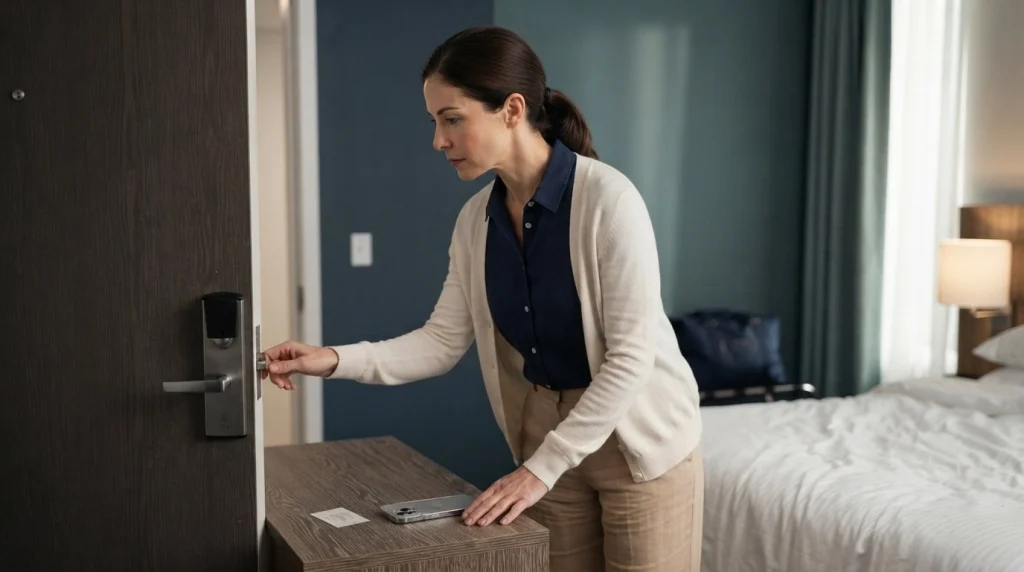
Good room-security habits can reduce unnecessary access and make it easier to respond if another unexpected visit occurs. They cannot guarantee that nobody will enter, so combine preventive steps with a plan for getting help.
Set clear housekeeping preferences
At reception, explain that you prefer staff to contact you before entering for non-urgent housekeeping or maintenance. Ask whether the property can add a privacy note to your reservation and confirm how its staff handle occupied rooms.
A “Do Not Disturb” sign may help communicate your preference, but it is not an absolute guarantee against emergency or otherwise permitted entry. If staff have already entered unexpectedly, ask management what additional measures it can offer.
Use the available door security correctly
- Lock the door: Use the deadbolt or other interior lock whenever you are inside, if available.
- Check the door: Confirm that it closes fully and that the latch engages.
- Use the door viewer: If someone knocks, verify who they are before opening the door.
- Verify visitors: Call reception through a trusted number if you did not arrange the visit.
- Check secondary access: Secure windows, balcony doors, and connecting-room doors where present.
Never disable a fire-safety device or block an emergency exit to make the room feel more secure. Any extra security device should be lawful, compatible with the door, and safe to use in an emergency.
Protect your room number and personal information
Ask reception not to disclose your room number or confirm your presence to other callers or visitors without appropriate verification. Avoid saying your room number loudly in public areas, and keep your key card separate from documents displaying your accommodation details.
If you move rooms because of a safety concern, request that the new room number remain confidential. Tell trusted contacts only the details they need to assist you.
Keep a simple emergency plan
Before settling in, identify the nearest usable exit and learn how to contact reception or security. Save the local emergency number if you know it, and keep your phone charged and accessible.
For broader preparation, review the official lodging safety checklist for advice on checking locks, emergency exits, room phones, and suspicious activity.
It also helps to know the location of the hotel’s staffed public areas. If an employee makes you uncomfortable, you can move toward reception or another populated area instead of remaining alone with them.
Section takeaway: Set your privacy preferences, use the locks provided, keep your room number confidential, and know how to get help. These measures support your safety without creating a false sense of complete protection.
What mistakes should solo female travelers avoid?
After an unexpected entry, it’s natural to feel angry, embarrassed, or unsure about what to do next. You can protect yourself more effectively by avoiding actions that increase risk or make it harder to document the incident.
Don’t assume the employee’s intentions
Some entries result from genuine mistakes, while others may involve inappropriate conduct. Avoid deciding that everything is harmless simply because the person wears a uniform, but do not put yourself at risk trying to establish their motives.
Focus on observable facts, including what the employee did, whether they left when asked, and how management responded. Those details are more useful when you make a formal complaint.
Don’t feel pressured to be polite at your own expense
You can be respectful without agreeing to an unwanted interaction. If you feel unsafe, a firm request to leave is appropriate, and you do not owe anyone a lengthy explanation.
Equally, you do not have to confront the person face-to-face. Calling reception, asking security to attend, or leaving for a safer location may be the better choice.
Don’t delay reporting because you lack proof
You can report an unexpected entry even if you did not take a photograph or obtain the employee’s name. Write down what you remember while the details are fresh and ask management to identify the person through its own records.
Do not search an employee’s personal information, publish unverified accusations, or risk a confrontation to gather evidence. Keep your complaint factual and use the appropriate reporting channels.
Don’t accept reassurance without a practical response
An apology can be appropriate, but it does not automatically resolve a security concern. If the explanation is unclear, ask what happened, how the hotel will prevent a repeat, and who will be responsible for following up.
If the answers do not reassure you, request a room change or relocate. Your decision should reflect your safety assessment rather than the pressure to avoid inconveniencing staff.
Section takeaway: Avoid confrontation, assumptions, and unnecessary delays. Set boundaries, record the facts, and choose the response that best protects you.
Frequently asked questions
Can hotel staff enter my room without permission?
Hotel staff access rules depend on local law, hotel policies, and the circumstances. Emergencies or authorized maintenance may justify entry in some situations, but staff do not automatically have unlimited access. Ask management to explain the reason and check local rules if you believe your privacy rights were violated.
What should I do if hotel staff enter while I’m sleeping or changing?
Cover yourself if possible, move to a safer position, and tell the person to leave if you feel comfortable doing so. Contact reception once safe, report the incident, and request that management investigate. If the person refuses to leave, threatens you, or attempts unwanted contact, seek immediate assistance.
Should I call the police if hotel staff enter my room unexpectedly?
Not every unexpected entry requires police involvement, particularly if it appears to be an isolated service mistake. However, contact local police or emergency services if you suspect assault, attempted theft, forced entry, stalking, threats, or another crime. You do not need the hotel’s permission to report a safety concern.
Can I demand a different hotel room after an unexpected entry?
You can request a room change and explain why you no longer feel comfortable in your current room. Whether the hotel must provide one or cover related costs depends on local law, the booking terms, and the circumstances. Ask for the new room number to remain confidential and confirm the arrangements in writing.
What if the hotel manager says the entry was normal procedure?
Ask the manager to explain the specific policy, why it applied to your room, and whether staff could have notified you beforehand. If you remain concerned, request a written complaint record and consider contacting the property’s head office, booking platform, or relevant local authority. A policy explanation does not automatically resolve a safety concern.
How can I stop hotel staff from entering my room again?
Ask reception to record your privacy preferences and request advance contact for non-urgent visits. Use the available interior locks and display a “Do Not Disturb” sign where appropriate. These steps may reduce unnecessary entry, but they cannot guarantee that staff will never enter for an emergency or another permitted reason.
Should I leave the hotel if I feel unsafe after an unexpected entry?
Yes, leaving is a reasonable option if you believe the risk continues or management cannot provide a credible safety response. Arrange secure transportation and alternative accommodation, keep essential belongings with you, and tell someone you trust about your plans. If you face an immediate threat, contact emergency services first.
Final takeaway: Your privacy and safety come first
When hotel staff enter your room unexpectedly, you do not need to panic or immediately decide whether the incident was intentional. Focus on getting safe, establishing boundaries, and confirming what happened through hotel management.
Document the incident, ask for a practical solution, and consider changing rooms or properties if your concerns remain unresolved. A calm response does not mean accepting behavior that makes you feel unsafe.
For solo female travelers, confidence comes from knowing your options before a difficult situation arises. Keep your phone accessible, know how to contact hotel security, and trust yourself to seek help when something feels wrong.
Your next step: Before your next solo trip, save your accommodation’s verified contact details, learn the local emergency number, and check the room’s locks when you arrive. A few minutes of preparation can make an unexpected situation easier to manage.
Travel safety note: Hotel access rules and emergency procedures vary by destination. For current destination-specific advice, consult the U.S. Department of State or your own government’s official travel advice. If you are in immediate danger, contact the appropriate local emergency service.