Should a Woman Stay in a Hostel on Her First Solo Trip?
Quick Answer
Yes, a woman can stay in a hostel on her first solo trip, and it can be a great choice. Pick a well-reviewed hostel in a convenient location, consider a female-only dorm, and check basic lodging safety guidance before booking. If sharing a room would make you too anxious to sleep, choose a private hostel room or hotel instead.
A hostel makes sense when:
- You want company: Common areas and hostel activities make meeting other travelers easier.
- You choose carefully: Recent reviews, a practical location, lockers, and staffed reception matter more than a bargain price.
- You start small: A four- or six-bed dorm usually feels less overwhelming than a large dorm.
- You protect valuables: Keep passports, money, cards, and electronics locked rather than loose beside your bed.
- You trust your comfort level: You can request another room or leave if something feels wrong.
My first-timer preference
- I would choose a smaller female-only dorm in a highly rated, centrally located hostel for a first stay.
If you’re wondering, should a woman stay in a hostel on her first solo trip, the answer depends on more than safety. Your sleep, privacy needs, budget, destination, and comfort around strangers matter too.
I like hostels because they can make solo travel feel less lonely. But I never choose one simply because it’s cheap.
In This Guide
- Is a hostel a good idea for a woman’s first solo trip?
- Is a hostel or hotel better for your first solo trip?
- How do you choose a good hostel as a solo woman?
- Should you choose a female-only or mixed dorm?
- How can a woman stay safer after checking into a hostel?
- What if you’re nervous about hostel life?
- Frequently asked questions
Is a Hostel a Good Idea for a Woman’s First Solo Trip?
For many women, yes. A good hostel combines affordable accommodation with built-in opportunities to meet people.
A hostel is accommodation where travelers can book shared dorm beds, although many hostels also offer private rooms. Common kitchens, lounges, tours, and social events are common features.
Why hostels can make solo travel easier
One surprising part of a first solo trip is how much time you spend making decisions alone. Even simple choices can feel tiring after a long travel day.
A friendly hostel can reduce that sense of isolation. You might find people having breakfast together, joining a walking tour, or comparing plans in the lounge.
- Easy social contact: You don’t have to approach strangers in random places to meet other travelers.
- Lower accommodation costs: A dorm bed often costs less than booking an entire room.
- Useful local information: Staff often know practical transport routes, tours, restaurants, and nearby services.
- Flexible room choices: Many properties have mixed dorms, female-only dorms, and private rooms.
- Solo-friendly atmosphere: You’re unlikely to be the only person traveling without a companion.
The social part helped me most when I first became comfortable planning solo travel. Having somewhere communal to return to can make an unfamiliar destination feel smaller.
Why a hostel isn’t automatically the right choice
Hostels involve compromises. You’ll usually give up some privacy, quiet, personal space, or control over the room.
A dorm might include snoring, early alarms, late arrivals, rustling bags, and people turning lights on. None of those problems are dangerous, but they can drain your energy.
- Choose another option if shared sleeping spaces make you highly anxious.
- Consider a private room if you need uninterrupted sleep.
- Avoid party-focused properties if nightlife isn’t part of your trip.
- Don’t choose a poorly located hostel just to save a small amount.
Section Takeaway: A hostel can be excellent for a first solo trip when its social benefits outweigh the loss of privacy. Comfort matters as much as price.
Is a Hostel or Hotel Better for Your First Solo Trip?
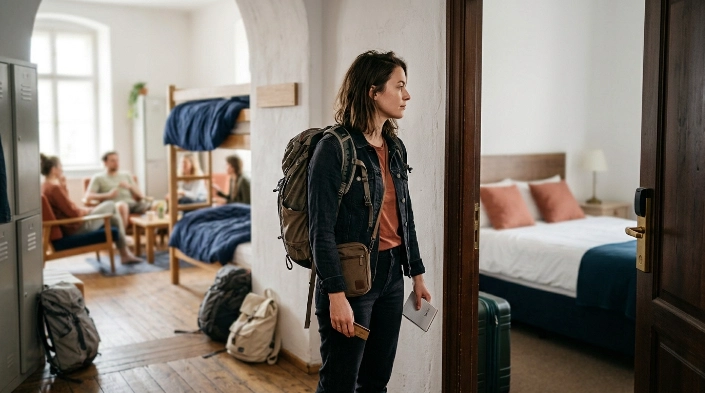
Neither accommodation type is always better. A hostel favors social connection and budget, while a hotel usually gives you more privacy and control.
I choose based on how demanding the trip will be. After a long flight or late arrival, privacy can be worth paying for.
| Option | Privacy | Meeting People | Best For |
|---|---|---|---|
| 4-6 bed female dorm | Low to moderate | Easy | First-timers wanting a social stay |
| Large shared dorm | Low | Easy | Budget-focused travelers comfortable sharing space |
| Private hostel room | High | Easy in common areas | Women wanting hostel social life with private sleep |
| Hotel room | High | Usually limited | Rest, privacy, work, or late arrivals |
Think about the first night separately
You don’t need one accommodation style for your entire trip. Mixing hostels and private rooms works well.
For example, I may choose a private room after an overnight flight. I can switch to a dorm once I’m rested and know the area.
Don’t assume every hostel is a party hostel
Hostels vary widely. Some focus on nightlife, while others attract hikers, digital nomads, families, or travelers seeking quiet communal spaces.
Lonely Planet’s current guide to staying in hostels also emphasizes choosing your room type around your needs. That distinction matters more than the word “hostel” on the listing.
Section Takeaway: Pick the sleeping arrangement that gives you enough rest to enjoy the trip. You can still meet travelers without sleeping in a shared dorm.
How Do You Choose a Good Hostel as a Solo Woman?
Start with location, recent reviews, and basic security. A beautiful hostel isn’t useful if reaching it alone feels stressful.
As of 2026, I also check the latest official destination guidance before international trips. Conditions can change faster than old blog posts.
Read recent reviews strategically
Don’t only look at the overall rating. Search recent reviews for comments about security, cleanliness, staff response, nighttime noise, and the surrounding area.
I pay special attention to reviews written by solo women. Their concerns often match mine more closely.
- Lockers: Check whether each guest gets a locker large enough for valuables.
- Reception: Confirm when staff are available, especially for evening arrivals.
- Room access: Key cards or controlled entry can limit casual access.
- Location: Look at the walk from major transport stops, not just map distance.
- Recent feedback: Give more weight to current reviews than comments from years ago.
- Bathroom setup: Decide whether shared, private, or female-only facilities matter to you.
Research the neighborhood, not just the property
A hostel can have excellent reviews yet sit somewhere inconvenient for your plans. Check how you’ll return after dinner or an evening activity.
The U.S. State Department’s guidance for women travelers recommends researching local transportation and destination-specific risks. Travelers of other nationalities can also consult their own government’s travel service.
Pro tip: Check current government travel guidance shortly before departure and again during longer trips. Local transport, security, demonstrations, weather, and entry conditions can change.
Plan your arrival before you leave home
Your first arrival deserves extra planning. I want to know how I’ll reach the hostel before my plane or train arrives.
- Save the full hostel address offline.
- Screenshot the booking confirmation and check-in instructions.
- Check the last train, metro, or bus time.
- Identify a licensed taxi or reputable ride option as backup.
- Keep enough battery and mobile data for navigation.
- Tell a trusted person where you’re staying.
Section Takeaway: A hostel’s location, access controls, recent reviews, and arrival logistics matter more than trendy photos or the cheapest available bed.
Should You Choose a Female-Only or Mixed Dorm?
For a first hostel stay, I generally favor a small female-only dorm. It can remove one source of uncertainty while you learn how hostel life works.
That doesn’t mean mixed dorms are automatically unsafe. Many women stay in them comfortably.
When a female-only dorm makes sense
A female-only room can feel less intimidating if you’ve never shared accommodation with strangers. It may also make changing clothes or getting ready easier.
- You feel anxious about sharing sleeping space with men.
- You want a gentler introduction to dorm life.
- You prefer female-only bathroom facilities when available.
- You know better sleep will improve your first trip.
These rooms can fill quickly in popular destinations. Book earlier when this room type is important to you.
What about a mixed dorm?
A mixed dorm can be perfectly workable when the hostel is reputable and you’re comfortable with the setup. I would still prefer a smaller room for my first experience.
Lonely Planet’s discussion of mixed dorms for solo women notes positive traveler experiences while also recommending speaking with staff when safety concerns arise.
- Check whether beds have privacy curtains.
- Keep valuables secured instead of beside your pillow.
- Wear sleep clothing you’d feel comfortable being seen in.
- Know where reception is before going to bed.
- Ask to change rooms if someone repeatedly ignores boundaries.
A private hostel room is a useful middle ground
You can get hostel common areas without sharing your bedroom. That option works well for women who enjoy social travel but need private downtime.
It may cost more than a dorm. Still, I sometimes consider the sleep and reduced anxiety worth the difference.
Section Takeaway: Female-only dorms often provide the easiest introduction, but room quality and hostel management matter more than the label alone.
How Can a Woman Stay Safer After Checking Into a Hostel?

Create a simple routine as soon as you arrive. Knowing your room, exits, storage, and staff location reduces avoidable uncertainty.
I do these checks before unpacking because they’re easier while I’m still alert.
My first 15 minutes after check-in
- Find the exits: Notice the nearest emergency route and stairs.
- Check your locker: Make sure it closes securely and use your own lock when needed.
- Locate reception: Know where to find staff during the night.
- Test room access: Understand how doors and key cards work.
- Store documents: Lock away your passport, backup cards, and excess cash.
- Save the address: Keep the hostel’s name and location available offline.
Don’t advertise valuable belongings
Shared accommodation means people come and go. I don’t leave my passport, wallet, laptop, or expensive camera sitting on the bed.
A lock is one of the simplest hostel items to pack. Check whether the property requires a specific lock size.
Keep social drinking within your own limits
Hostel bars and pub crawls can be fun, but you don’t owe anyone a night out. I keep enough awareness to navigate back to my room and manage my belongings.
- Don’t leave a drink unattended.
- Know how you’ll return before going out.
- Keep your phone charged.
- Avoid telling new acquaintances detailed future plans immediately.
- Leave any situation that becomes uncomfortable.
Give yourself permission to change rooms
You don’t need proof that something is wrong before asking for help. Persistent staring, sexual comments, unwanted touching, or repeated boundary violations are enough reasons to involve staff.
If staff dismiss a serious concern, consider alternative accommodation. A backup payment method makes that decision easier.
Pro tip: Save the destination’s emergency number and your relevant embassy or consulate information before traveling internationally. Use official government sources rather than relying on an old social media post.
Section Takeaway: Hostel safety is less about being suspicious of everyone and more about keeping control of your belongings, transport, boundaries, and backup options.
What If You’re Nervous About Hostel Life?
Being nervous doesn’t mean you’re unprepared for solo travel. A shared room is unfamiliar for many first-time travelers.
I make the experience easier by reducing the number of new things happening at once.
Start with two or three nights
You don’t need to book a ten-night dorm stay to prove anything. A short reservation gives you room to reassess.
If you love the hostel, you may extend the booking. If not, you’ve learned something useful about your travel style.
Choose smaller dorms first
A four- or six-bed dorm tends to feel calmer than a room with many bunks. There are fewer alarms, bags, conversations, and people moving around.
The difference can matter when you’re already processing a new city. Sleep is part of travel planning too.
Pack for dorm comfort
- Earplugs: Useful for snoring, doors, alarms, and street noise.
- Eye mask: Helpful when roommates turn lights on at different times.
- Small lock: Use it for the hostel locker when required.
- Flip-flops: Useful for shared shower areas.
- Small pouch: Carry toiletries without unpacking everything.
- Portable charger: Helpful when the nearest outlet isn’t beside your bunk.
You don’t need to be outgoing
Hostel social life isn’t an obligation. You can say hello, join one activity, and spend the rest of the evening reading.
I find structured activities easier than forcing conversation. Walking tours, communal dinners, and small group excursions provide an obvious reason to talk.
Know when the hostel isn’t working for you
Sometimes a property simply isn’t a good match. That’s different from failing at solo travel.
- You haven’t slept properly for several nights.
- The atmosphere feels aggressive or excessively chaotic.
- Staff ignore security concerns.
- Roommates repeatedly cross personal boundaries.
- The location makes returning after dark unnecessarily difficult.
- Your anxiety remains so high that you cannot enjoy the destination.
Changing accommodation is a practical decision. Your trip doesn’t become less independent because you choose a private room.
Section Takeaway: Treat your first hostel as an experiment, not a test of courage. A short stay and smaller dorm let you learn your preferences without trapping yourself.
Frequently Asked Questions About Hostels on a First Solo Trip
Are hostels safe for women traveling alone?
Many women use hostels while traveling alone, but safety differs by property and destination. Check recent reviews, location, secure storage, room access, staffing, and official destination guidance before booking.
Is a female-only dorm safer than a mixed dorm?
A female-only dorm may feel more comfortable and reduce certain concerns, especially for a first stay. However, the hostel’s overall security, management, location, and guest behavior still matter.
How many beds should I choose in my first hostel dorm?
I would start with a four- or six-bed dorm when possible. Smaller rooms usually mean fewer people moving around and fewer disruptions during the night.
Should I stay in a hostel if I’m shy?
Yes, if the accommodation otherwise suits you. You don’t have to attend parties or socialize constantly, and organized tours or communal meals can make meeting people easier.
Can I keep my passport in a hostel locker?
A secure locker is usually preferable to leaving a passport unattended in a dorm. Check that the locker closes properly, and follow destination-specific rules if local law requires you to carry identification.
What should I do if someone makes me uncomfortable in a hostel?
Move toward a public or staffed area and tell hostel staff. Ask to change rooms if needed, and leave the property if the issue is serious or staff won’t help.
Should I book my whole first solo trip in hostels?
No. Mixing accommodation types can work better. You might use hostels when you want company and book a private room before an early flight or after an exhausting travel day.
My final take: Staying in a hostel can be one of the easiest ways to make a first solo trip feel social without giving up your independence.
Choose the property rather than the cheapest bed. Start with a small female-only dorm if that feels comfortable, protect your valuables, plan your arrival, and always give yourself permission to change accommodation.
Your first solo trip doesn’t have to prove how fearless you are. It only needs to help you travel confidently enough to want to do it again.