How Can a Woman Handle Airport Arrival Alone for the First Time?
Quick Answer
If you’re wondering how can a woman handle airport arrival alone for the first time, focus on the process rather than trying to understand the whole airport at once. Follow the arrival signs, keep your passport and phone secure, collect your bag, complete immigration or customs when required, and use pre-arranged or licensed transport to leave the airport. The U.S. State Department’s guidance for women travelers also recommends researching transportation and arranging reputable airport transfers when appropriate.
Your first-arrival steps
- Follow arrival signs: Look for Arrivals, Baggage Claim, Passport Control, Immigration, or Connections.
- Keep documents ready: Have your passport, visa documents, hotel address, and onward-travel details available.
- Stay inside the airport: Solve baggage, phone, money, or transport problems before leaving the secure terminal area.
- Collect the correct bag: Check the baggage tag or another identifying detail before walking away.
- Use official transport: Choose a licensed taxi counter, recognized ride service, airport train, shuttle, or pre-booked driver.
- Share your progress: Message a trusted person after landing and again when you’re safely in your transport.
Arriving alone can feel more intimidating than the flight itself. The signs are unfamiliar, everyone seems to know where they’re going, and you may be tired after hours in the air.
The good news is that a first airport arrival alone is usually a sequence of small tasks. I handle each stage separately rather than thinking about the entire journey at once.
In This Guide
- What should a woman do before landing at an airport alone?
- What happens after your plane lands?
- How do you handle immigration and customs alone?
- How do you collect baggage without getting confused?
- How can a woman leave the airport safely when traveling alone?
- What should you do if something goes wrong?
- Frequently asked questions
What does handling an airport arrival alone mean?
It means independently navigating the steps between leaving the aircraft and reaching your safe onward transportation. Depending on the journey, those steps can include immigration, baggage claim, customs, finding the arrivals hall, getting connected to mobile data, and choosing transport.
What should a woman do before landing at an airport alone?
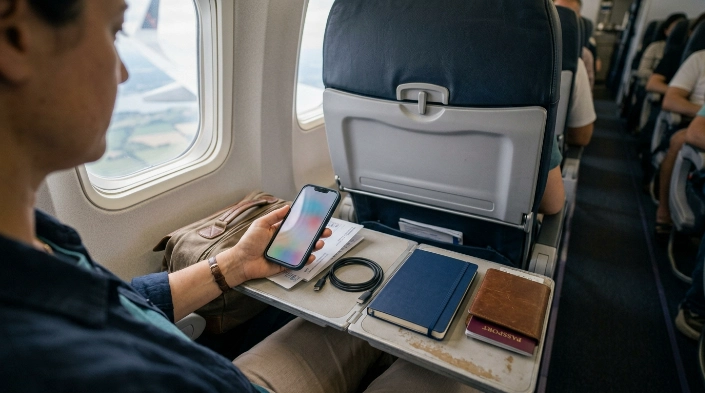
The easiest solo airport arrival begins before the aircraft touches down. I like to prepare the information I’ll need while I’m still seated and calm.
Save the information you may need offline
Your phone may not connect immediately after landing. Airport Wi-Fi can also require registration, a text message, or an email login.
Before the trip, save screenshots or offline copies of the details that matter most:
- Your accommodation name and full address.
- Your booking confirmation.
- Your driver’s name or transfer instructions, if pre-booked.
- Your airline flight number.
- Your passport information page stored securely as a backup.
- Your travel insurance details.
- An emergency contact.
- A map showing your accommodation area.
Keep your actual passport physically secure. A screenshot is useful as backup information, but it doesn’t replace the original document where officials require it.
Know how you’re leaving the airport
Decide this before landing if possible. Arriving tired is not the ideal moment to compare six unfamiliar transport options.
Your plan might be an airport train, hotel shuttle, licensed taxi queue, recognized ride-hailing service, or pre-booked transfer. Check the airport’s official website before travel because pickup zones can change.
I also save the name of the terminal. Large airports may have several terminals with separate taxi, train, or ride-hailing areas.
Tell someone you’ve landed
A simple check-in creates an extra layer of reassurance. Send a short message once your phone reconnects.
You can send another message after entering your taxi, shuttle, train, or other transport. If you’re comfortable doing so, share the trip details or live location with someone you trust.
For international trips, review the U.S. State Department’s international travel planning guidance or the equivalent government travel authority in your home country before departure.
Section Takeaway: Prepare your arrival address, transportation plan, important documents, and emergency contact before landing. You will have fewer decisions to make when you’re tired.
What happens after your plane lands?
After landing, don’t rush just because other passengers are moving quickly. Airport arrivals follow signs and controlled pathways, so you rarely need to invent your own route.
Start by following the correct signs
If this is your final destination, follow signs for Arrivals, Exit, Baggage Claim, Passport Control, or Immigration. If you’re connecting, follow Connections or Transfers instead.
Don’t automatically follow another passenger. She may have a connecting flight while you’re leaving the airport.
Domestic and international arrivals are different
A domestic arrival is usually simpler because there is normally no international border inspection. International arrivals can include immigration and customs requirements determined by the destination country.
| Arrival Step | Typical Domestic Arrival | Typical International Arrival |
|---|---|---|
| Leave aircraft | Yes | Yes |
| Passport or immigration control | Usually no | Often required |
| Baggage claim | If you checked baggage | If you checked baggage |
| Customs process | Normally no international customs step | May be required |
| Arrivals hall | After baggage claim or exit | Usually after border and customs procedures |
| Onward transport | Taxi, rideshare, train, bus, shuttle, pickup | Taxi, rideshare, train, bus, shuttle, pickup |
Airport layouts and border procedures vary. Treat the table as a navigation model rather than a universal rule.
Stop and read instead of guessing
If you reach a junction with five signs, move to the side before checking them. Standing in the middle of a moving crowd creates unnecessary pressure.
Airport employees are used to questions. Show your boarding pass and ask, “Where do I go for arrivals?” if you’re uncertain.
Section Takeaway: Follow airport signs one stage at a time. Don’t let the speed of other passengers make you feel that you need to rush.
How do you handle immigration and customs alone?
For an international arrival, immigration can feel intimidating the first time. In practice, your job is to present the required documents and answer questions clearly.
Have your documents accessible
Keep your passport somewhere secure but easy for you to reach. Don’t bury it underneath clothes or electronics while standing in the queue.
Depending on the destination, officials may ask about:
- Your reason for visiting.
- How long you’re staying.
- Where you’re staying.
- Your return or onward travel.
- Your visa or entry authorization.
- Items you need to declare.
Answer the question asked and keep your response simple. You don’t need to sound experienced.
Secondary checks do not automatically mean something is wrong
Some travelers are directed to additional screening or questioning. Procedures vary by country, and additional inspection isn’t by itself proof that a traveler has done anything wrong.
For example, U.S. Customs and Border Protection explains that international travelers may undergo primary inspection and some travelers may be referred for additional processing. You can review U.S. Customs and Border Protection travel information before a U.S. arrival.
Understand customs before you pack
Customs rules concern what you’re bringing into a country. Food, plants, medicines, cash, alcohol, tobacco, and other goods can have destination-specific restrictions or declaration requirements.
Never guess about a restricted item simply because another traveler says it’s fine. Check official customs or border-control guidance for the country you’re entering.
Pro tip: Entry requirements can change. Verify visa, passport, customs, and border rules through the destination government’s official immigration or customs website before departure.
How do you collect baggage without getting confused?
Baggage claim is usually easier once you understand the screens. Look for your flight number or departure city, then note the assigned carousel number.
Check that the suitcase is actually yours
Black and dark-blue suitcases can look almost identical. Check your baggage tag, name label, ribbon, strap, sticker, or another identifying feature.
Don’t leave the baggage area until you’re reasonably sure you have the correct bag. Returning to a restricted baggage hall can be difficult at some airports.
What if your bag doesn’t appear?
Stay in the baggage-claim area and find your airline’s baggage service counter before exiting. Show staff your baggage receipt or checked-bag tag.
Keep the baggage report and reference number if a missing-bag case is opened. Your airline can explain its tracking and delivery process.
Use the airport as your problem-solving zone
This is one of my favorite first-time solo travel rules: fix manageable problems before walking outside. The terminal usually gives you staff, signs, toilets, seating, charging options, and information desks in one controlled environment.
If your phone is nearly dead, charge it before leaving. If you need mobile data, connect before you start searching for your driver.
If you need local cash, use an established airport bank or ATM where available. Don’t display your entire travel budget while reorganizing money.
How can a woman leave the airport safely when traveling alone?

The transition from the terminal to ground transportation deserves extra attention. This is where you’re moving from a controlled airport environment into an unfamiliar city.
Use the transport method you planned
If you booked a driver, confirm the pickup instructions rather than accepting the first person who says your hotel name. If you’re using a taxi, follow airport signs to the official taxi rank or authorized booking counter.
The State Department specifically advises women travelers to consider arranging reputable transportation to and from airports. Local conditions differ, so check destination-specific guidance before travel.
Verify your vehicle before getting inside
For an app-based ride, compare the license plate, vehicle description, and driver details shown in your app. Ask the driver to identify the passenger they’re collecting rather than volunteering all your information first.
If anything doesn’t match, don’t get into the vehicle. Return toward airport staff or a populated pickup area and resolve the problem there.
Keep your phone available
Your phone shouldn’t disappear into your suitcase after baggage claim. Keep it charged and accessible during the trip to your accommodation.
I prefer to have the accommodation address already open on my phone. That removes one small source of stress if the driver asks where I’m going.
Listen to discomfort without panicking
You don’t need proof that someone is dangerous before declining an unsolicited ride or unwanted help. A simple “No, thank you” followed by moving toward staff or a busier area is enough.
Avoid sharing unnecessary details about being completely alone, your room number, or how much cash you’re carrying. Friendly conversation doesn’t require giving strangers your full itinerary.
Section Takeaway: Use official or pre-planned transportation, verify the vehicle, keep your phone accessible, and stay in the terminal if anything about the pickup feels wrong.
What should you do if something goes wrong?
A smooth arrival is ideal, but solo travel gets easier when you know what to do when the plan breaks. Most airport problems are inconvenient rather than catastrophic.
Your driver doesn’t arrive
Don’t immediately leave the designated pickup area searching through unfamiliar streets. Contact the transport company, hotel, or driver using the verified number in your booking.
If you can’t reach them, return to an official information desk. Choose another authorized transport option from inside the airport.
Your phone has no internet
Try official airport Wi-Fi or ask an information desk where you can connect. Your offline screenshots should still give you your accommodation address and booking information.
This is why I never make my arrival plan depend on opening one email. Important information should be available even when the internet isn’t.
Your phone battery is almost dead
Use a charging station or power bank before leaving when practical. Save the remaining battery for transportation, maps, communication, or an emergency.
Someone is making you uncomfortable
Move toward airport staff, security personnel, an information counter, airline employees, or another busy public area. Don’t feel obligated to remain polite to someone who won’t respect your boundaries.
Airport emergency procedures and police numbers vary by country. Save the destination’s official emergency number before your trip.
You feel sick after a long flight
Ask airport staff for medical assistance if you need urgent help. Don’t force yourself into a long transport journey if you feel unable to travel safely.
For international travel, the CDC recommends preparing for destination-specific health risks and emergencies before departure. Its before-you-travel guidance covers travel health preparation and emergency planning.
Pro tip: For medical requirements, vaccines, health notices, or destination-specific disease risks, check official public-health guidance such as CDC Travelers’ Health or your country’s equivalent authority.
Section Takeaway: When the plan fails, stay in a staffed public part of the airport while you solve it. Your priority is a safe next step, not sticking stubbornly to the original plan.
Frequently asked questions
Is it safe for a woman to arrive at an airport alone?
Many women navigate airports alone every day, but safety depends on the airport, destination, arrival time, and onward transport. Research the destination, keep communication available, and use authorized or pre-arranged transport rather than assuming every airport has the same conditions.
What should I do first after getting off the plane?
Check the signs before doing anything else. Follow Arrivals or Baggage Claim if it’s your destination, or Connections and Transfers if you have another flight.
Should I book an airport transfer for my first solo trip?
A pre-booked transfer can reduce decisions after a long flight, especially when arriving late or somewhere with complicated transport. It isn’t required everywhere, so compare it with official airport trains, taxis, shuttles, and recognized ride services.
What documents should I keep in my hand luggage?
Keep your passport, required visa documents, boarding information, accommodation address, essential medication, and important travel confirmations accessible. Don’t place documents needed for entry inside checked baggage.
What if I don’t understand airport signs?
Stop and ask an airport employee rather than wandering. Showing your boarding pass or flight number often makes it easier for staff to point you toward baggage claim, immigration, a connection, or the correct terminal exit.
Should I exchange money immediately after landing?
You don’t always need cash immediately because payment options vary by destination. If you do need local currency, use an established airport bank, ATM, or authorized exchange provider and avoid displaying large amounts of cash.
What is the most important solo female airport safety rule?
Don’t leave the airport until you know exactly how you’re reaching your next destination. A few extra minutes inside a staffed terminal is better than stepping outside while confused, disconnected, or unsure about your transportation.
Your first solo airport arrival doesn’t need to look confident to be successful. You can stop, read signs, ask questions, check your phone, and take your time.
Think in small stages: leave the aircraft, complete border procedures if needed, collect your bag, enter the arrivals hall, verify your transport, and check in with someone you trust. Once you’ve done it once, the process becomes much less mysterious.
Before your next solo trip, save this checklist with your booking documents. Having a simple arrival plan can turn one of the most intimidating parts of first-time solo travel into a manageable routine.