What Should a Woman Do on the First Evening of Her First Solo Trip?
Quick Answer
On the first evening of your first solo trip, keep your plans simple. Check into your accommodation, contact someone you trust, learn the immediate area, eat somewhere convenient, and return before you become tired or disoriented. If you’re traveling internationally, reviewing an official international travel checklist before your trip can also help you prepare.
Your first-evening priorities
- Check in first: Get settled before deciding whether you want to explore.
- Confirm your location: Save the accommodation address and nearby landmarks on your phone.
- Message someone: Let a trusted person know that you’ve arrived safely.
- Explore locally: Keep any first-night walk short and easy to reverse.
- Eat early: Choose a convenient restaurant instead of crossing the city for a famous place.
- Protect tomorrow: Get enough sleep rather than trying to make the first night memorable.
One useful rule
- If an activity makes your arrival day more complicated, save it for tomorrow.
Your first evening alone can feel strangely important. You may be excited, tired, proud, nervous, and unsure what you’re supposed to do next.
I prefer to treat that first evening as an arrival period rather than the official start of sightseeing. The goal is to feel oriented enough that tomorrow starts calmly.
Solo female travel means traveling independently while managing your own transportation, accommodation, plans, decisions, and personal safety. Your first evening is therefore less about proving independence and more about creating a comfortable base.
In This Guide
- What should you do in the first 60 minutes after arrival?
- Should you go out on your first night alone?
- How far should you explore on the first evening?
- What is the safest way to handle dinner and drinks?
- What if you feel lonely, anxious, or exhausted?
- What should you avoid on your first evening?
- Frequently asked questions
What Should You Do in the First 60 Minutes After Arrival?
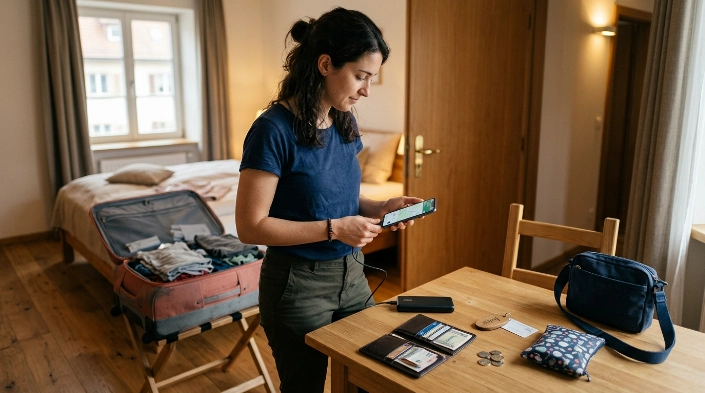
Use your first hour to establish a safe, comfortable base. Don’t rush out simply because you’re afraid of “wasting” part of your trip.
Your body may also be more tired than you realize after airports, train stations, unfamiliar streets, and carrying luggage.
Complete a simple arrival routine
- Check into your accommodation. Confirm how the main entrance, room lock, elevator, and reception arrangements work.
- Charge your phone. Make sure your battery can comfortably last through any short evening outing.
- Save your accommodation address. Screenshot it or save it offline, including the local-language version when useful.
- Check your mobile connection. Confirm that mobile data, your SIM, or your eSIM works outside the building.
- Locate your essentials. Identify your passport, cards, cash, room key, medications, and portable charger.
- Send an arrival message. Tell your chosen contact that you’ve reached your accommodation.
This routine sounds ordinary. That’s exactly why it works.
You remove several small uncertainties before dealing with an unfamiliar neighborhood. That can make your first solo evening feel much more manageable.
For international travel, I also like checking destination-specific health information before departure rather than trying to solve health questions after landing. The CDC’s Before You Travel guidance is one official starting point.
Learn the building before learning the city
Notice which entrance remains open late and how you get back inside. If there’s a front desk, note its operating hours.
- Find the nearest well-lit main street.
- Identify a convenience store or supermarket.
- Check where taxis or rideshares can safely stop.
- Notice a nearby landmark you can recognize easily.
- Save reception or host contact details.
You don’t need to memorize the neighborhood. You only need enough orientation to avoid feeling lost twenty minutes later.
Should You Go Out on Your First Night Alone?
You can go out if you feel alert, comfortable, and oriented. Staying in is equally reasonable, especially after a long journey or late arrival.
There is no prize for immediately walking into an unfamiliar city alone. Your solo trip has already started.
Use your energy level, not your itinerary
Ask yourself whether you’re hungry, alert, comfortable with the neighborhood, and able to navigate back without stress. If several answers are no, simplify the evening.
- High energy: Take a short local walk and have an early dinner nearby.
- Moderate energy: Buy food close to your accommodation and explore one or two nearby streets.
- Low energy: Stay in, shower, eat, prepare tomorrow’s essentials, and sleep.
- Late arrival: Prioritize checking in and settling down rather than sightseeing.
First-time solo travelers sometimes feel they must prove they aren’t scared. That pressure can lead to longer walks, later nights, or more complicated transportation than they would normally choose.
You don’t need to prove anything. A calm first evening is good trip planning.
Keep someone informed
A simple check-in arrangement can reduce worry for both you and someone at home. Decide beforehand how often you want to communicate.
If you’re a U.S. citizen traveling internationally, the State Department’s Smart Traveler Enrollment Program is another resource for receiving relevant embassy or consulate alerts.
How Far Should You Explore on the First Evening?
Keep your first exploration within an area you can understand quickly. For many travelers, that means a short loop around the accommodation rather than crossing the city.
Think in terms of easy navigation, not a fixed distance.
Choose the simplest version of the evening
| First-evening plan | Best when | Suggested approach |
|---|---|---|
| Stay in | You’re exhausted or arrived late | Eat, shower, organize tomorrow, sleep |
| Short neighborhood walk | You feel alert and comfortable | Explore nearby streets, shops, and landmarks |
| Dinner nearby | You’re hungry but don’t want a complicated night | Choose somewhere easy to reach and return from |
| Full evening sightseeing | You arrived early and already know the area | Only do this if transportation and return plans feel straightforward |
During a short walk, notice how the neighborhood changes as you move away from your accommodation. Busy commercial streets can become quiet residential blocks surprisingly quickly.
If a street feels confusing or uncomfortable, turn around. You never need a more dramatic reason.
Build tomorrow’s mental map
Your first walk can make the next morning easier. Look for the transit stop, breakfast options, an ATM inside a bank if needed, and the direction you’ll leave for your first activity.
That small preview reduces decision-making when you’re ready to explore properly.
What Is the Safest Way to Handle Dinner and Drinks?
For your first solo dinner, convenience usually matters more than finding the city’s most famous restaurant. Pick somewhere easy to reach, comfortable to sit in alone, and simple to return from.
An early meal can also help if you’re nervous about eating alone for the first time.
Make your first solo meal easy
- Choose a restaurant near your accommodation.
- Check its opening hours before leaving.
- Save the location on your map.
- Bring only what you need.
- Keep enough phone battery for navigation.
- Know how you’ll return before you order.
Eating alone often feels more noticeable to you than it does to everyone else. Bring a book, journal, or simply enjoy people-watching.
After one or two meals, the experience often becomes surprisingly normal.
Be conservative with alcohol on arrival day
Alcohol can affect judgment, navigation, and awareness. Your first night in an unfamiliar place isn’t an ideal time to discover how tiredness, jet lag, dehydration, and alcohol interact.
If you drink, stay within limits that leave you fully aware of your surroundings. Keep control of your drink and your return plan.
The CDC also publishes general health and transportation guidance during travel, which is worth reviewing for longer or international trips.
What If You Feel Lonely, Anxious, or Exhausted?
Feeling unsettled on your first evening doesn’t mean solo travel was a mistake. Arrival day combines unfamiliar surroundings with fatigue and a sudden lack of your normal routines.
Give yourself one night before judging the entire trip.
Create a small familiar routine
You don’t need to manufacture excitement. Familiar actions can help your brain settle into the new environment.
- Take a shower.
- Change into comfortable clothes.
- Call or message someone you trust.
- Eat something familiar.
- Prepare clothes and essentials for tomorrow.
- Set an alarm and plan breakfast.
- Write down one thing you’re excited to do the next day.
Travel anxiety often feels louder when you have no immediate task. Giving yourself several small jobs can make the evening feel structured.
Don’t compare your evening with social media
Your first solo night doesn’t need rooftop cocktails, instant hostel friends, sunset photographs, or a cinematic walk through the city. Those moments can happen later.
An uneventful evening can be exactly what helps you wake up confident the next morning.
What Should You Avoid on Your First Evening?
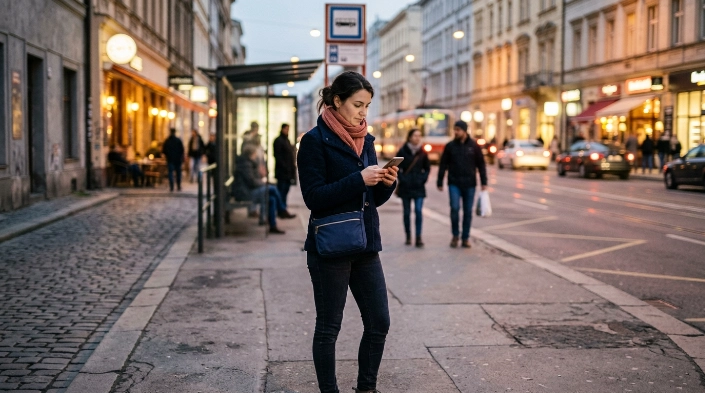
Avoid creating unnecessary complexity when you’re at your most tired and least familiar with the destination. Arrival day is a poor time for plans that depend on perfect navigation or quick decisions.
My rule is simple: if postponing something until tomorrow makes it easier, postpone it.
First-night choices worth reconsidering
- Long unplanned walks: It’s easier to become disoriented when you’re tired.
- Multiple transportation changes: Save complicated routes for daylight when possible.
- Getting noticeably intoxicated: Stay able to make clear decisions and navigate independently.
- Telling strangers too much: You don’t need to share your room number, detailed itinerary, or the fact nobody expects you back.
- Showing valuables unnecessarily: Keep passports, spare cards, and excess cash secured when possible.
- Ignoring your instincts: Leave a place or situation if you become uncomfortable.
- Overscheduling: Your first night doesn’t need to contain several attractions.
Before international trips, review the current government advisory for your actual destination because conditions and guidance can change. Advice written for one city or country shouldn’t automatically be applied to another.
Pro tip: As of 2026, always verify destination-specific safety, entry, health, and emergency information through official government sources shortly before departure.
Frequently Asked Questions About the First Evening of a Solo Trip
Is it okay to stay in on the first night of a solo trip?
Yes. Staying in can be the best choice after a long journey, late arrival, or major time-zone change. You can use the evening to eat, recharge your phone, organize your belongings, plan the next morning, and get enough sleep.
Should a woman walk around alone on the first evening?
A short walk can make sense when you feel alert and comfortable with the area. Keep the route easy to understand, remain aware of your surroundings, and turn back whenever the area becomes confusing or uncomfortable.
Should I tell someone where I’m staying?
Sharing your accommodation details and basic itinerary with a trusted contact is a sensible travel habit. You can also agree on how often you’ll check in so someone knows when they should expect to hear from you.
What should I do if I arrive after dark?
Prioritize reaching your confirmed accommodation and checking in. Unless you’re confident about the area, consider eating at the accommodation, ordering food where appropriate, or using a nearby option rather than beginning a sightseeing trip.
What if I’m scared after arriving alone?
Give yourself time to settle before deciding how you feel about solo travel. Eat, rest, contact someone familiar, and make a simple plan for the next morning; tiredness and sensory overload can make ordinary uncertainty feel much larger.
Is it safe to tell people I’m traveling alone?
You don’t need to disclose that you’re alone to strangers. Use your judgment, especially when someone asks where you’re staying, your room number, your detailed schedule, or whether anybody expects you somewhere later.
What should I prepare for the second day?
Charge your phone and portable battery, check the weather, save your first destination offline, prepare appropriate clothing, confirm transportation, and decide where you’ll eat breakfast. A prepared morning can make your first full solo day feel much easier.
Your first evening doesn’t need to be impressive. It needs to help you feel rested, oriented, and ready for your first full day.
Start small, pay attention to your energy, and give yourself permission to change plans. Confidence on a solo trip usually grows through ordinary decisions made well, not through forcing yourself into uncomfortable situations.