How Can a Solo Female Traveler Choose a Safe Hotel?
Quick Answer
A solo female traveler can choose a safer hotel by researching the neighborhood, reading recent reviews from other women, checking reception and room security, and planning a reliable arrival route. Compare practical safety features rather than relying on star ratings or attractive photographs alone. Before booking, review the U.S. Department of State’s lodging safety guidance alongside current advice for your destination.
What to check before booking
- Neighborhood safety: Choose a location with practical transport links, accessible services, and a comfortable route to the entrance.
- Recent reviews: Look for repeated comments about security, staff availability, unwanted visitors, and the surrounding streets.
- Secure access: Check for functioning room locks, controlled guest access where available, and a reliable way to contact reception.
- Arrival arrangements: Confirm late check-in procedures and plan transport from the airport or station.
- Emergency readiness: Look for clear fire exits, working alarms, and an accessible emergency contact.
- Backup options: Save an alternative hotel and share your accommodation details with someone you trust.
One important rule
- If the location, room security, or staff response makes you uncomfortable, request another room or choose different accommodation. You do not need to ignore a concern just because you have already paid.
Choosing a safe hotel is one of the most useful decisions you can make when traveling alone as a woman. The right accommodation can make arrivals less stressful, evenings easier to manage, and unexpected problems simpler to handle.
When I evaluate accommodation for a solo trip, I look beyond the photographs and nightly rate. I want to understand the neighborhood, how I will enter the building, and whether I can get help if something goes wrong.
This guide explains how to compare hotels, assess reviews, recognize warning signs, and prepare for check-in without letting safety concerns take over your trip.
In This Guide
- What makes a hotel safe for a solo female traveler?
- How do you research a hotel’s location?
- How should you read hotel reviews before booking?
- Which type of accommodation is best for solo women?
- What safety features should you check before booking?
- How can you check hotel safety at arrival?
- Hotel safety FAQ for solo female travelers
What Makes a Hotel Safe for a Solo Female Traveler?
A safe hotel is accommodation that helps you manage foreseeable risks through a suitable location, secure access, functioning room locks, and dependable ways to request assistance. No hotel can guarantee complete safety, so evaluate several features together.
Solo female travel safety means making informed choices that protect your privacy, belongings, physical security, and ability to get help while traveling independently.
Look at the whole property, not just your room
A beautiful bedroom cannot compensate for a poorly lit entrance, an isolated location, or an unreliable check-in process. Consider what happens from the moment you arrive until you return at night.
I recommend assessing five connected areas:
- Location: Can you reach the hotel comfortably using transport available at your arrival time?
- Building access: Does the property take reasonable steps to manage entry into guest areas?
- Room security: Can you secure the door and windows, including any balcony or connecting door?
- Staff support: Can you reach reception or security when you need assistance?
- Emergency planning: Are exits identifiable, and do you know how to contact local emergency services?
Understand what a high rating actually tells you
A highly rated hotel may excel at cleanliness, breakfast, or customer service without necessarily having the security features you need. A lower-priced property may be perfectly suitable, provided its location, access arrangements, and room condition meet your requirements.
Think of safety as a separate booking criterion rather than a benefit automatically included with a higher star rating.
Pro tip: Check your destination’s official government travel advice for local crime concerns, transport risks, and relevant laws or customs before choosing a neighborhood.
Section Takeaway: Choose accommodation based on several practical safety factors working together, not one rating, amenity, or reassuring photograph.
How Do You Research a Hotel’s Location?

Research the neighborhood and your complete arrival route before comparing room prices. A hotel should be practical to reach at the time you expect to arrive, with transport and essential services that suit your itinerary.
Check the neighborhood on a map
Open a mapping app and examine the streets immediately around the hotel. Look for transport stops, restaurants, pharmacies, convenience stores, and other places that may help you navigate an unfamiliar area.
Pay attention to the route from the nearest station or drop-off point to the actual entrance. A short distance on a map may still involve poorly lit streets, steep hills, complicated crossings, or isolated passages.
Before booking, check these details:
- Whether your planned transport stops close to the hotel entrance.
- Whether the route includes isolated alleys or poorly lit stretches.
- Whether restaurants and shops nearby suit your likely arrival and return times.
- Whether the entrance is clearly identifiable from the street.
- Whether reliable transport remains available after evening activities.
Match the location to your arrival time
A hotel that works well for a midday arrival may be inconvenient after a delayed flight landing at 11 p.m. Check whether reception operates overnight and whether the property accepts late arrivals without special arrangements.
For example, compare a centrally located hotel with a cheaper property requiring a long walk from the last bus stop. If you arrive after dark with luggage, the extra transport cost may be worth paying for a simpler journey.
Research local conditions rather than relying on labels
Terms such as “city center,” “tourist district,” and “residential neighborhood” do not automatically indicate safety. Conditions can vary between nearby streets, and busy areas can still experience theft or harassment.
Use recent local information alongside official travel guidance. The UK Foreign, Commonwealth & Development Office travel advice pages provide destination-specific information that can help you assess local conditions.
Keep your arrival plan simple: save the address, confirm the entrance, arrange suitable transport, and identify a backup property before you leave home.
Section Takeaway: Evaluate the route to the hotel as carefully as the hotel itself. Convenient, well-planned arrivals can reduce stress and unnecessary exposure.
How Should You Read Hotel Reviews Before Booking?
Read recent reviews for repeated, specific comments about security, reception, access, and the surrounding neighborhood. Reviews from solo women can offer useful context, but no single review proves that a property is safe or unsafe.
Search for details instead of relying on star ratings
Start with the newest reviews, then look for patterns across different guests. Recent information is particularly useful when a property has changed management, renovated its rooms, or altered its reception arrangements.
Search review text for terms such as:
- Security: Door locks, key cards, guest access, and security staff.
- Reception: Overnight staffing, check-in problems, and responses to complaints.
- Privacy: Unwanted visitors, room-number handling, and access to guest corridors.
- Location: Lighting, noise, transport access, and comfort returning after dark.
- Maintenance: Broken locks, windows that do not close, and unresolved repairs.
One complaint about a broken lock may describe an isolated problem. Several recent reports about the same issue deserve more attention, especially if management appears not to have addressed them.
Give greater weight to useful, verifiable details
A review saying “I felt safe” offers a helpful personal impression, but it does not explain why. A review describing staffed reception, controlled access, and a well-lit entrance gives you more concrete details to investigate.
Compare reviews across more than one booking platform when possible. Also check whether the property responds constructively to concerns about security and maintenance.
Recognize common review red flags
Pause before booking if you find a pattern of complaints involving:
- Unexplained entry into occupied rooms.
- Doors or windows that repeatedly fail to lock.
- Unwanted people entering guest-only areas.
- Reception being unavailable despite advertised staffing.
- Staff dismissing credible safety complaints.
- Listings that conceal the property’s actual address or entrance.
These concerns are reasons to investigate further, not automatic proof of criminal activity. Contact the property with specific questions or choose another hotel if its answers do not reassure you.
Section Takeaway: Prioritize consistent, recent, detailed evidence over popularity, promotional photographs, or one unusually positive or negative review.
Which Type of Accommodation Is Best for Solo Women?
The best accommodation depends on your budget, destination, arrival time, privacy needs, and comfort with shared spaces. A hotel is not automatically safer than every guesthouse or hostel, so compare the actual property and its arrangements.
Use this comparison to narrow your options before checking individual listings.
| Accommodation type | Potential advantages | What to verify |
|---|---|---|
| Established hotel | Private room and potentially staffed reception | Door security, overnight assistance, and guest access |
| Boutique hotel | Smaller property that may offer attentive service | Reception hours, entrance security, and emergency procedures |
| Female-only hostel dorm | Often a budget-friendly way to meet other women travelers | Dorm access, individual lockers, bathroom arrangements, and staff availability |
| Private hostel room | Private sleeping space with shared social facilities | Room locks, shared-area access, and nighttime staffing |
| Guesthouse or bed-and-breakfast | May provide local advice and a quieter atmosphere | Host availability, private entrance arrangements, and secure room access |
| Short-term rental | Kitchen facilities and more independent living space | Verified listing, lawful operation, building entry, and emergency support |
Should you choose a female-only hostel?
Female-only dormitories may feel more comfortable if you enjoy meeting other travelers and want to control accommodation costs. However, shared rooms still require careful attention to lockers, access arrangements, personal boundaries, and the property’s location.
Choose a private room if sleeping privacy matters more to you. Confirm that the room has its own functioning lock rather than assuming privacy comes with the booking.
When is a traditional hotel worth the extra cost?
A hotel with reliable overnight reception may suit travelers arriving late, visiting an unfamiliar city for the first time, or needing help arranging transport. That support can be particularly valuable when plans change unexpectedly.
Compare the full cost rather than the advertised nightly rate. Include taxes, transport, late-arrival charges, and any additional fees before deciding which property offers the best practical value.
Section Takeaway: Choose the accommodation type that fits your travel style, then apply the same checks for location, access, privacy, and emergency support.
What Safety Features Should You Check Before Booking?
Before paying, confirm that the property has the basic features you need to secure your room and obtain help. If an important detail is missing from the listing, ask the hotel directly instead of assuming it will be available.
Ask about access and reception
Look for a property that can explain how guests enter the building and reach their rooms. Controlled entry, key-card access, and staffed reception can be useful, although none guarantees that every visitor is properly screened.
Contact the hotel with a short list of questions:
- Is reception staffed throughout the night?
- How do guests enter the building after normal check-in hours?
- Are guest-room floors accessible only to authorized guests, where applicable?
- Can staff help arrange a reputable taxi or transfer?
- Can the property accommodate a request for a room with secure windows and no connecting door?
Check room locks, windows, and privacy
Ask whether rooms have functioning locks and an additional interior latch or deadbolt where appropriate. A peephole or other safe way to verify visitors can also be useful.
If you prefer not to stay on the ground floor, ask whether an upper-floor room is available. However, do not choose a room location that makes emergency evacuation difficult or compromises accessibility needs.
Look beyond personal security
A safe stay also depends on fire precautions and basic building maintenance. Check whether the property describes its emergency procedures and whether guests can identify an exit route.
Useful questions include:
- Are smoke alarms and fire-safety equipment provided as required?
- Are emergency exits clearly marked and accessible?
- Are windows, balconies, and room doors maintained properly?
- Does the property provide a working way to contact staff?
- Are accessibility features available if you need them?
Carbon monoxide is another consideration in properties using fuel-burning appliances. Ask about detectors when relevant, particularly in accommodation with gas heaters or other combustion equipment.
For more detailed guidance, consult the U.S. Department of State’s official lodging safety recommendations.
Balance safety with your budget
You do not necessarily need a luxury hotel to find suitable accommodation. A modest property with secure access, recent positive reviews, and a practical location may meet your needs better than an expensive hotel with inconvenient arrival arrangements.
Compare your shortlisted hotels against the same requirements rather than paying extra for features that do not solve your particular concerns.
Section Takeaway: Verify the features that matter before booking. Clear answers about access, locks, staffing, and emergency arrangements are more useful than vague promises of security.
How Can You Check Hotel Safety When You Arrive?
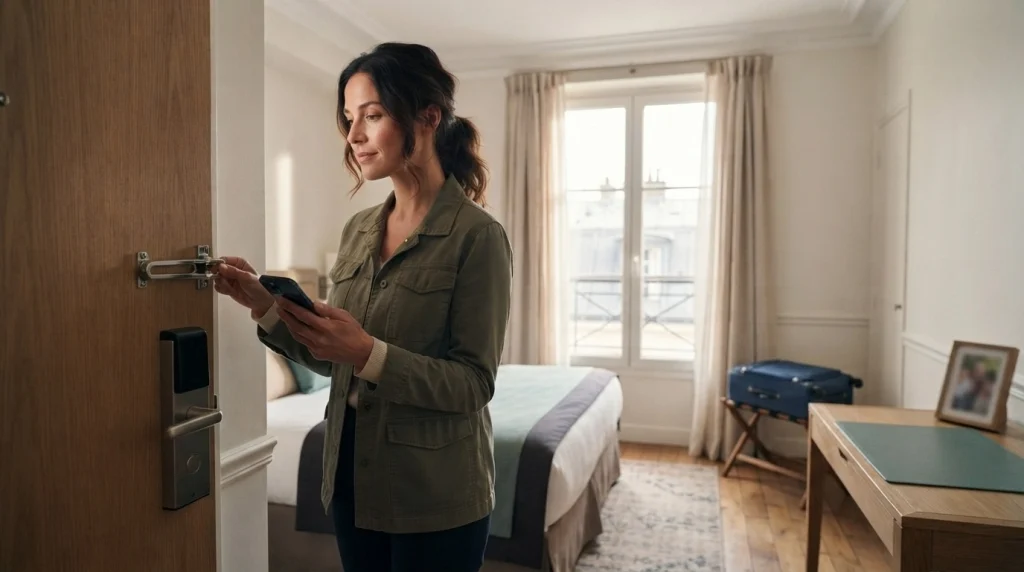
Once you arrive, protect your room information, inspect the room before unpacking, and identify your emergency exit. If an essential security feature does not work, ask for a solution immediately rather than hoping the problem will disappear.
Keep your room number private
At check-in, you can ask staff to write your room number down rather than announce it where other guests can hear. Keep your key card and booking information private, and avoid sharing your exact room location with new acquaintances.
If the hotel cannot provide your booked room or staff make you uncomfortable, ask about alternatives before settling in.
Complete a quick room inspection
Before opening your luggage, follow a consistent checklist. It helps you spot problems while changing rooms remains relatively straightforward.
- Test the main door lock and any interior secondary lock.
- Check that windows and balcony doors close and secure properly.
- Inspect any connecting door and confirm it locks.
- Make sure curtains close fully where privacy requires it.
- Check the room’s smoke alarm and review the emergency information.
- Confirm that you can contact reception or security.
- Identify the nearest stairwell and a second possible exit route if available.
You do not need to search for imagined dangers in every corner. Focus on the room’s access points, obvious maintenance problems, and the information you would need in an emergency.
Secure the room at night
Use the functioning locks provided and keep your phone, room key, and essential medication accessible. Avoid placing luggage or other belongings where they could obstruct an exit.
A portable door alarm or door wedge may provide additional reassurance if it is suitable for the door and permitted locally. It should never replace a proper lock or prevent you from evacuating quickly.
Know what to do when something feels wrong
You do not have to open your door to an unexpected visitor, even if they claim to work for the hotel. Keep the door closed and call reception through a known contact method to verify the visit.
If the property fails to address a serious security problem, request a different room or move to another hotel. If you face an immediate threat, contact local emergency services when you can do so safely.
Share your hotel details and itinerary with someone you trust. If you change accommodation, send the updated address so your contact knows where to reach you.
Pro tip: Before departure, save the local emergency number and your country’s embassy or consulate contact details. Official destination advice can help you confirm which services are available.
Section Takeaway: A brief arrival routine helps you protect your privacy, spot problems early, and make a calm decision about whether to stay.
Hotel Safety FAQ for Solo Female Travelers
Is it safe for a woman to stay in a hotel alone?
Yes, women can stay in hotels alone while taking sensible precautions. Research the neighborhood, read recent reviews, check room security, protect your room number, and keep a trusted person informed of your accommodation details. Conditions vary by property and destination.
Is it safer to book a hotel in the city center?
Not automatically. A central hotel may provide convenient transport and nearby services, but busy areas can also experience theft or harassment. Compare the specific streets, entrance, arrival route, recent reviews, and local safety advice before booking.
Should solo female travelers choose hotels with 24-hour reception?
Round-the-clock reception can be helpful when you arrive late, lose access to your room, or need assistance. However, overnight staffing alone does not guarantee security. Check the hotel’s entry arrangements, staff responsiveness, room locks, and emergency procedures.
Are female-only hostels safer than regular hotels?
Female-only hostels can provide a more comfortable shared environment for some women, but they do not automatically offer stronger security than hotels. Check dorm access, lockers, staff availability, bathroom arrangements, and the surrounding neighborhood before making a choice.
Should I tell hotel staff that I am traveling alone?
You generally do not need to announce your solo status to other guests or strangers. You can share relevant information privately with trusted staff when necessary, while keeping your room number, travel schedule, and personal details discreet in public areas.
What should I do if a hotel room does not feel safe?
Keep your belongings together, contact reception, and explain the specific concern. Request a room change or leave for alternative accommodation if the issue remains unresolved. If you face immediate danger, prioritize reaching a safer place and contacting local emergency services.
Is a portable hotel door lock necessary?
A portable lock or door wedge may offer additional reassurance in some rooms, but neither is essential for every traveler. Check compatibility and local rules, never interfere with emergency evacuation, and do not use a travel accessory as a substitute for a properly functioning hotel lock.
Choose a Hotel That Helps You Travel With Confidence
Choosing a safe hotel as a solo female traveler starts with careful research, realistic expectations, and a few simple checks. Prioritize the neighborhood, recent guest experiences, secure access, and a practical plan for arriving and leaving.
Before your next booking, compare two or three suitable properties using the same checklist. Confirm any unanswered questions directly with the hotel, save your booking details offline, and share your itinerary with someone you trust.
You deserve accommodation that supports your independence without making every decision feel stressful. Prepare thoughtfully, trust your judgment, and choose the place where the practical details make you feel comfortable staying.