How Should a Woman Choose a Hotel for Her First Solo Trip?
Quick Answer
For a first solo trip, choose a hotel in a convenient, well-connected area with strong recent reviews, straightforward transportation, reliable locks, and staffed reception when possible. Location matters more than luxury because an easy arrival and simple route back at night can remove much of the stress of traveling alone. Before booking internationally, review official lodging safety guidance for current recommendations.
Start with these hotel checks
- Choose location first: Look for useful transport, food, pharmacies, and active streets within easy reach.
- Read recent reviews: Search for repeated comments about the neighborhood, nighttime access, staff, noise, locks, and cleanliness.
- Check reception hours: Make sure your arrival time matches the hotel’s check-in arrangements.
- Study the route: Know exactly how you will travel from the airport or station to the hotel.
- Confirm room security: Look for dependable door and window locks plus appropriate fire-safety equipment.
- Keep a backup: Save one or two alternative hotels in case the property does not feel right after arrival.
One useful first-trip rule
- Imagine reaching the hotel alone, tired, after sunset. If the journey already seems confusing on a map, consider an easier location.
Your first hotel can shape how your entire first solo trip feels. A peaceful room in an inconvenient area can create more stress than a simple hotel beside useful transport.
I recommend choosing for ease, location, and predictability before extras such as a rooftop pool or designer lobby. This guide shows how to judge a hotel through a solo female travel safety lens without treating every unfamiliar place as dangerous.
In This Guide
- What Matters Most When Choosing a Hotel for a First Solo Trip?
- How Can You Tell If a Hotel Location Is Good for a Solo Woman?
- Which Hotel Safety Features Should You Check?
- How Should You Read Hotel Reviews Before Booking?
- Hotel, Hostel, or Rental: Which Is Easier for a First Solo Trip?
- What Should You Do Before Booking and After Check-In?
- Frequently Asked Questions
What Matters Most When Choosing a Hotel for a First Solo Trip?
The best first-solo-trip hotel is one that makes everyday decisions simple. Prioritize a practical location, dependable access, recent guest feedback, comfortable room security, and an arrival plan you understand.
Definition: A solo-travel-friendly hotel is an accommodation that lets one traveler arrive, check in, move around the surrounding area, secure her room, and get help without depending on a companion.
Put logistics ahead of luxury
For a first trip, I would happily trade a bigger room for a better location. A hotel two blocks from useful transportation may be more valuable than a prettier property requiring a long taxi ride every day.
Think about the ordinary moments of your trip. You may need breakfast, medicine, drinking water, an ATM, public transportation, or a quick meal after a tiring travel day.
- Airport or station connection: Can you reach the hotel without several confusing transfers?
- Food nearby: Can you get dinner without making a long journey after check-in?
- Transportation: Is a station, bus stop, or reputable taxi option easy to access?
- Useful services: Are pharmacies, convenience stores, or other everyday services reasonably close?
- Check-in: Will the desk or designated check-in method be available when you arrive?
Decide what makes you comfortable enough to sleep
Different travelers need different levels of privacy. One woman may love a social hostel, while another may relax only after closing the door of a private hotel room.
Don’t choose accommodation because someone online says solo travelers are “supposed” to stay there. Good sleep makes navigation, decision-making, and sightseeing easier the next day.
Make the first night especially easy
Your first few hours deserve more planning than your third afternoon. You may be tired, carrying luggage, dealing with unfamiliar currency, or trying to understand a new transportation system.
A simple first-night hotel reduces those decisions. This matters even more after an international flight or a late arrival.
- Save the full hotel address offline.
- Screenshot your booking confirmation.
- Check the hotel’s arrival and check-in instructions.
- Choose your primary airport or station transfer.
- Save one backup transportation option.
- Keep the hotel phone number available offline.
For international trips, review the destination’s current advisory, local customs, and transportation information before booking. The U.S. State Department’s international travel planning resources are one useful starting point for U.S. travelers.
Section Takeaway: Choose the hotel that makes arrival, sleep, transportation, and everyday errands easy. Your first solo hotel does not need to be impressive; it needs to work well when you are managing everything yourself.
How Can You Tell If a Hotel Location Is Good for a Solo Woman?

A useful hotel location is easy to reach, connected to the places you plan to visit, and practical at the hours you expect to move around. Judge the exact street and route rather than relying only on a neighborhood’s reputation.
Use the “8 p.m. test” before booking
Open a map and imagine returning to the hotel at 8 p.m. after dinner. Look at how far you would walk, how many transit changes you need, and whether an easier route exists.
This isn’t about assuming that nighttime is automatically unsafe. It is about reducing navigation stress when you are tired or your phone battery is low.
- Check walking distance from useful transport.
- Look for major roads or obvious landmarks near the property.
- Check whether restaurants and shops operate nearby.
- Study your route from your likely evening activities.
- See whether reputable taxi or ride services operate locally.
Look beyond “city center” labels
Booking sites can describe a property as central even when it sits far from the places you actually want to visit. Measure the distance to your own itinerary.
A hotel near three attractions you don’t care about is not convenient. Build your decision around your airport, train station, tours, museums, restaurants, or event venues.
Check transportation before checking room decor
A beautiful hotel can become frustrating if the nearest useful station requires a 25-minute walk. That inconvenience multiplies every time you leave or return.
On a short trip, paying slightly more for location can sometimes reduce transportation spending. It can also save several hours across a three- or four-day itinerary.
Plan specifically for your arrival time
Daylight arrival can make a first solo check-in easier when schedules allow. You have more time to understand the area and solve problems before the evening.
If you must arrive late, remove uncertainty elsewhere.
- Confirm that late check-in is allowed.
- Ask how you will enter if reception closes.
- Arrange your final transportation leg in advance when appropriate.
- Keep enough battery for navigation and communication.
- Save the hotel’s address in the local language when useful.
Pro tip: Safety conditions can change by destination and over time. Review your own government’s current travel advice and local official information before relying on general online descriptions.
Section Takeaway: Evaluate the journey to the hotel, not just the hotel itself. A simple route, useful transportation, nearby services, and predictable late-arrival arrangements can make a first solo trip much easier.
Which Hotel Safety Features Should You Check?
Look for basic security and emergency features that help you control your room and get assistance. Reliable locks, staffed common areas, working fire equipment, clear exits, and dependable communication matter more than dramatic marketing about security.
Check access and staffing
A staffed front desk can be reassuring for a first solo trip because you have a person to contact when a key stops working or you need local information. Reception hours vary, especially at smaller properties.
Before paying, check these practical details:
- Reception hours: Know whether someone is present overnight.
- Building access: Check whether guest areas require a key card, code, or staffed entrance.
- Room lock: Your room door should lock securely from inside.
- Windows or balcony: Accessible openings should have working locks.
- Hotel contact: You should have a clear way to reach staff when needed.
Don’t overlook fire and carbon monoxide safety
Safety isn’t limited to crime. Fire exits, smoke alarms, sprinklers, and carbon monoxide precautions can matter in any type of accommodation.
The U.S. Fire Administration advises travelers to review the evacuation plan and locate the two nearest exits after arriving. Its hotel and vacation rental fire-safety guidance also recommends checking for appropriate smoke alarms and sprinkler systems.
Once inside your room, spend one minute orienting yourself.
- Locate the nearest stairwell or emergency exit.
- Check the evacuation diagram.
- Make sure your door closes and locks properly.
- Test how to contact reception.
- Notice the location of alarms and emergency equipment.
Remember that “security” doesn’t replace judgment
A guard, camera, or key-card elevator can be useful. None of those features guarantees that nothing will go wrong.
The better approach is layering simple habits. Keep your door locked, avoid announcing your room number publicly, meet unfamiliar people in common spaces, and contact staff when something seems wrong.
Official guidance for women travelers also recommends avoiding unnecessary disclosure about where you are staying and planning transportation carefully.
Pro tip: Emergency numbers, hotel standards, and available safety equipment vary by destination. Verify local emergency contacts before departure and save them somewhere you can reach without internet access.
Section Takeaway: Look for ordinary systems that work: secure room access, responsive staff, clear exits, fire protection, and reliable communication. Those basics are more useful than vague claims that a property is “completely safe.”
How Should You Read Hotel Reviews Before Booking?
Use reviews to find repeated patterns rather than treating one review as proof. Recent comments about location, check-in, staff response, locks, noise, transportation, and the surrounding streets are especially useful.
Search reviews instead of reading randomly
If the platform offers review search, use practical words. You can learn more from ten targeted minutes than from scrolling through hundreds of comments.
- “solo”
- “woman” or “female”
- “night”
- “station”
- “walk”
- “street” or “area”
- “reception”
- “lock”
- “noise”
- “late check-in”
Pay attention when several unrelated guests mention the same problem. A repeated complaint about a broken entrance door deserves more weight than one vague comment saying the area “felt weird.”
Prioritize recent reviews
Hotels change management, staffing, renovation status, and procedures. Construction can change surrounding streets too.
I would give current feedback more weight than a glowing review from several years ago. Recent photos can also reveal whether the property still matches its listing.
Separate comfort complaints from important patterns
A traveler disliking the pillow is different from multiple guests reporting that nobody answered during late check-in. Learn which complaints affect your own trip.
| Review Pattern | Why It Matters | What to Do |
|---|---|---|
| Repeated late check-in problems | You could arrive without straightforward room access. | Confirm your exact arrival process before paying. |
| Multiple complaints about door locks | Room security is a basic requirement. | Choose another property unless recent evidence shows the issue was fixed. |
| Frequent street-noise complaints | Poor sleep can make solo travel more tiring. | Request a quieter room or compare another hotel. |
| Consistent praise for helpful reception | Responsive staff can simplify transport or check-in problems. | Treat it as a useful positive signal, not a safety guarantee. |
| Guests mention difficult transport access | You may face the same journey every day. | Map the exact route before choosing the cheaper room. |
Read the hotel’s own answers too
Management responses can show whether staff address recurring issues directly. A clear explanation is more useful than an argumentative or generic response.
Still, reviews are only one input. Compare them with maps, official destination information, transportation schedules, and the hotel’s stated policies.
Hotel, Hostel, or Rental: Which Is Easier for a First Solo Trip?
A staffed hotel is often the most predictable option for a first solo trip, while hostels can make socializing easier and rentals may provide more space. The best choice depends on whether you value privacy, staff support, social contact, or independent living most.
| Feature | Staffed Hotel | Hostel | Short-Term Rental |
|---|---|---|---|
| Privacy | Usually high with a private room | Low in dorms; high in private rooms | Usually high for an entire unit |
| On-site help | Often available through reception | Common in staffed hostels | Varies widely by host and property |
| Social opportunities | Usually limited | Often strong through shared spaces and activities | Usually limited in private units |
| Check-in predictability | Often straightforward at staffed properties | Depends on reception hours | May rely on codes, lockboxes, or host coordination |
| Kitchen access | Uncommon in standard rooms | Common in many hostels | Common in entire-home rentals |
Choose a hotel if you want predictable support
A hotel can work well when you want a private space and someone to contact about luggage, transportation, maintenance, or room problems. Check desk hours because small hotels may not operate reception around the clock.
Choose a hostel if social contact matters
Hostels often provide common areas, tours, meals, or organized events. Some also offer women-only dorms and private rooms.
Read the description carefully. A party hostel and a quiet boutique hostel can create completely different first-trip experiences.
Choose a rental when independence suits your trip
A short-term rental can provide laundry, a kitchen, and more living space. However, check-in and emergency assistance may work differently from a staffed hotel.
Fire-safety rules also vary by property and jurisdiction. Whatever accommodation type you choose, identify exits and check available alarms after arrival.
Section Takeaway: For a first trip, predictability can be worth paying for. Choose the accommodation style that gives you the right balance of privacy, human support, social contact, and easy arrival.
What Should You Do Before Booking and After Check-In?
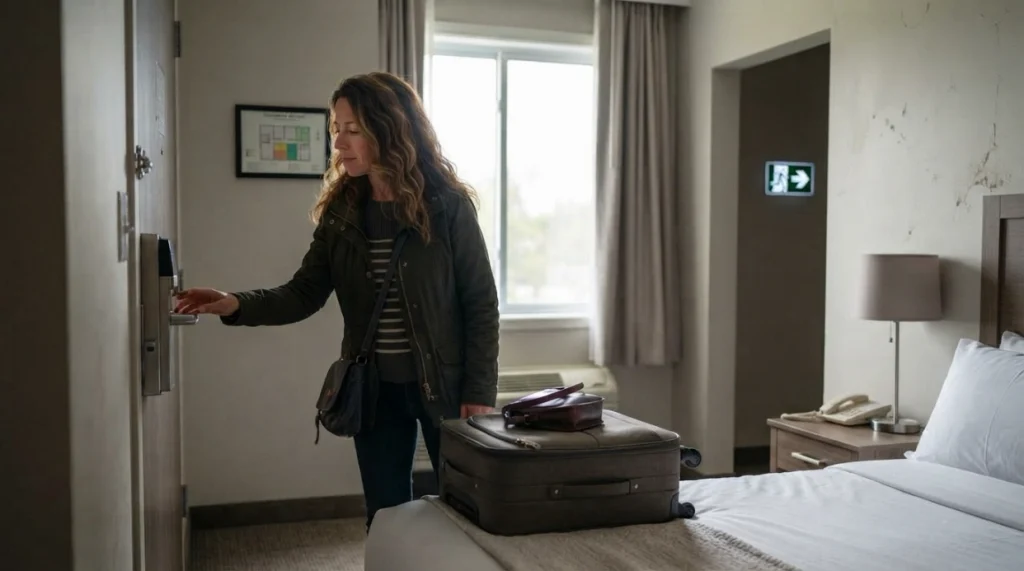
Before booking, verify the details that could cause problems on arrival. After check-in, spend a few minutes checking your room, exits, communication options, and immediate surroundings.
Use this final pre-booking checklist
- Map the hotel from your arrival airport, station, or bus terminal.
- Check reception and check-in hours.
- Read recent reviews about location and access.
- Confirm cancellation terms.
- Check whether taxes or resort charges are included.
- Verify luggage-storage arrangements if your schedule requires them.
- Confirm accessibility needs directly with the property when necessary.
- Save one backup accommodation option.
If accessibility affects your trip, contact the accommodation directly instead of relying only on generic website filters. Ask specific questions about elevators, steps, bathroom access, door width, or other features you need.
Do a two-minute room check
Don’t unpack immediately. First, make sure the room works for you.
- Close and lock the entrance door.
- Check accessible windows and balcony doors.
- Confirm that you can contact reception.
- Locate your nearest emergency exit.
- Check the room’s evacuation information.
- Report anything that appears damaged or unsuitable.
If the room or property feels significantly different from what you booked, address it early. Ask the hotel to correct the problem or change rooms when appropriate.
Protect your room information
You don’t need to announce your room number in a lobby, restaurant, or taxi. Keep the key packet containing your room information separate when practical.
Meet new acquaintances in public hotel areas rather than automatically inviting them to your room. Those habits preserve privacy without requiring you to avoid meeting people.
Make a simple check-in plan with someone you trust
Share your accommodation name and basic itinerary with a trusted contact when that makes sense for you. Agree on a communication routine that doesn’t turn your vacation into hourly reporting.
A message after arrival and another after a long travel day may be enough. The point is making sure someone knows where you planned to be.
For international travel, the CDC recommends checking destination-specific health information before departure. Its pre-travel guidance also encourages travelers to prepare for unexpected health issues and consider how they would obtain care.
Pro tip: For destination-specific health requirements, disease risks, medicines, or vaccines, check official health guidance rather than depending on hotel reviews or social-media posts.
Section Takeaway: Book carefully, then verify the important details after arrival. A few minutes spent checking locks, exits, communication, and your route can prevent avoidable stress later.
Frequently Asked Questions
Is it better for a woman traveling alone to stay in a hotel or hostel?
A hotel may be easier if you value privacy and predictable staff support. A hostel can be better if meeting other travelers matters to you. Women-only dorms or private hostel rooms can offer a middle ground, but check reception hours, recent reviews, and location before booking.
Should a solo woman book a hotel with 24-hour reception?
It can be helpful, especially when your flight or train arrives late. However, 24-hour reception is not mandatory for every trip. If reception closes, confirm exactly how late check-in works and how you can contact someone if the entry code or key system fails.
What hotel floor is best for a solo female traveler?
There is no universal floor that is safest in every building. Focus on a room with reliable locks and a clear evacuation route. Know where the stairs are, review the fire plan, and ask hotel staff about another room if the assigned location concerns you.
How do I know whether a hotel’s neighborhood is safe?
Don’t rely on one “safe neighborhood” label. Check current official destination information, recent hotel reviews, transportation options, and the exact route you will use. Consider how the area functions during the hours you expect to return, not only how it appears during daytime.
Should I tell hotel staff that I’m traveling alone?
You usually don’t need to announce your solo status beyond information genuinely required during booking or check-in. You can ask reception for transportation or neighborhood advice without discussing personal details. Avoid unnecessarily telling strangers where you are staying or your exact room number.
Is a cheaper hotel outside the center worth it on a first solo trip?
Sometimes, but calculate the full cost. Add transportation fares, extra travel time, late-night taxi needs, and the inconvenience of repeated transfers. A slightly more expensive central room can offer better value when it simplifies a short first trip.
What should I do if I arrive and don’t feel comfortable at the hotel?
Identify the specific problem first. Ask staff to correct room or access issues when possible. If you still believe the accommodation does not meet your needs, use your backup plan and move somewhere else when doing so is practical and safe.
Choosing Your First Solo Hotel: Final Takeaway
For your first solo trip, choose the hotel that makes the trip easier rather than the one that simply looks best online. Prioritize location, transportation, recent reviews, reliable access, secure room features, and a check-in process that matches your arrival.
Your goal isn’t to eliminate every possible risk. It is to remove unnecessary uncertainty so you have more energy for the enjoyable part of traveling alone.
- Choose a location you can navigate confidently.
- Map the arrival route before paying.
- Read recent, practical reviews.
- Confirm check-in and reception hours.
- Check locks and emergency exits after arrival.
- Keep important information available offline.
- Save a backup accommodation option.
A first solo trip becomes less intimidating when the basics are dependable. Give yourself an easy place to return to each night, and let the rest of the adventure grow from there.