How Can a Woman Choose a Destination for a Short Solo Weekend?
Quick Answer
A woman choosing a destination for a short solo weekend should prioritize easy transportation, a convenient neighborhood, comfortable accommodation, manageable costs, and activities she genuinely enjoys. For an international weekend, also check the latest official travel and safety information before booking.
Use this six-point destination test
- Easy journey: Choose somewhere you can reach without spending most of your weekend in transit.
- Simple transportation: Make sure you can move around without complicated transfers or an unwanted rental car.
- Good base: Look for accommodation near restaurants, activities, and dependable transportation.
- Comfortable environment: Research neighborhoods, local customs, current conditions, and how the area feels after dark.
- Enough to enjoy: Pick somewhere with two or three things you genuinely want to do.
- Realistic budget: Compare total costs, including transport, accommodation, meals, and local travel.
My simplest rule
- For a two-night trip, choose the destination that creates the least logistical stress while still making you excited to leave home.
A short solo weekend sounds simple, but destination choice can make or break it. When women ask me how to choose a destination for a short solo weekend, I start with practicality rather than a list of supposedly perfect cities.
The best solo female weekend destination is usually not the most famous place. It is the place where transportation, accommodation, safety planning, cost, and your interests fit together without creating unnecessary stress.
In This Guide
- What Makes a Good Destination for a Short Solo Weekend?
- How Far Should You Travel for a Two- or Three-Day Solo Trip?
- Should You Choose a City, Small Town, Beach, or Nature Destination?
- How Do You Research Safety and Logistics Before Booking?
- How Can You Compare Two or Three Possible Destinations?
- How Do You Match a Destination to Your Travel Personality?
- Frequently Asked Questions
What Makes a Good Destination for a Short Solo Weekend?
A good solo weekend destination is easy enough to manage that logistics do not dominate the trip. You should be able to arrive, understand your surroundings, enjoy several activities, and return home without feeling rushed.
For me, the key question is not, “Is this destination popular?” I ask, “Will this destination work well within the time I actually have?”
A short solo weekend trip is usually a one- to three-night independent trip where you make your own decisions about transportation, accommodation, meals, activities, and daily pace.
Start with transportation
Your destination should be straightforward to reach. A direct train, bus, drive, or short flight often works better than a cheaper route involving several connections.
Transfers create more opportunities for delays. They also consume time you could spend enjoying the destination.
- Direct route: Fewer transfers usually mean a calmer arrival.
- Reasonable departure: Avoid schedules that require exhausting pre-dawn starts unless you are comfortable with them.
- Simple arrival: Know how you will reach your accommodation from the station or airport.
- Reliable return: Check Sunday or holiday schedules before paying for accommodation.
Look at the neighborhood, not just the destination
A fantastic city can become inconvenient if you stay far from everything. A less famous destination can feel effortless when your hotel sits near restaurants, transit, and attractions.
For a weekend, I would usually pay a little more for location rather than lose hours commuting across town.
Open a map before booking. Mark your accommodation, arrival point, planned activities, food options, and transportation stops.
Make sure there is enough to do, but not too much
You do not need 30 attractions for a two-night getaway. Two or three experiences you are genuinely excited about are enough.
- One main attraction or activity
- One neighborhood, market, museum, beach, or nature area to explore
- A few easy food choices
- One indoor backup for bad weather
A destination overflowing with must-see attractions can tempt you to over-plan. Short solo travel feels better when you have room to change your mind.
Section Takeaway: A good weekend destination combines easy access, a convenient base, manageable transportation, and enough activities to make the journey worthwhile.
How Far Should You Travel for a Two- or Three-Day Solo Trip?
Travel time matters more on a weekend than on a week-long vacation. As a practical guideline, I try to keep one-way transit within roughly three to four hours when possible.
This is not a safety rule. It is a time-management rule.
Think in door-to-door hours
A one-hour flight is rarely a one-hour journey. You may need airport transportation, an early arrival, security, boarding, baggage collection, and another transfer after landing.
A three-hour direct train can sometimes leave you with more usable vacation time than a short flight.
| Trip Type | Typical Effort | Weekend Fit | Main Consideration |
|---|---|---|---|
| 1–2 hour direct trip | Low | Excellent | Leaves plenty of destination time |
| 2–4 hour direct trip | Low to moderate | Very practical | Works well for two nights |
| Short flight | Moderate | Depends on airport time | Calculate door-to-door travel |
| Multiple connections | High | Less convenient | Delays can consume the weekend |
Consider arrival time too
Arriving at 2 p.m. and arriving at 11:30 p.m. create very different first evenings. I prefer arrival schedules that let me check in and understand the neighborhood before I am tired.
Late arrivals are not automatically unsafe. They simply require more planning for transport, check-in, food, and navigation.
A nearby destination is still real solo travel
You do not have to cross a border or board a plane for the trip to count. A town two hours away can teach you plenty about navigating, eating alone, making decisions, and managing your own schedule.
That makes short trips especially useful for women testing solo travel before committing to a longer vacation.
Section Takeaway: Measure travel in door-to-door time rather than miles. For a short weekend, protecting your destination time usually matters more than going far away.
Should You Choose a City, Small Town, Beach, or Nature Destination?
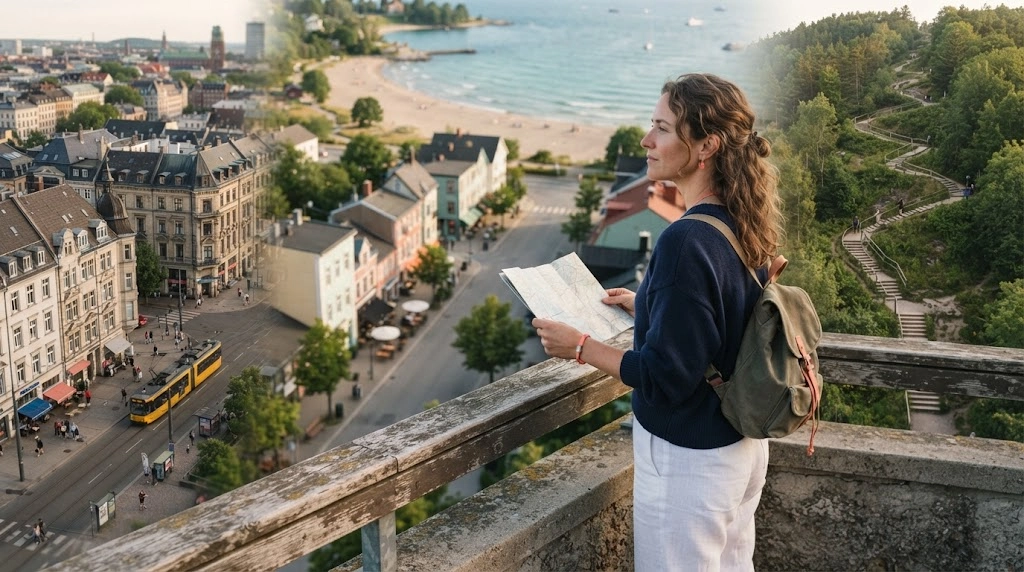
There is no single destination type that works for every woman. The better choice depends on your transport skills, desired pace, interests, and comfort with isolation.
A busy city may feel reassuring to one traveler and exhausting to another.
Choose a city if you want options
Cities often make short weekends easy because transport, restaurants, attractions, and accommodation are concentrated together. They also give you alternatives when weather or plans change.
- Good public transportation can reduce the need for a car.
- Restaurants and cafés may stay open later.
- Walking tours and classes offer structured social contact.
- Museums provide easy bad-weather options.
- More accommodation choices make it easier to prioritize location.
Choose a small town if you want a slower pace
A compact town can be ideal when your goal is walking, cafés, reading, local food, or simply getting away from a busy routine.
Research transportation carefully. Limited evening buses or Sunday schedules can become important when you do not have a car.
Choose a beach destination if rest is the goal
A beach weekend can work beautifully when accommodation, food, and the beach are close together. It becomes less convenient when every activity requires a long taxi ride.
Check weather before booking. A destination built around outdoor time needs a backup plan during stormy or extreme conditions.
Choose nature when you understand the logistics
Nature does not have to mean isolated backcountry travel. A staffed lodge near well-marked trails can provide outdoor time without the complexity of remote camping.
For a first solo nature weekend, I would look for established trails, predictable transport, nearby services, and reliable communication.
- Check daylight hours.
- Download offline maps.
- Understand trail difficulty.
- Check weather before leaving.
- Tell someone your approximate plan.
- Know when transportation or park services stop.
Pro tip: Conditions can change. When travel involves outdoor hazards, international borders, or health concerns, confirm current information through government agencies and destination authorities before departure.
How Do You Research Safety and Logistics Before Booking?
Research should help you understand specific risks and practical problems, not decide whether an entire city is simply “safe” or “unsafe.” Conditions vary by neighborhood, time, activity, and current events.
As of 2026, I still treat official guidance as the starting point for international travel research rather than relying only on old blog posts or viral videos.
Check current official information
For international travel, review the destination’s government guidance, local laws, entry requirements, and current advisories. The U.S. State Department also maintains specific guidance for women travelers.
For destination-specific health concerns, the CDC Travelers’ Health destination directory is another useful starting point.
Research the exact neighborhood
Do not stop after searching the destination name. Research where visitors commonly stay and how your chosen neighborhood connects to transportation.
- How far is accommodation from the station or airport route?
- Are restaurants within a comfortable distance?
- Will you need transportation after dinner?
- Do recent accommodation reviews mention location problems?
- Is reception staffed when you expect to arrive?
Check transportation before you book accommodation
I like to work backward from my arrival. I identify my station or airport, then study how I would reach each possible neighborhood.
This can eliminate an attractive hotel that creates unnecessary transport problems.
Understand local norms
Social expectations, clothing norms, alcohol laws, photography rules, and attitudes toward women can differ significantly between destinations.
The goal is not to become anxious about cultural differences. It is to avoid arriving completely unprepared.
Create a simple safety plan
A weekend safety plan does not need to be dramatic. It should cover the predictable problems that can happen on almost any trip.
- Arrival: Know how you will reach your accommodation.
- Communication: Keep enough phone battery and mobile data for navigation.
- Money: Carry a backup payment method separately.
- Accommodation: Save its address offline.
- Contact: Share basic travel details with someone you trust.
- Exit plan: Keep enough financial flexibility to change transportation or accommodation when needed.
Pro tip: Safety conditions can change faster than travel articles. Check the relevant official travel advisory close to departure, especially when traveling internationally.
Section Takeaway: Research specific neighborhoods, transportation, local norms, and current official guidance instead of relying on vague destination reputations.
How Can You Compare Two or Three Possible Destinations?
When several places sound appealing, stop collecting more ideas. Put the finalists beside each other and compare the factors that will affect your actual weekend.
I use a simple destination scorecard, but I do not treat it like mathematics. Its purpose is to expose inconvenient tradeoffs.
| Factor | What to Compare | Why It Matters |
|---|---|---|
| Travel time | Door-to-door hours | Protects your limited weekend |
| Transport | Walking, transit, taxis, car needs | Affects independence and cost |
| Accommodation | Location, recent reviews, check-in | Shapes your daily experience |
| Activities | Two or three genuine priorities | Prevents choosing by hype alone |
| Weather | Forecast and seasonal conditions | Can change the whole itinerary |
| Total cost | Transport, room, food, local travel | Shows the real trip price |
| Current conditions | Official guidance and local updates | Old reputations may be outdated |
Calculate the real cost
A cheap ticket does not always create a cheap weekend. Airport transfers, baggage fees, taxis, and expensive accommodation can reverse the calculation.
Compare the complete trip rather than one attractive price.
- Round-trip transportation
- Accommodation
- Airport or station transfers
- Local transportation
- Meals
- Activities
- Taxes or destination fees
- Travel insurance when appropriate
Use a three-activity test
Write down three things you would enjoy doing in each destination. If you struggle to find three without forcing it, that destination may not be right for this particular weekend.
Browsing a current collection of destination guides can help you identify realistic activities and neighborhoods before narrowing your shortlist.
Do not optimize every variable
The cheapest destination may take longer to reach. The easiest destination may cost slightly more.
Choosing a trip means accepting tradeoffs. Your goal is a weekend that works, not a theoretically perfect destination.
How Do You Match a Destination to Your Travel Personality?

Your comfort level matters just as much as attractions. A destination that suits an experienced solo traveler may feel unnecessarily demanding for someone taking her first overnight trip alone.
I recommend choosing one small challenge, not five at once.
If you are nervous about traveling alone
Reduce unfamiliar variables. Choose a destination with simple transportation, a central accommodation option, and an easy return journey.
- Stay one or two nights.
- Choose a direct route.
- Book accommodation before leaving.
- Plan your first meal.
- Choose one scheduled activity.
- Return while you still have energy.
If you worry about loneliness
Choose somewhere that offers optional social structure. Walking tours, cooking classes, museum programs, group excursions, and hostel events let you spend time around people without needing a travel companion.
You can participate when you want company and leave when you want quiet.
If you love independence
A flexible city or compact regional destination may suit you. Look for enough choices that you can make decisions spontaneously.
Leave large sections of the itinerary open. Solo travel becomes much more enjoyable when you stop treating free time as a planning failure.
If you mainly need rest
Do not choose a destination because social media says you should be sightseeing all day. A hotel with a good location, a comfortable café, a waterfront walk, and one activity may be exactly what you need.
Rest is a legitimate reason to travel.
If you want to build confidence for a bigger trip
Use the weekend as a rehearsal. Practice the skills you expect to need later.
- Navigate to an unfamiliar destination.
- Check into accommodation alone.
- Use local transportation.
- Eat one meal alone.
- Handle an unexpected change.
- Spend unstructured time by yourself.
Notice what felt easy and what created stress. That information is more useful for planning your next trip than following someone else’s list of ideal destinations.
Section Takeaway: Pick a destination that stretches your confidence slightly without turning every part of the weekend into a challenge.
Frequently Asked Questions
What is a good first destination for a woman traveling alone?
A good first destination is easy to reach, straightforward to navigate, and interesting enough for a short stay. Look for convenient accommodation, dependable transportation, food nearby, and two or three activities you would genuinely enjoy.
How far should I travel for a solo weekend?
For a two- or three-day trip, keeping one-way travel near three or four hours can preserve more vacation time. This is only a planning guideline. A longer journey can still work when transportation is direct and the schedule suits you.
Is a big city better than a small town for a first solo trip?
Either can work. Cities often provide more transportation, restaurants, accommodation, and backup activities. Small towns can offer a calmer pace but may have limited evening or weekend transportation, so check schedules before deciding.
Should I choose somewhere I have visited before?
Returning somewhere familiar can be an excellent first solo weekend because you already understand part of the geography. A new destination can also work when transportation and accommodation are simple. Familiarity is useful, but it is not required.
How do I know whether a destination is safe for solo female travel?
Research current official guidance, specific neighborhoods, local transportation, cultural expectations, and recent accommodation information. Avoid treating one broad crime ranking or an old social media post as a complete safety assessment because conditions can vary by place and time.
Should I stay in a hotel or hostel on a solo weekend?
Choose the environment that helps you rest and feel comfortable. Hotels usually offer more privacy, while hostels can provide communal spaces and social activities. In either case, prioritize location, recent reviews, security, and clear check-in arrangements.
What if I choose the wrong destination?
A weekend does not need to become your favorite trip to be useful. You may discover that you prefer cities, nature, quieter hotels, more structure, less sightseeing, or different transportation. That knowledge makes your next solo trip easier to plan.
Choose the Weekend That Feels Manageable and Exciting
The right short solo destination should make you curious without making the planning process unnecessarily difficult. Start with transportation, accommodation location, current conditions, cost, and the activities you want most.
Then choose the place that gives you enough structure to feel prepared and enough freedom to enjoy being on your own.
Your first or next solo weekend does not need to prove how adventurous you are. A simple two-night trip can still give you independence, confidence, and a clearer sense of how you like to travel.
Choose one manageable destination, book the essential pieces, check current information, and leave a little empty space in the itinerary. That empty space is often where solo travel starts to feel like your own.